
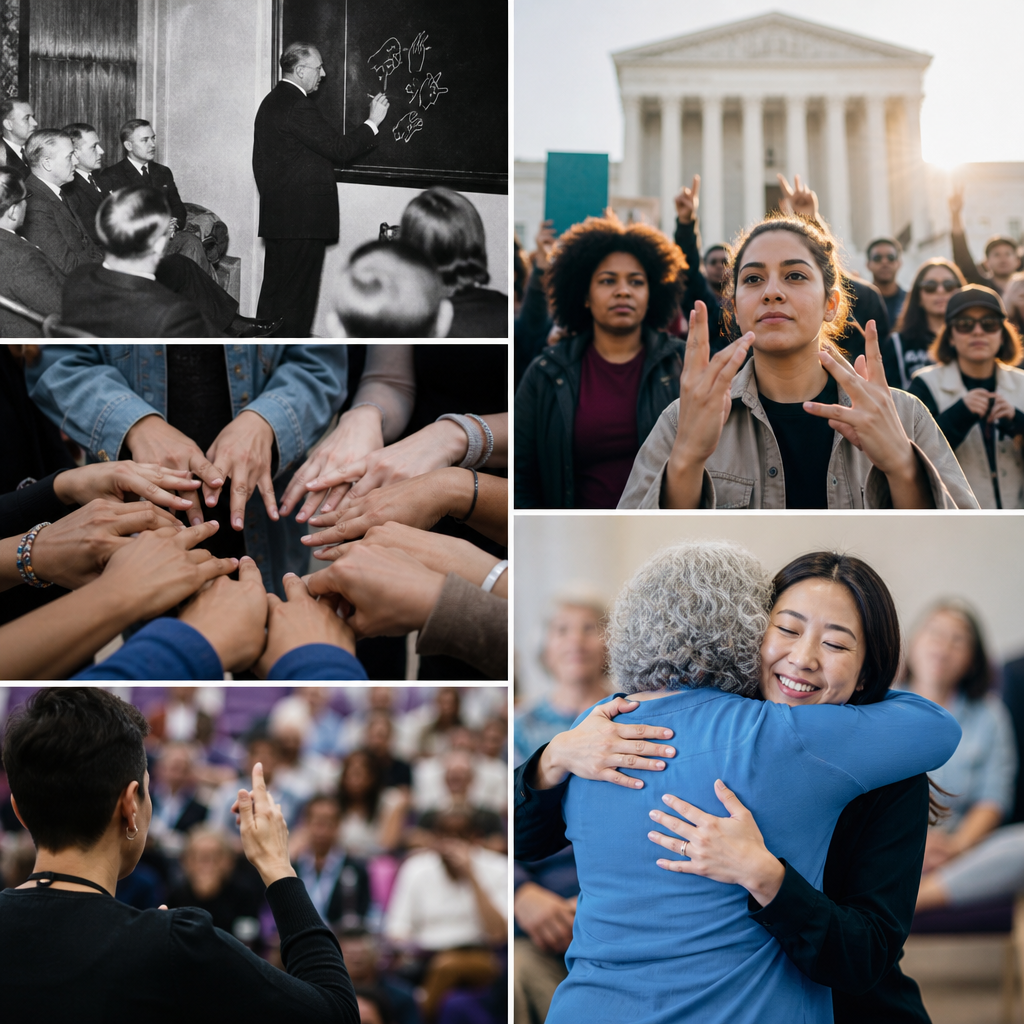
Deaf rights movements were shaped by a series of turning points that reveal how audism became embedded in schools, law, medicine, employment, and public culture. Audism means the belief that hearing and speaking are inherently superior to being Deaf, signing, or living through visual language. In practice, it appears when institutions treat Deaf people as broken hearing people rather than as members of a linguistic and cultural minority. The history of audism is therefore not only a record of prejudice. It is also the story of organized resistance, community building, and policy change led by Deaf people who insisted on access, dignity, language rights, and self-determination.
I have worked with Deaf history materials, disability policy records, and accessibility standards long enough to see one recurring pattern: progress rarely arrived because institutions suddenly became enlightened. It came because Deaf communities documented harm, built organizations, challenged experts, and forced systems to change. That history matters today because many current debates about captioning, cochlear implants, inclusive education, interpreter access, and workplace accommodation repeat older arguments in updated forms. Understanding the history of audism helps readers recognize those patterns quickly and respond with more precision.
This hub article maps the key moments that shaped Deaf rights movements across education, language policy, civil rights law, technology, and public protest. It focuses on milestones with lasting influence, including the nineteenth-century struggle over sign language, the 1880 Milan Conference, early Deaf organizing, eugenic thinking, legal reforms in the late twentieth century, and modern fights for digital access. Together, these moments explain how audism evolved and why Deaf-led advocacy remains essential.
Before formal rights movements: Deaf communities, sign languages, and early models of education
Long before modern disability law, Deaf people were forming communities around shared language and mutual support. In Europe and North America, signed communication flourished wherever Deaf people gathered, even when hearing authorities dismissed it as inferior. One major early milestone was the development of institutional Deaf education in the eighteenth and nineteenth centuries. In France, Abbé de l’Épée helped establish public education for Deaf students using sign-based instruction. His work was imperfect and shaped by his era, but it proved a critical point: Deaf children could learn complex subjects through visual language.
That principle traveled. In the United States, Thomas Hopkins Gallaudet and Laurent Clerc helped found the American School for the Deaf in 1817. Clerc, a Deaf teacher from France, brought both instructional experience and sign language influence that contributed to what became American Sign Language, or ASL. Early Deaf schools became more than classrooms. They were social centers where students met peers, developed identity, exchanged signs, and later formed civic networks. Many Deaf leaders of the nineteenth and twentieth centuries first encountered Deaf culture in school settings.
These institutions were not free from paternalism, yet they created conditions for collective consciousness. When people ask why language access sits at the center of Deaf rights history, the answer is simple: schools were where access could either be enabled or violently suppressed. The earliest progress in Deaf education showed that signed languages supported literacy, reasoning, and community. Later attacks on signing were therefore not neutral pedagogical choices. They were expressions of audism.
The Milan Conference of 1880: the global victory of oralism
No single event is cited more often in the history of audism than the Second International Congress on Education of the Deaf, held in Milan in 1880. Delegates, dominated by hearing educators, passed resolutions favoring oralism, the method that prioritizes speech and lipreading while excluding sign language from instruction. Deaf participants were effectively marginalized, and the outcome was used worldwide to justify removing sign language from classrooms and replacing Deaf teachers with hearing oralists.
The practical consequences were severe. In many schools, children were punished for signing, forced to sit through speech drills, and denied full access to academic content. Oralism consumed time that could have gone to science, mathematics, writing, and history. Some students learned to speak intelligibly; many did not. More importantly, even students who acquired speech often lost educational depth because language access was filtered through methods designed to make them appear hearing.
Milan mattered because it transformed bias into policy. It gave institutional legitimacy to the idea that spoken language was the only respectable goal, and that Deaf success should be measured by approximation to hearing norms. This shift also reduced Deaf authority in education. Deaf teachers, once central figures, were pushed out in many countries. That removal weakened intergenerational transmission of sign language and leadership. Modern critiques of language deprivation trace directly back to this era, when generations of Deaf children were denied fluent early language exposure in the name of normalization.
Deaf self-advocacy grows: organizations, publications, and collective identity
Audism did not go unanswered. In the United States, the National Association of the Deaf, founded in 1880, emerged partly as a response to oralist pressure. Similar organizations developed elsewhere as Deaf people recognized the need for collective advocacy. These groups defended sign language, promoted Deaf employment, published news, and preserved cultural memory. Their work is a foundational chapter in the history of Deaf rights movements because it shifted Deaf people from being objects of policy to authors of policy demands.
Print culture played a major role. Deaf newspapers and association bulletins created transregional networks long before digital communication. They circulated debates about schooling, marriage, labor, citizenship, and communication methods. Through these channels, Deaf leaders argued that sign language was not a crude substitute for speech but a complete language with grammar, nuance, and expressive range. That argument was based on lived reality long before linguistics formally validated signed languages in the twentieth century.
One reason this period matters for understanding audism is that it shows resistance was never merely reactive. Deaf communities built institutions of their own: clubs, churches, sports associations, alumni groups, and advocacy bodies. Those spaces generated leadership and protected identity when mainstream institutions excluded them. They also created the political infrastructure later used in fights over interpreting services, education reform, and civil rights law.
Eugenics, citizenship, and the pathologizing of Deaf lives
In the late nineteenth and early twentieth centuries, audism overlapped with eugenics, a movement that claimed society should manage reproduction to eliminate supposedly undesirable traits. Influential figures, including Alexander Graham Bell, expressed fears that Deaf people marrying one another would produce a separate “deaf variety” of humanity. Bell’s views on communication were more complex than popular summaries suggest, but his opposition to sign-centered Deaf social networks and Deaf intermarriage fed damaging public narratives.
Eugenic thinking framed Deafness as a social threat rather than a human variation. That framing justified intrusive surveillance of Deaf families, pressure against Deaf marriage, and the broader medicalization of Deaf identity. In some jurisdictions, disabled people, including Deaf people, were swept into sterilization laws and institutional systems that treated bodily and cultural difference as defects requiring control. The point was not only reproductive policy. It was the expansion of expert authority over Deaf lives.
This era hardened one of audism’s core assumptions: that hearing professionals should define what is best for Deaf people without Deaf consent. Rights movements later challenged this assumption in education, medicine, and law. Today, whenever Deaf perspectives are excluded from decisions about language planning, implant policy, emergency communication, or school placement, the same logic reappears. The historical lesson is clear: pathologizing language difference invites broader denial of autonomy.
Language recognition and the rebuilding of Deaf cultural legitimacy
A major turning point came in the mid-twentieth century when linguistic research began dismantling the myth that signed languages were incomplete or primitive. The most widely cited breakthrough was William Stokoe’s work at Gallaudet in the 1960s, which analyzed ASL as a language with its own phonology, morphology, and syntax. Stokoe’s scholarship did not “invent” ASL’s legitimacy; Deaf communities had always known their language worked. What his research did was challenge hearing academia on its own terms and give institutions fewer excuses to deny reality.
This mattered far beyond universities. Once signed languages could be described using established linguistic frameworks, advocacy around education and interpreting gained stronger footing. Schools could no longer credibly claim that sign blocked cognitive growth. Interpreting began to professionalize. Teacher training, curriculum design, and public policy debates slowly shifted from assimilationist assumptions toward bilingual and bicultural models in some settings.
| Turning point | What changed | Why it mattered for Deaf rights |
|---|---|---|
| 1817 American School for the Deaf | Sign-based schooling gained an institutional home | Created community, literacy pathways, and future leadership networks |
| 1880 Milan Conference | Oralism became dominant policy | Legitimized suppression of sign language and Deaf teachers |
| 1880 National Association of the Deaf | Deaf-led advocacy became organized nationally | Built political power against exclusionary education and employment practices |
| 1960s Stokoe linguistic research | ASL recognized as a full language by scholars | Strengthened arguments for bilingual education and interpreter access |
| 1988 Deaf President Now | Leadership discrimination became a public civil rights issue | Proved Deaf governance and representation were nonnegotiable |
| 1990 Americans with Disabilities Act | Access obligations became enforceable in law | Expanded rights to interpreters, communication access, and accommodation |
Recognition, however, was uneven. Many schools continued using methods that restricted signing, and many hearing parents still received medicalized advice that minimized Deaf culture. That gap between research and practice remains important in the history of audism. Evidence alone does not end discrimination; institutions must be compelled to apply it.
Deaf President Now and the politics of representation
In 1988, Gallaudet University students launched the Deaf President Now protest after the board appointed a hearing president over qualified Deaf candidates. The protest lasted eight days and drew national attention. Students shut down the campus, organized media strategy, articulated demands, and insisted that a Deaf institution should not be governed according to hearing assumptions about leadership. Their success led to the appointment of I. King Jordan as Gallaudet’s first Deaf president.
This was a watershed moment because it made audism visible to the broader public. Many hearing observers initially failed to understand why representation mattered if the selected leader was sympathetic. Deaf activists answered directly: exclusion from leadership is not symbolic trivia. It shapes policy, expectations, and whose knowledge counts. If hearing-controlled institutions always reserve top authority for hearing people, they reinforce the idea that Deaf people are capable students and workers but not full decision-makers.
Deaf President Now also changed movement strategy. It demonstrated the power of disciplined messaging, coalition building, and direct action rooted in community pride rather than pity-based appeals. The protest remains one of the clearest examples of Deaf civil rights mobilization because it linked language, identity, and governance in one public confrontation. Many later campaigns for interpreting, captioning, and educational equity borrowed its framing: nothing about Deaf people should be decided without Deaf leadership.
Law, technology, and the modern fight against structural audism
Late twentieth-century law converted many movement demands into enforceable rights. In the United States, Section 504 of the Rehabilitation Act of 1973 established a baseline prohibition on disability discrimination in federally funded programs. The Americans with Disabilities Act of 1990 expanded obligations across employment, state and local government, transportation, telecommunications, and public accommodations. For Deaf people, these laws mattered most where “effective communication” became a legal standard. Courts and agencies increasingly recognized that access might require qualified interpreters, captioning, TTY systems, relay services, visual alerts, and policy changes.
Technology transformed advocacy as well as access. TTY devices enabled text communication over phone lines. Telecommunications Relay Services, strengthened under Title IV of the ADA, reduced isolation in work and daily life. Later, video relay service changed communication speed by allowing signed conversations through interpreters over broadband connections. Closed captioning expanded through broadcasting regulation and consumer demand, though compliance remained inconsistent. The Twenty-First Century Communications and Video Accessibility Act of 2010 addressed newer digital platforms, helping extend accessibility expectations into internet-era communications.
Still, structural audism adapted. Automatic captions often remain error-prone in classrooms, hospitals, and live events. Emergency alerts can fail when officials rely on audio-first communication. Workplaces may offer note taking when an interpreter is required, or use unqualified staff to interpret sensitive meetings. Educational placement still reflects old battles: some Deaf children thrive in mainstream schools with strong support, while others are isolated without peers, fluent models, or direct instruction in sign. The lesson from this history is not that rights are complete. It is that each legal and technical win must be defended in implementation.
For anyone studying the history of audism, the central pattern is consistent. Audism has survived by changing form: from open bans on sign language, to medical paternalism, to underfunded accommodations, to digital systems designed without Deaf users in mind. Deaf rights movements have answered by building community, demanding representation, insisting on language access, and turning lived experience into policy reform. If you want to understand current debates across the broader Understanding Audism topic, start here: follow the language question, examine who holds decision-making power, and ask whether Deaf people can participate fully on their own terms. That framework explains the past and remains the surest guide for improving the future.
Frequently Asked Questions
What were some of the earliest turning points that shaped Deaf rights movements?
Some of the earliest turning points came from the way Deaf education was defined in the nineteenth century. In many places, Deaf communities had already shown that signed languages could support learning, social life, and intellectual development. Early Deaf schools often became centers of community formation, where Deaf students met one another, developed leadership, and built shared cultural identity. Those schools mattered because they helped establish the idea that Deaf people were not isolated individuals with a medical problem, but members of a linguistic minority with their own ways of communicating and organizing life.
A major shift occurred when hearing authorities increasingly took control of Deaf education and began promoting the belief that speech and lip-reading were superior to sign language. This was not just a classroom debate. It reflected a broader ideology that treated hearing norms as the standard for intelligence, citizenship, and social worth. As oralist methods spread, signed languages were pushed aside, and many Deaf children were punished or discouraged from signing. That suppression had lasting consequences because schools were one of the main institutions through which society defined what Deaf people could become.
These early educational battles were crucial to Deaf rights movements because they revealed how audism could become embedded in institutions. The issue was never only whether a child learned to speak. It was whether Deaf people would be allowed to learn in their natural language, participate in community life, and develop without being told that their identity was inferior. In that sense, the struggle over education became one of the foundational moments of Deaf political consciousness and collective resistance.
Why is the rise of oralism considered such a defining moment in Deaf rights history?
The rise of oralism is considered defining because it reshaped the lives of Deaf people across generations. Oralism promoted the idea that Deaf children should be taught to speak and lip-read rather than use sign language. Supporters often presented this as progress, but for many Deaf people it meant exclusion from accessible education, delayed language development, and the devaluing of Deaf culture. Oralism was rooted in audist assumptions: that speech was inherently superior, that signing was a lesser form of communication, and that Deaf success depended on becoming as close to hearing as possible.
In practice, oralism often meant that Deaf children spent enormous amounts of time trying to imitate sounds they could not fully hear, instead of gaining broad access to knowledge through language they could use fluently. In many schools, sign language was banned outright, and children faced punishment for using it. This did more than restrict communication. It sent a message that Deaf ways of being were unacceptable. It also separated young people from older Deaf role models and from the cultural transmission that happens when language, history, and identity are shared across generations.
Deaf rights movements grew stronger in response to these harms. Activists, educators, and Deaf community leaders challenged the notion that speech should be the measure of human value. They argued that real education requires full language access, not forced conformity to hearing norms. The pushback against oralism helped create a broader political framework for Deaf rights by linking language access, educational equality, dignity, and self-determination. That is why oralism remains one of the most important and most contested moments in Deaf history.
How did Deaf rights movements expand beyond schools into law, employment, and public life?
Although schools were a central battleground, Deaf rights movements expanded when activists made clear that audism did not end at graduation. In law and public policy, Deaf people often faced exclusion because courts, government agencies, and public institutions failed to provide interpreters or accessible communication. This could affect every part of life, from legal proceedings and medical appointments to voting, housing, and emergency information. When institutions assumed that spoken communication was the default and that Deaf people should simply adapt, audism became part of everyday governance.
Employment was another major area of struggle. Deaf workers were frequently denied jobs, steered into limited occupations, or judged according to stereotypes about communication ability rather than actual skill. Employers often assumed Deaf people were less capable, more difficult to accommodate, or unsuitable for leadership and customer-facing roles. These attitudes reflected a deeper social bias: the belief that hearing and speaking were tied to competence, intelligence, and professionalism. Deaf rights advocates challenged those assumptions by demanding equal opportunity, workplace access, and recognition that barriers were created by institutions, not by Deafness itself.
Public culture also became an important arena. Media representations often portrayed Deaf people through pity, deficiency, or inspirational clichés instead of showing the complexity of Deaf lives. Activists responded by promoting Deaf leadership, community arts, sign language visibility, and a stronger public understanding of Deaf culture. Over time, Deaf rights movements helped shift the conversation from charity to rights, from cure to access, and from assimilation to recognition. That broader expansion mattered because it showed that Deaf justice is not a single-issue concern. It involves education, labor, healthcare, civic participation, and the right to exist in public without being treated as lesser.
What role did Deaf-led activism and cultural pride play in changing public attitudes?
Deaf-led activism was essential because it challenged a long history in which hearing professionals, educators, and policymakers spoke about Deaf people without listening to Deaf perspectives. When Deaf activists organized on their own terms, they reframed the conversation. Instead of accepting the idea that Deafness was mainly a medical deficit, they asserted that Deaf people are members of a language community and a cultural minority. That shift in framing had enormous consequences. It changed what counted as justice, what kinds of policies were demanded, and who had the authority to define Deaf experience.
Cultural pride played a powerful role in this transformation. Celebrating sign languages, Deaf schools as community spaces, Deaf art, storytelling, performance, and shared historical memory helped counter the shame imposed by audist systems. Pride did not mean ignoring barriers. It meant refusing the claim that dignity depends on approximating hearing behavior. Public expressions of Deaf identity made visible what audism tried to erase: that signed languages are complete languages, that Deaf ways of communicating are rich and effective, and that Deaf communities have generated their own intellectual, social, and political traditions.
As Deaf-led movements gained momentum, public attitudes began to change. Hearing society was increasingly pushed to understand access not as a favor, but as a right. Activism also created new expectations around representation, consultation, and leadership. Rather than being passive recipients of services, Deaf people demanded to shape the institutions that affected their lives. That insistence on self-representation remains one of the most significant achievements of Deaf rights history, because lasting change depends on Deaf people being recognized not as objects of policy, but as authors of their own future.
Why do these historical moments still matter in discussions about Deaf rights today?
These historical moments still matter because the core issues have not disappeared. The same assumptions that fueled earlier forms of audism can still influence educational policy, medical decision-making, workplace standards, and media narratives. Debates may now take new forms, but the underlying question often remains the same: will Deaf people be valued on their own terms, or will they continue to be measured against hearing norms? Understanding history helps clarify that many present-day barriers are not accidental. They are the result of long-standing systems that privileged speech, sound, and hearing-centered definitions of normalcy.
This history also matters because it shows that progress did not happen automatically. Rights were advanced through collective struggle, community organizing, legal advocacy, cultural affirmation, and resistance to exclusionary systems. When people learn about the suppression of sign language, the exclusion of Deaf voices from policy decisions, or the unequal treatment Deaf people faced in public institutions, they can better understand why access, interpretation, language rights, and Deaf leadership remain urgent issues. Historical memory helps prevent old patterns from being repackaged as innovation or benevolence.
Most importantly, these turning points matter because they provide a framework for current and future advocacy. They remind us that Deaf rights are not only about accommodation. They are about language, power, identity, and belonging. They ask society to move beyond seeing Deaf people as broken hearing people and instead recognize them as full participants in civic and cultural life. That lesson remains central today, whether the discussion is about inclusive education, healthcare ethics, employment equity, or the visibility of sign language in public culture.