A day in the life of a deaf person is shaped less by silence than by communication, access, routine, and the constant design of environments that either include or exclude. In practical terms, deafness describes significant hearing loss that limits access to sound, while the word Deaf often refers to people who identify with a cultural and linguistic community centered on sign language, shared history, and visual ways of living. That distinction matters because no single daily experience represents every deaf person. Some use American Sign Language, British Sign Language, or another national sign language as a first language. Some rely on lipreading, hearing aids, cochlear implants, captions, or a mix of tools. Others move fluidly between deaf and hearing spaces depending on work, family, and education.
I have seen repeatedly that the biggest factor in daily quality of life is not hearing level alone. It is access. A deaf commuter can navigate a city smoothly when trains display delays clearly, staff know basic communication strategies, and emergency alerts appear visually. The same person can be shut out in minutes when a pharmacy calls names aloud with no screen, a manager covers their mouth while speaking, or a clinic forgets to book an interpreter. For readers exploring personal stories, this hub article frames what everyday deaf life actually includes: morning routines, family interactions, school and work communication, technology, social life, health care, identity, and the barriers that still require energy to overcome.
This topic matters because millions of people worldwide live with hearing loss, yet public understanding still leans on outdated assumptions. The World Health Organization has estimated that more than 430 million people need rehabilitation for disabling hearing loss, and that figure is projected to rise. Still, many stories about deafness focus narrowly on what someone cannot hear rather than how they communicate, problem-solve, build community, and advocate for equal participation. A realistic portrait is more useful. It helps employers design better workplaces, families communicate more respectfully, educators support students effectively, and hearing readers understand why captions, interpreters, and visual alerts are not extras. They are basic access, and access shapes every hour of the day.
Morning routines, home life, and the visual start to the day
For many deaf people, the day begins with technology designed for visual or tactile awareness. Instead of a standard alarm clock, common tools include vibrating alarms under a pillow, smartwatches with haptic alerts, sunrise lamps, and connected home systems that flash lights for doorbells or smoke alarms. In homes with deaf parents, baby monitors may vibrate, trigger lights, or stream video. These details sound small to hearing readers, but they determine independence. A smoke detector that only beeps is a safety failure; a detector connected to strobe lights and bed shakers is usable design.
Morning communication varies by household. In Deaf families where sign language is primary, breakfast conversations happen naturally across the table, often with strong eye contact and quick visual turn-taking. In mixed deaf-hearing households, communication may combine signs, speech, texting, gestures, and writing on shared apps. One parent may sign while the other voices. Children often adapt quickly, learning to wave in a line of sight, tap a shoulder appropriately, or flash a light to get attention rather than calling from another room. These are not unusual accommodations inside deaf life. They are normal etiquette.
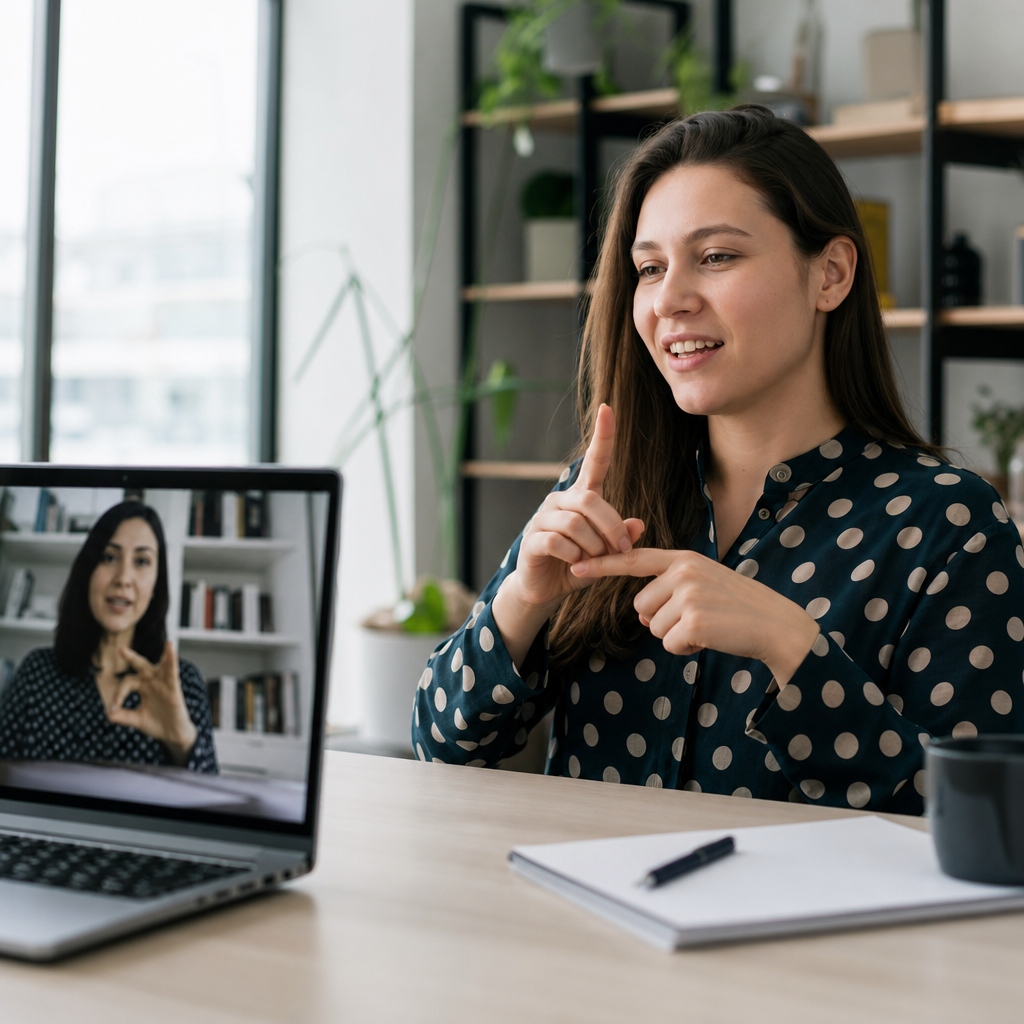
Getting ready for the outside world also involves planning for communication access. A deaf professional may check whether a video meeting platform supports pinned interpreters and live captions. A student may confirm a note-taker is available for lectures. Someone visiting a new office may message ahead to ask whether reception uses a visual queueing system. This planning is rarely visible to hearing peers, yet it is part of the cognitive labor many deaf people carry daily. The morning is not just about getting dressed and leaving home. It is often the first round of access management.
Commuting, errands, and navigating public spaces
Public spaces reveal immediately whether a city understands accessibility. The best systems provide visual information everywhere: station boards, gate changes, text-based customer support, induction loops where useful for hard of hearing users, and staff trained not to default to shouting. Deaf commuters often depend on clear sightlines and real-time updates because overhearing ambient announcements is not an option. When platforms change without visual notice, the result is missed trains, missed appointments, and unnecessary stress.
Errands can be similarly uneven. At a coffee shop with digital order screens, eye contact, and patience, ordering is routine. At a bank that insists on telephone verification with no alternative, the process becomes exclusionary. Pharmacies, clinics, and government offices are frequent pain points because they still rely heavily on spoken names, shouted instructions, and inaccessible call systems. Many deaf people use speech-to-text apps such as Ava, Live Transcribe, or built-in phone caption features for quick exchanges, but apps are not a perfect substitute for staff competence. Accuracy drops with background noise, accents, poor microphones, and multiple speakers.
| Daily situation | Common barrier | Accessible solution |
|---|---|---|
| Waking up | Audio-only alarm or smoke alert | Vibrating alarm, strobe alert, smart home notifications |
| Train commute | Platform changes announced only over speakers | Large visual boards and app-based push alerts |
| Work meeting | Rapid overlapping speech and no captions | Turn-taking, live captions, interpreter, agenda in advance |
| Medical visit | Reception calls names aloud and masks lip movements | Visual queue system, interpreter booking, written follow-up |
| Social dinner | Dim lighting and side conversations | Good lighting, circular seating, one speaker at a time |
These examples show a key truth: deafness becomes more disabling when systems are built around sound alone. Where information is visual, structured, and predictable, daily life is efficient. Where communication depends on overhearing, guessing, or calling by phone, a simple errand can consume disproportionate time and energy.
School, work, and the effort behind communication
At school or work, communication access affects performance, confidence, and advancement. Deaf students may use interpreters, captioning, FM or DM systems, notetakers, or preferential seating, but those supports only work when institutions understand how to deploy them consistently. I have watched well-meaning organizations fail because they booked an interpreter for the keynote but not the networking lunch, or enabled automated captions without checking accuracy for technical vocabulary. Access is not a single event. It must cover the whole experience.
In workplaces, meetings are often the hardest part of the day. Group discussion depends heavily on turn-taking, facial visibility, and clear moderation. When people interrupt, speak while looking at slides, or talk from across the room, comprehension drops sharply. A deaf employee may spend extra effort tracking who is speaking, reading captions with a short delay, watching an interpreter, and reviewing chat messages simultaneously. That multitasking can create fatigue even when the meeting appears accessible from the outside. The term listening fatigue is common among hard of hearing people using amplification, while many sign language users describe parallel visual and cognitive fatigue from sustained decoding and monitoring.
Strong workplaces reduce that load with simple practices. They circulate agendas in advance, ensure one person speaks at a time, use high-quality microphones for remote captioning, and summarize decisions in writing. Microsoft Teams, Zoom, and Google Meet all offer live captioning, but human captioners or interpreters remain important for accuracy in legal, medical, academic, or highly technical settings. Under laws such as the Americans with Disabilities Act in the United States and the Equality Act in the United Kingdom, employers and service providers may be required to provide reasonable accommodations. The exact process varies by country, but the principle is stable: access is part of participation, not a favor.
Social life, identity, and personal stories beyond stereotypes
Social life for deaf people is rich, but it often depends on setting. Restaurants with poor lighting, loud background music, and long rectangular tables can be exhausting because visual communication becomes fragmented. By contrast, Deaf community gatherings are often arranged around visibility: people sit in circles, wave to attract attention, and maintain clear sightlines. In those spaces, communication is fast, layered, and expressive. Humor, storytelling, and cultural references travel visually, and many deaf people describe a sense of ease there that hearing environments rarely offer.
Personal stories vary widely. One person may be born to deaf parents, grow up signing from infancy, attend a residential school for the deaf, and move through adulthood with a strong cultural identity. Another may lose hearing later in life, grieve the change, and gradually build new routines through captioning, hearing technology, and deaf peer networks. A third may navigate several worlds at once: signing with friends, speaking with hearing relatives, and using text-based communication at work. None of these stories is more authentic than another. Deaf life is not one narrative arc.
What unites many accounts is the need to correct stereotypes. Deaf people do not all lipread well; even skilled lipreaders catch only part of English visually because many sounds look identical on the lips. Cochlear implants do not restore natural hearing; outcomes differ, and users still need communication strategies and accommodations. Sign languages are full languages with their own grammar, not mime or signed versions of spoken languages. These facts matter because assumptions shape behavior. When hearing people understand them, everyday interactions improve immediately.
Health care, relationships, and the invisible work of self-advocacy
Health care remains one of the clearest tests of whether society takes deaf access seriously. Booking appointments by telephone, receiving spoken instructions in waiting rooms, or discussing treatment without qualified interpretation creates obvious risk. Miscommunication in medical settings is not a minor inconvenience; it can affect consent, diagnosis, medication use, and follow-up care. Best practice is clear: providers should ask for preferred communication methods in advance, book qualified interpreters when needed, supply written summaries, and avoid relying on family members for complex interpretation.
Relationships, both romantic and familial, also involve ongoing communication choices. Hearing partners who learn sign language often transform the balance of effort in a relationship because access stops flowing in one direction. Deaf parents routinely advocate in schools and clinics, not only for themselves but for their children. Deaf professionals may mentor younger people on requesting accommodations without apology. This self-advocacy is skilled work. It requires legal knowledge, emotional steadiness, and repeated explanation of basic access needs in places that should already understand them.
By the end of the day, many deaf people are managing more than tasks. They are managing environments. A realistic understanding of a day in the life of a deaf person starts with this central point: deafness is not defined by passivity or lack. It is shaped by communication systems, cultural identity, technology, and the quality of inclusion built into ordinary moments. If you want to learn from personal stories, start by noticing access in your own workplace, school, business, or family. Add captions, improve visual information, ask people how they prefer to communicate, and follow through. Small design choices change daily life in measurable ways, and better access always benefits more people than you expect.
Frequently Asked Questions
What does a typical day look like for a deaf person?
A typical day for a deaf person can look very similar to anyone else’s in terms of work, family, errands, meals, hobbies, and rest, but the difference often lies in how information is received and how communication is managed. Many deaf people move through the day using visual, tactile, and technological tools rather than relying on sound. That might include waking up with a vibrating alarm, checking text messages instead of voice mails, using captions for news or video content, and communicating through sign language, speechreading, writing, or a mix of methods depending on the person and situation. Daily routines are often shaped by whether an environment is accessible. A workplace with interpreters, captioning, clear sightlines, and coworkers who understand communication preferences can make the day smooth and efficient, while a noisy, poorly lit, or unaccommodating setting can make basic interactions unnecessarily tiring.
It is also important to understand that there is no single “deaf experience.” Some people identify as Deaf and are part of a sign language community with its own cultural norms, values, and shared history. Others may describe themselves as deaf or hard of hearing and use spoken language more often, hearing technology, or both. For one person, the day may center around American Sign Language and visual communication; for another, it may involve cochlear implants, hearing aids, lip reading, and captioned phone calls. What often shapes the day most is not deafness itself, but whether the world around the person is designed to include them. Access to communication, information, transportation announcements, emergency alerts, meetings, and casual social moments can determine whether a day feels ordinary, stressful, empowering, or isolating.
How do deaf people communicate throughout the day?
Deaf people communicate in many different ways, and most use whatever combination works best for them in specific situations. Sign language is one of the most important and fully developed forms of communication in Deaf communities, offering rich grammar, nuance, humor, and emotional expression. In addition to sign language, some deaf people use speech, speechreading, text messaging, email, live transcription apps, captioned video calls, relay services, written notes, gestures, and visual cues. Communication choices can depend on personal preference, language background, age of onset of hearing loss, education, family environment, access to interpreters, and whether the other person knows how to communicate accessibly. Throughout the day, a deaf person may shift between methods seamlessly, such as signing with friends, texting a coworker, using captions during a meeting, and writing instructions during a brief interaction in a store.
Good communication is rarely only the responsibility of the deaf person. The people around them play a major role in making conversations effective. Simple habits such as facing the person, speaking clearly without exaggeration, keeping hands away from the mouth, maintaining good lighting, and reducing background distractions can make an enormous difference. In professional or medical settings, qualified interpreters or real-time captioning may be necessary for full access. Technology has also transformed communication, making it easier to stay connected through video platforms, captioned calls, and instant messaging. Even so, barriers remain when people assume that speaking louder solves the issue or when they treat access tools as optional. The most successful communication happens when deaf people are able to express their preferences and others respect them without making the interaction awkward or burdensome.
What challenges can a deaf person face in everyday environments?
Many of the biggest challenges in a deaf person’s day come not from hearing loss alone, but from environments built with sound as the default. Everyday situations can become difficult when important information is delivered only through spoken announcements, alarms, intercoms, or conversations that are not visible. Public transportation, waiting rooms, workplaces, schools, restaurants, and healthcare settings can all present obstacles if visual access is poor or accommodations are missing. Something as small as an employee calling a name aloud in a crowded office can create confusion, while something as serious as a lack of accessible emergency alerts can put safety at risk. Group conversations are another common challenge because multiple people may speak at once, turn away, cover their mouths, or shift topics rapidly without providing visual cues.
There is also a social and emotional layer to these barriers. Deaf people may be excluded unintentionally when others forget to include them in side conversations, laugh at comments that were not interpreted, or assume communication is too inconvenient. Repeated moments like these can be draining over time. Many deaf people become highly skilled at self-advocacy, constantly asking for captions, clarification, interpreters, visual alerts, or better positioning in a room. While those strategies are effective, they also require energy. Accessible design reduces that burden. Clear signage, captioned media, visual alert systems, trained staff, and communication-aware social habits help transform everyday spaces from frustrating to welcoming. In that sense, the challenge is often not deafness itself, but the preventable barriers created by environments that fail to account for different ways of receiving information.
How does Deaf culture influence daily life?
For people who identify as Deaf with a capital D, daily life may be shaped not only by hearing status but by membership in a cultural and linguistic community. Deaf culture centers visual communication, especially sign language, and includes shared experiences, social norms, humor, storytelling traditions, values around direct communication, and a strong sense of collective identity. This can influence everything from how a person socializes to how they arrange their physical space. For example, visual access matters deeply in Deaf spaces, so seating may be arranged in ways that allow everyone to see one another clearly, lighting is often considered carefully, and attention-getting methods such as waving, tapping a shoulder, or flicking lights are normal and respectful. These practices are not small adaptations; they reflect a complete and coherent way of living in the world.
Deaf culture can also affect how a person experiences family life, friendships, education, and community events. Many Deaf people value spaces where they do not have to explain themselves, request access repeatedly, or work to follow spoken conversation. In those environments, communication is immediate and natural, and social interaction can feel more relaxed and complete. The distinction between deafness as an audiological condition and Deaf identity as a cultural experience matters because it reminds readers that not everyone sees deafness as a deficit. For many, it is part of a rich identity connected to language and belonging. That perspective can shape a person’s daily routines, preferred social settings, and sense of pride. Understanding Deaf culture helps move the conversation away from stereotypes about silence and toward a more accurate picture of community, communication, and lived experience.
How can hearing people make everyday interactions more accessible and respectful for deaf people?
Hearing people can make a major difference by approaching communication with awareness, flexibility, and respect. One of the most helpful first steps is to ask the deaf person what works best rather than making assumptions. Some may prefer sign language, others may use speech and lip reading, and others may want communication through text, captioning, or an interpreter. In conversation, it helps to get the person’s attention before speaking, face them directly, keep the area well lit, and avoid talking while turning away or covering the mouth. Speaking naturally is usually more effective than shouting or over-enunciating. In group settings, taking turns, identifying who is speaking, and ensuring key information is repeated or interpreted can help the deaf person stay fully included rather than partially informed.
Accessibility should also extend beyond one-on-one interaction. Hearing people who organize workplaces, classrooms, medical visits, events, or public services should think in terms of systems, not last-minute fixes. That means providing captions for videos and meetings, arranging interpreters when needed, using visual alerts, sharing written follow-ups, and making sure announcements are available in visible formats. Just as important is social inclusion. Do not treat accommodations as special favors, and do not speak to a companion or interpreter instead of directly to the deaf person. Small choices communicate respect. When hearing people understand that access is a basic part of participation, not an extra convenience, everyday life becomes more equitable. For a deaf person, that can mean less effort spent overcoming barriers and more freedom to focus on work, relationships, interests, and the ordinary rhythm of the day.