Audism in education systems today shapes who gets access to language, belonging, and opportunity long before students enter the workforce. Audism is the belief, policy pattern, or institutional practice that treats hearing ways of communicating and learning as inherently superior to Deaf, hard of hearing, or signing ways of being. In schools, that bias appears in obvious decisions, such as denying interpreters, and in quieter assumptions, such as measuring success only by spoken language outcomes. I have seen education teams discuss inclusion while scheduling assemblies without captions, placing Deaf students in rooms where they cannot see the teacher’s face, or expecting one interpreter to cover a full day without breaks. These are not small oversights. They influence literacy development, social identity, academic confidence, and long-term attainment.
This topic matters because education systems do more than deliver curriculum. They establish norms about whose communication counts, whose culture is recognized, and whose needs are considered standard. For Deaf and hard of hearing students, equitable education depends on language access, qualified staff, accessible environments, and respect for Deaf culture as more than a support service issue. Modern society often celebrates diversity rhetorically, yet schools still default to hearing-centric models: lecture-heavy instruction, rapid verbal turn-taking, poor acoustics, and compliance frameworks that focus on minimum accommodation rather than full participation. Audism in modern society is therefore highly visible in education, where legal rights, instructional design, technology, and culture intersect every day.
Understanding audism in education also requires precision. Deaf refers broadly to people with significant hearing differences and can include cultural identity tied to sign language communities. Hard of hearing usually refers to people with partial hearing who may use speech, hearing technology, sign, or a combination. Access means more than being present in the room. It includes direct communication, understandable instruction, peer interaction, emergency information, extracurricular inclusion, and assessment conditions that do not penalize a student for inaccessible delivery. When access is reduced to note-taking support or a seat near the front, schools miss the central issue: students learn best when language is fully available from the start, not patched in after barriers appear.
As a hub article for understanding audism in modern society, this page maps how audism shows up across education systems today. It covers early childhood programs, K-12 schools, higher education, technology, policy, and practical reform. The core point is straightforward: audism is not only personal prejudice. It is embedded in structures, habits, procurement choices, staffing models, and definitions of achievement. Once those patterns are named clearly, schools can replace them with better ones.
How Audism Operates in Everyday Schooling
In education, audism operates through design choices that assume hearing students are the default user. A teacher lectures while walking around the room, writes while speaking, dims lights for videos without captions, or calls out instructions during transitions. None of these acts may be intended to exclude, but together they create a constant tax on Deaf and hard of hearing students. They must watch, lip-read, track slides, monitor interpreters, and infer missed information simultaneously. Cognitive load rises while instructional clarity falls. Over time, this can be mistaken for lack of attention or lower ability, when the actual problem is inaccessible delivery.
Institutional audism also appears in placement and support decisions. Many systems still treat mainstreaming as automatically superior, even when language access is inconsistent. A student may be placed alone in a neighborhood school with itinerant support for a few hours each week, despite evidence that peer access and fluent communication matter for social development and academic growth. Conversely, some schools recommend separate placement without seriously considering the child’s communication profile or family goals. The audist element is not inclusion or specialization by itself. It is making those decisions from hearing norms rather than from access, language development, and informed choice.
Discipline and participation policies can carry the same bias. Deaf students are sometimes labeled disruptive for looking away from a speaker to watch an interpreter, tapping peers for attention, or using visual communication in quiet spaces designed around hearing norms. Group work can become exclusionary when turn-taking is unmanaged and multiple students speak at once. Standard classroom participation grades often reward rapid spoken responses instead of thoughtful signed or typed contributions. In faculty training, these barriers are frequently treated as isolated accommodations issues rather than predictable outcomes of hearing-centered classroom practice.
Language Access in Early Childhood and K-12 Education
The most consequential decisions often happen early. Children need full language exposure in their first years to support cognition, literacy, self-regulation, and social development. When schools or early intervention teams frame sign language as a last resort instead of a complete language, they risk language deprivation. This is one of the clearest forms of audism in education systems today. Families may be pressured toward speech-only pathways without balanced information about bilingual options, Deaf mentors, or the reality that hearing technology does not guarantee effortless language access. Cochlear implants and hearing aids can be valuable tools, but they are not cures, and outcomes vary by age at implantation, auditory environment, device use consistency, support quality, and individual factors.
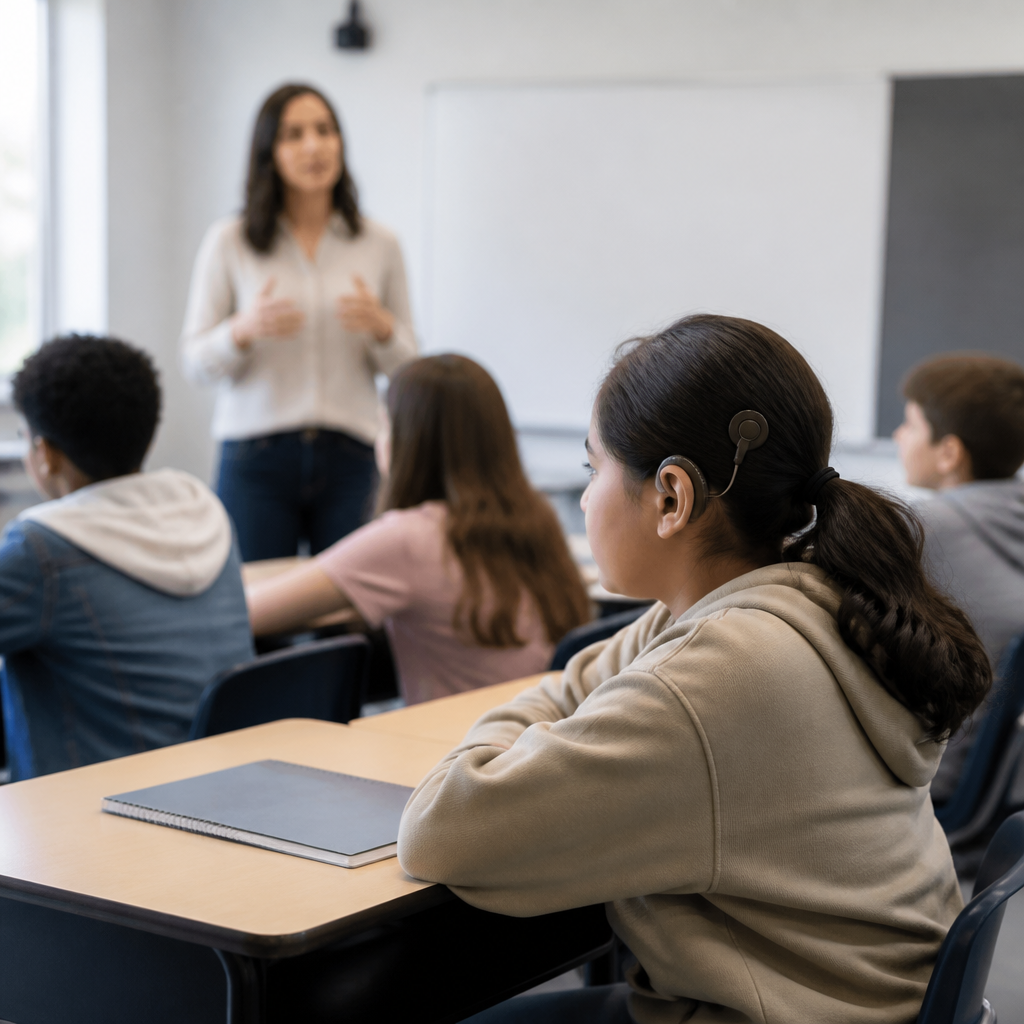
In K-12 settings, language access means more than assigning an interpreter. It requires matching services to the student and context. A fluent signer may need direct instruction in sign from a teacher who can teach complex concepts without mediation. A hard of hearing student using spoken English may need remote microphone systems, captioned media, acoustic treatment, and teachers trained to face the class while speaking. A student who uses both sign and speech may need flexible supports across settings, including sports, labs, field trips, and counseling sessions. Effective teams build access plans around actual communication demands, not around a generic disability category.
| Educational area | Common audist practice | Better access-centered practice |
|---|---|---|
| Early intervention | Presenting speech-only routes as the preferred goal | Providing balanced guidance on sign, spoken language, bilingual development, and Deaf community resources |
| Classroom teaching | Relying on live verbal instruction without visual supports | Using captioned media, visible turn-taking, written directions, and sightline-aware teaching |
| Assessment | Testing content through inaccessible spoken delivery | Separating language access from subject mastery and adapting administration appropriately |
| School events | Providing access only in core lessons | Including interpreting or captions in assemblies, clubs, trips, and emergencies |
Literacy instruction deserves special attention. Deaf students do not struggle because deafness prevents reading. They struggle when schools disconnect print from accessible language. Strong programs explicitly connect vocabulary, syntax, background knowledge, and narrative structure across sign, speech, and print. Teachers who understand bilingual pedagogy do not treat sign as interference. They use it to build comprehension, discuss morphology, and support metalinguistic awareness. Schools that ignore this often misread delayed literacy as proof that more speech drill is needed, when the better response is richer language access and stronger content teaching.
Higher Education, Testing, and the Hidden Curriculum
Audism does not end at graduation from secondary school; it often becomes less visible and more bureaucratic in colleges and universities. Students are expected to self-advocate, navigate disability services offices, request accommodations repeatedly, and manage instructors who vary widely in accessibility knowledge. I have seen institutions approve captioning in principle but delay implementation until weeks into a course, leaving students to piece together lectures from slides, partial notes, and peer summaries. By the time access is fixed, learning gaps and social exclusion are already established.
Lecture-heavy teaching magnifies barriers. In higher education, speed is often treated as rigor: fast seminars, overlapping discussion, impromptu questions, and dense audiovisual content. Without real-time captions, qualified interpreters, accessible discussion protocols, and captioned recordings, Deaf and hard of hearing students spend more energy obtaining information than analyzing it. Testing can also be audist when oral instructions differ from written ones, listening components are used unnecessarily, or invigilation staff are not trained to communicate accessibly. The hidden curriculum matters too. Office hours, networking events, labs, internships, and student societies frequently lack the access planning applied to formal classes, even though these spaces strongly influence retention and career pathways.
Professional programs reveal another layer. In medicine, law, teaching, and engineering, gatekeeping can be framed as safety or communication standards while actually reflecting hearing bias. Essential functions should be defined carefully and based on outcomes, not traditions. For example, a nursing student may meet clinical communication requirements through interpreters, captioned devices, visual alarms, and team protocols. A law student can excel in advocacy through sign interpretation, CART, and disciplined turn management. The question is not whether access tools change the learning environment. They do. The question is whether institutions are willing to redesign environments to measure competence rather than conformity to hearing norms.
Technology, Policy, and Why Compliance Alone Falls Short
Technology can reduce audism, but only when procurement and implementation are done well. Automatic captions help, yet they still miss technical vocabulary, names, accent variation, and signed nuance. CART often offers higher accuracy for high-stakes events, while qualified interpreters remain essential in many settings. Classroom audio systems, hearing loops, remote microphones, visual alerting systems, and learning platforms with accessible video all contribute to participation. Problems arise when schools buy tools as symbolic fixes. A platform may support captions but be populated with uncaptioned content. A school may install a loop system without staff understanding receiver compatibility. Technology is infrastructure, not a substitute for planning.
Legal frameworks in many countries prohibit discrimination and require reasonable accommodations, but compliance standards are a floor, not a full educational model. In the United States, the Individuals with Disabilities Education Act, Section 504, and the Americans with Disabilities Act each shape duties differently. In the United Kingdom, the Equality Act and special educational needs frameworks govern related obligations. The details vary, yet a common issue remains: schools often ask what is minimally defensible instead of what access actually requires. That mindset is audism in administrative form. When decisions are driven by budget convenience, staff availability, or assumptions that Deaf students should adapt, rights become procedural rather than meaningful.
Data and accountability are equally important. Many systems do not track access quality with enough specificity. They may count accommodations provided without evaluating whether those accommodations worked. They may monitor test scores while ignoring interpreter qualifications, caption accuracy, student communication preferences, teacher training rates, or participation in extracurriculars. Better governance uses both quantitative and qualitative indicators: attendance, retention, literacy growth, complaint patterns, course completion, and direct student feedback. Without this, schools can claim inclusion while leaving core barriers untouched.
What Equitable Reform Looks Like in Modern Society
Reducing audism in education systems today requires structural reform, not occasional goodwill. First, schools need a language-first model. That means recognizing that full access to language, whether through sign, speech, text, or a bilingual approach, is foundational and time-sensitive. Families should receive balanced early information, including contact with Deaf adults, speech-language professionals who understand deaf education, and educators fluent in accessible pedagogy. Second, staffing must improve. Qualified teachers of Deaf students, educational interpreters with subject-matter competence, captioning providers, and trained general educators are not optional extras. They are core instructional resources.
Third, classroom design should assume varied communication needs from the beginning. Practical changes are straightforward: stable sightlines, one-speaker-at-a-time discussion norms, written instructions paired with oral ones, captioned media checked before class, acoustic treatment where needed, and lesson pacing that allows interpreted interaction. Universal Design for Learning can help, but only if used concretely rather than as a slogan. Fourth, student voice must shape policy. Deaf and hard of hearing students can describe where access fails: lunchrooms, buses, labs, substitute-taught classes, parent nights, or emergency drills. Those details matter because audism often survives in the spaces adults overlook.
Finally, systems should define success more intelligently. Success is not a student appearing to function like a hearing peer at any cost. It is a student learning, participating, forming identity, and moving through school without preventable language barriers. Audism in modern society persists when education systems value assimilation over access. The alternative is both practical and achievable: build schools where communication access is planned, Deaf culture is respected, and competence is measured fairly. If you are reviewing programs under the broader understanding audism topic, start here: audit language access, staffing, technology, and student experience, then fix the barriers that hearing-centered design keeps normalizing.
Frequently Asked Questions
What is audism in education systems, and how does it affect students?
Audism in education is the set of beliefs, policies, and everyday practices that place hearing norms above Deaf, hard of hearing, and signing ways of learning, communicating, and participating. In practical terms, it shows up when schools assume spoken language is the only meaningful path to academic success, social development, or independence. That assumption can influence everything from placement decisions and classroom instruction to discipline, testing, and family communication. Even when educators have good intentions, systems can still be audist if they treat access as an exception rather than a right.
The effects on students are significant and often long-term. When a child does not receive full language access from the start, it can affect literacy, content learning, self-advocacy, confidence, and sense of belonging. Students may be expected to “fit” classrooms that were not designed for them, instead of schools adapting to meet their communication needs. Over time, that can create academic gaps that are wrongly blamed on the student rather than on barriers in the environment. Audism also affects identity: students may absorb the message that signing is less valuable, Deaf culture is secondary, or needing accommodations is a weakness. In reality, the issue is not the student’s hearing status. The issue is whether the education system offers genuine, consistent, and culturally respectful access to learning.
What are some common examples of audism in schools today?
Some examples are highly visible, such as refusing to provide a qualified interpreter, delaying captioning, or placing a Deaf student in a mainstream classroom without language support. Others are more subtle and often normalized. A school may prioritize speech training over content access, evaluate student progress mainly through spoken language benchmarks, or discourage the use of sign language because it is seen as less desirable than speech. Teachers may speak while facing the board, show uncaptioned videos, or rely on classroom discussion formats that exclude students who need visual access. These may be treated as minor oversights, but repeated over time, they become structural barriers.
Audism can also appear in staffing and policy decisions. Schools may hire personnel without sufficient training in Deaf education, fail to include Deaf professionals in decision-making, or assume one accommodation works for every student. Family engagement can be audist as well when schools do not provide accessible meetings, interpreters, or clear information about bilingual and bicultural educational options. Another common example is social exclusion: students may technically be present in class but miss side conversations, peer interactions, announcements, jokes, and informal learning moments that hearing students absorb automatically. This kind of access gap is easy to overlook if schools define inclusion as physical placement alone. True inclusion means full participation in communication, instruction, and community life.
How does audism influence language access and academic outcomes?
Language access is one of the most important issues in any discussion of audism because education depends on being able to fully receive and express ideas. When schools limit access to sign language, delay communication support, or insist that spoken language must come first, students can lose valuable time during critical periods of language development. That loss does not just affect communication in the moment. It can shape reading comprehension, writing, concept development, executive functioning, and the ability to engage with increasingly complex academic material. If a student cannot fully access instruction, assessment results may reflect barriers in delivery rather than actual understanding.
Audism influences academic outcomes by confusing compliance with learning and speech with achievement. A student may be praised for using spoken language while still missing core content, or may be judged as less capable because they prefer sign language or need visual supports. In many cases, the problem is not that the student cannot learn the material. It is that the instruction is filtered through systems that were not built for visual communication. High-quality language access, whether through sign language, interpreters, captioning, direct communication, assistive technology, or a combination of supports, gives students a fair chance to demonstrate what they know. When that access is consistent and respected, academic outcomes improve because students are no longer spending energy trying to overcome unnecessary communication barriers.
What can teachers and school leaders do to reduce audism in the classroom and across the school?
Reducing audism starts with shifting the central question from “How do we make this student function in a hearing environment?” to “How do we build an environment where this student has full and equal access?” Teachers can begin with practical steps: ensure all videos are captioned, face students while speaking, provide visual supports, pause for interpretation, share materials in advance, and check for understanding in ways that do not rely only on spoken participation. They should also recognize that access is not limited to academics. Group work, assemblies, extracurriculars, hallway communication, emergency procedures, and informal peer interactions all matter. If a student cannot fully access those spaces, the school is still leaving barriers in place.
School leaders have a broader responsibility to address policies, staffing, and culture. That includes hiring qualified interpreters and Deaf education professionals, training staff on language access and Deaf cultural competence, and involving Deaf adults and community members in program design. Leaders should review whether IEP processes, discipline systems, assessments, and placement practices unintentionally privilege hearing norms. They should also support families with accessible information so decisions are informed rather than shaped by pressure toward a single communication model. Most importantly, schools should treat sign language and Deaf ways of knowing as legitimate and valuable, not as backup options. When schools move from accommodation-only thinking to an access-and-belonging framework, they create conditions where Deaf and hard of hearing students can participate fully and succeed on their own terms.
Why is addressing audism in education important beyond the classroom?
Addressing audism in education matters because school is where many children first learn what kinds of communication, identity, and participation are considered normal or valued. If students grow up in systems that treat hearing and speaking as the default standard for intelligence, leadership, and belonging, those messages follow them into higher education, employment, healthcare, and civic life. Education does more than deliver academic content; it shapes confidence, relationships, opportunity, and expectations for the future. When schools challenge audism early, they help prevent broader forms of exclusion later on.
This issue also matters for classmates, educators, and communities. Inclusive, language-accessible schools teach everyone that human communication is diverse and that equity is not about forcing sameness. Students who learn in environments that respect Deaf and hard of hearing peers are better prepared to live and work in a society that values accessibility and shared responsibility. For Deaf and hard of hearing students themselves, the benefits are even deeper: stronger identity development, better mental health, fuller participation, and more authentic pathways to achievement. Addressing audism is not a niche concern or a specialized add-on. It is a core educational equity issue because it asks whether schools are truly prepared to support every student’s right to language, belonging, and meaningful opportunity.