
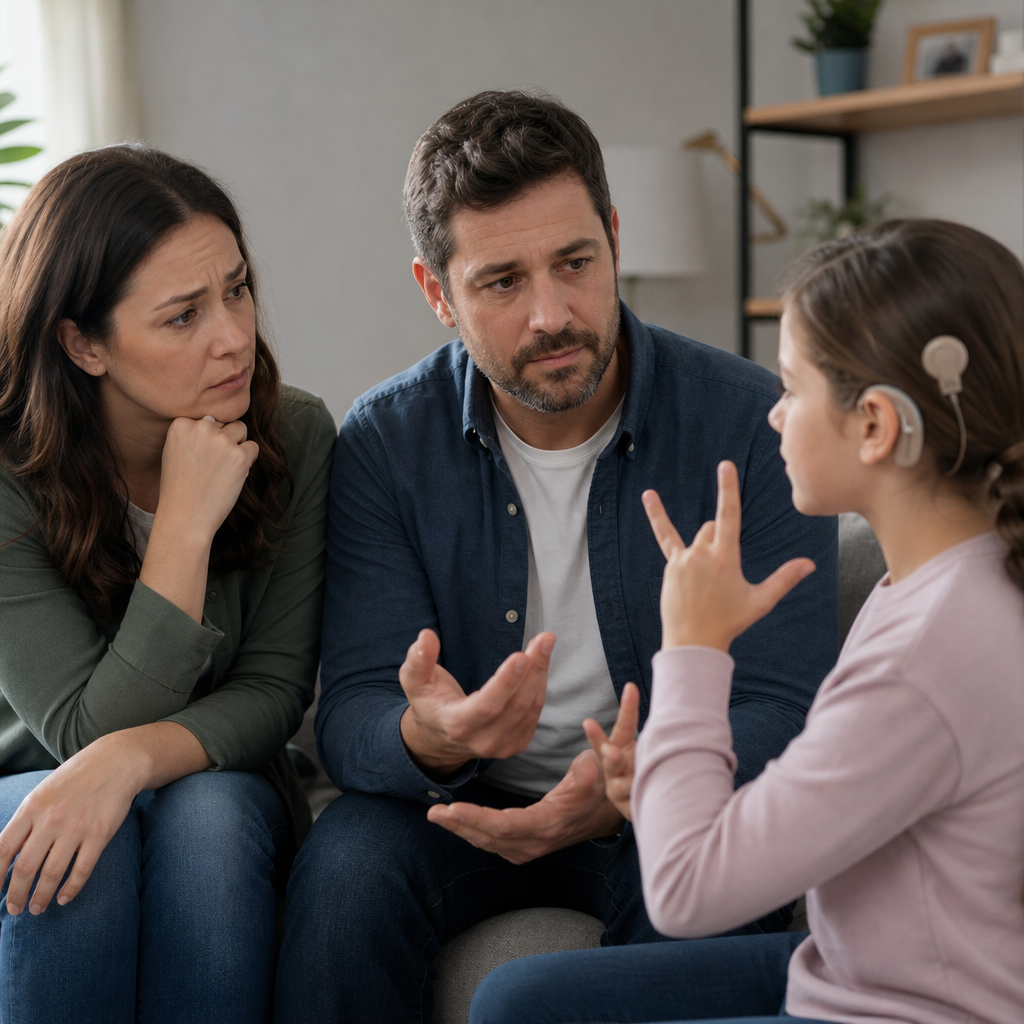
Challenges in deaf-hearing family communication shape daily life in thousands of homes, affecting trust, identity, emotional safety, and practical decision-making from childhood through adulthood. In this context, deaf-hearing family communication means ongoing interaction between Deaf, hard of hearing, and hearing relatives who may not share the same language access, cultural background, or assumptions about disability. The subject matters because family is usually a child’s first community, and when communication is limited, the effects reach far beyond missed words. I have worked with families navigating sign language learning, school planning, interpreting logistics, and intergenerational conflict, and the same pattern appears repeatedly: when access is delayed, relationships become strained; when access is prioritized, family bonds become stronger and more resilient.
Many people think the core problem is simply that one person cannot hear what another person says. In practice, the challenge is broader. It includes language deprivation, inconsistent access to conversation, reliance on one family member to interpret, disagreements about technology such as hearing aids or cochlear implants, and tension between Deaf cultural values and hearing family norms. A deaf child may sit at the dinner table while conversation moves too fast to follow. A hearing parent may love their child deeply yet still underestimate how exhausting lipreading is. A Deaf adult with hearing relatives may be invited to every holiday and still leave isolated because no one signs fluently.
This family and relationships hub article explains the main barriers, what they look like in real homes, and which solutions actually improve communication. It also sets the foundation for related topics such as parenting, siblings, grandparents, marriage, caregiving, education, and mental health. The goal is not to portray deaf-hearing families as broken. Many are close, creative, and highly adaptive. The goal is to show where communication fails, why those failures are predictable, and how families can build accessible routines that support belonging rather than leaving one member to constantly catch up.
Why communication breaks down early
The most significant communication challenge often begins in infancy or early childhood, especially when hearing parents receive limited guidance after a child is identified as deaf or hard of hearing. More than 90 percent of deaf children are born to hearing parents, which means most families do not enter parenthood already fluent in sign language or familiar with Deaf community resources. If professionals present speech-only approaches as the default and frame sign language as a backup, families may spend critical early years chasing audibility instead of building a fully accessible first language. That delay can affect vocabulary, emotional regulation, school readiness, and attachment.
I have seen parents assume that hearing technology would close the gap quickly, only to discover that devices improve sound access but do not make communication effortless in noisy kitchens, cars, playgrounds, or large gatherings. Children miss side comments, jokes, whispered comfort, and overheard learning. Those small moments matter because family communication is not only about formal instruction. It is how children learn values, conflict repair, humor, and social timing. When access depends on ideal acoustics, perfect device use, and adults remembering to face the child, gaps accumulate quietly.
Another early barrier is emotional hesitation. Hearing relatives may feel embarrassed signing in public, afraid of making mistakes, or overwhelmed by the pace of language classes. Deaf children often read that hesitation as lack of interest. The result is painful: parents may be trying hard, yet the child experiences inconsistency and distance. Families do better when they treat accessible communication as nonnegotiable, the way they would treat food safety or seat belts. Fluency can develop over time; commitment must be immediate.
Common challenges across family relationships
Communication difficulties show up differently depending on the relationship. Parents may struggle with discipline, explanation, and emotional coaching. Siblings may become informal interpreters or compete for attention. Grandparents may want closeness but resist learning new communication methods. Romantic partners may disagree about cultural identity, communication preferences, or social inclusion. Across all of these relationships, the shared issue is unequal access to information and participation.
A practical example is the family car. Hearing relatives often continue talking while facing forward, with music on and road noise in the background. For a deaf or hard of hearing family member, that environment can make speech unreadable and signing impossible. Another example is the family event where everyone chats at once. Hearing members may later say, “We were all together,” while the deaf relative experienced an hour of fragmented observation. Physical presence is not the same as communicative inclusion.
Conflict also intensifies when one person becomes responsible for bridging the gap. In many homes, a hearing sibling with stronger sign skills interprets for parents and the deaf child. This can reverse family roles and place adult responsibilities on a child. In other families, the deaf person is expected to request repeats constantly, monitor who is speaking, and educate everyone else about access. That burden leads to fatigue, withdrawal, and resentment. Healthy family communication distributes responsibility across the whole household rather than assigning access work to the person with the least power.
| Family situation | Typical communication barrier | Better practice |
|---|---|---|
| Dinner conversation | Multiple speakers, fast turn-taking, no visual cues | One speaker at a time, good lighting, shared signing or captioned support |
| Medical appointment | Relative interprets complex information informally | Qualified interpreter or reliable remote interpreting, direct communication with patient |
| School meeting | Parents discuss services without child access | Age-appropriate inclusion, interpreter, written follow-up, visual explanation |
| Holiday gathering | Extended family does not sign, side conversations dominate | Prepare basic signs, seating circles, texting group updates, planned inclusive activities |
Language access, identity, and cultural tension
One of the deepest challenges in deaf-hearing family communication is that the problem is not only linguistic. It is also cultural. Deaf culture generally values direct visual communication, shared attention, signed storytelling, and community spaces where access is assumed. Hearing families may operate through spoken conversation from room to room, indirect cues, and the expectation that the deaf person will adapt. When these norms collide, misunderstandings can be misread as attitude problems instead of access problems.
Identity becomes especially important during adolescence. A deaf teenager may meet Deaf peers, learn more advanced sign language, and begin to see deafness not as a defect but as a cultural and linguistic identity. Some hearing relatives welcome that growth. Others feel threatened, particularly if they invested heavily in a medical model focused on normalization. I have worked with families where a teenager’s new pride in signing was interpreted as rejection of speech, school, or family. In reality, the teenager was often asking for fuller participation and respect.
These tensions are not solved by forcing one model. Families need space to discuss both practical communication needs and identity openly. A child can use hearing technology and still need sign language. A parent can support speech therapy and still become an active member of the local Deaf community. Bilingual and bimodal approaches frequently produce the healthiest family dynamics because they reduce the all-or-nothing pressure that turns language decisions into loyalty tests.
Emotional consequences for children and adults
When communication remains inconsistent, the emotional consequences are serious. Children who cannot easily discuss fears, mistakes, or daily events with caregivers are at higher risk for loneliness, behavior misinterpretation, and unmet mental health needs. Adults often assume a child understood a rule, apology, or explanation when the child only caught part of it. That confusion can look like defiance. Over time, repeated misunderstandings damage trust on both sides.
Deaf adults in hearing families often describe a quieter form of grief. They may love their relatives and still feel unknown by them. Family members know the broad facts of their lives but miss nuance because deep conversation is rare. This is especially common during milestones such as weddings, bereavement, parenting, and elder care. In those moments, superficial communication is not enough. People need access to emotion, memory, and decision-making language.
Mental health clinicians increasingly recognize that communication barriers can mask depression, anxiety, trauma responses, or family conflict. The issue is not that deafness causes poor mental health. The issue is that chronic exclusion, information gaps, and forced accommodation create stress. Families that improve access often report a rapid drop in tension because fewer interactions are based on guessing. Clear communication does not eliminate every disagreement, but it gives families a fair foundation for resolving them.
Technology, interpretation, and their limits
Technology can improve deaf-hearing family communication, but it should never be treated as a complete solution. Hearing aids amplify sound; they do not restore normal hearing. Cochlear implants provide access to sound for many users, but outcomes vary by age of implantation, auditory history, mapping quality, rehabilitation, and daily environment. Captioned phones, speech-to-text apps, video relay services, and alerting devices can all reduce barriers. In my experience, families benefit most when they understand exactly what each tool can and cannot do.
For example, automatic captions help with logistics, but they often fail with overlapping speakers, accented speech, children’s voices, or specialized vocabulary. Speech-to-text apps may be useful in a pharmacy or at the airport yet too inaccurate for emotional family conversations. Likewise, a relative who knows some sign language is not the same as a qualified interpreter. In medical, legal, or educational settings, trained interpreters follow professional standards for accuracy, completeness, and role boundaries. Family members usually cannot maintain those boundaries, especially under stress.
The best approach is layered access. A family might sign at home, use captions for media, text for quick updates, arrange interpreters for important appointments, and choose seating and lighting intentionally at gatherings. Redundancy is a strength, not a sign of failure. Communication improves when families stop searching for a single perfect fix and instead build an accessible environment across settings.
What effective families do differently
Families that communicate well usually share several habits. First, they commit to a common language, often sign language, and practice it daily rather than waiting for fluency before using it. Second, they build visual routines: tapping a shoulder before speaking, keeping hands visible, pausing while chewing, turning on lights, and making sure the deaf person can see who is talking. Third, they plan access before important events instead of improvising in the moment.
I have seen remarkable changes when families adopt simple structures. A weekly check-in with clear turn-taking can transform parent-teen conflict. A grandparent who learns fifty functional signs can move from awkward visits to genuine play and storytelling. A hearing spouse who stops saying “never mind” and instead repeats information directly communicates respect. These actions seem small, but they signal that inclusion belongs to everyone.
Outside support also matters. Families often improve faster when they connect with Deaf mentors, parent-to-parent networks, sign language classes taught by fluent signers, and schools that respect visual language access. Established tools such as CART captioning, Video Remote Interpreting, the Individuals with Disabilities Education Act process in the United States, and audiology best practices can all help when used appropriately. Still, no service replaces family responsibility. The strongest households make access part of everyday culture, not an occasional accommodation.
Building a stronger family communication hub
As the central family and relationships resource within community, lifestyle, and real stories, this topic connects to many other conversations: raising deaf children, navigating mixed hearing-status marriages, supporting Deaf elders, setting boundaries with extended family, and handling conflict without leaving anyone out. The central lesson is clear. Challenges in deaf-hearing family communication are real, but they are not mysterious. They arise when access is optional, when identity is dismissed, or when one person is expected to do all the adapting.
Families improve when they choose shared language, visual access, qualified support, and honest discussion about needs and identity. That work protects attachment, reduces misunderstanding, and gives every relative a fuller place in family life. If your household includes both deaf and hearing members, start with one concrete step this week: learn new signs together, change one daily routine for visual access, or schedule professional communication support for an upcoming event. Consistent access is not a courtesy. It is the foundation of belonging.
Frequently Asked Questions
1. Why is communication often so difficult in deaf-hearing families, even when everyone cares about each other?
Communication can be difficult in deaf-hearing families because love and good intentions do not automatically create shared access to language. In many families, hearing relatives speak naturally and move through daily routines without realizing how much information is passed casually through sound, tone, side comments, quick instructions, and overlapping conversation. A Deaf or hard of hearing family member may miss parts of that communication if the home does not consistently provide accessible language through sign language, visual communication habits, captioning, clear turn-taking, or direct attention-getting strategies. Over time, this can create a pattern where one person is always trying to catch up while others assume they already understand what is happening.
Another major challenge is that family members may have very different beliefs about deafness. Some see deafness mainly as a medical issue to be managed, while others understand it as a cultural and linguistic identity. Those different viewpoints shape decisions about language, education, technology, independence, and family expectations. If parents or relatives do not understand Deaf culture or do not have strong signing skills, the Deaf family member may feel emotionally close to the family but still excluded from full participation. Misunderstandings can then be interpreted as attitude problems, disobedience, distance, or lack of interest, when the real issue is limited access.
Family communication also becomes more complicated because these patterns begin early. Childhood is when trust, attachment, identity, and emotional safety are formed. If a child cannot fully access comfort, discipline, humor, explanations, and family stories, the impact can be long-lasting. The problem is rarely a lack of caring. More often, it is a lack of shared tools, consistent effort, and awareness that communication access must be built intentionally every day.
2. How can poor communication in a deaf-hearing family affect a child’s emotional development and identity?
Poor communication can affect a child’s emotional development in deep and lasting ways because family is usually the first place where a child learns who they are, whether they belong, and whether their feelings will be understood. When a Deaf or hard of hearing child cannot easily communicate with hearing relatives, they may miss out on emotional nuance, spontaneous reassurance, family conflict resolution, and everyday conversations that teach social expectations. This can lead to frustration, loneliness, confusion, or the feeling of always being on the outside of family life, even in a loving home.
Identity is also shaped by access to language and role models. If a child grows up with limited exposure to sign language, Deaf adults, or positive messages about deafness, they may internalize the idea that they are a problem to be fixed or accommodated only when convenient. On the other hand, when a family supports accessible communication and respects Deaf identity, the child is more likely to develop confidence, self-advocacy, and a healthy understanding of both their family relationships and their place in the wider world. This is especially important in deaf-hearing families, where the child may be navigating two different cultural frameworks at once.
Emotional safety depends on being able to ask questions, express fear, disagree, joke, and be fully included in family decision-making. Without that access, children may become withdrawn, act out behaviorally, or rely heavily on one family member as an interpreter of the world. These outcomes are not inevitable, but they are common when communication barriers are left unaddressed. Strong emotional development is far more likely when families treat accessible communication not as an extra effort, but as a basic requirement for trust and connection.
3. What are the most effective ways to improve communication between Deaf, hard of hearing, and hearing family members?
The most effective way to improve communication is to commit to shared language access as a family responsibility, not as the Deaf or hard of hearing person’s burden. In many cases, that means learning and regularly using sign language. Even when a family member uses speech, hearing aids, or cochlear implants, sign language can provide a reliable visual foundation for connection, especially during stressful moments, across rooms, in noisy environments, or when technology is unavailable. Families that communicate well often make accessibility part of daily life by facing each other, getting attention before speaking, reducing visual and auditory distractions, speaking clearly, using captions, and making sure important information is never delivered casually out of view.
Consistency matters more than occasional effort. A family may say they support communication access, but if only one person signs, if major conversations happen too quickly, or if the Deaf family member is expected to piece together fragments, the barriers remain. It helps to establish practical habits such as one person speaking at a time, repeating missed information without frustration, sharing plans in writing when needed, and including the Deaf or hard of hearing family member in all conversations rather than only the ones others think are important. Everyday moments matter just as much as school meetings, medical appointments, or formal discussions.
Families can also benefit from outside support. Deaf mentors, sign language classes, family counseling with professionals who understand deaf-hearing dynamics, and community involvement can all strengthen communication. Importantly, improvement is not only about technique. It also requires attitude. Hearing relatives need to be open to changing their habits, listening without defensiveness, and recognizing that full inclusion may require more time, patience, and humility than they first expected. When families embrace that work, communication often becomes not just more efficient, but more honest and more emotionally connected.
4. How do communication barriers affect trust, conflict, and decision-making in deaf-hearing families?
Communication barriers can weaken trust because trust depends on knowing that you will be informed, heard, and included. In deaf-hearing families, trust can be damaged when Deaf or hard of hearing members repeatedly miss information, are told about decisions after the fact, or are excluded from conversations because others assume it is too difficult to include them. This can happen in small daily matters, such as schedule changes or household expectations, and in major life issues, such as education, healthcare, finances, or caregiving decisions. When a person is consistently the last to know, they may stop feeling like a full participant in family life.
Conflict is also intensified when communication is incomplete. A hearing relative may believe they explained something clearly, while the Deaf family member may have received only part of the message. Emotional tone can be lost, details can be misunderstood, and unresolved frustrations can build over time. In some families, the problem becomes cyclical: miscommunication leads to conflict, conflict makes people communicate less, and reduced communication creates even more misunderstanding. This pattern is especially harmful when children are expected to comply with rules they could not fully access or when adults are judged unfairly as rude, distant, or uncooperative.
Decision-making suffers when access is inconsistent because informed participation requires complete information. A Deaf teenager should be able to understand family expectations directly. A Deaf adult should not have to depend on others to interpret every important conversation. A hard of hearing elder should not be excluded because meetings move too fast. Healthy decision-making in families requires transparency, patience, and the assumption that everyone deserves equal access to the discussion. When communication is accessible, trust grows because family members can see that their voice genuinely matters.
5. What should families do if they want to become more inclusive and supportive over time?
Families that want to become more inclusive should begin by acknowledging that communication access is a long-term practice, not a one-time fix. The first step is honest self-assessment. Families need to ask whether the Deaf or hard of hearing member can fully understand everyday conversation, emotional discussions, humor, conflict, and important decisions in real time. If the answer is no, then the family has clear work to do. That work may include learning sign language, improving visual communication habits, using captioned media, changing how group conversations happen, and making sure inclusion is built into routines rather than offered only during emergencies or formal events.
It is also important to center the experiences of the Deaf or hard of hearing family member instead of assuming others already know what works best. Different people have different communication preferences, and those preferences can change by setting, age, technology use, or emotional context. Families should ask direct questions, listen carefully, and respond without defensiveness. Inclusion improves when hearing relatives stop seeing access requests as criticism and start understanding them as guidance. This shift can transform the emotional climate of the home because it shows respect, flexibility, and genuine commitment.
Long-term inclusion often grows through education and community. Families can learn from Deaf adults, attend community events, seek qualified counseling, and connect with schools or support organizations that understand deaf-hearing family dynamics. Progress may be gradual, and mistakes are inevitable, but steady effort matters. The goal is not perfection. The goal is a family environment where communication is accessible, identity is respected, and no one has to fight for basic participation in their own home.