The Americans with Disabilities Act, or ADA, is the primary civil rights law protecting deaf and hard of hearing people from discrimination in public life. When organizations fail to provide effective communication, accessible policies, or equal participation, they create ADA violations that can block education, employment, healthcare, transportation, commerce, and civic access. I have worked with accessibility reviews, complaint documentation, and policy corrections across public-facing organizations, and the same failures appear repeatedly: no qualified interpreters, broken captioning, inaccessible emergency communication, and staff who do not understand that accessibility is a legal obligation rather than a courtesy. For the deaf community, these barriers are not minor inconveniences. They can mean missed diagnoses, lost jobs, exclusion from school, unsafe travel, or inability to use basic services independently.
Understanding common ADA violations affecting the deaf community matters because the law is broad, practical, and enforceable. Title I covers employment. Title II applies to state and local government services, including public schools, courts, police, and transit. Title III covers private businesses open to the public, such as hospitals, restaurants, hotels, theaters, banks, retail stores, and medical offices. The Rehabilitation Act, especially Section 504 and Section 1557 in healthcare settings, may add parallel obligations when federal funding is involved. A key legal phrase is effective communication. Under Department of Justice rules, covered entities must furnish appropriate auxiliary aids and services when needed to ensure communication with people with disabilities is as effective as communication with others. For deaf people, that can include qualified sign language interpreters, Video Remote Interpreting, real-time captioning, note taking, assistive listening systems, TTY compatibility in limited contexts, accessible video content, visual alerts, and written communication depending on the situation.
Two terms are especially important. Auxiliary aids and services are the tools and supports used to make communication accessible. Qualified interpreter does not mean any person who knows some sign. It means someone able to interpret effectively, accurately, and impartially, both receptively and expressively, using necessary specialized vocabulary. In practice, that definition is where many organizations fail. They substitute lip reading, handwritten notes, family members, or untrained bilingual staff for communication access that the law actually requires. This hub article explains the most common violations, why they happen, where legal standards come from, and what institutions should do instead. It also serves as a foundation for deeper pages on healthcare access, workplace rights, education, public accommodations, digital accessibility, and complaint options.
Failure to Provide Effective Communication in Public Services and Businesses
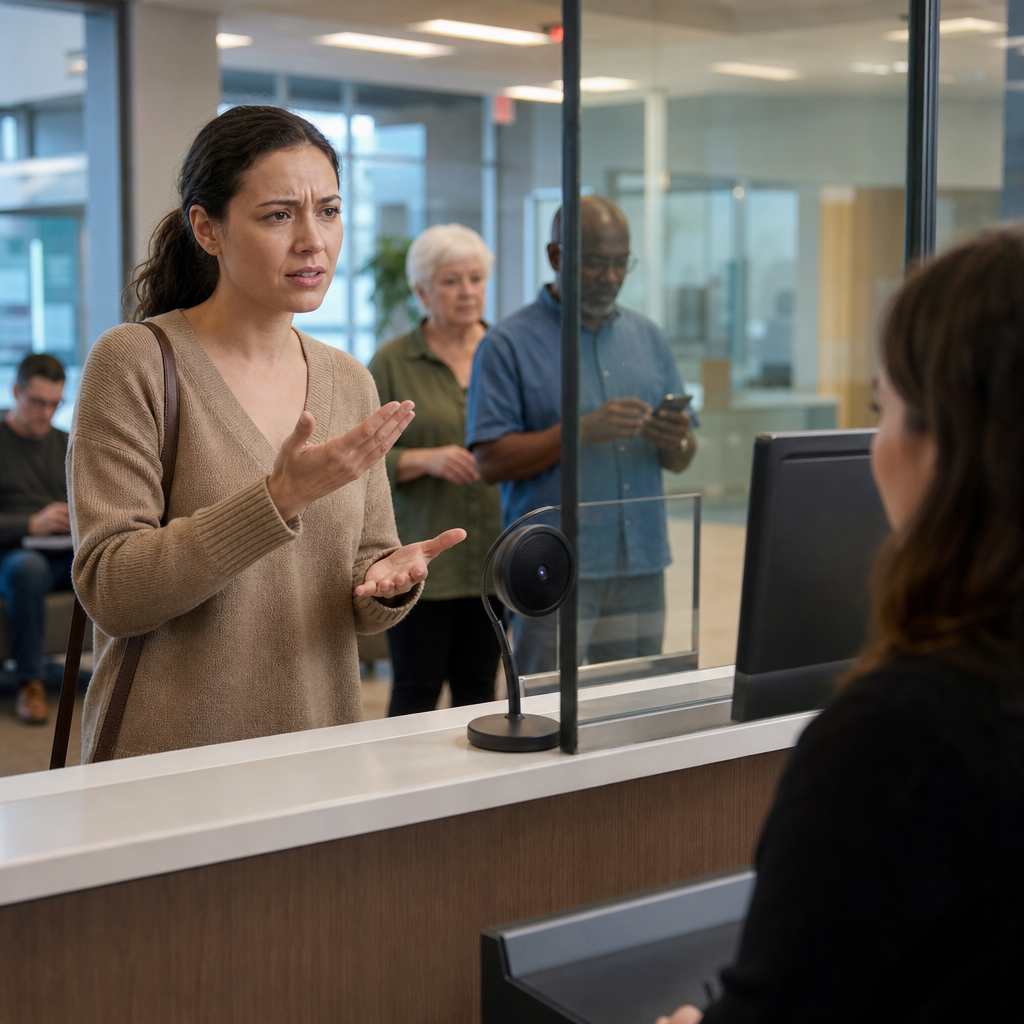
The most widespread ADA violation is simple to describe: a covered entity communicates in a way that works for hearing people but not for deaf people, then claims that minimal effort is enough. In government offices, hospitals, urgent care clinics, social service agencies, police interactions, court programs, and private businesses, staff often default to writing notes or speaking louder. That is not the legal standard. The standard is whether communication is effective in context. A short retail transaction may be handled with writing, gestures, or a text-based exchange. A psychiatric intake, legal hearing, college orientation, or informed consent conversation usually requires a qualified interpreter or another robust accommodation because the information is complex, interactive, and high stakes.
Healthcare provides some of the clearest examples. A deaf patient arrives at an emergency department with chest pain. Registration staff attempt to rely on handwritten notes. A physician asks rapid follow-up questions, the patient misses nuance, and discharge instructions are not fully understood. This pattern has led to repeated enforcement actions by the Department of Justice and the Department of Health and Human Services. Hospitals often violate the ADA by refusing to schedule interpreters in advance for known appointments, using children or spouses to interpret, or claiming Video Remote Interpreting is always sufficient even when the connection freezes, camera angle is poor, or the patient has vision, mobility, or cognitive factors that make VRI ineffective. The National Association of the Deaf has repeatedly highlighted that VRI can supplement access but cannot replace in-person interpreting in every situation.
Public services make the same mistakes. City offices may hold hearings without captioning or interpreters. Police may attempt to interrogate or obtain statements without securing a qualified interpreter, creating due process concerns beyond ADA compliance. Transit agencies may post service disruptions only by audio announcement. Courts sometimes assume CART captioning or an interpreter can be arranged at the last minute, then proceed anyway when it cannot. In each case, the violation is not merely absence of a tool; it is denial of equal opportunity to receive information, ask questions, and participate independently.
Misuse of Interpreters, Captioning, and Communication Technology
Another common category involves providing a communication aid in name only. Organizations may think they are compliant because they offered something, but the ADA requires that the aid be appropriate and workable. I often see businesses maintain a VRI cart, a captioning subscription, or an interpreter contact list and assume that possession solves the issue. It does not. If staff are untrained, equipment is not tested, interpreters are not truly qualified, or the accommodation is chosen without considering the person and setting, the result can still be a violation.
Qualified interpreter errors are especially common. A school program may use a staff member who knows basic signs but lacks fluency in academic terminology. A hospital may call security personnel who know conversational ASL. A conference venue may book an interpreter with no experience in legal, medical, or technical content. Accuracy matters because misunderstanding one medication instruction, disciplinary warning, or benefits explanation can have serious consequences. The Department of Justice specifically discourages relying on companions except in emergencies involving imminent threats or when the deaf person requests it and it is appropriate. Even then, a minor child should almost never be used to interpret.
Captioning failures are equally significant. Public meetings streamed without captions, training videos with auto-generated errors, classroom media without subtitles, and workplace webinars that lack live captions all create barriers. Automatic speech recognition has improved, but unedited captions still routinely misstate names, technical terms, and numbers. For legal compliance, accuracy, synchronization, completeness, and placement matter. CART, Communication Access Realtime Translation, remains the best option for live events where precision is critical. Closed captions should be enabled on public video content, and staff should know how to turn them on across platforms such as Zoom, Microsoft Teams, YouTube, and Vimeo.
| Setting | Common Violation | What Compliance Usually Requires |
|---|---|---|
| Hospital or clinic | Using notes or family members for complex medical discussions | Qualified interpreter, effective VRI when appropriate, or CART for detailed communication |
| Public meeting | No live captions or interpreter for community participation | Advance accommodation process, CART, interpreter, accessible recordings |
| Workplace training | Video modules without captions | Accurate captions, accessible platform, interpreter for interactive sessions when needed |
| Retail or restaurant | Staff refuse text-based communication or visual alerts | Simple written exchange, visual paging, accessible ordering and payment process |
| Court or law enforcement | Proceeding with interviews or hearings without qualified access support | Qualified legal interpreter, visual notification systems, documented accommodation protocol |
Employment Violations Under Title I
In employment, ADA violations affecting deaf workers usually arise during hiring, onboarding, training, team communication, and workplace culture. Employers sometimes assume accommodation is too expensive, too disruptive, or only necessary after hiring. That is incorrect. Employers with fifteen or more employees must provide reasonable accommodations absent undue hardship, and they may not screen out qualified applicants because communication access requires planning. The Equal Employment Opportunity Commission has made clear that interpreters, captioned training, accessible meetings, visual alarms, text-based communication tools, and modified policies can all be reasonable accommodations.
Hiring is a major problem point. Employers may reject applicants after a phone screening requirement that could easily be replaced by email, text relay, video relay scheduling, or an accessible interview format. Interviews are sometimes conducted without interpreters despite advance notice. Once hired, deaf employees are excluded from informal but important communication: side conversations in meetings, safety briefings, emergency drills, promotion-track networking, and mandatory trainings delivered only in audio format. I have seen otherwise capable workers disciplined for missing information that was never made accessible to them.
Another violation involves delay. An employer agrees to accommodation in principle but takes weeks or months to act, leaving the employee without access during probationary periods or performance reviews. Delay can itself become discrimination when it effectively denies equal participation. Employers also err by insisting on the cheapest option rather than an effective one. For example, using generic auto captions for a fast-moving compliance training may not provide equal access if specialized vocabulary is mistranscribed. In manufacturing, hospitality, healthcare, and logistics, visual alert systems and accessible safety procedures are critical. A deaf employee who cannot perceive an evacuation announcement, machine warning, or supervisor instruction because the employer relied only on audible systems is facing a serious compliance failure.
Digital Accessibility, Emergency Information, and Program Access
Modern ADA compliance for the deaf community extends far beyond face-to-face interaction. Websites, mobile apps, self-service kiosks, streaming platforms, online forms, and emergency messaging systems increasingly determine whether a service is truly accessible. A city may provide online permit applications but embed instructional videos without captions. A hospital portal may contain telehealth features that do not integrate interpreters well. A university may post lecture recordings without captioning for weeks. A retailer may use customer service systems that force voice calls. These are not edge cases; they are mainstream access barriers.
Although the ADA does not list every technical requirement in one simple statute section, enforcement trends and settlements consistently point toward digital accessibility expectations. The Web Content Accessibility Guidelines, especially WCAG 2.1 AA, are widely used as the benchmark. For deaf users, that usually means captions for prerecorded and live multimedia where applicable, transcripts when useful, visual alternatives to audio cues, compatibility with relay-based communications, and support for text-based customer service. Public entities and businesses should not wait for complaints to fix these issues. Digital content is now core service delivery.
Emergency communication is an area where failures can become dangerous very quickly. Hotels may have audible-only fire alarms in some areas or fail to provide effective visual notification devices for guests who need them. Airports and train stations may rely heavily on loudspeaker changes without synchronized visual display updates. Workplaces may issue urgent instructions over PA systems without text alerts. During severe weather, public agencies may post videos of officials speaking without captions or interpreters. The Federal Communications Commission has additional rules touching telecommunications and televised emergency information, but from an ADA perspective, the core question remains whether deaf people receive timely, equivalent information. If they do not, access is not equal.
Policy Gaps, Staff Training Failures, and How to Prevent Violations
Most recurring ADA violations affecting the deaf community are not caused by legal uncertainty. They are caused by weak policy, poor training, and failure to budget for accessibility as a normal operating expense. Organizations often have a nondiscrimination statement but no practical process for requesting interpreters, no vendor relationships, no captioning workflow, and no designated decision maker. Frontline staff improvise, managers worry about cost, and the deaf individual is asked to solve the problem. That operational failure is predictable and preventable.
A compliant organization needs written procedures that answer basic questions clearly. How does a person request an accommodation? Who approves it? How quickly is it arranged? Which vendors provide interpreters or CART? When is in-person interpreting required instead of VRI? How are public events announced with accommodation information? How are videos captioned before publication? How are emergency alerts delivered visually? How are complaints escalated and corrected? These are management questions, not abstract legal theory. In my experience, once leaders build a repeatable system, access improves quickly and disputes drop sharply.
Training must also be practical. Staff should understand that lip reading is unreliable, that many deaf people use different communication modes, and that the individual’s expressed preference matters. They should know how to face a person while speaking, reduce background noise, use plain writing when appropriate, enable captions, and avoid asking companions to interpret. Procurement teams should include accessibility in contracts for event platforms, telehealth systems, kiosks, and audiovisual vendors. Facilities teams should maintain visual alarms and assistive listening systems. Human resources should integrate accommodation response timelines into standard workflow. Good compliance is cross-functional.
The central lesson is straightforward: common ADA violations affecting the deaf community usually happen when organizations treat communication access as optional, situational, or too specialized to plan for. The law requires equal access, and equal access depends on effective communication, qualified support, accessible technology, and staff who know what to do. For an Advocacy and Rights hub, this means every related issue connects back to one principle: deaf people must be able to receive information, express themselves, and participate independently across employment, healthcare, education, government, business, and digital life.
If you manage services, start with an accessibility audit focused on interpreting, captioning, emergency communication, and digital content. If you are a deaf person, family member, advocate, or ally, document barriers, request corrections in writing, and learn which title of the ADA applies to the setting. Strong policies prevent complaints, but informed complaints also drive change. Use this hub as your starting point, then explore the deeper articles in this section on healthcare rights, workplace accommodations, public services, communication access technology, and enforcement options.
Frequently Asked Questions
What are some of the most common ADA violations that affect deaf and hard of hearing people?
Some of the most common ADA violations involve failures in effective communication rather than obvious physical barriers. For deaf and hard of hearing people, that often means a business, school, hospital, government office, or employer does not provide appropriate auxiliary aids and services needed for equal access. Examples include refusing to arrange a qualified sign language interpreter when one is necessary, relying on handwritten notes during complex conversations, failing to provide real-time captioning for meetings or public events, not offering accessible emergency alerts, or using policies that require phone-only communication without another accessible option.
Other frequent violations include staff members making assumptions about what a deaf person “should be able to use” instead of engaging in an individualized assessment. A hospital may assume lip reading is enough during informed consent discussions. A college may post videos without captions. A courthouse may delay interpreter requests until the last minute. A retailer may refuse to communicate in writing during a service interaction. These failures can shut people out of healthcare decisions, education, workplace participation, legal processes, and everyday commerce. Under the ADA, covered entities generally must ensure communication is as effective for deaf and hard of hearing individuals as it is for others, and that obligation is often where violations occur.
Does the ADA always require a sign language interpreter for deaf individuals?
No. The ADA does not require a sign language interpreter in every situation, but it does require effective communication, and in many situations a qualified interpreter is the only appropriate solution. The right aid or service depends on the context, the complexity of the communication, the length of the interaction, and the communication method used by the individual. For a brief, simple exchange, writing back and forth may be enough. For a medical consultation, mental health session, school disciplinary hearing, job training, legal proceeding, or public meeting, a qualified interpreter or real-time captioning may be necessary to ensure full understanding and equal participation.
A common ADA mistake is treating interpreters as optional or asking the deaf person to “bring someone” to interpret. That is usually not compliant. Family members, children, or unqualified staff generally should not be used in place of a qualified interpreter except in very limited circumstances. The covered entity is typically responsible for providing and paying for the appropriate aid or service. The law focuses on effectiveness, not convenience. If the communication is important, lengthy, technical, fast-paced, interactive, or legally significant, a failure to provide a qualified interpreter can become a serious ADA violation.
How do healthcare providers commonly violate the ADA when serving deaf patients?
Healthcare settings are one of the most common places for serious ADA violations because communication in medical care affects safety, consent, privacy, and treatment outcomes. A frequent problem is when providers rely on lip reading, gestures, written notes, or a patient’s family member during discussions that are medically complex. That approach may be inadequate when explaining symptoms, diagnoses, medications, surgery risks, discharge instructions, mental health concerns, or follow-up care. If the patient cannot fully understand or ask questions in an effective way, the provider may be denying equal access under the ADA.
Other common healthcare violations include refusing to schedule interpreters for appointments, canceling interpreter requests due to cost, using remote interpreting technology that is low quality or not functioning properly, failing to caption educational videos shown to patients, and not making intake, consent, or aftercare processes accessible. Emergency departments may also violate the ADA when they delay communication access during critical decision-making periods. The ADA does not permit a provider to choose a less effective method simply because it is faster or cheaper. Hospitals, clinics, dental offices, specialists, urgent care centers, and mental health providers are expected to assess communication needs and provide appropriate aids and services in a timely manner so deaf patients can participate equally in their own care.
Can employers, schools, and public agencies violate the ADA through policies that seem neutral on paper?
Yes. Many ADA violations arise from policies that appear neutral but create communication barriers in practice. A rule that all appointments must be scheduled by phone, a training program that uses uncaptioned videos, an emergency procedure that relies only on spoken announcements, or a public service process that requires verbal check-ins can exclude deaf and hard of hearing people even if no one intended to discriminate. The ADA looks at whether a person with a disability has meaningful and equal access, not just whether the written policy uses neutral language.
In employment, a company may violate the ADA by failing to provide interpreters for orientation, team meetings, disciplinary meetings, or safety training, or by refusing technology like captioned communications platforms when reasonable accommodation is needed. In education, schools and universities may violate the law by not captioning lectures and online content, not providing interpreters for class and campus events, or delaying accommodations so long that the student falls behind. Public agencies can run into ADA problems when hearings, public meetings, court processes, or social services are not accessible. A policy can be discriminatory if it blocks equal participation, and organizations often need policy revisions, staff training, and clear accommodation procedures to correct these issues.
What should someone do if they believe they have experienced an ADA violation related to deaf access?
If someone believes they have experienced an ADA violation, the first step is often to document what happened as clearly as possible. That can include dates, times, names of staff involved, the type of service or event, what accommodation was requested, how the organization responded, and what barrier resulted. Saving emails, text messages, screenshots, appointment records, denial letters, video links, captions errors, and written policies can be very helpful. Strong documentation is especially important when the violation involves repeated failures, delayed accommodations, inaccessible communication methods, or a harmful outcome in healthcare, employment, education, or public services.
After documenting the issue, the person can notify the organization and request corrective action, especially if the barrier may be resolved quickly through policy correction, interpreter scheduling, captioning, staff retraining, or another access measure. If the problem is not fixed, a complaint may be filed with the appropriate agency, such as the U.S. Department of Justice, another federal enforcement agency, a state or local civil rights office, or an internal compliance office depending on the setting. In some cases, consulting an attorney or disability rights advocate is the best next step, particularly where access failures are ongoing or have caused significant harm. The key point is that ADA compliance is not a favor or a courtesy. Deaf and hard of hearing people have a legal right to effective communication and equal participation, and organizations that fail to provide that access can be required to change their practices.