
Understanding reasonable accommodations for deaf individuals starts with a simple legal and practical truth: equal access is not achieved by treating everyone the same, but by removing barriers that prevent full participation. In disability law, a reasonable accommodation is a change in policy, practice, communication method, or environment that enables a qualified person with a disability to access employment, education, government services, healthcare, housing, transportation, and public life. For deaf and hard of hearing people, that often means effective communication. In my work reviewing access policies and helping organizations respond to accommodation requests, I have seen the same pattern repeatedly: problems arise when institutions assume hearing is the default and communication support is optional. It is not optional when the law requires equal opportunity.
For deaf individuals, accommodation needs vary widely. Some people use American Sign Language as their primary language. Others rely on spoken English, lip reading, captioning, hearing aids, cochlear implants, relay services, note-taking support, or a combination. DeafBlind individuals may use tactile interpreters, Protactile methods, screen readers, refreshable braille displays, or support service providers. Because communication preferences differ, the right approach is individualized rather than one-size-fits-all. That principle sits at the center of disability rights law in the United States, especially the Americans with Disabilities Act, Section 504 of the Rehabilitation Act, the Fair Housing Act, the Air Carrier Access Act, the Individuals with Disabilities Education Act, and related state laws. Together, these rules create a framework requiring covered entities to provide access unless doing so would fundamentally alter the program or impose an undue burden.
This matters because communication access affects every major life activity. A missed interpreter at a medical appointment can compromise informed consent. Lack of captioning during workplace training can block advancement. Failure to provide a qualified interpreter in court can undermine due process. Refusing a visual alarm in housing can put a tenant at risk during an emergency. Reasonable accommodations for deaf individuals are therefore not merely conveniences; they are tools that protect safety, autonomy, privacy, employment, learning, and civic participation. As a hub article in the broader Advocacy & Rights topic, this guide explains the core legal protections, the accommodation process, common examples, compliance standards, and the practical steps deaf people and organizations should understand when navigating ADA and legal protections.
The legal foundation: ADA, Section 504, FHA, IDEA, and other protections
The Americans with Disabilities Act is the anchor law for deaf access in the United States. Title I covers employers with fifteen or more employees and requires reasonable accommodation for qualified applicants and employees unless the accommodation causes undue hardship. Title II applies to state and local governments, including public schools, courts, police departments, public hospitals, and transit agencies. Title III applies to places of public accommodation, such as private hospitals, doctor offices, restaurants, hotels, retail stores, theaters, museums, and many service providers. For deaf individuals, Titles II and III are especially important because they require effective communication, not just physical entry into a building. The Department of Justice regulations specifically recognize auxiliary aids and services, including qualified interpreters, CART, captioning, exchange of written notes in some settings, assistive listening systems, and accessible electronic information.
Section 504 of the Rehabilitation Act applies to programs and entities receiving federal financial assistance, and it often overlaps with the ADA. Most hospitals, universities, school districts, and many social service providers are covered. Section 504 matters because it can provide an additional enforcement path through federal agencies such as the Office for Civil Rights at the Department of Education or Department of Health and Human Services. In education, the Individuals with Disabilities Education Act adds another layer for eligible students in K-12 public schools by requiring special education and related services through an Individualized Education Program. For housing, the Fair Housing Act requires reasonable accommodations in rules and policies and reasonable modifications when necessary for equal use and enjoyment of a dwelling. For air travel, the Air Carrier Access Act governs airlines rather than the ADA. Telecommunications access is covered through Title IV of the ADA and FCC regulations supporting relay services.
These laws share a common purpose but use different standards. The ADA asks whether an accommodation is reasonable, effective, and necessary for equal access. Title II gives primary consideration to the communication choice requested by the person with a disability, meaning public entities should honor that choice unless another equally effective method exists or the request would fundamentally alter the service or create undue financial and administrative burdens. Title III requires public accommodations to furnish appropriate auxiliary aids and services where necessary for effective communication, unless doing so would result in a fundamental alteration or undue burden. In practice, this means context matters. A brief retail purchase may be handled with writing, while a complex medical consultation, legal proceeding, mental health session, or disciplinary hearing will often require a qualified sign language interpreter or real-time captioning.
What counts as a reasonable accommodation for deaf individuals
A reasonable accommodation for a deaf person is any adjustment that gives meaningful access to communication, information, or participation. In employment, examples include sign language interpreters for interviews, staff meetings, trainings, disciplinary meetings, and performance reviews; captioned video content; CART for large events; videophones and relay access; visual alert systems; flexible communication by email or chat instead of voice-only calls; and reassignment of marginal job tasks that depend entirely on unaided hearing. In public services and businesses, accommodations may include qualified interpreters, Video Remote Interpreting when appropriate, open or closed captions, assistive listening systems, text-based communication, accessible kiosks, visual queue systems, and emergency alerts delivered in visual and vibrating formats.
In healthcare, the best accommodation is driven by complexity, risk, and patient preference. I have seen providers try to rely on handwritten notes for situations involving surgery consent, oncology consultations, labor and delivery, psychiatric evaluation, and discharge instructions. That is usually not effective communication. The Department of Justice and Department of Health and Human Services have both made clear that the method must actually work for the person and the situation. Family members generally should not be used as interpreters except in a true emergency involving imminent threat when no qualified interpreter is available. Children should almost never interpret. Accuracy, impartiality, confidentiality, and specialized vocabulary all matter.
| Setting | Common accommodation | When it is often appropriate | Key limitation |
|---|---|---|---|
| Medical appointment | Qualified ASL interpreter | Diagnosis, treatment planning, consent, complex discussion | Must be scheduled reliably and matched to language needs |
| Workplace training | Real-time captioning or interpreter | Group instruction, safety training, compliance sessions | Auto-captions alone may be inaccurate |
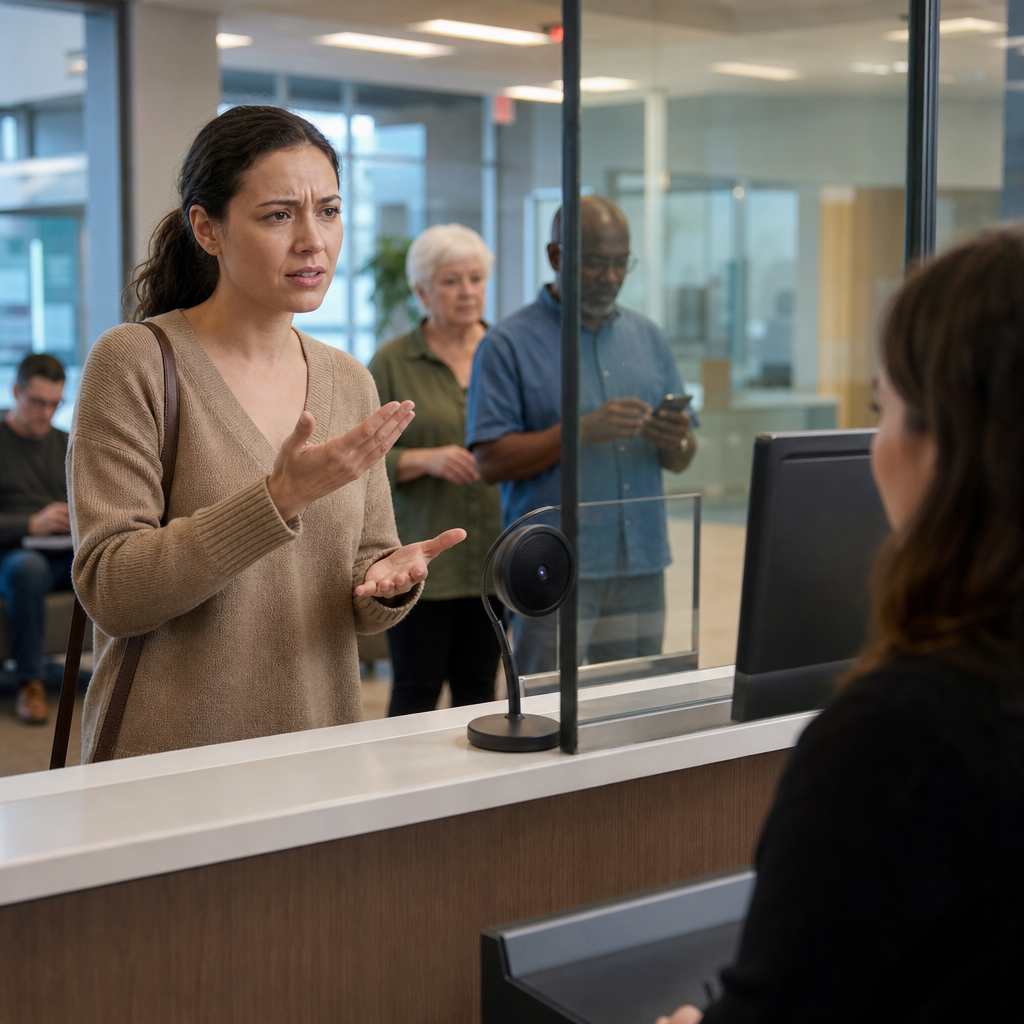
| Retail or front desk | Written exchange or speech-to-text app | Brief, simple transactions | Usually inadequate for detailed or sensitive issues |
| Housing | Visual alarm and text-based communication | Emergency alerts, maintenance notices, leasing communication | Building systems may require modification approval |
Not every requested aid must be granted exactly as asked, but the alternative must be equally effective. That phrase is critical. A hospital cannot deny an interpreter and then claim that lip reading is enough if the patient says it is not. An employer cannot post mandatory training videos without captions and assume a transcript delivered later solves the problem. A city cannot hold public meetings without captioning and tell attendees to read minutes afterward. Effective communication must be timely, accurate, and delivered in a manner that preserves privacy and independence. Delayed access is often denied access.
How the accommodation process works in employment, education, and public life
The accommodation process usually begins with notice. A deaf individual, family member, advocate, or representative informs the covered entity that communication access is needed. No special legal words are required. Saying, “I am deaf and need an ASL interpreter for this meeting,” is enough to trigger review. In employment, the employer may engage in an interactive process to understand the limitation, the essential functions of the job, and effective options. Employers can request limited medical documentation when the disability or need is not obvious, but many deaf accommodation requests are straightforward and should not turn into unnecessary paperwork delays. The Job Accommodation Network, funded by the U.S. Department of Labor, remains one of the most reliable sources for practical accommodation guidance.
In schools and universities, processes differ depending on age and institution. K-12 students may receive services through IDEA, Section 504 plans, or both. Colleges usually route requests through disability services offices, but faculty and departments still carry implementation responsibility. In courts, hospitals, and government programs, requests may go through ADA coordinators, patient relations departments, clerk offices, or agency access units. Good systems confirm the request in writing, identify the event date, choose the service provider, and document how access will be delivered. Bad systems leave deaf people repeatedly explaining their needs to each new staff member. Centralized tracking, trained front-line staff, and vendor relationships with interpreter agencies reduce that failure point.
Timing matters. Interpreters and CART providers often need advance scheduling, especially in rural areas or for evening events. But lack of advance notice does not erase legal duties. Entities are expected to plan for recurring access needs, maintain contracts, and have backup procedures. Video Remote Interpreting can help when onsite interpreters are unavailable, yet it is not a universal solution. It requires adequate bandwidth, proper camera placement, sufficient screen size, and a user who can see the screen clearly. In emergency departments, jails, shelters, and noisy intake areas, I have seen VRI fail because staff treated the technology as a checkbox rather than a communication system. When VRI is ineffective, the entity must switch to another aid, often an onsite interpreter.
Common disputes, legal standards, and how enforcement actually happens
Most disputes about reasonable accommodations for deaf individuals fall into familiar categories: delayed interpreters, refusal to provide one at all, substitution of ineffective aids, poor quality captioning, inaccessible emergency information, retaliation after a request, and policies that burden the deaf person with arranging or paying for access. Under the ADA, the covered entity generally pays for the accommodation. A doctor cannot bill the patient for an interpreter. An employer cannot require an applicant to bring one. A college cannot charge extra for captioning required for equal access. Cost can be considered under undue burden analysis, but it is assessed in relation to the overall resources of the organization, not the budget preference of a single department manager.
Enforcement occurs through several channels. Individuals may file internal grievances, agency complaints, or lawsuits. ADA Title I employment claims usually begin with the Equal Employment Opportunity Commission. Title II and Title III complaints may be filed with the Department of Justice, while healthcare and education complaints may also go to the Office for Civil Rights. Housing complaints may go to the Department of Housing and Urban Development. Many states have human rights commissions or civil rights agencies with parallel protections, and some state laws cover smaller employers or offer stronger remedies than federal law. Settlement agreements often require policy changes, staff training, notice posting, vendor procedures, and monitoring, not just individual relief.
Case law consistently emphasizes context. Courts and enforcement agencies look at the complexity of the communication, the importance of the interaction, the length of the exchange, the effectiveness of the aid used, and whether the entity gave proper weight to the person’s expressed need. They also examine whether the person was excluded from benefits or placed at a substantial disadvantage. The strongest documentation usually includes dated requests, names of staff involved, screenshots, email confirmations, written denials, and a clear explanation of what information was missed because access failed. If you are denied an accommodation, ask for the decision in writing, identify the exact event or service affected, and state what accommodation would provide effective communication. Specific records change outcomes.
Building effective access: best practices for deaf individuals and covered entities
Legal compliance is the floor, not the goal. The organizations that handle deaf access well treat communication planning as an operational function. They train reception staff to recognize requests, maintain interpreter and CART vendor contracts, caption prerecorded and live video, test visual alert systems, and assign responsibility to an ADA or access coordinator with authority to solve problems quickly. They also distinguish between convenience and legal sufficiency. Automatic captions on meeting platforms are useful, but they are not always accurate enough for technical, legal, or medical content. Qualified interpreters must be able to interpret effectively, accurately, and impartially, using any necessary specialized vocabulary. That standard is regulatory, not optional.
For deaf individuals, preparation helps protect rights without shifting responsibility away from the entity. Make requests as early as practical, describe your preferred accommodation, and keep copies of confirmations. If an event is high stakes, such as surgery, court, a job interview, or a disciplinary hearing, be explicit that effective communication is required and that alternatives like lip reading or written notes are insufficient if that is true for you. If access fails, document what happened immediately. At the same time, it is worth recognizing tradeoffs. Some people prefer interpreters; others prioritize captioning for meetings with many speakers. Some Deaf professionals use ASL in one setting and speech-to-text in another. The best accommodation is the one that works for the individual in that context.
Understanding reasonable accommodations for deaf individuals ultimately means understanding that rights are exercised through systems, not slogans. The law protects access to work, school, healthcare, housing, government programs, transportation, and public accommodations, but those protections are strongest when requests are clear, responses are timely, and decision-makers know the governing standards. If you are deaf, hard of hearing, or supporting someone who is, start by identifying the setting, the law that applies, and the communication method that will be effective. If you represent an employer, provider, school, landlord, or agency, audit your processes before a complaint forces change. Equal access is achievable, legally required, and easier to deliver when it is built into everyday operations from the start.
Frequently Asked Questions
What is a reasonable accommodation for a deaf individual?
A reasonable accommodation for a deaf individual is a modification or support that removes communication barriers and allows equal access to work, school, healthcare, housing, government programs, transportation, and other public services. The key idea is not special treatment, but effective access. For a deaf person, that may include a qualified sign language interpreter, real-time captioning, video relay support, assistive listening technology, written communication, visual alerts, or changes to policies that otherwise assume everyone can hear spoken information. What counts as reasonable depends on the setting, the task being performed, and the communication needs of the individual. In practice, the accommodation must be effective, timely, and appropriate for the specific situation rather than generic or symbolic. For example, handing someone written notes may work for a brief interaction, but it may not be enough for a complex medical appointment, a workplace training session, or a legal proceeding where full and accurate communication is essential.
How do employers determine what accommodation is appropriate for a deaf employee or job applicant?
Employers should determine appropriate accommodations through an individualized, interactive process. That means they should communicate directly with the deaf employee or applicant about the barriers involved, the essential functions of the job, and the accommodation options that would provide effective communication and equal opportunity. There is no one-size-fits-all answer because deaf individuals use different communication methods. Some primarily use American Sign Language, some rely on captioning, some prefer written communication, and some use a combination depending on the context. Employers should focus on what allows the person to participate fully in interviews, meetings, trainings, supervision, safety briefings, and day-to-day job duties. Effective accommodations might include interpreters for group meetings, CART captioning for trainings, videophones, visual alarm systems, or adjustments to communication protocols. A good employer does not guess or choose the cheapest option without considering effectiveness. The legal and practical standard is whether the accommodation genuinely enables access without creating an undue hardship, and that analysis should be based on facts, not assumptions about deafness or workplace communication.
Are interpreters always required as a reasonable accommodation?
No, interpreters are not always required, but they are often necessary when the communication is lengthy, complex, interactive, or legally significant. Whether an interpreter is needed depends on the nature of the communication and the deaf person’s preferred and effective mode of communication. For a simple transaction, exchanging written information may be enough. For a job interview, medical consultation, classroom lecture, disciplinary meeting, court-related matter, or public hearing, a qualified interpreter may be the only accommodation that provides meaningful access. It is important to understand that an interpreter is not interchangeable with any person who knows some sign language. The interpreter must be qualified, able to interpret accurately and impartially, and familiar with the vocabulary of the setting. In many situations, captioning may also be effective, but not for everyone. The central legal principle is effective communication. If the communication involves important decisions, rights, consent, safety, or detailed discussion, the organization should not assume that gestures, lip reading, or note passing are enough. The right accommodation is the one that allows the deaf individual to understand and participate fully and accurately.
What does “effective communication” mean in healthcare, education, and public services?
Effective communication means the deaf individual can receive information and express questions, decisions, and concerns with substantially the same clarity, timeliness, and accuracy as a hearing person. In healthcare, this can be especially important because misunderstanding symptoms, diagnoses, treatment options, medications, or consent forms can have serious consequences. A hospital or clinic may need to provide a qualified interpreter, video remote interpreting if appropriate and functioning properly, or other aids that allow meaningful communication during appointments and emergencies. In education, effective communication means students must be able to access lectures, discussions, instructions, audiovisual materials, and campus services, not just be physically present in the room. That may require interpreters, captioned media, note-taking support, or other communication tools. In government offices and public services, effective communication means deaf individuals can participate in programs, complete forms, ask questions, attend hearings, and understand their rights and obligations. The standard is not minimal communication or delayed communication. It is communication that works in real time, in context, and with enough accuracy for full participation.
Can a request for accommodation be denied, and if so, on what grounds?
Yes, a specific accommodation request can sometimes be denied, but not simply because it is inconvenient, unfamiliar, or based on stereotypes about cost or feasibility. In many legal settings, an organization may deny a requested accommodation if it can show that the accommodation would create an undue hardship, fundamentally alter the nature of the service or program, or is not actually necessary for effective access. Even then, the analysis does not end with a denial. The organization still has a duty to explore alternative accommodations that would be effective. For example, if one requested method is unavailable for a particular event, the organization should consider another method that still ensures meaningful communication rather than offering no support at all. A lawful decision must be grounded in an individualized assessment, not blanket policies such as refusing all interpreters, requiring family members to interpret, or insisting that written notes are always sufficient. In many situations, denying an accommodation without discussing alternatives or without acting promptly can itself create a barrier to equal access. The best approach is to evaluate the request seriously, communicate openly, document the process, and focus on solutions that give the deaf individual a real opportunity to participate on equal terms.