
Choosing between a therapist who signs directly and a therapist who works through an interpreter can shape the entire course of mental health care for a Deaf client. In therapy, communication is not a side issue; it is the treatment. When a client needs to describe trauma, track mood shifts, test a belief, or sit in silence while a hard realization lands, the quality of language access affects trust, speed, nuance, and clinical accuracy. That is why the question “ASL vs interpreter in therapy: what’s better?” matters to Deaf adults, Deaf teens, parents, clinicians, and referral networks across health, wellness, and mental health services.
To answer it well, key terms need to be clear. ASL means American Sign Language, a complete natural language with its own grammar, discourse structure, and cultural context. A signing therapist may be Deaf or hearing, but they communicate directly in ASL without a third party in the room. Interpreter-based therapy usually means a hearing therapist speaks English while a qualified sign language interpreter renders the session between English and ASL. Related models include Certified Deaf Interpreter support, telehealth sessions using remote interpreters, and bilingual-bicultural therapy led by clinicians trained in both mental health practice and Deaf culture.
After years of working around behavioral health access issues, one pattern is consistent: there is no single best option for every Deaf person, but there are clear differences in therapeutic fit. Some clients progress faster with direct ASL communication because rapport develops more naturally and emotional timing stays intact. Others do well with an interpreter, especially when the clinical specialist they need does not sign and the interpreter has strong mental health experience. The most effective choice depends on the client’s language preferences, trauma history, diagnosis, geography, privacy concerns, and the actual qualifications of everyone in the room.
This article serves as a hub for Deaf-friendly therapy and support. It explains how each therapy model works, where each model excels, what can go wrong, and how to evaluate services before booking an appointment. It also covers practical issues that often determine access, including licensing, confidentiality, insurance, crisis planning, telehealth, family therapy, and the role of cultural competence. If you are trying to compare options for individual counseling, couples work, psychiatric care, or long-term support, the goal here is simple: help you choose the communication setup that gives the best chance of safe, accurate, and effective therapy.
What direct ASL therapy does best
Direct ASL therapy often provides the strongest therapeutic alliance because communication flows between client and clinician without relay delay. In practice, that matters more than many hearing systems realize. When a Deaf client is discussing panic symptoms, family rejection, language deprivation, workplace discrimination, or childhood medical trauma, timing and facial grammar carry clinical meaning. A therapist who signs fluently can respond in real time to affect, hesitation, avoidance, and shifts in intensity. The session feels less segmented, and interventions such as validation, grounding, motivational interviewing, and cognitive restructuring can happen with better pacing.
Direct communication also reduces message loss. Skilled interpreters work hard to preserve meaning, but therapy is dense with ambiguity, metaphor, unfinished thoughts, and emotionally loaded signing choices. A client may soften, intensify, or reframe an experience through movement, space, and nonmanual signals. A therapist who understands ASL directly can ask a follow-up in the exact moment the meaning changes. That can improve assessment accuracy for depression, PTSD, obsessive thoughts, substance use, and relational conflict. In my experience, direct-signing sessions also make it easier to discuss interpreter fatigue, audism, cochlear implant conflict, and Deaf identity without first filtering those topics through a third person.
Another advantage is cultural congruence. Deaf-friendly therapy is not only about language access. It also involves understanding Deaf norms around information sharing, eye contact, turn-taking, visual attention, community networks, school histories, and the impact of exclusion from incidental learning. A therapist can be clinically competent and still miss the significance of mainstreaming, residential school experiences, or lifelong communication barriers in medical and family settings. Direct ASL providers, especially those with Deaf culture expertise, are often better positioned to distinguish pathology from adaptation. For example, a client’s vigilance in public spaces may relate less to generalized anxiety and more to realistic safety planning in hearing environments that routinely fail to provide access.
When interpreter-based therapy is the better option
Interpreter-mediated therapy can be the best and most practical option when the clinical specialty matters more than direct signing alone. A Deaf client with an eating disorder, obsessive-compulsive disorder, bipolar disorder, perinatal depression, or complex trauma may need a therapist with deep expertise in a specific treatment model such as ERP, EMDR, DBT, CBT-I, or family systems work. In many regions, there simply are not enough signing clinicians to meet that need. In those cases, a highly qualified therapist working with a highly qualified interpreter may offer better care than a signing therapist who lacks the necessary specialty training.
This model can also improve access to psychiatry, inpatient consultation, group treatment, and rural care. In community mental health, hospitals, and university systems, interpreter support often opens doors that would otherwise remain closed. Telehealth has expanded those options. A Deaf client in a small town can now work with a licensed trauma specialist several states away while using a remote interpreter or, if appropriate, direct video communication in ASL. For many families, this is the difference between waiting months with no support and starting treatment quickly.
Interpreter-based therapy works best when the interpreter has mental health competence, understands clinical boundaries, and is comfortable with emotionally intense content. General community interpreting skill is not enough by itself. Therapy involves confidentiality demands, role clarity, complex affective language, and situations where the interpreter must render disorganized thought, suicidal statements, or family conflict accurately without cleaning up the message. The therapist also has to know how to work with an interpreter: speaking in manageable segments, addressing the client rather than the interpreter, checking meaning directly, and leaving time for processing. When those pieces are in place, interpreter-supported therapy can be ethical, effective, and clinically sound.
Core differences that affect outcomes
The central difference between direct ASL therapy and interpreter-based therapy is not convenience. It is how the communication structure changes the treatment process. Direct ASL usually increases immediacy, privacy, and emotional resonance. Interpreter-based therapy usually increases provider choice and specialty access. The right decision depends on which factors are most clinically important for the person seeking help.
| Factor | Direct ASL Therapist | Therapist With Interpreter |
|---|---|---|
| Rapport building | Usually faster because communication is direct | Can be strong, but often takes longer with a third party present |
| Access to specialists | Limited in many regions | Much broader, especially for niche diagnoses and methods |
| Nuance of language | Best preserved when therapist is fluent in ASL | Depends on interpreter skill and therapist collaboration |
| Privacy concerns | Fewer people involved | Requires trust in interpreter confidentiality and boundaries |
| Scheduling | Simpler once provider is found | Often more complex because interpreter availability matters |
| Cultural understanding | Often stronger, but not automatic | Varies widely by therapist and interpreter experience |
These differences affect outcomes in practical ways. A Deaf teen in family therapy may shut down with an interpreter present because conflict already feels exposed. A Deaf adult with severe OCD may prefer interpreter access if it allows treatment with an ERP specialist who has excellent outcomes. A trauma survivor who has spent years being misunderstood may need direct ASL for basic psychological safety. The communication setup should support the therapeutic goal, not just satisfy minimum access rules.
Confidentiality, trust, and emotional safety
Many clients assume an interpreter automatically weakens confidentiality. Legally and ethically, qualified interpreters are bound by confidentiality standards, and healthcare entities are required under the Americans with Disabilities Act and Section 504 to provide effective communication in many settings. In reality, however, trust is emotional as well as procedural. A Deaf client may know the interpreter socially, may worry about community overlap, or may feel less willing to disclose sexual trauma, substance use, psychosis symptoms, or relationship abuse with a third person present. Those concerns are not irrational. They should be discussed before treatment starts.
Direct ASL therapy often feels safer because fewer people share the room, and the client does not need to split visual attention between therapist and interpreter. That can matter in trauma treatment. Hypervigilant clients often monitor every face and movement. Adding another person can increase cognitive load and reduce felt safety. On the other hand, some clients feel safer with an interpreter because the interpreter helps normalize communication and can reduce fear of being linguistically judged by a hearing therapist who signs imperfectly. Safety depends not only on model but on competence and fit.
Best practice is transparent preparation. Clients should be told who will attend, whether the interpreter has mental health experience, how records identify interpreter involvement, what happens in emergencies, and whether a different interpreter can be requested. If a client hesitates to speak openly with a particular interpreter, that signal should be taken seriously. Effective therapy requires conditions where honesty is possible.
How to choose the right Deaf-friendly therapy setup
Start with the clinical question, not the access form alone. Ask what treatment is needed: general supportive counseling, trauma therapy, medication management, couples counseling, child therapy, addiction treatment, or crisis stabilization. Then ask what communication conditions make that treatment most likely to work. A direct-signing therapist is often the strongest first choice when available and qualified. But specialty care should not be sacrificed without thought if an interpreter-supported expert is clearly better suited to the diagnosis.
Screen providers carefully. Ask whether the therapist is fluent in ASL or conversational only. Ask whether they have worked with Deaf clients who share your age group or diagnosis. Ask which treatment approaches they actually use, not just which acronyms they list online. For interpreter-based care, ask who arranges interpreting, whether the interpreter has behavioral health experience, and how missed appointments or emergency sessions are handled. If the answer is vague, access may fail when it matters most.
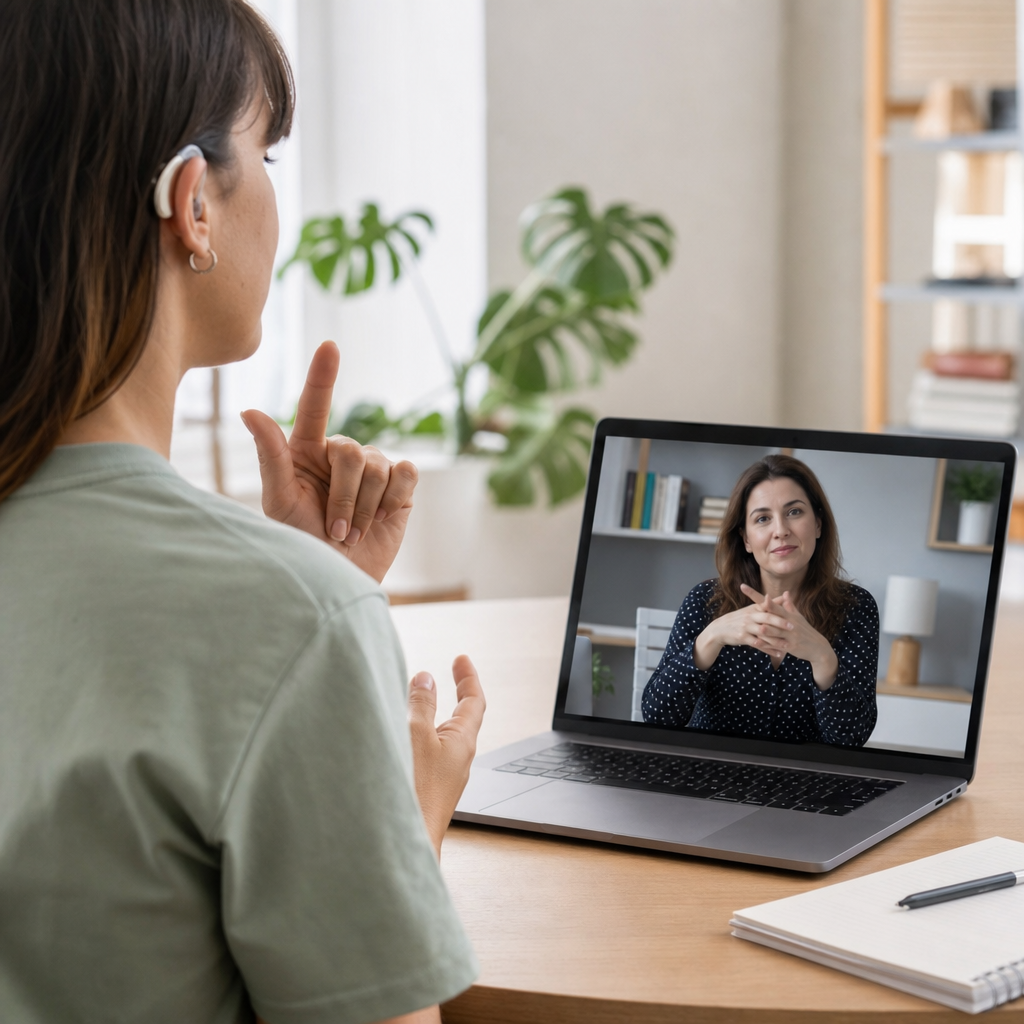
Telehealth deserves special attention. Video therapy can be excellent for Deaf clients when lighting, camera framing, connection stability, and platform usability are addressed. Direct ASL teletherapy often works very well because visual communication is central. Interpreter-based telehealth can also work, but the layout must allow clear view of both clinician and interpreter, with enough screen size to read facial grammar and finger spelling. Small-phone sessions are often a poor substitute for larger screens.
For families and caregivers, the same principles apply. Children need language-rich care. Deaf children with delayed access to fluent language may present with behavioral symptoms that are partly communication symptoms. Parents should seek clinicians who understand language deprivation, educational placement, and Deaf identity development. In couples counseling, direct signing may reduce triangulation; in some cases, an interpreter may still be necessary to reach a therapist with strong relationship treatment skills. The best setup is the one that supports clarity, trust, and sustained engagement over time.
Building a broader support system beyond therapy
Therapy is only one part of Deaf-friendly mental health support. Better outcomes usually come from a network that includes accessible primary care, psychiatric consultation when needed, peer support, crisis resources, and community belonging. Deaf clients often carry stressors that therapy alone cannot solve: inaccessible workplaces, family communication barriers, school exclusion, insurance obstacles, and chronic exhaustion from navigating hearing systems. Good clinicians address these realities directly and help clients build practical supports rather than treating every problem as an internal disorder.
A strong support plan may include Deaf peer groups, vocational counseling, case management, school advocacy, substance use recovery meetings with access services, and safety planning in ASL. For some clients, psychoeducation about trauma, grief, burnout, and boundaries is as important as weekly counseling. For others, the priority is medication access with a psychiatrist who understands how interpretation affects symptom assessment. Hub resources on Deaf-friendly therapy and support should make these pathways visible so clients do not stop at the first appointment and assume that is the whole system.
The key takeaway is straightforward. Direct ASL therapy is often the best option when fluency, rapport, and cultural understanding are central to care. Interpreter-based therapy is often the best option when it opens access to the right specialist and the interpreting is truly qualified. Neither model is universally superior. What matters is effective communication, clinical fit, and psychological safety. If you are seeking therapy, ask direct questions, insist on accessible care, and choose the setup that lets you communicate fully enough to do real therapeutic work.
Frequently Asked Questions
Is it better to see a therapist who signs directly in ASL, or can therapy through an interpreter work just as well?
In many cases, a therapist who communicates directly in ASL offers the strongest foundation for therapy because the client and therapist can build rapport without a third person filtering timing, tone, or emotional nuance. Therapy depends on much more than the literal meaning of words. It involves pauses, facial expression, body language, immediacy, and the ability to move naturally between feelings, memories, and insight. For Deaf clients who use ASL as their primary language, direct communication often makes sessions feel faster, safer, and more emotionally precise.
That said, therapy through a qualified interpreter can still be effective, especially when a signing therapist is not available, there are insurance or location limits, or a client connects strongly with a therapist whose clinical expertise is a great fit. A skilled mental health interpreter can support meaningful treatment, but the setup is different. The presence of an interpreter adds another person to the room, which may affect privacy, pacing, and the natural flow of sensitive conversations. Some clients are completely comfortable with that structure, while others find it harder to disclose painful or deeply personal material.
The better option is usually the one that gives the Deaf client the clearest language access, the strongest sense of trust, and the most accurate clinical understanding. If a client feels more fully seen and understood with a signing therapist, that is often ideal. If an interpreter-supported setting provides access to a specialist the client truly wants to work with, that can also be a strong choice when the interpreter is appropriately trained and the therapist knows how to work effectively in that model.
Why does direct ASL communication matter so much in therapy compared with other healthcare settings?
Therapy is different from many medical appointments because communication is not just a tool used to deliver treatment; it is the treatment itself. In a routine healthcare visit, communication may focus on symptoms, instructions, or decisions. In therapy, the work happens inside the conversation. A client may be trying to describe the exact feeling that came before a panic episode, the subtle difference between shame and grief, or the meaning of a memory they have never shared before. Small shifts in language can change the entire clinical picture.
Direct ASL communication matters because ASL is a complete language with its own grammar, rhythm, and emotional texture. When a Deaf client can think, feel, and respond in their primary language, therapy often becomes more accurate and less exhausting. The client does not have to translate internally, adjust to awkward pacing, or worry that a delicate emotional meaning may be flattened. The therapist can also observe information that is clinically relevant, including signing style, affect, hesitation, intensity, and changes in expression that may signal fear, ambivalence, dissociation, or relief.
This does not mean interpreted therapy cannot work. It means direct language access is especially valuable in mental health because therapeutic progress often depends on nuance. The closer the communication is to the client’s natural language, the easier it is to explore trauma, identity, relationships, and emotional patterns with depth and precision. For many Deaf clients, that directness is not a luxury. It is central to quality care.
What are the pros and cons of using an interpreter in therapy sessions?
The main advantage of using an interpreter is access. A Deaf client may be able to work with a therapist who has specialized experience in trauma, addiction, OCD, eating disorders, couples therapy, or another area that would otherwise be unavailable. In regions where signing therapists are limited, interpreted therapy can open doors to care that might not exist locally. It may also reduce wait times and expand options for scheduling, insurance coverage, and treatment format.
There are also situations where a client simply prefers a particular therapist’s style, regardless of whether that therapist signs directly. If the therapeutic fit is excellent and the interpreter is highly skilled in mental health settings, the arrangement can support meaningful and effective treatment. Some clients become very comfortable with the structure over time and feel fully able to do deep clinical work.
The challenges are just as important to understand. An interpreter adds a layer between client and therapist, which can affect intimacy, spontaneity, and trust. Sessions may move more slowly because everything must be interpreted. Silence, interruption, overlapping emotion, or rapid thought processes can be harder to manage naturally. A client may hesitate to disclose sexual trauma, family conflict, substance use, or intrusive thoughts in front of an additional person. There is also the issue of clinical accuracy: therapy language is nuanced, and not every interpreter has mental health training or the ability to convey complex emotional content with precision.
Another concern is that the therapist may miss language-based cues if they do not understand ASL directly. Even with an excellent interpreter, some aspects of expression are experienced differently when mediated. For this reason, interpreted therapy tends to work best when everyone is prepared: the interpreter has mental health competence, the therapist understands how to pace and structure interpreted sessions, and the client feels comfortable with the arrangement from the start.
How can a Deaf client tell whether an interpreted therapy setup is actually high quality?
A high-quality interpreted therapy setup should feel clear, respectful, emotionally safe, and clinically smooth. One of the first signs is the interpreter’s background. Ideally, the interpreter has experience in mental health settings, understands confidentiality at a professional level, and can handle sensitive material without overstepping, softening, or becoming part of the therapeutic process. Mental health interpreting requires more than general fluency. It demands comfort with trauma-related language, diagnostic concepts, emotional intensity, and complex interpersonal dynamics.
The therapist’s behavior matters too. A strong therapist will speak directly to the client, not to the interpreter, and will maintain the therapeutic relationship with the Deaf client as the central focus. They should explain how confidentiality works, ask about communication preferences, and make room for feedback if the pace or style of interpretation is not working. They should also understand that interpreted sessions may require more intentional turn-taking and slightly different timing.
The client should pay attention to how the sessions feel over time. Are meanings coming through accurately? Does it feel possible to express subtle emotions? Is the therapist responding to what was truly meant, or only to a simplified version? Can difficult material be discussed without feeling exposed or rushed? If the answer to these questions is no, the setup may not be serving the client well.
It is completely appropriate for a Deaf client to ask practical questions before starting: Does the interpreter have mental health experience? Will the same interpreter be used consistently? What is the process if communication problems arise? Can the client request a different interpreter if needed? Good interpreted therapy is not just about having someone in the room who can sign. It is about creating conditions where therapeutic meaning can move accurately and safely between all parties.
What should a Deaf client consider when deciding between a signing therapist and a therapist who uses an interpreter?
The most important consideration is where the client feels most able to be fully honest, emotionally present, and understood. That may sound simple, but it is the core of effective therapy. If a client knows they open up more easily in direct ASL, that matters. If they become guarded when a third person is present, that matters too. On the other hand, if the best available specialist does not sign and the client feels comfortable with an interpreter, that may be the best path forward.
Clients should also consider the nature of the issues they want to address. Highly sensitive topics such as trauma, sexuality, shame, family violence, or psychosis may feel easier to process with a therapist who signs directly. For other treatment goals, a strong interpreted setup may work very well. The client should think about communication fatigue, the emotional pace of sessions, privacy concerns, and whether they prefer a more direct or more structured interaction style.
Practical factors matter as well. Availability, insurance, location, waitlists, telehealth access, and therapist specialization can all influence the decision. A signing therapist may offer ideal language access but may not have the clinical focus a client needs. An interpreter-supported therapist may bring outstanding expertise in a specific disorder or treatment method. The best decision often balances communication access with clinical fit rather than treating them as separate issues.
Ultimately, the question is not only “Which option is better in theory?” but “Which option gives this client the best chance to do real therapeutic work?” The right choice is the one that supports trust, depth, accuracy, and consistency. For many Deaf clients, that will be a therapist who signs directly in ASL. For others, it will be a highly skilled therapist working with a qualified mental health interpreter. The standard should always be effective, accessible care, not mere accommodation.