Telehealth accessibility for Deaf individuals sits at the intersection of healthcare access, communication rights, digital design, and clinical safety. Telehealth includes video visits, remote patient monitoring, secure messaging, online scheduling, patient portals, and phone-based triage. Accessibility means these services can be used effectively, independently, and with equivalent quality by people with different communication needs. In this context, Deaf individuals may use American Sign Language, signed English, speechreading, captions, text chat, relay services, hearing aids, cochlear implants, or a mix of approaches. Treating Deaf patients as a single group leads to poor care. Communication preferences vary widely, and telehealth systems must account for that variation from the first click through diagnosis, treatment, follow-up, billing, and records access.
This matters because communication errors in healthcare are never minor. A missed symptom detail, an unsigned consent explanation, or an inaccessible after-visit summary can delay treatment or create avoidable harm. During the rapid expansion of virtual care, I saw organizations solve scheduling speed while overlooking interpreter workflows, caption quality, and portal usability. That gap affects routine primary care, urgent care, mental health, audiology, pharmacy counseling, and chronic disease management. Deaf patients often face added friction before the clinical encounter even begins: inaccessible websites, staff who default to voice calls, platforms without pinning for interpreters, and clinicians unfamiliar with legal obligations. A strong healthcare accessibility strategy removes those barriers systematically, not case by case.
As a hub topic, healthcare accessibility goes beyond one video appointment. It covers digital front doors, disability accommodations, language access, informed consent, emergency escalation, privacy, insurance, and outcomes measurement. For Deaf individuals, telehealth can be a major equalizer when built correctly. It eliminates travel, broadens specialist access, and makes follow-up easier. Yet poor implementation can reproduce the same exclusion found in physical clinics. The central question is simple: can a Deaf patient book, join, understand, participate in, and act on a telehealth visit with the same confidence as any other patient? The sections below explain what that requires in practical terms.
What Telehealth Accessibility Means in Practice
Accessible telehealth for Deaf individuals begins with communication access, but it does not end there. A compliant and effective service supports the full care journey: finding a clinician, requesting an accommodation, receiving reminders, completing forms, connecting to the visit, understanding the care plan, and obtaining follow-up materials in an accessible format. The most reliable approach is to ask every patient for a preferred communication method at registration, store that preference as structured data in the electronic health record, and surface it to scheduling and clinical staff before every encounter. Free-text notes are not enough because they are easy to miss and impossible to report on consistently.
Communication access may involve a qualified sign language interpreter, real-time captioning, secure chat, visual alerting, or combinations of these supports. For many Deaf ASL users, qualified interpreting is the primary requirement, especially for complex discussions such as medication risks, informed consent, oncology treatment, surgery, reproductive care, or behavioral health. Automatic captions can help some patients, but they are not a substitute for interpreting when sign language is the patient’s language. Caption accuracy varies with medical terminology, accents, crosstalk, and internet quality. In my work reviewing telehealth workflows, the best-performing systems gave patients an accommodation choice during scheduling and triggered an interpreter booking workflow automatically.
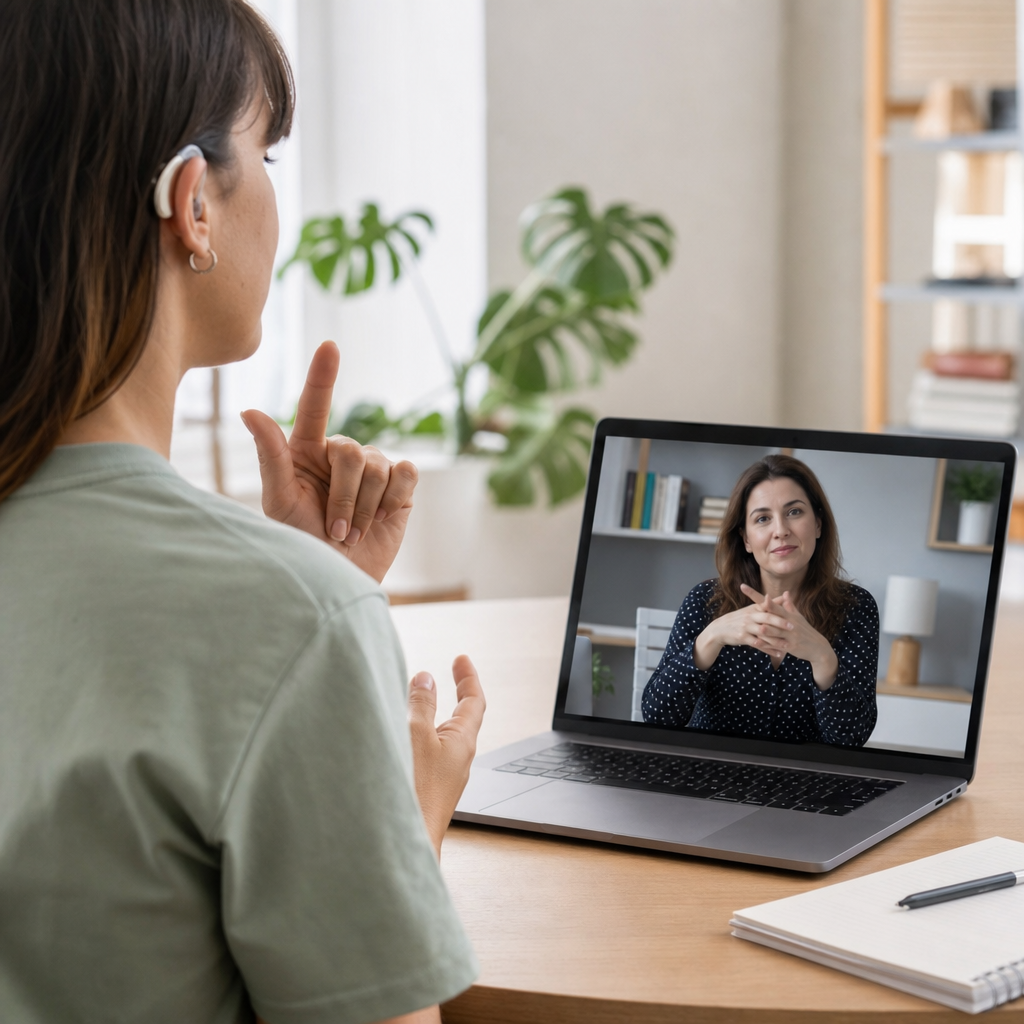
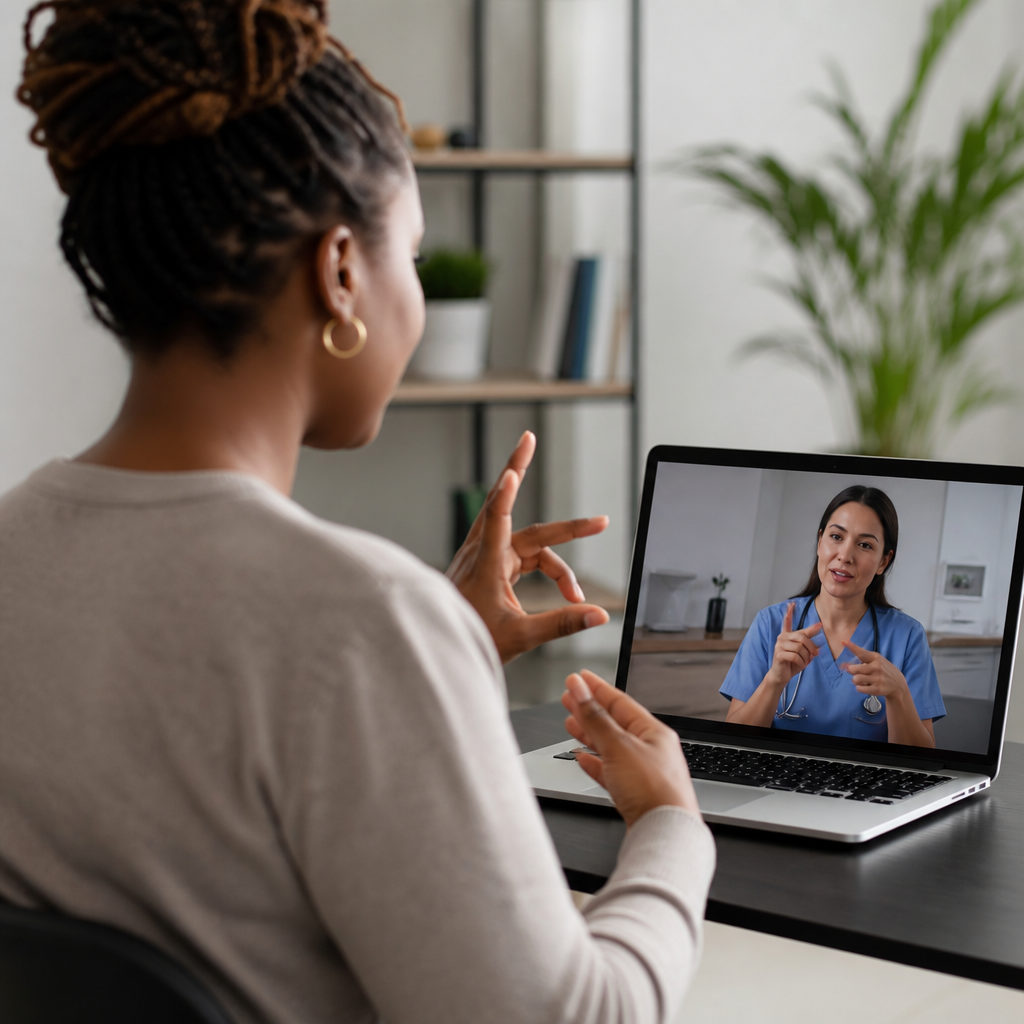
Platform design also matters. A usable video interface needs spotlight or pinning so the interpreter remains visible, stable gallery views, keyboard accessibility, high-contrast controls, and support for chat without covering the signer’s hands or face. Patients should be able to test audio, video, captions, and device permissions before the appointment. If a session fails, the fallback should not be “we will call you,” because voice-only fallback excludes some Deaf patients. A better protocol is secure text chat, immediate reconnection links, or a backup video room that already includes the interpreter.
Legal, Ethical, and Safety Foundations
Healthcare organizations in the United States generally operate under the Americans with Disabilities Act, Section 504 of the Rehabilitation Act, Section 1557 of the Affordable Care Act, and state nondiscrimination laws. These rules require effective communication, not merely a good-faith attempt. In practice, that means providers must furnish appropriate auxiliary aids and services when needed unless doing so would fundamentally alter the service or create an undue burden, a high threshold for most healthcare settings. Cost alone is rarely a defensible reason to deny an interpreter for a clinically significant visit. This is especially true for hospitals and health systems with broad telehealth operations.
Ethically, communication access supports autonomy, beneficence, and informed consent. A patient cannot give meaningful consent if they do not fully understand risks, alternatives, or next steps. Safety depends on precision. Consider chest pain triage: if a patient relies on captions that incorrectly render “pressure,” “radiating,” or “shortness of breath,” the clinician may misjudge urgency. Mental health is another high-risk area. Nuance, emotional tone, pauses, and culturally specific expressions matter, and a qualified mental health interpreter can materially improve accuracy. Family members should not be used as default interpreters except in narrow emergencies, because privacy, coercion, and accuracy problems are well documented.
Documentation is part of trust. The medical record should note what accommodation was provided, whether it functioned effectively, and any barriers encountered. That creates continuity and reduces repeated explanations by the patient. It also supports quality improvement and legal defensibility. When organizations treat accessibility as a safety issue rather than a customer service add-on, performance improves. Training follows, budgets become more realistic, and leaders start measuring interpreter fulfillment rates, caption reliability, no-show differentials, and patient satisfaction by disability status instead of assuming equal access exists.
Core Barriers Across the Healthcare Journey
The most common telehealth barriers for Deaf individuals appear before the visit. Scheduling systems often require phone calls, and contact center scripts may not recognize relay services or text-first communication preferences. Patient portals may send voice reminders without equivalent text or email alerts. Intake forms sometimes ask whether a patient has a hearing impairment but fail to ask what accommodation is needed. That wording is both outdated and operationally weak. The better question is direct: what communication support do you want for appointments, messages, and urgent outreach? Precision improves service delivery.
During the visit, barriers usually involve workflow and interface design rather than clinician intent. Interpreters join late because no one sent the correct link. The platform rearranges tiles so the interpreter becomes too small to read. Captions cover the mouth, making speechreading harder. Clinicians share screens full of dense text without pausing to explain visuals. Some providers talk while looking down at another monitor, reducing lip visibility and nonverbal clarity. Others rush through instructions because video visits are tightly scheduled. None of these issues are inevitable. They are design and training problems, and they can be fixed.
After the visit, accessibility often drops sharply. Medication instructions may be written at a reading level that does not match the patient’s preference or language background. Referral calls may be placed by voice, not text. Educational videos may lack accurate captions. Billing departments may send inaccessible notices that are difficult to resolve. These post-visit failures undermine otherwise successful clinical care. Healthcare accessibility is therefore a full-system responsibility spanning the website, contact center, EHR, telehealth platform, clinicians, interpreters, and revenue cycle teams.
| Care stage | Common barrier | Accessible solution |
|---|---|---|
| Scheduling | Phone-only booking | Online self-scheduling with accommodation field and text confirmation |
| Pre-visit | No interpreter workflow | Automatic interpreter request tied to appointment type and patient preference |
| Live visit | Interpreter not visible | Platform with pinning, stable layout, and pre-visit technical test |
| Clinical discussion | Inaccurate captions for medical terms | Qualified interpreter or CART for detailed communication needs |
| Follow-up | Voice-only outreach | Secure messaging, SMS alerts, and accessible written summaries |
Designing Accessible Telehealth Systems
An accessible telehealth program is built, not improvised. Start with procurement. When evaluating platforms such as Zoom for Healthcare, Microsoft Teams, Doxy.me, Epic-integrated video, or Amwell, ask for specific accessibility capabilities: multi-participant support, interpreter pinning, manual and automatic captions, keyboard navigation, screen reader compatibility, browser flexibility, bandwidth performance, and support for mobile devices. Request demonstrations using real clinical scenarios, not generic sales walkthroughs. I have seen teams sign contracts before testing interpreter visibility on small screens, then spend months creating workarounds that frustrate everyone.
Workflow design should match clinical risk. Routine follow-ups may work well with captions and chat, while complex specialty consultations may require scheduled ASL interpretation every time. Build accommodation logic into the EHR and scheduling rules. If a patient preference indicates ASL, the system should prompt staff to secure a qualified interpreter and prevent last-minute surprises. Staff need scripts that are short and explicit: “Would you like ASL interpretation, live captioning, chat support, or another communication accommodation for this visit?” This language respects choice and improves data quality.
Technical support is equally important. Patients need clear pre-visit instructions in plain language with screenshots, caption setup steps, troubleshooting guidance, and a nonvoice help option. Organizations should offer test calls, especially for older adults or first-time users. Device access matters too. Some patients only have smartphones, and certain layouts make interpreters hard to see on small screens. In those cases, clinics can suggest landscape mode, tablet loaner programs, community access sites, or in-person alternatives when virtual quality would be clinically inadequate. Accessibility includes recognizing when telehealth is the wrong modality for a specific encounter.
Clinical Communication and Staff Training
Clinicians do not need to become accessibility specialists, but they do need practical communication habits. Look at the camera when speaking, pause between major points, avoid talking over the interpreter, and confirm understanding using teach-back. Teach-back means asking the patient to explain the plan in their own words, not merely asking whether they understood. This is one of the simplest ways to catch communication gaps. Visual support helps as well: concise diagrams, medication schedules, and shared summaries can reinforce complex instructions without replacing direct conversation.
Frontline staff training should cover Deaf culture basics, relay service etiquette, accommodation workflows, privacy, and escalation paths when technology fails. One recurring issue is staff hanging up on relay calls because they mistake the operator for spam. Another is assuming every Deaf patient reads English at the same level or prefers the same support. Training should emphasize that communication preference is individual and should be asked, documented, and honored. In behavioral health, pairing trained clinicians with interpreters experienced in therapeutic settings improves rapport and reduces the risk of misreading affect or intent.
Organizations should also define what qualifies as an effective accommodation for different scenarios. A medication refill check may be manageable through secure messaging. A new cancer diagnosis is not the moment to rely on imperfect auto-captions. Emergency departments, urgent care networks, and hospital-at-home programs need rapid access to remote interpreters at all hours. Measurable service standards help: interpreter connection within a defined number of minutes, caption availability for every supported visit type, and post-visit summaries delivered in accessible formats within the normal workflow.
Measurement, Accountability, and the Broader Accessibility Hub
Healthcare accessibility improves when leaders measure it with the same seriousness as wait times or readmission rates. Useful metrics include the percentage of patients with documented communication preferences, interpreter fulfillment rate, visit completion rate by accommodation type, technical failure rate, complaint themes, no-show differentials, and patient-reported understanding of care plans. Segmenting these measures by service line reveals where barriers persist. In many systems, mental health and specialty care show stronger interpreter workflows than imaging scheduling or pharmacy counseling, even though patients experience the organization as one connected system.
This hub topic also connects telehealth to adjacent accessibility issues. Digital accessibility standards such as WCAG inform portal and website design. Language access policies intersect with disability accommodations when Deaf patients use ASL as their primary language. Emergency preparedness matters because severe weather, infectious disease surges, and home-based care all increase reliance on virtual communication. Insurance and reimbursement matter too. If a plan covers telehealth broadly but a provider lacks accommodation processes, theoretical access still fails in practice. The same is true for public health messaging, preventive screenings, and care coordination across specialists.
The most successful organizations treat accessibility as infrastructure. They map the patient journey, test with Deaf users, correct failures, and refresh training continuously. They build internal links between digital teams, compliance leaders, patient experience teams, contact centers, and clinical operations so problems are solved at the system level. Telehealth accessibility for Deaf individuals is therefore not a niche concern. It is a practical benchmark for whether healthcare accessibility is real, measurable, and safe. Review your scheduling, platform, documentation, and follow-up workflows now, then close the gaps before the next patient encounters them.
Frequently Asked Questions
What does telehealth accessibility mean for Deaf individuals?
Telehealth accessibility for Deaf individuals means much more than simply offering a video appointment. It means every part of the digital healthcare experience can be used effectively, independently, and with the same quality of care offered to hearing patients. That includes online scheduling, patient portals, secure messaging, video visits, remote patient monitoring, prescription instructions, follow-up communication, and urgent triage pathways. Accessibility must support a range of communication preferences, including American Sign Language, captioning, written English, relay services, and visual alerts. Because Deaf patients are not a single uniform group, accessible telehealth must be flexible enough to meet different language backgrounds, literacy levels, and technology needs.
In practice, accessibility also affects safety, accuracy, and trust. If a patient cannot clearly understand symptoms, medication instructions, consent forms, or follow-up steps, care quality suffers. A platform may appear compliant on paper but still fail if captions are inaccurate, interpreters are not integrated smoothly, or clinical staff do not know how to communicate respectfully and efficiently. True telehealth accessibility means the technology works, the communication support is reliable, and the healthcare team is prepared. The goal is equivalent access: Deaf patients should be able to receive timely, private, understandable, and clinically effective care without unnecessary barriers or extra burden.
What communication accommodations should telehealth providers offer during virtual visits?
Telehealth providers should offer multiple communication accommodations because no single solution works for every Deaf patient. Common supports include qualified American Sign Language interpreters, real-time captioning, text-based chat within the platform, secure messaging for follow-up questions, and visual rather than audio-only notifications. Providers should ask patients in advance what accommodation they prefer instead of making assumptions. Some Deaf individuals primarily use ASL and may need a qualified medical interpreter for full access. Others may prefer live captioning, written instructions, or a combination of supports depending on the visit type and the complexity of the medical discussion.
It is also important that accommodations are built into the workflow, not improvised at the last minute. For example, the telehealth platform should support multi-party video so an interpreter can join clearly and remain visible throughout the visit. Captions should be accurate enough for medical conversations, not just casual speech. Clinicians should know basic best practices such as facing the camera, speaking at a natural pace, avoiding talking over the interpreter, confirming understanding, and providing written summaries afterward. For appointments involving diagnosis changes, medication adjustments, informed consent, or mental health discussions, communication support becomes especially critical. A strong telehealth accessibility process ensures accommodations are dependable, clinically appropriate, and available without delay.
Are captions alone enough to make telehealth accessible for Deaf patients?
No, captions alone are not always enough. Captions can be extremely helpful, especially for Deaf or hard of hearing patients who prefer spoken English with text support, but they do not replace all other forms of communication access. Automated captions may struggle with medical terminology, accents, poor audio quality, multiple speakers, or fast-paced conversation. In healthcare, even small transcription errors can affect diagnosis, medication use, informed consent, and patient safety. For patients who use ASL as their primary language, captions may not provide equivalent access because ASL is a distinct language with its own grammar and structure, and written English may not be the most effective communication format.
The most accessible telehealth systems treat captions as one possible accommodation rather than a complete solution. Providers should assess the patient’s preferred method of communication before the visit and document that preference in the health record or scheduling system. In many cases, combining supports works best, such as a qualified ASL interpreter during the live visit plus written after-visit instructions and secure messaging for follow-up. The standard should be effective communication, not the mere presence of a technical feature. If a patient cannot fully understand or participate in the appointment, then the service is not truly accessible, even if captions were technically available.
What are the biggest barriers Deaf individuals face when using telehealth?
Deaf individuals can encounter barriers at every stage of the telehealth journey, not just during the clinician interaction itself. Problems often begin with appointment scheduling if systems depend on phone calls, voicemail, or audio prompts without accessible alternatives. Patient portals may have unclear language, poor usability, or inaccessible identity verification steps. During the visit, barriers can include lack of interpreter coordination, captioning that is unavailable or inaccurate, platforms that do not allow a third participant to join easily, limited video quality that makes sign language difficult to see, and clinicians who are unfamiliar with Deaf communication needs. After the visit, inaccessible lab notifications, medication instructions, and follow-up calls can continue the problem.
There are also broader structural barriers. Many healthcare organizations still treat accessibility as an exception rather than a core design requirement, which leads to delays and inconsistent service. Staff may not know how to arrange accommodations, document patient preferences, or troubleshoot technical issues. Some platforms are designed around audio assumptions, such as verbal waiting room announcements or phone-based support channels. Digital inequities can add another layer, including unreliable internet access, lack of compatible devices, or poor camera positioning for signing. These barriers matter because they directly affect healthcare outcomes. When communication is difficult, patients may avoid care, misunderstand treatment plans, or lose confidence in the health system. Removing these barriers requires both accessible technology and operational readiness.
How can healthcare organizations improve telehealth accessibility for Deaf patients?
Healthcare organizations can improve telehealth accessibility by addressing policy, technology, staff training, and patient experience together. First, they should create a clear process for identifying and documenting each patient’s communication preferences at registration and scheduling, then make sure that information follows the patient across services. Second, they should choose telehealth platforms that support accessibility features such as high-quality multi-party video, reliable captioning, on-screen interpreter visibility, secure messaging, and compatibility with assistive technologies. Third, they should establish interpreter workflows that are fast, consistent, and available for routine, specialty, urgent, and follow-up care. Accessibility should be available by design, not handled as a one-off accommodation crisis.
Training is equally important. Clinicians, schedulers, nurses, technical support staff, and administrators all need practical guidance on working with Deaf patients in telehealth settings. That includes understanding communication rights, avoiding assumptions, using plain language, confirming comprehension, and knowing when a visit format is not clinically safe without additional support. Organizations should also test their systems with Deaf users, collect feedback, and measure outcomes such as no-show rates, patient satisfaction, interpreter delays, and communication-related complaints. Strong telehealth accessibility is not just a legal or ethical issue; it is a quality-of-care issue. When organizations build systems that support Deaf patients effectively, they improve safety, equity, efficiency, and trust across the entire care experience.