
Strong social connections are not a luxury for Deaf individuals; they are a core health need that shapes mental wellbeing, identity, safety, and daily quality of life. In work with Deaf clients, interpreters, community organizers, and hearing families, I have seen the same pattern repeatedly: isolation rarely comes from deafness itself. It comes from communication barriers, inaccessible environments, and social habits built around hearing norms. When those barriers are reduced, friendships deepen, family relationships improve, and participation in school, work, faith groups, and community life expands quickly.
Social connection means having dependable, meaningful relationships that offer belonging, mutual support, and regular interaction. Social isolation is the objective lack of contact with others, while loneliness is the subjective feeling of disconnection even when people are nearby. These are related but not identical. A Deaf person may be surrounded by hearing coworkers all day and still feel profoundly alone if conversations are inaccessible. Another may spend substantial time alone yet feel connected through Deaf clubs, signed video chats, and trusted family routines. Understanding that difference matters because solutions must address both access and emotional fit.
This topic matters because social isolation is linked with higher stress, depression, anxiety, poorer sleep, lower self-esteem, and reduced healthcare engagement. Public health research consistently connects strong relationships with better resilience and longer-term wellbeing. For Deaf individuals, the stakes can be even higher when delayed language access, stigma, or exclusion have accumulated over years. Early communication barriers can affect attachment, education, confidence, and willingness to join groups later in life. Adults may avoid social settings after repeated experiences of being left out, misunderstood, or expected to carry the full burden of accommodation.
Building strong social connections, then, is not about telling Deaf people to “put themselves out there.” It is about creating accessible communication, finding identity-affirming spaces, strengthening practical relationship skills, and using technology and community resources strategically. This hub article covers the foundations of social isolation and connection for Deaf individuals: what creates disconnection, where meaningful relationships often begin, how families and peers can support inclusion, which tools help, and what signs suggest extra mental health support is needed. If you want a clear roadmap for reducing isolation and building lasting community, start here.
Why Social Isolation Happens for Deaf Individuals
Social isolation among Deaf people usually develops through systems, not personal failure. The most common drivers are inaccessible communication, lack of shared language, and environments designed without Deaf participation. In childhood, many Deaf children are born to hearing parents who do not initially know sign language. If families receive poor guidance or delayed access to language, everyday connection can suffer at home during the exact years when bonding and identity are forming. In school, mainstream settings may provide academic placement without social access, leaving students physically present but excluded from lunch conversations, after-school activities, and informal peer bonding.
Adulthood brings new barriers. Meetings may move too quickly for interpreters to capture side remarks. Group dinners in dim restaurants can make visual communication difficult. Video content without captions, phone-based systems, and emergency information delivered only by audio create constant friction. Over time, many Deaf adults become selective about where they spend energy. That is an adaptive response, but if the circle becomes too small, isolation grows. Add experiences like audism, tokenism, or being praised for coping alone, and people may hesitate to ask for accommodations that would make connection possible.
Intersectionality also matters. A Deaf immigrant, DeafBlind person, LGBTQ+ Deaf adult, or Deaf senior may face additional barriers tied to language, race, mobility, or age. Rural residents often have fewer nearby Deaf events and limited interpreter availability. Some late-deafened adults grieve a sudden social shift after hearing loss and may not yet identify with Deaf culture. Others use cochlear implants or hearing aids and navigate mixed spaces where assumptions about communication ability create misunderstanding. There is no single Deaf experience, but across groups, social connection improves when communication preferences are respected and access is built in from the start.
Where Strong Connections Often Begin
For many Deaf individuals, the strongest social bonds begin in places where communication is easy and identity is understood without explanation. Deaf community spaces remain central: Deaf clubs, cultural organizations, sports leagues, advocacy groups, alumni networks, and local events hosted in sign language. These settings reduce the mental load of lip-reading, repeating information, or managing hearing people’s discomfort. They also create the kind of informal interaction where real relationships grow: chatting before an event starts, sharing rides, helping with errands, celebrating milestones, and checking in during difficult weeks.
Connection also grows through shared purpose. I have seen friendships form fastest when people work together on something concrete: volunteering at a Deaf festival, joining a recreational volleyball team, participating in a church ministry with interpreters, attending a parent support group for families with Deaf children, or taking an American Sign Language class led by Deaf instructors. The activity matters less than the repeated, accessible contact around a common interest. Consistency is what turns recognition into trust. Weekly routines often build stronger ties than occasional large events.
Online spaces can be equally important, especially for people who live far from urban Deaf communities. Signed content on video platforms, moderated Facebook groups, Discord servers, Reddit communities, and messaging apps give Deaf people ways to ask questions, exchange advice, and maintain friendships across distance. These spaces are not a complete substitute for local relationships, but they often become the bridge that helps someone find mentors, local resources, or the confidence to attend an in-person gathering. For isolated teens and newly deafened adults, seeing others communicate fluently and live fully can be a turning point.
How Families and Friends Can Reduce Isolation
Families have enormous influence on whether a Deaf person experiences belonging or chronic exclusion. The single most effective step is learning and consistently using the person’s preferred communication method, whether that is ASL, another signed language, spoken language with visual supports, cued speech, writing, or a combination. In practice, this means more than learning a few signs. It means making communication possible during ordinary moments: at the dinner table, in the car using safe alternatives, during medical appointments, while discussing feelings, and during conflicts when nuance matters most.
Hearing relatives often underestimate how exhausting partial access can be. If one family member interprets casually while everyone else keeps talking, the Deaf person receives fragments, not full participation. Better habits are simple and powerful: face the person, keep lighting good, take turns, avoid speaking over one another, repeat side comments, caption media, and ensure that family jokes and spontaneous updates are included. At gatherings, one ally who actively bridges access can transform the experience, but the best outcome is shared responsibility across the whole group.
Friendships with hearing peers grow stronger when curiosity replaces pity. Deaf individuals do not need to be “rescued” from deafness; they need communication access and mutual respect. Good friends ask what works, follow through, and stay flexible. They choose restaurants with better lighting, text instead of insisting on voice calls, use live captioning when helpful, and learn enough sign to converse naturally. They also understand that misunderstandings happen and can be repaired without embarrassment. Trust grows when accommodation is treated as normal, not as a favor owed.
Communication Strategies That Make Relationships Last
Lasting social connection depends on communication strategies that reduce friction before problems build up. Clear preference-setting is one of the most useful skills. Many Deaf adults benefit from having a short, direct explanation ready: “I use ASL and text best,” or “Please face me and speak one at a time.” This is not self-advocacy as performance; it is efficient relationship maintenance. The easier you make it for others to understand how to communicate, the more likely they are to succeed consistently.
Repair strategies matter too. In group settings, missed information is inevitable. Strong relationships are built when people feel comfortable pausing and fixing the gap. Phrases such as “Can you repeat that?” “Who is speaking?” “Please summarize the joke,” or “Let’s move to better lighting” protect connection in real time. On the hearing side, repeating key points without annoyance is a mark of inclusion. Good communicators understand that access is not a one-time setup but an ongoing adjustment.
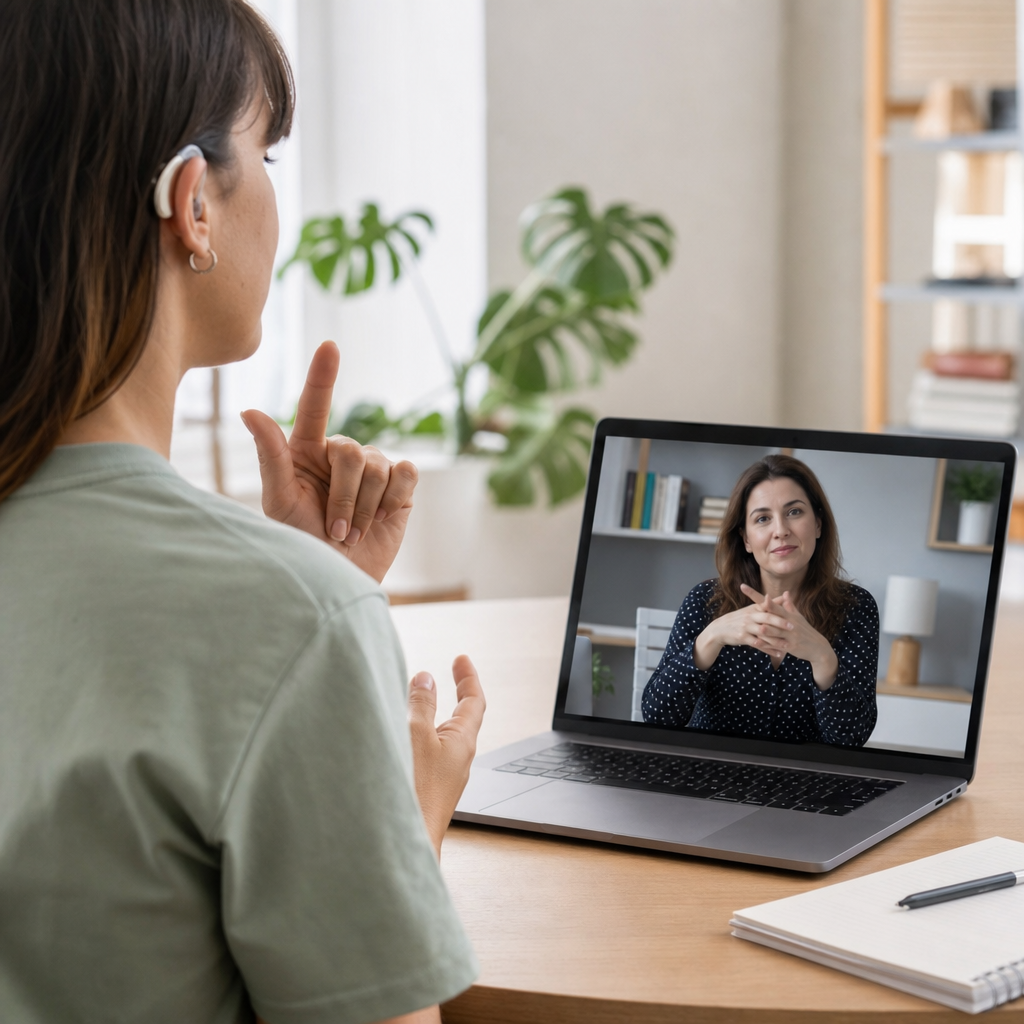
Technology now supports these strategies in practical ways. Live Transcribe on Android, Apple’s Live Captions features, CART services, Zoom captioning, relay services, and messaging platforms with video notes all extend access. None is perfect. Auto-captions can miss names, accents, and fast turn-taking, and they should not replace qualified interpreters when accuracy is essential. But in everyday social life, the right mix of tools often keeps conversations flowing and lowers the chance that small access failures become emotional distance.
| Setting | Common Barrier | Helpful Strategy | Useful Tool |
|---|---|---|---|
| Family dinner | Multiple people talking at once | Take turns and repeat side comments | Good lighting and visual seating |
| Work meeting | Fast discussion and jargon | Share agenda and notes in advance | Interpreter, CART, Zoom captions |
| Restaurant outing | Dim light and background noise | Choose quieter seating and face each other | Text for clarifying details |
| Online friendship | Distance and inconsistent contact | Schedule regular video check-ins | Video messaging apps |
Community, Identity, and Mental Health
Connection becomes more durable when it includes identity, not just interaction. Deaf culture offers language, humor, values, history, and shared norms that many Deaf people describe as deeply regulating. Being in a space where eye contact, visual attention, direct communication, and signed storytelling are understood can reduce stress immediately. That relief is not trivial. It helps people move from constant accommodation management into genuine presence. For adolescents especially, meeting Deaf adults with varied careers, families, and communication styles can expand what feels possible.
At the same time, not every Deaf person finds belonging in the same community. Some identify strongly with signing spaces; others move across Deaf, hard of hearing, oral, late-deafened, or disability communities. Mental health improves when people are allowed to build identity in a way that fits their lived experience rather than being pressured into a single model. Clinicians who work effectively with Deaf clients understand this nuance. They also screen for isolation directly because loneliness may be hidden beneath statements like “I’m fine alone” or “Group settings are too much.”
Professional support can help when isolation has become entrenched. Deaf-aware therapy, peer support, school counseling with communication access, and community health programs can address grief, social anxiety, trauma from exclusion, and relationship repair. The National Association of the Deaf, state Deaf service agencies, vocational rehabilitation programs, and local centers for independent living often connect people with resources beyond therapy alone. In my experience, the best outcomes come when emotional support and practical access planning happen together.
Building a Sustainable Social Life Over Time
Strong social connection is built through repeatable habits, not one dramatic breakthrough. A sustainable plan usually starts small: one regular group, one dependable friend, one family communication improvement, and one tool that reduces friction. From there, momentum grows. Someone might begin by attending a monthly Deaf coffee meetup, then join a volunteer committee, then reconnect with a sibling through weekly signed video calls. Each step increases familiarity, confidence, and reciprocity. The goal is not a packed social calendar. It is a network that feels reliable, accessible, and emotionally safe.
It also helps to review social health the way you would review physical health. Ask direct questions. Do I have people I can contact easily? Do conversations leave me energized or drained? Are my main relationships accessible without constant struggle? Am I included in ordinary life, not just formal events? If the answer is often no, change one condition rather than blaming yourself. Switch groups, request better access, practice clearer communication, or seek Deaf-centered spaces where less explanation is required.
Deaf individuals can build strong social connections when communication access, shared identity, and practical support come together. Isolation is not an inevitable part of being Deaf. It is a solvable problem shaped by environment, habits, and opportunity. The most effective path is clear: strengthen language access, invest in consistent communities, use technology wisely, and ask for support before loneliness becomes chronic. Start with one accessible conversation, one recurring gathering, or one family change this week. Small improvements, repeated steadily, create the kind of belonging that protects mental health and makes everyday life feel larger, warmer, and more connected.
Frequently Asked Questions
Why are strong social connections especially important for Deaf individuals?
Strong social connections are essential for everyone, but they can be especially important for Deaf individuals because connection affects far more than companionship. It influences mental health, stress levels, personal safety, self-confidence, identity development, and access to practical support in everyday life. When a Deaf person is included in conversations, community events, workplaces, and family life through accessible communication, relationships tend to feel more natural, stable, and meaningful. When access is limited, isolation can develop even in rooms full of people.
It is important to understand that deafness itself does not create loneliness. More often, disconnection grows from barriers such as poor communication access, environments built around spoken conversation, lack of sign language skills among family or peers, and social settings where Deaf people are expected to adapt constantly. Over time, these barriers can lead to exhaustion, withdrawal, and a sense of being overlooked. By contrast, when communication is clear and reciprocal, Deaf individuals are better able to participate fully, build trust, maintain friendships, and strengthen their sense of belonging.
Social connection also supports identity. Many Deaf individuals gain confidence and emotional grounding through relationships with other Deaf people, Deaf mentors, interpreters who understand boundaries and access needs, and hearing allies who communicate respectfully. These connections can validate lived experience, reduce stigma, and create spaces where communication feels effortless rather than draining. In that sense, strong social ties are not a luxury. They are a core health and quality-of-life need.
What are the biggest barriers that make it harder for Deaf people to build and maintain friendships?
The most significant barriers are usually not personal shortcomings. They are structural and social barriers rooted in hearing-centered norms. A common example is the group conversation that moves too quickly, where multiple people talk at once, turn away while speaking, or laugh before access is provided. Even when no harm is intended, the Deaf person may be left trying to piece together what happened. Repeated experiences like this can make socializing feel tiring instead of enjoyable.
Another major barrier is inconsistent communication access. Some Deaf individuals use American Sign Language or another signed language as their primary language, while others rely on speechreading, captions, written communication, assistive technology, or a combination of tools. Problems arise when friends, coworkers, schools, or community groups assume one method fits all situations. If people are unwilling to slow down, face the person directly, use visual communication strategies, or arrange interpreting and captioning when needed, relationships can remain surface-level simply because access is never reliable.
There are also emotional and cultural barriers. Deaf individuals are often expected to do the extra work of educating others, requesting accommodations, repairing awkward interactions, and pretending communication was “good enough” when it was not. That burden can lead to social fatigue. In addition, hearing people sometimes misunderstand Deaf culture, underestimate the importance of signed languages, or confuse accessibility with inconvenience. These attitudes can make Deaf individuals feel like outsiders in their own families, workplaces, or neighborhoods.
Transportation, event design, lighting, background noise, and digital accessibility can also matter more than many people realize. A poorly lit restaurant, a video call without captions, or a speaker who covers their mouth can all reduce participation. In short, the biggest obstacles are usually not about willingness to connect. They are about whether the environment allows connection to happen in a way that is clear, respectful, and sustainable.
How can Deaf individuals build stronger social connections in everyday life?
Building stronger social connections often starts with seeking environments where communication is accessible and mutual effort is expected. For many Deaf individuals, that means spending time in Deaf community spaces, sign language groups, advocacy organizations, local events, online communities, alumni networks, or hobby-based groups that welcome visual communication. These spaces can make a major difference because they reduce the constant pressure to adapt and increase the chances of forming relationships based on ease, shared experience, and trust.
It can also help to be intentional about communication preferences. Telling new friends, coworkers, neighbors, or family members what works best, whether that is signing, facing you while speaking, texting instead of calling, using captions, or taking turns in group discussions, can make social interactions more successful from the beginning. While it should not always be the Deaf person’s job to educate everyone, clear communication preferences often give supportive people the information they need to engage better.
Consistency matters as much as outreach. Strong relationships usually grow through repeated contact, small acts of reliability, and shared routines. Joining the same class each week, attending recurring Deaf events, volunteering, participating in community organizations, or setting regular meetups with friends can turn casual contact into deeper connection. Online spaces can support this too, especially for Deaf individuals in rural areas or places with limited local Deaf communities. Video-based platforms, group chats, and Deaf-centered social networks can create genuine friendship when used intentionally.
Equally important is protecting energy. Not every social space is worth the effort if access is poor and the burden always falls on one person. Strong connection is more likely when relationships are reciprocal, not one-sided. Deaf individuals often benefit from investing more time in people who show curiosity, patience, and follow-through. A smaller circle of truly accessible, respectful relationships is often healthier than a larger social network built on constant misunderstanding.
What can hearing friends and family do to better support Deaf loved ones socially?
The most helpful thing hearing friends and family can do is stop treating communication access as optional. Inclusion is not simply inviting a Deaf person into the room. It means making sure they can fully participate once they are there. That may involve learning sign language, using clear visual communication, facing the person when speaking, reducing background noise, ensuring good lighting, using captions, repeating missed comments, and being mindful in group conversations. Small adjustments often have a large impact when they are done consistently.
Hearing loved ones should also take initiative rather than waiting to be told what to do every time. Many Deaf people spend years asking for the same accommodations repeatedly, which can be exhausting and discouraging. Family members and friends who proactively ask, “What will make this gathering easier?” or “How can we make sure everyone is included?” help remove that burden. Better yet, they build accessible habits before problems arise. For example, choosing captioned media, arranging seating in a circle, or summarizing side conversations can make social time more natural and less stressful.
Learning about Deaf culture is equally important. Deafness is not just a medical condition; for many people, it is also a cultural and linguistic identity. Hearing relatives who respect signed languages, understand community values, and recognize the difference between access and charity tend to build stronger, more trusting relationships. Support should not come from pity. It should come from respect, partnership, and the understanding that communication is a shared responsibility.
Finally, hearing allies should notice whether the Deaf person is actually included, not just physically present. If conversations move too fast, if jokes are not interpreted, if plans are changed by phone without follow-up text, or if key information is missed, exclusion is still happening. Real support means paying attention, making adjustments, and staying committed over time. That consistency is what turns good intentions into genuine social connection.
Can technology and community resources help Deaf individuals strengthen their social lives?
Yes, and for many Deaf individuals, technology and community resources are central to building and maintaining connection. Captioning tools, video relay services, messaging apps, video platforms, visual alert systems, social media groups, and accessible event platforms can all make communication easier and more immediate. Technology is especially valuable when distance, transportation, work schedules, or limited local Deaf population make in-person community harder to sustain. A well-captioned video call or an active group chat can help friendships continue between meetings and prevent social isolation from deepening.
Community resources also play a major role. Deaf centers, advocacy organizations, sign language classes, peer support groups, alumni associations, disability resource offices, faith communities with interpreting access, and local cultural events can provide structured opportunities to meet people and develop lasting relationships. These spaces are often more than social outlets. They can become places where Deaf individuals exchange information, build leadership skills, find mentors, and feel understood without having to explain basic access needs over and over again.
That said, technology works best when it supports meaningful communication rather than replacing it entirely. Automatic captions can help, but they are not always accurate. Video calls are useful, but they still require good lighting, strong internet, and platforms that support visual communication. In-person interaction, when accessible, often allows for richer conversation and stronger community ties. The ideal approach is usually a mix: using technology to stay connected and using community resources to deepen belonging.
For Deaf individuals who feel isolated, starting with one accessible tool or one trusted community resource can be enough to begin changing that pattern. A single online Deaf community, local meetup, or peer-led organization can open the door to friendship, support, and a stronger sense of place. Connection often grows step by step, especially when the tools and environments are designed with access in mind.