
Effective communication with a deaf person starts with one principle: make meaning accessible without guessing, rushing, or treating deafness as a barrier to respect. In practical terms, that means choosing communication methods that fit the person, the setting, and the goal of the conversation. Some deaf people use sign language as their first language. Others rely on lipreading, captioning, hearing aids, cochlear implants, speech, text, or a mix of methods that changes throughout the day. I have worked in classrooms, meetings, clinics, and public service settings where small adjustments completely changed whether a deaf person could participate or was left out. The difference was rarely goodwill alone. It was preparation, clarity, and knowing which method to use. This article explains the main communication methods, when each works best, and how to avoid the mistakes that most often break understanding.
The term deaf person includes people with different hearing levels, language backgrounds, and identities. Some identify culturally as Deaf and use a national sign language such as American Sign Language, British Sign Language, or Auslan. Others identify as hard of hearing and prefer spoken communication supported by technology. Communication methods are the tools and practices used to exchange information clearly: sign language, interpreters, speechreading, writing, gestures, captioning, relay services, assistive listening systems, and digital messaging. Understanding these methods matters because communication access affects education, healthcare, employment, safety, and relationships. A missed medication instruction, a confused interview question, or an inaccessible team meeting has real consequences. The good news is that effective communication is learnable. You do not need fluency in sign language to communicate respectfully, but you do need attention, patience, and the willingness to ask what works best.
Start by asking the person’s preferred communication method
The fastest way to improve communication is to ask, directly and politely, “What is the best way for us to communicate?” That question prevents assumptions. Many hearing people assume all deaf people lipread. In reality, lipreading is difficult and incomplete. Even skilled speechreaders may catch only part of what is said because many sounds look identical on the lips. Others assume every deaf person signs, but sign language use varies by upbringing, education, community, and country. Preference can also depend on context. A deaf employee might prefer email for complex instructions, an interpreter for training, and captioned video for company updates.
When I plan accessible communication, I look at four factors first: language, environment, complexity, and urgency. Language means whether the person prefers sign language, spoken language, or text. Environment means lighting, background noise, distance, and visibility. Complexity asks whether the topic is simple, like confirming a time, or detailed, like legal or medical information. Urgency matters because a quick text may work for logistics, while an emergency may require visual alerts, plain language, and confirmation of understanding. Asking preference is not a formality. It is the basis of accurate communication.
Use sign language when it is the person’s primary language
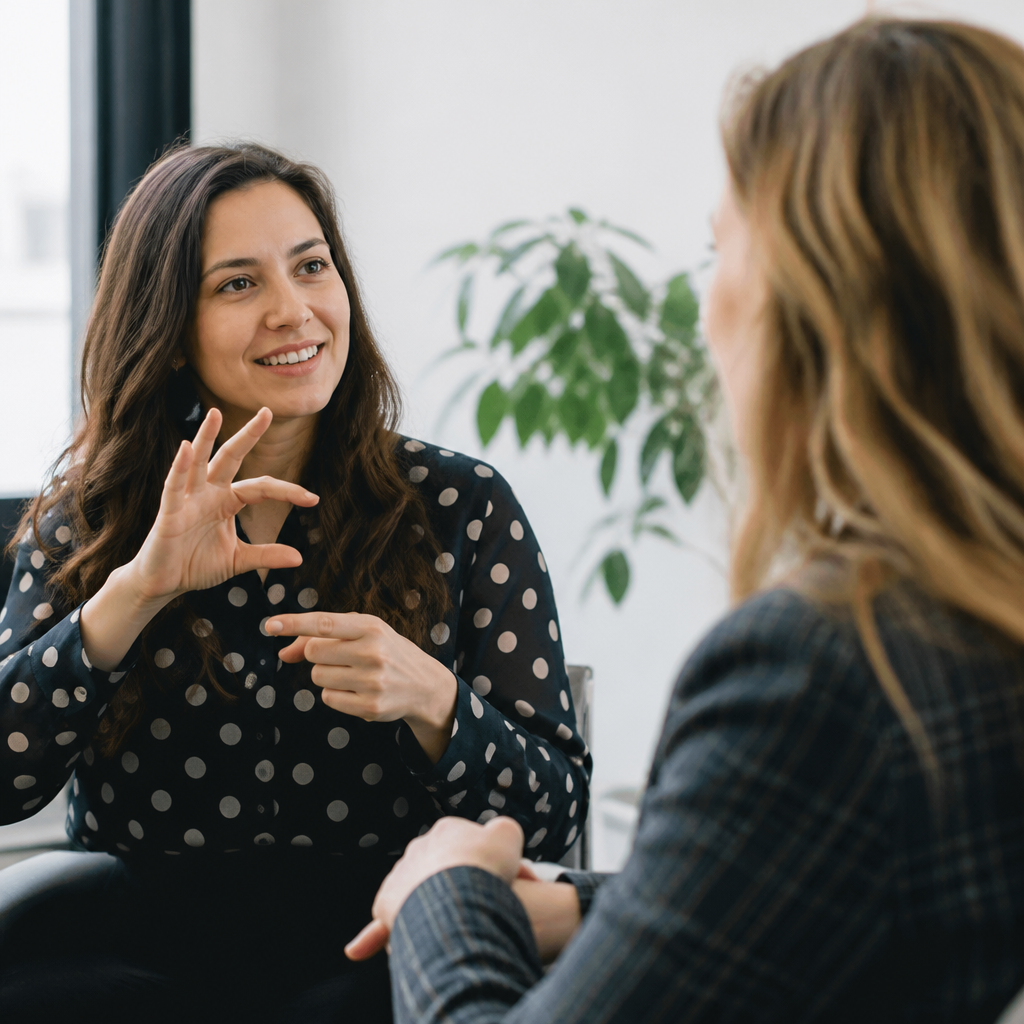
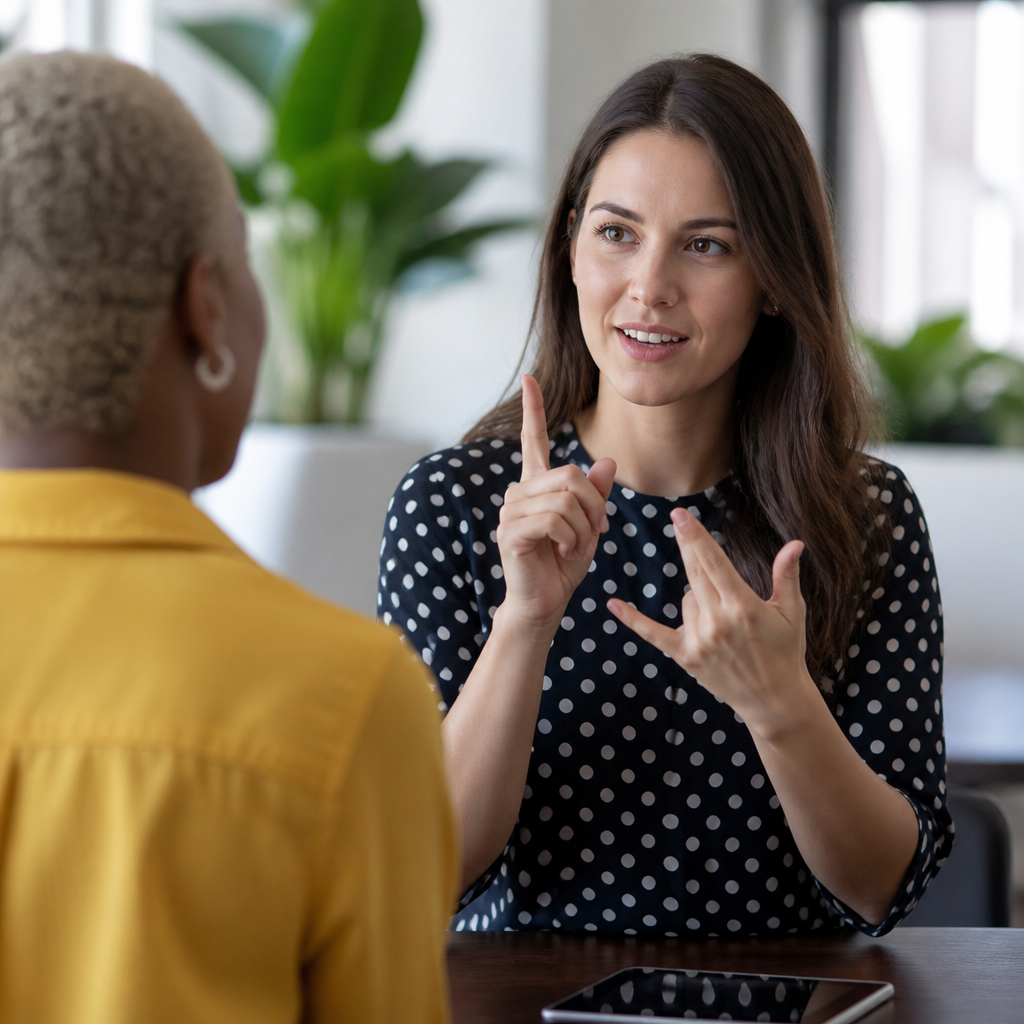
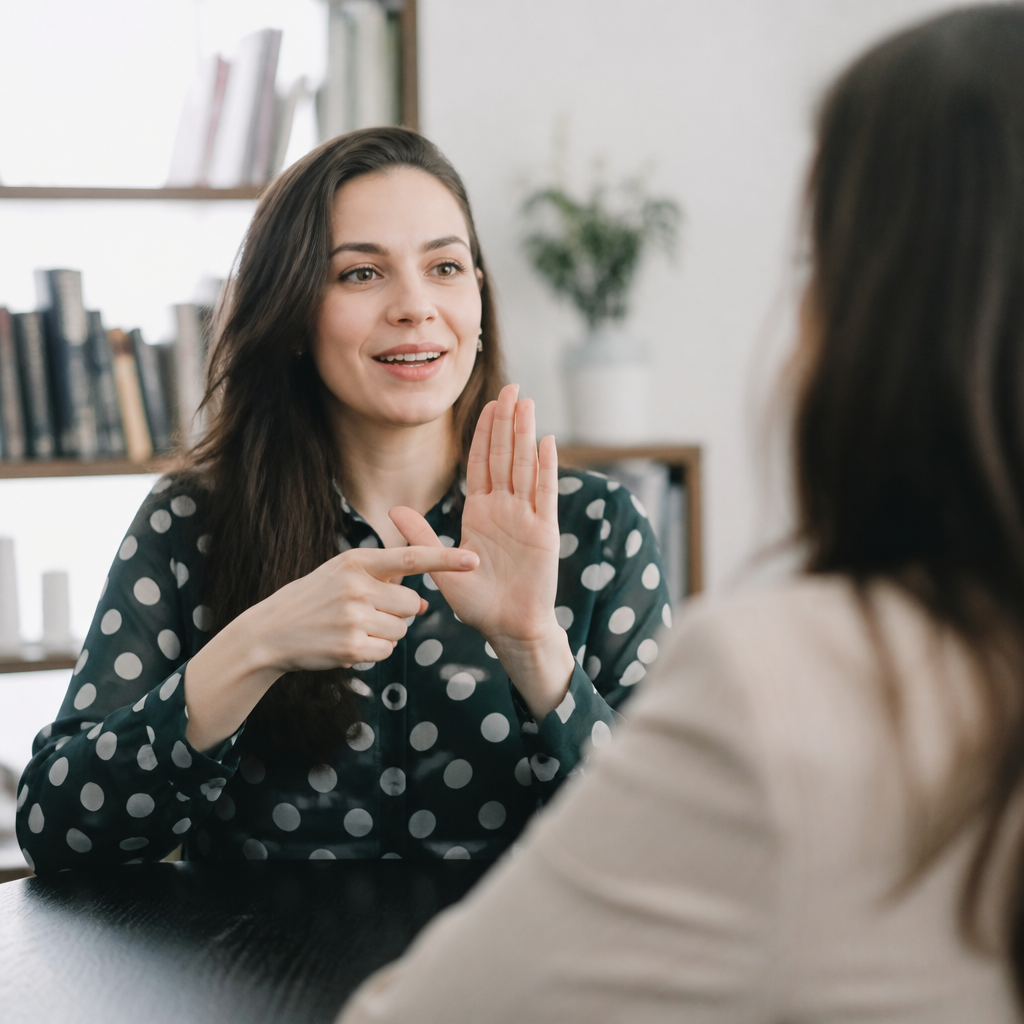
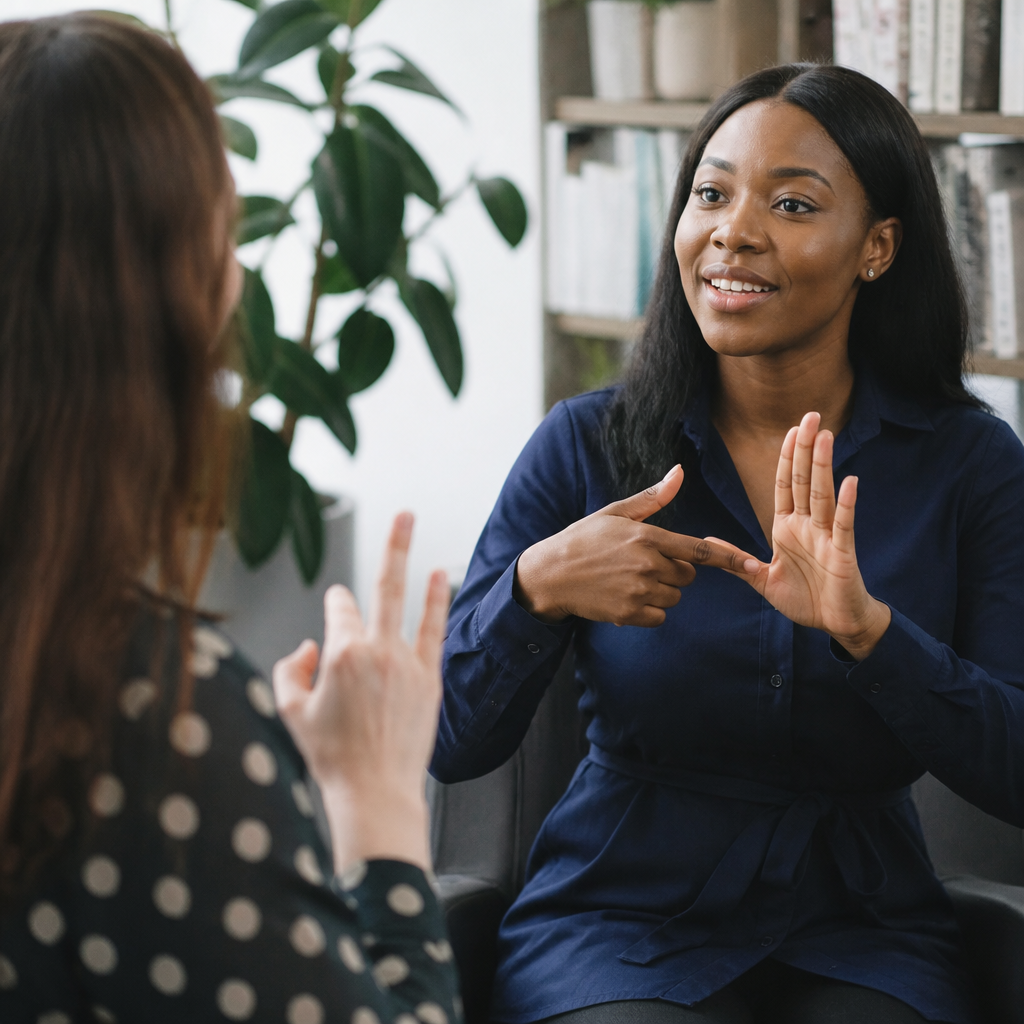
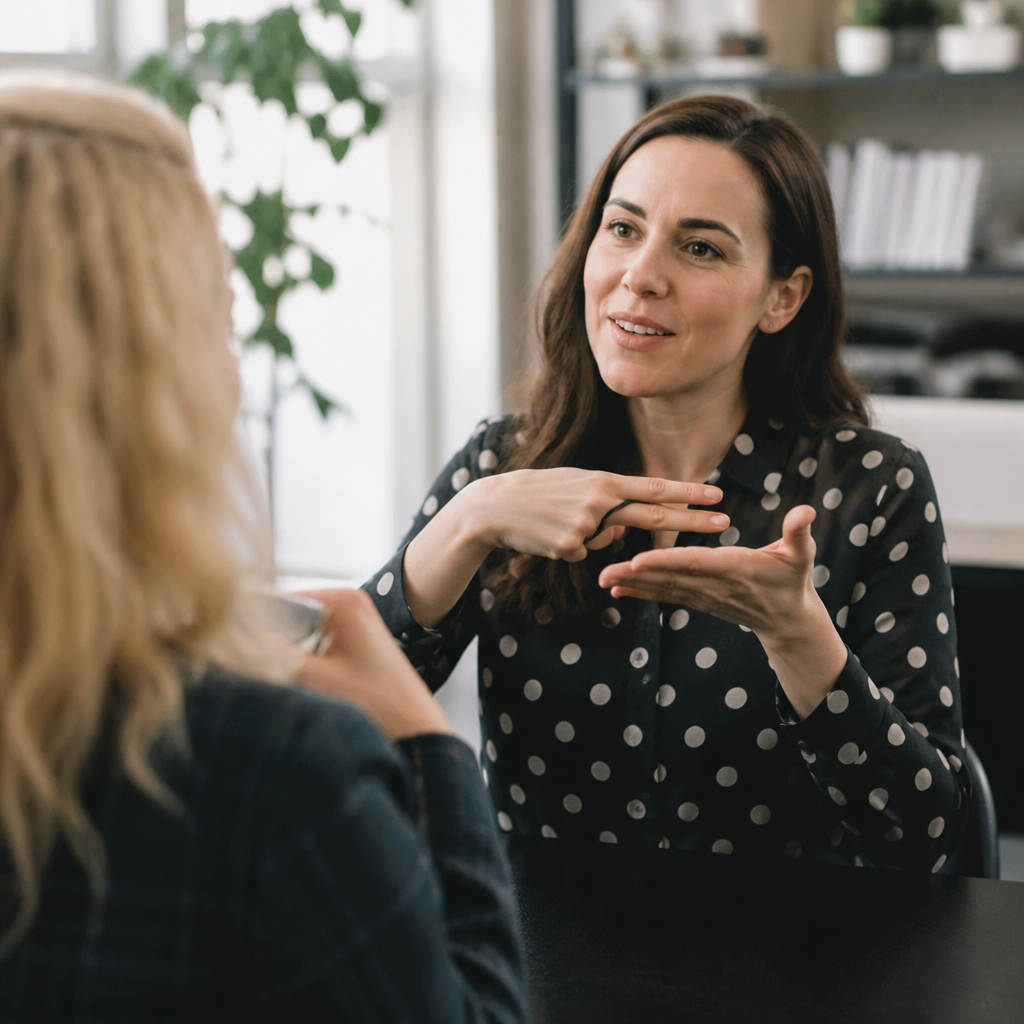
For many Deaf people, sign language is the most complete and natural way to communicate. Sign languages are full languages with their own grammar, syntax, and cultural context. American Sign Language is not signed English; British Sign Language is different from both ASL and spoken English; many countries have their own sign languages. If the deaf person signs and you sign fluently, face them directly, keep your hands visible, and sign at a natural pace. Good signing depends on visual access, so avoid standing in shadow, turning away, or blocking your face.
If you do not sign fluently, use what you know honestly and do not pretend to understand. For simple exchanges, basic signs, fingerspelling, gestures, and written support may be enough. For important conversations, use a qualified sign language interpreter. This matters in workplaces, schools, medical appointments, government services, court settings, and training sessions where details must be accurate. Professional interpreters follow standards of confidentiality and message accuracy. In the United States, interpreter quality is often assessed through credentials linked to the Registry of Interpreters for the Deaf, while many countries maintain their own certification systems. Family members should not be used as interpreters for sensitive or high-stakes communication except in true emergencies, because they may filter, omit, or misunderstand information.
Know when lipreading and spoken communication can help
Lipreading, also called speechreading, can support communication, but it should never be treated as a complete solution. Only part of spoken English is visible on the lips, and facial hair, accents, fast speech, masks, poor lighting, and looking down at notes all reduce accuracy. If a deaf person uses lipreading, speak clearly at a normal pace, face them, and keep your mouth visible. Do not exaggerate mouth movements or shout. Over-enunciation distorts speech patterns and often makes lipreading harder. Shouting changes the shape of words and can feel patronizing.
Plain language improves understanding. Use short sentences, one topic at a time, and direct phrasing. Instead of saying, “We’re sort of looking at maybe moving things around later if everyone’s available,” say, “The meeting moved to 3 p.m. today.” Confirm key details such as dates, names, addresses, dosage, or next steps. In healthcare and customer service, I always write down proper nouns and numbers because those are the items most often missed. If the person uses hearing aids or cochlear implants, remember that these tools assist hearing but do not restore typical hearing. Background noise, reverberation, and group conversations can still make spoken communication difficult.
Written communication, texting, and speech-to-text are often the most efficient option
Writing is one of the most dependable communication methods because it creates a visible record and reduces ambiguity. Pen and paper still work well for quick exchanges, but phones, tablets, live chat, and shared documents are often faster. Texting is ideal for appointments, directions, product questions, and follow-up notes. In offices and classrooms, real-time collaborative tools such as Google Docs, Microsoft Teams chat, Slack, and Zoom chat can make back-and-forth communication immediate without interrupting the flow of a meeting.
Automatic speech recognition has made speech-to-text far more useful than it was a few years ago. Apps such as Live Transcribe on Android, built-in captioning tools on smartphones, Otter, Microsoft Teams live captions, Google Meet captions, and Zoom captions can turn spoken language into readable text in real time. These tools work best in quieter spaces with one speaker at a time. They are less reliable with technical vocabulary, overlapping talk, strong accents, or unstable internet connections. For high-stakes communication, especially medical, legal, or educational content, automated captions should be checked and supplemented by a human service when accuracy is critical.
| Method | Best use case | Main advantage | Limitation |
|---|---|---|---|
| Sign language | Detailed conversations with signers | Full language access | Requires shared language or interpreter |
| Lipreading and speech | Short face-to-face exchanges | Fast when conditions are good | Often incomplete and tiring |
| Writing or texting | Instructions, logistics, follow-up | Clear record of information | Can be slow for long discussions |
| Live captions | Meetings, classes, presentations | Scales well in groups | Accuracy varies by audio quality |
| Interpreter | Complex or high-stakes communication | High accuracy for sign users | Requires scheduling and cost planning |
Set up the environment so visual communication can work
Communication breaks down most often because the environment is wrong, not because the people are uncooperative. Deaf communication is highly visual. Good lighting should be in front of your face, not behind you. Reduce visual clutter if the person is signing or lipreading. Limit background noise if they use residual hearing, hearing aids, or cochlear implants. In meetings, seat participants in a circle or U-shape where faces are visible. In classrooms, ensure the teacher, board, slides, and interpreter can all be seen without constant head-turning. In video calls, use a stable camera, frame the upper body for signing, keep your mouth visible, and turn on captions.
Turn-taking matters in groups. One person should speak at a time, and topic changes should be signposted clearly. If someone asks a question from the back of the room, repeat or paraphrase it before answering. That practice helps everyone, not only deaf participants. In public spaces, visual alerts are essential. Flashing alarms, captioned announcements, digital queue systems, and display boards support independent access. The built environment shapes communication more than most hearing people realize.
Work effectively with interpreters, captioners, and relay services
Communication support professionals make access possible, but only when hearing participants know how to work with them. If an interpreter is present, speak to the deaf person, not to the interpreter. Say, “What do you think about this plan?” rather than, “Ask her what she thinks.” Maintain natural eye contact with the deaf person. Provide interpreters or captioners with agendas, slides, names, and technical terms in advance so they can prepare accurate equivalents. Preparation improves quality dramatically in specialized fields such as engineering, law, and medicine.
For phone communication, relay services can bridge spoken and signed or typed communication. Video relay services connect a deaf sign language user with an interpreter via video, who then voices to the hearing caller and signs the response back. Text relay and captioned telephone services support people who prefer typed or captioned calls. These services are essential for booking appointments, contacting government offices, handling customer support, and reaching emergency or after-hours services where email is too slow. Staff should be trained not to hang up when a relay operator announces the call.
Avoid the common mistakes that create confusion or exclusion
Most communication failures follow predictable patterns. People start talking before getting the deaf person’s attention. They cover their mouth, turn to a screen, walk away while speaking, or continue talking from another room. They say “never mind” instead of repeating information, which signals that access is optional. They rely on one method for every situation even when it is failing. They forget to summarize decisions in writing after a meeting. They schedule training without captions or an interpreter and then act surprised when participation drops.
The fix is practical. Get attention first with a wave, light tap on the shoulder, or visual cue. Face the person before you speak. Rephrase rather than simply repeat if something is missed. Use multimodal communication: speech plus writing, signing plus visual aids, captions plus slides. Confirm understanding without being patronizing. Ask, “Do you want me to write that down?” or “Would captions help for this part?” In my experience, the most effective communicators are flexible. They adjust quickly, do not take correction personally, and treat access as part of basic professionalism.
Build long-term communication habits at home, work, school, and in public services
Effective communication with a deaf person is not a one-time technique. It is a system of habits. At home, that can mean facing each other before speaking, keeping rooms well lit, using shared calendars, and agreeing on visual alerts for doorbells, alarms, and baby monitors. At work, it means captioned meetings, accessible onboarding, interpreter booking procedures, and written follow-ups for action items. In schools, it means early language access, teacher training, note-taking support, and audiovisual materials that are always captioned. In healthcare, it means documenting a patient’s preferred communication method, arranging qualified interpreters, and never substituting convenience for comprehension.
The core rule is simple: use the method that gives the deaf person direct, reliable access to the full message. Ask what works best, adapt the environment, choose the right tools, and confirm understanding. Sign language, lipreading, writing, captions, interpreters, and relay services each have a place. None is universally best, and assumptions cause most problems. When communication is planned well, conversations become faster, safer, and more respectful for everyone involved. Review your current habits, identify one setting you can improve today, and make access part of how you communicate every time.
Frequently Asked Questions
What is the best way to start a conversation with a deaf person?
The best way to start is respectfully and clearly, without making assumptions about how the person prefers to communicate. First, get their attention in a polite visual or physical way, such as a gentle tap on the shoulder, a small wave, or by moving into their line of sight. Once you have their attention, speak or sign naturally and make it easy for them to see your face. Good lighting, a calm environment, and direct eye contact can make a major difference, especially for someone who uses lipreading, facial expressions, or visual cues to follow the conversation.
Just as important, ask what communication method works best for them. Some deaf people prefer sign language, while others may prefer speech, text on a phone, live captions, writing notes, or a combination of methods. There is no single “correct” approach that fits everyone. Effective communication starts when you let the deaf person guide the method instead of guessing based on appearance, speech, or whether they use hearing technology. That small step shows respect and often makes the entire interaction smoother, faster, and less stressful for everyone involved.
Should I speak normally, more slowly, or louder when talking to a deaf person?
In most cases, you should speak normally, clearly, and at a natural pace rather than shouting or exaggerating your mouth movements. Speaking louder does not automatically make speech easier to understand, and for many deaf or hard of hearing people, volume is not the main issue. Distorted speech, overly dramatic lip movements, or rapid talking can actually make comprehension harder. A clear speaking rhythm, straightforward wording, and visible facial expressions are usually far more helpful than increased loudness.
If the person uses lipreading, it helps to face them directly, keep your mouth visible, and avoid covering your face with your hands, food, masks without clear panels, or objects. Good communication also means reducing background noise and competing distractions when possible. If something is not understood, try rephrasing instead of simply repeating the same words more loudly. For example, if “The meeting was moved to noon” is missed, “We will meet at 12 o’clock instead” may be easier to understand. The goal is not to force one method of communication, but to make meaning accessible in the way that works best for that individual.
What if I do not know sign language?
You do not need to know sign language to communicate respectfully and effectively with a deaf person, although learning even a few basic signs can be helpful and appreciated. If you do not share a signed language, there are still many practical ways to communicate well. You can use written notes, text messages, speech-to-text apps, live captioning tools, gestures, visual aids, and simple, direct language. The key is to stay patient, flexible, and focused on mutual understanding rather than becoming embarrassed or giving up too quickly.
It is also important not to treat the lack of shared sign language as a reason to exclude the deaf person from the conversation. In group settings, that might mean typing key points, using captions during video calls, or pausing to ensure important information is understood. For more complex situations, such as medical appointments, legal meetings, workplace training, or school discussions, a qualified sign language interpreter or communication professional may be necessary. That is not a special favor; it is often an essential access support. Effective communication is less about perfect fluency and more about making the effort to use tools and methods that allow the deaf person full participation.
Are lipreading and hearing devices enough for communication?
No, not always. Lipreading can be useful, but it is often misunderstood as being far more complete or accurate than it actually is. Only part of spoken language is visible on the lips, and many sounds look similar or identical when spoken. Lighting, facial hair, accents, speed, head movement, and context all affect how much can be understood. Even a skilled lipreader may miss significant information, especially in long, technical, emotional, or fast-moving conversations. That is why lipreading should be seen as one possible support, not a complete solution.
The same is true of hearing aids and cochlear implants. These tools can improve access to sound for some people, but they do not “fix” deafness or guarantee effortless communication. People use hearing technology in very different ways, and the benefit can vary depending on environment, fatigue, background noise, device settings, and the type of conversation. A deaf person may hear some sounds clearly, some partially, and others not at all. The most effective approach is not to assume what a device allows them to understand, but to ask and adapt. Combining clear speech, visual access, captioning, writing, sign language, or other supports often leads to much better communication than relying on one method alone.
What are the most important etiquette tips when communicating with a deaf person in everyday situations?
The most important etiquette principle is simple: communicate directly and respectfully. Speak to the deaf person, not only to their interpreter, companion, friend, or family member. If an interpreter is present, maintain eye contact with the deaf person and treat them as the person you are actually addressing. In everyday settings, be mindful of whether they can see you before you begin speaking, and avoid talking while turning away, walking off, or looking down at your phone. These small habits make conversations much easier to follow and show that you value the other person’s full participation.
It also helps to be patient if communication needs to be repeated, clarified, or shifted to another method. Do not pretend to understand if you do not. Likewise, do not assume a deaf person understood everything if they nodded once or smiled politely. Check for understanding when the information matters. In group conversations, take turns speaking, identify topic changes clearly, and avoid multiple people talking at once. In digital spaces, use captions for video content whenever possible. Most importantly, avoid framing deafness as a problem to overcome. The real goal is access, inclusion, and mutual understanding. When you approach communication with openness and flexibility, you create a far better interaction than any one technique can provide on its own.