
Choosing the right communication method affects how clearly you share ideas, how quickly you solve problems, and how included every participant feels. In workplaces, classrooms, healthcare settings, and families, communication methods are not interchangeable tools; each one carries different strengths, limits, accessibility needs, and social cues. When I help teams improve communication systems, the first mistake I see is assuming one channel works for every message. It never does. A quick text can confirm a pickup time, but it cannot replace a nuanced conversation about medical consent, conflict at work, or a child’s language development. The right choice depends on purpose, audience, urgency, privacy, literacy, language access, and whether communication is spoken, signed, written, visual, or technology assisted.
In the broad field of sign language and communication, “communication methods” refers to the ways people send, receive, and clarify meaning. That includes face-to-face speech, sign languages such as American Sign Language, lip reading support, written messages, gestures, visual symbols, interpreters, captioning, video relay, communication boards, speech-generating devices, email, chat, phone calls, and video meetings. It also includes multimodal communication, where people combine methods to improve understanding. A Deaf employee might prefer direct signing in person, use captioned video for meetings, and rely on email for documentation. An autistic student may communicate best with speech plus a visual schedule. A stroke survivor might use a tablet-based augmentative and alternative communication system during rehabilitation and texting with family at home.
This topic matters because communication barriers create real costs. They delay care, damage relationships, reduce educational outcomes, and shut people out of decisions that affect them. The World Health Organization and national public health agencies consistently show that inaccessible communication contributes to poorer health experiences for Deaf and disabled people. In business, weak channel selection wastes time through missed context, duplicated work, and preventable errors. In personal life, the wrong method can make someone feel ignored, pressured, or misunderstood. A strong communication strategy starts with matching the method to the need, then adapting when conditions change. This hub article explains the main communication methods, when each works best, where each falls short, and how to build a practical system that supports clarity, accessibility, and trust across settings.
What communication methods include and how they differ
Communication methods can be grouped into several categories: spoken communication, signed communication, written communication, visual communication, and aided communication using technology or physical tools. Spoken communication includes face-to-face conversation, phone calls, voice notes, and meetings. Signed communication includes natural sign languages, manually coded systems, and tactile signing for DeafBlind users. Written communication covers email, text messages, reports, notes, and live chat. Visual communication includes symbols, pictures, infographics, facial expression, body language, and environmental cues like signage. Aided communication includes low-tech options such as picture exchange boards and high-tech options such as speech-generating devices, communication apps, captioning platforms, and video relay services.
The key difference between methods is not only format but cognitive and practical demand. A phone call requires hearing access, attention in real time, and comfort responding immediately. Email supports detail and recordkeeping, but response time may be slow. Sign language provides rich grammar and direct human connection for many Deaf signers, but only if others sign or qualified interpreters are available. Captioning helps in meetings, but automatic captions still miss names, jargon, and overlapping speech. Gesture and facial expression add meaning, but they are not substitutes for a full language when complex ideas must be exchanged. Effective communication planning begins by recognizing these demands instead of treating communication as a single generic skill.
How to choose the right method for a specific need
The most reliable way to choose a communication method is to assess six factors: message complexity, urgency, audience preference, accessibility, privacy, and documentation needs. Complex topics usually require richer channels. If a manager needs to discuss performance feedback, a live meeting with follow-up notes is stronger than a text. If a clinic needs a patient’s informed consent, the method must be accessible, interactive, and accurate enough for questions and confirmation. Urgent issues favor immediate channels such as direct conversation, phone, video, or instant messaging, but urgency never overrides accessibility. A Deaf patient should not be pushed into a voice call because staff failed to arrange interpreting or caption support.
Audience preference is equally important. People engage better when they can use their strongest language and most comfortable format. In my work, communication breakdowns often disappear when organizations simply ask, “How do you prefer to communicate?” Privacy also matters. Sensitive legal, medical, financial, or human resources discussions should happen in secure channels with clear records of decisions. Documentation needs can turn a verbal exchange into a mixed-method process: discuss live, then summarize in writing. That pattern reduces ambiguity and supports accountability. The strongest communication method is often not one method at all, but a sequence chosen deliberately.
Comparing common communication methods in everyday settings
Different methods fit different tasks. The comparison below reflects patterns I have seen repeatedly in workplace audits, training sessions, and accessibility planning. No option is universally best. The right choice depends on the people involved and the setting.
| Method | Best use | Main strengths | Main limitations |
|---|---|---|---|
| Face-to-face conversation | Complex discussion, relationship building, conflict resolution | Immediate feedback, nonverbal cues, faster clarification | Requires scheduling, may exclude Deaf or disabled participants without access support |
| Phone call | Urgent updates, quick decisions | Fast, personal, convenient when mobile | No visual cues, inaccessible for many Deaf and hard of hearing users, weak recordkeeping |
| Documentation, detailed instructions, formal communication | Searchable record, scalable, attachments supported | Can be slow, overloaded inboxes reduce response quality | |
| Text or chat | Short updates, coordination, reminders | Fast, low effort, widely used | Tone is easy to misread, poor for nuance or long decisions |
| Sign language | Primary communication for many Deaf signers | Full natural language, direct, culturally appropriate | Requires shared signing skill or interpreting access |
| Video meeting with captions or interpreter | Remote collaboration, telehealth, distributed teams | Visual access, broader participation, screen sharing | Dependent on bandwidth, platform quality, and access setup |
| AAC device or app | Communication support for nonspeaking or speech-limited users | Promotes independence, customizable vocabulary | Requires setup, training, and partner patience |
In practical terms, a school might use teacher speech plus visual supports for class routines, sign language interpretation for assemblies, and email for parent documentation. A hospital may rely on plain-language written instructions, qualified interpreters, and bedside communication boards. A distributed company may reserve chat for logistics, video for brainstorming, and project software for task history. The method should fit the work rather than forcing people to fit the channel.
Sign language, interpreting, and communication access
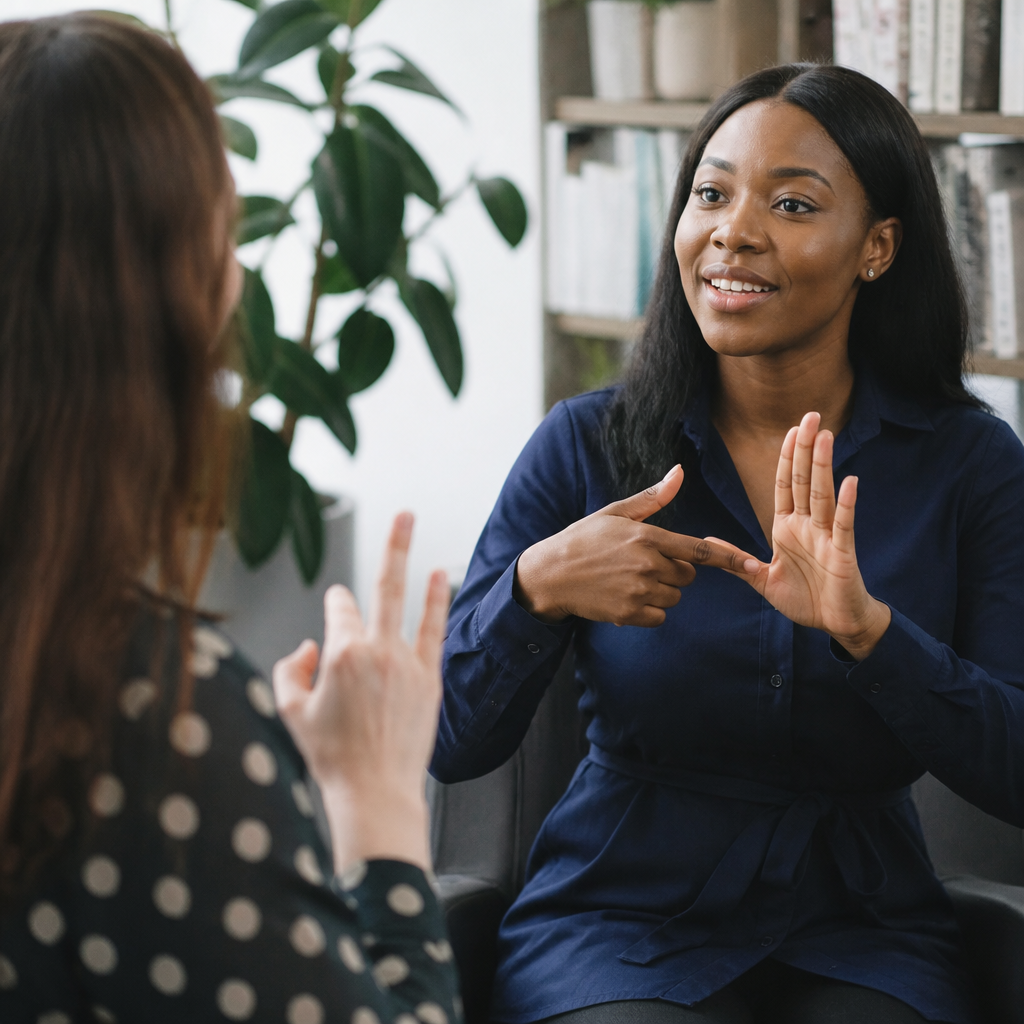
Within sign language and communication, one of the most important distinctions is between knowing that a Deaf person “uses sign” and understanding what meaningful access actually requires. Sign languages are complete natural languages with their own grammar, not visual versions of spoken English. American Sign Language, British Sign Language, and Auslan are separate languages. Assuming written English is an equal replacement for signed communication is a common and serious error, especially in education, healthcare, and employment. For many Deaf signers, direct communication in sign language is the clearest, fastest, and most respectful method available.
When direct signing is not possible, qualified interpreters are often essential. Qualified means more than conversational signing ability. It means the interpreter can accurately convey register, terminology, turn-taking, and cultural nuance in the setting involved. Medical, legal, and academic environments carry specialized vocabulary and higher consequences for mistakes. Remote interpreting can work well when scheduled properly and supported by good camera placement, lighting, and stable internet. Captioning can complement interpreting, especially in group meetings, but it does not replace sign language for users whose strongest language is signed. Effective access planning asks the Deaf person which supports they prefer and builds from that answer.
Written, digital, and asynchronous communication
Written communication is often the backbone of modern coordination because it creates a record. Email, messaging platforms, shared documents, ticketing systems, and project tools such as Slack, Microsoft Teams, Asana, Trello, and Jira allow teams to document decisions, assign tasks, and review history. Asynchronous communication is especially valuable across time zones or for people who process information better with time to reflect. It reduces pressure for immediate response and gives users space to translate, caption, review, or compose carefully.
Still, written communication has limits. Literacy levels vary. Long paragraphs discourage response. Ambiguous wording travels far before anyone notices the problem. In accessibility reviews, I often find organizations overusing chat for decisions that belong in a fuller format. The fix is straightforward: use clear subject lines, short paragraphs, bullet-like structure within prose, concrete deadlines, and plain language. For Deaf and hard of hearing users, written channels may be highly effective, but that depends on language background and context. For AAC users, written chat can be excellent because it reduces time pressure. For everyone, written communication works best when expectations are explicit: who responds, by when, and where final decisions are stored.
Communication methods for accessibility, disability, and inclusion
Accessible communication is not a special add-on; it is part of competent practice. People communicate in different ways because of hearing level, vision, speech differences, language background, neurodiversity, mobility, age, or temporary conditions such as injury and fatigue. Inclusive systems provide options. A Deaf participant may need sign language interpreting or live captions. A blind user may need screen-reader-compatible documents instead of image-based PDFs. A person with aphasia may benefit from extra processing time, supported conversation techniques, and key words in writing. A nonspeaking person may use an AAC device that partners must wait for respectfully.
Standards and laws vary by country, but the core principle is consistent: the burden should not fall on the individual to overcome a preventable barrier. Universal design improves outcomes for everyone. Captions help viewers in noisy spaces, plain language helps nonexperts, visual agendas improve meeting focus, and written summaries reduce disputes. Inclusion also requires training communication partners. A brilliant device or platform fails if staff interrupt AAC users, ignore interpreters’ line-of-sight needs, or keep talking while captions lag behind. The right method is the one that preserves meaning, autonomy, and participation for the person using it.
Building a practical communication system that works
The best communication method for your needs usually emerges from a system, not a single preference. Start by mapping recurring situations: urgent alerts, routine updates, sensitive conversations, collaborative planning, customer support, teaching, and formal documentation. Assign a primary method and a backup for each. For example, a clinic may use patient portal messages for routine questions, video visits with captions for remote follow-up, interpreters for complex appointments, and written after-visit summaries in plain language. A family with a Deaf child may use sign at home, text for school coordination, and visual schedules for routines. A manager may set team norms that chat is for quick coordination, email is for final approvals, and video meetings are for discussion that needs live clarification.
Review your system regularly. Measure response time, error rates, participation, and user satisfaction. Ask where misunderstandings happen and who is being excluded. Test accessibility before a high-stakes event, not during it. Keep equipment charged, interpreter bookings confirmed, and documents readable on mobile devices and assistive technology. Most importantly, ask people what works for them and believe the answer. Choosing the right communication method is not about chasing the newest tool. It is about matching message, medium, and human need with care. If you treat this page as your starting hub, use it to audit your current habits, identify gaps, and build communication choices that are clearer, more inclusive, and more effective every day.
Frequently Asked Questions
How do I choose the best communication method for a specific situation?
The best communication method depends on three things: the complexity of the message, the urgency of the situation, and the needs of the people involved. Start by asking whether the topic is simple or nuanced. A short scheduling update may work well in a text or email, while a sensitive performance discussion, medical explanation, or classroom concern usually deserves a phone call, video meeting, or in-person conversation where tone, body language, and immediate clarification are possible. If the issue is urgent, real-time channels such as phone calls, live chat, or face-to-face conversations are usually more effective than email, which may sit unread for hours. If the information needs a record, such as instructions, decisions, or follow-up tasks, written communication is often essential even if the first conversation happened verbally.
Just as important, consider accessibility and comfort. Some people process information better in writing. Others need visual cues, captioning, assistive technology compatibility, translation support, or extra time to respond. In workplaces, classrooms, healthcare settings, and families, communication works best when the method matches both the message and the audience. That is why one channel never works for everything. A quick text may be efficient for a reminder, but it can create confusion if used for emotionally loaded, detailed, or collaborative topics. Choosing well means thinking beyond convenience and focusing on clarity, inclusion, and outcome.
When is written communication better than speaking in person or on a call?
Written communication is better when accuracy, documentation, consistency, or flexibility matters most. Email, shared documents, messaging platforms, and patient or student portals are useful when people need time to review information, refer back to details, or respond on different schedules. Written communication is especially effective for instructions, summaries, policies, timelines, meeting notes, and decisions that should not rely on memory alone. In professional settings, it reduces the risk of disagreements about what was said. In education, it helps students revisit expectations and assignments. In healthcare, written instructions can improve understanding after a verbal explanation, particularly when someone is stressed or overwhelmed.
That said, written communication has limits. It often strips away tone, facial expression, and immediate feedback, which means a message can sound colder, harsher, or more confusing than intended. It is also easier to overload people with too much detail or unclear structure. A strong rule is this: use writing to preserve information, but do not assume writing alone is enough for emotionally sensitive, high-stakes, or complex issues. Often the most effective approach is layered communication: discuss the issue live, then send a written summary. That combination improves understanding, creates accountability, and supports people who need time to process what was discussed.
Why does the same message work well in one format but fail in another?
Every communication method carries its own strengths, weaknesses, and social cues. A message that succeeds in one channel may fail in another because the channel changes how people interpret meaning. In person, people rely on eye contact, posture, pauses, and facial expression to understand intent. On a phone call, tone of voice carries more weight. In a text message, there may be no tone cues at all, so brevity can feel efficient to one person and dismissive to another. A collaborative discussion that feels natural in a meeting may become fragmented and frustrating over email because participants cannot ask immediate follow-up questions or read group reactions in real time.
Context also changes effectiveness. In a busy workplace, a chat message may be perfect for a quick status update but a poor choice for discussing conflict. In a family setting, a group text may help coordinate logistics but create misunderstandings during emotionally charged conversations. In healthcare and education, people may already be under stress, which reduces attention, patience, and memory. That means the wrong channel can increase confusion even when the content itself is accurate. The method is not just a delivery tool; it shapes understanding. That is why effective communicators do not simply ask, “What do I want to say?” They also ask, “How will this be received in this format by this person at this moment?”
How can I make my communication more inclusive and accessible?
Inclusive communication begins with the assumption that people do not all receive, process, or respond to information in the same way. To make communication more accessible, offer information in more than one format whenever possible. For example, pair verbal discussions with written summaries, provide captions for video content, use readable formatting in documents, and avoid relying only on fast live discussion when participants may need additional processing time. In workplaces and classrooms, this may mean sharing agendas in advance, using clear plain language, and checking whether participants need interpretation, screen-reader-friendly materials, or alternative ways to contribute. In healthcare and family communication, it may mean slowing down, avoiding jargon, and confirming understanding instead of assuming agreement.
Inclusion also involves social and emotional accessibility. Some people are less likely to speak up in large meetings, while others communicate more comfortably in writing or one-on-one conversations. Power dynamics, language differences, disability, hearing or vision needs, neurodiversity, and cultural expectations all affect participation. Strong communicators create options rather than forcing everyone into a single channel. They ask what works best, notice who is being left out, and adjust their methods accordingly. Inclusive communication is not about making things more complicated; it is about removing unnecessary barriers so more people can fully understand, respond, and feel respected.
What are the biggest mistakes people make when choosing a communication method?
The biggest mistake is choosing a communication method based only on habit or speed. People often default to the channel they personally prefer rather than the one that best fits the message. That is how sensitive issues get squeezed into text messages, detailed instructions disappear in rushed verbal conversations, and important decisions become buried in long email threads. Another common mistake is assuming that if a message was sent, it was successfully communicated. Delivery is not the same as understanding. Communication fails when the audience cannot access the message easily, misreads the tone, lacks context, or has no practical way to respond with questions.
Other frequent mistakes include ignoring accessibility needs, overusing one channel for every purpose, failing to document important conversations, and not following up after complex discussions. Many problems can be prevented by matching the method to the goal: use real-time conversation for nuance, writing for records, and a combination for high-stakes topics. It also helps to think ahead about the human side of communication. Will this format make the person feel rushed, exposed, confused, or excluded? Will it support problem-solving or create defensiveness? The most effective communicators are intentional. They do not treat communication methods as interchangeable shortcuts. They treat them as strategic choices that influence clarity, trust, participation, and results.