Attending a deaf community event can be welcoming, lively, and eye-opening, whether you are Deaf, hard of hearing, late-deafened, hearing, or simply curious about Deaf culture and community life. A deaf community event is any gathering designed around visual communication, shared cultural norms, and accessible participation, from local coffee chats and silent dinners to theater performances, advocacy meetings, school fundraisers, job fairs, interpreted festivals, and national conferences. The common thread is not silence, as many first-time visitors assume, but connection built through sign language, visual attention, shared identity, and intentional access.
This matters because events are often where people first experience Deaf culture in practice rather than in theory. I have attended small grassroots meetups in church basements, large expos with vendor halls and workshops, and family-friendly outdoor festivals where toddlers signed with grandparents across picnic tables. In every setting, the strongest impression was the same: communication works differently, but it works extremely well when everyone follows the visual norms of the space. For many newcomers, knowing what to expect reduces anxiety, prevents accidental rudeness, and makes it easier to participate with confidence.
Key terms help. Deaf with a capital D often refers to cultural identity and community, while deaf may describe audiological hearing status. Hard of hearing can include people who use spoken language, sign language, hearing aids, cochlear implants, captioning, or some combination depending on context. Access may involve ASL interpreters, CART captioning, tactile interpreting, assistive listening systems, Deaf interpreters, clear sightlines, reserved seating, and good lighting. Community engagement means more than showing up; it means respecting the communication norms, supporting Deaf-led spaces, and understanding that events often serve social, educational, artistic, and advocacy functions at once.
As a hub for events and community engagement, this guide explains the atmosphere, etiquette, logistics, accessibility features, and common event types you are likely to encounter. It also answers practical questions people usually have before they attend: Do I need to know sign language? How do I introduce myself? What if I make a mistake? What accessibility should I expect? By understanding the basics before you arrive, you can focus less on uncertainty and more on building genuine relationships.
What a Deaf Community Event Feels Like
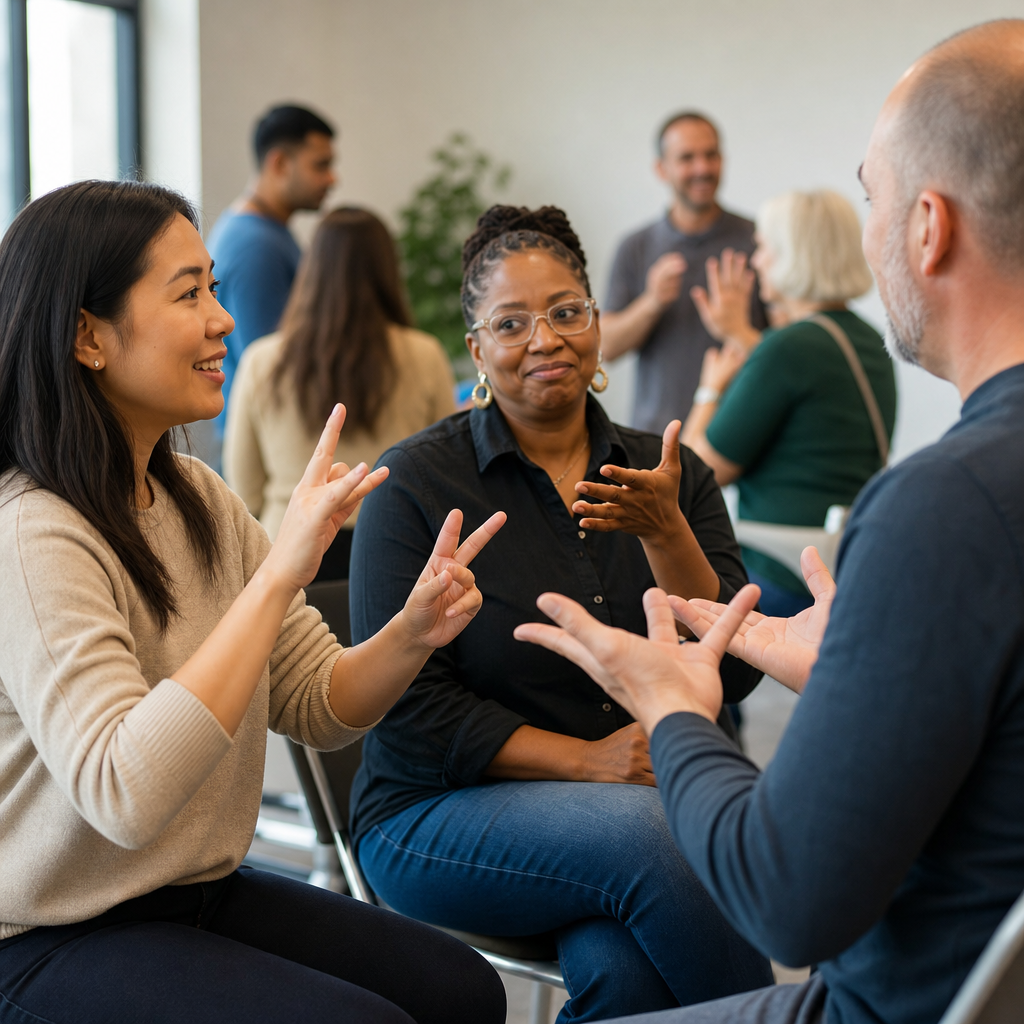
The first surprise for many hearing newcomers is that deaf community events are rarely quiet in the way they imagine. There is often laughter, signing across the room, animated facial expression, people tapping tables to get attention, children moving around freely, music felt through bass vibrations, and groups forming and reforming quickly. In visual conversations, timing is different from spoken conversation. People need clear sightlines, so circles and semicircles are common. Lighting matters. Backlighting from windows can make signing harder to read, while dim restaurants can slow everyone down.
You may notice people greeting each other at length. This is normal. Introductions can include where someone is from, what school they attended, whether they are Deaf, hard of hearing, hearing, or an interpreter, and who they know in common. Deaf communities can be tightly connected through schools for the Deaf, interpreting networks, advocacy organizations, alumni associations, sports leagues, and online groups. At many events, people are not being exclusive when they spend time reconnecting; they are reinforcing a relationship-centered culture that values context and familiarity.
Visual attention is central. Instead of calling out a name, people may wave within the person’s line of sight, lightly tap a shoulder, flash overhead lights, or stomp on a floor that carries vibration. In a formal gathering, an organizer may raise hands, flick lights, or use a projected visual cue to bring the room back together. This is one reason event setup matters so much. A room with obstructed views, poor lighting, and chairs in rigid rows can make participation harder than a room arranged for visual access.
Common Types of Deaf Community Events
Events vary widely, but several formats appear again and again. Social gatherings include silent dinners, coffee meetups, game nights, bowling outings, and family picnics. These are often the best starting point for first-time attendees because they are informal and conversational. Educational events can include ASL workshops, Deaf history presentations, school open houses, interpreter panels, and technology demonstrations focused on captioning apps, hearing devices, or video relay services. Cultural events may feature Deaf theater, visual vernacular performances, film screenings, storytelling, poetry in sign language, and art exhibitions.
There are also service-oriented and civic events. Advocacy meetings may focus on captioning policy, educational access, emergency preparedness, healthcare communication rights, or employment barriers. Job fairs and networking events can connect Deaf professionals with inclusive employers and vocational resources. Conferences often blend all of these functions, offering keynote speakers, breakout sessions, social mixers, exhibitor spaces, and youth programming. Major organizations such as the National Association of the Deaf and state Deaf associations have long used events to build leadership, share policy updates, and strengthen local networks.
| Event Type | What Usually Happens | Best For | What to Prepare |
|---|---|---|---|
| Silent dinner or meetup | Informal conversation in ASL or mixed communication styles | Newcomers, families, students | Basic introductions, patience, visual attention |
| Cultural performance | Theater, storytelling, poetry, film, or art centered on Deaf experience | Learning culture through observation | Arrive early, choose seats with clear sightlines |
| Workshop or panel | Structured learning with interpreters, captions, or Deaf presenters | Professionals, parents, advocates | Notebook, questions, access requests in advance |
| Advocacy or association meeting | Community updates, policy discussion, organizing | People seeking deeper engagement | Know the agenda, expect community debate |
Do You Need to Know Sign Language Before You Go?
No, but your experience improves if you arrive ready to communicate respectfully and adapt. Many deaf community events welcome hearing family members, friends, students, service providers, and neighbors. Still, the event is not primarily there to accommodate hearing comfort. That distinction matters. If you do not know sign language, learn a few basics before attending: how to introduce yourself, fingerspell your name, sign simple courtesies, and ask someone to repeat or slow down. This effort signals respect and reduces dependence on others to bridge every gap for you.
In my experience, newcomers who do best are honest and humble. They do not pretend fluency, dominate conversations with spoken language, or expect free tutoring from everyone they meet. Instead, they watch, follow the room, and ask brief practical questions when needed. If an event is beginner-friendly, organizers usually say so in advance. If it is not, that does not mean you are unwelcome; it means you should come prepared to observe, participate carefully, and accept that not every conversation will be accessible to you immediately.
Technology can help, but it is not a substitute for presence. Live transcription apps, notes on a phone, or text-based introductions can be useful in a pinch. However, overreliance on screens can interrupt eye contact and visual flow. If interpreters are present, use them appropriately and speak to the Deaf person, not to the interpreter. If you are attending with a Deaf friend, do not make them manage every interaction for you. Independent effort goes a long way in community spaces.
Etiquette, Communication Norms, and Mistakes to Avoid
The most important etiquette rule is simple: keep your face visible and your attention available. Looking down while someone signs, covering your mouth while speaking, or walking between people who are signing can break communication. If you need to pass through, move behind the signer when possible. To get attention, use a light shoulder tap or wave in the person’s visual field. Do not grab, yank, or overtap. In group settings, wait until the current visual exchange finishes before jumping in, because overlapping signed conversation is harder to parse than overlapping speech.
Another common issue is audism, the assumption that spoken language or hearing behavior is the default or superior standard. At events, this can show up subtly: insisting on speaking when signing is available, praising someone as “good” because they sound hearing, or treating Deaf attendees as inspirational for everyday activities. Avoid making cochlear implants, hearing aids, or speech ability your first topic of conversation. Those questions can feel intrusive and flatten a person’s identity to medical details. Ask about interests, work, family, and community connections instead.
If you make a mistake, correct it briefly and move on. Most people understand that newcomers are learning. The bigger problem is defensiveness. I have seen first-time visitors recover well simply by saying, “Thanks for telling me,” then adjusting. Events are community spaces, not tests. Respectful participation matters more than perfect signing. Watch how organizers manage turn-taking, where interpreters are positioned, whether announcements are signed and projected, and how people move around the room. The culture becomes easier to read once you pay attention to the visual logic behind it.
Accessibility Features and Practical Logistics
Well-run deaf community events are designed for access from the start, not patched together at the last minute. You should expect clear information about communication accommodations on registration pages or flyers. Common features include ASL interpreters, Deaf interpreters for complex or multilingual settings, open captions or CART, visible stage lighting, reserved seating for sightlines, reduced background noise, and staff who know how to direct attendees to access services. Larger venues may also offer hearing loops, assistive listening devices, tactile access, and emergency alerts that include visual signals.
Before attending, check the basics. Is the event Deaf-led or hearing-led with access services? Is it social, educational, political, or family oriented? Will there be voicing, signing only, or a mixed format? Are children welcome? Is there an RSVP process for accommodation requests? Conference planners often need interpreter and captioning requests in advance because qualified providers are scheduled weeks or months ahead. In the United States, many public events and programs consider accommodation obligations under the Americans with Disabilities Act, but the quality of implementation still varies widely.
Venue design affects participation more than many people realize. Good events avoid dark corners, narrow seating layouts, and speakers standing in front of bright windows. They provide breaks because visual attention is cognitively demanding over long periods. Food service matters too. Buffet lines can disrupt conversation, while round tables encourage visibility. At festivals or expos, maps and schedules should be easy to scan quickly. If an event lacks basic access, that is not a minor inconvenience; it can exclude attendees from the very purpose of gathering.
How to Get More Out of the Experience
If you want a meaningful experience, arrive with the goal of participating in community life rather than consuming an experience. Introduce yourself clearly, stay long enough for conversations to develop, and follow up with people you meet. Support Deaf businesses, artists, and organizations when they are featured. If there is a donation table, membership form, or volunteer sign-up sheet, consider using it. Community engagement becomes real when attendance leads to relationships, recurring involvement, and practical support.
It also helps to choose your first event strategically. A Deaf expo, school celebration, or community social is often easier for beginners than a policy meeting or advanced workshop. Parents of Deaf children may benefit most from family-centered gatherings where they can meet Deaf adults, educators, and other families in one place. Professionals such as teachers, healthcare workers, and HR staff may gain more from structured trainings with case studies and Q and A. Students learning ASL should seek events that welcome learners without turning Deaf attendees into unpaid instructors.
Over time, patterns emerge. You learn which local organizations host reliable events, which venues handle access well, and which gatherings are best for socializing, networking, or learning. That knowledge turns a single visit into ongoing community participation.
What should you expect at a deaf community event? Expect a visual, relationship-centered environment where access, identity, and communication are built into the experience. Expect social warmth, clear norms around attention and etiquette, and a wide range of event types, from casual dinners to conferences and advocacy meetings. Expect to adjust if you are new, especially if you do not yet sign fluently, but also expect that respectful effort will be noticed and appreciated.
The biggest benefit of attending is not just learning about Deaf culture; it is seeing how community engagement works when access is treated as essential rather than optional. That perspective can change how you communicate, plan events, support inclusion, and build relationships across differences. Whether you are looking for your first local meetup, a Deaf cultural performance, a family event, or a professional workshop, start with one well-organized gathering and show up ready to observe, respect, and connect.
Use this hub as your starting point for exploring events and community engagement more deeply, then take the next step: find a local deaf community event on a community center calendar, school for the Deaf page, association listing, or social media group, and attend with curiosity and care.
Frequently Asked Questions
What is a deaf community event, and who can attend?
A deaf community event is any gathering where communication, participation, and social interaction are centered on visual access and Deaf-friendly norms. These events can take many forms, including coffee meetups, silent dinners, cultural celebrations, theater performances, advocacy forums, school events, workshops, job fairs, interpreted public festivals, and large conferences. Some are primarily social, some are educational or professional, and others focus on community organizing, entertainment, or cultural pride. What they share is an intentional effort to create an environment where Deaf, hard of hearing, late-deafened, and signing participants can communicate comfortably and fully.
In most cases, anyone is welcome to attend, including hearing family members, friends, interpreters, students, professionals, and people who are simply interested in learning more about Deaf culture. The most important expectation is not that you already know everything, but that you arrive with respect, openness, and a willingness to adapt to the communication style of the space. Some events may be specifically intended for Deaf community members, while others are designed to be broadly inclusive, so it is always a good idea to read the event description beforehand. If you are unsure, checking registration details or contacting the organizer can help you understand the event’s purpose, audience, and accessibility features before you go.
What should I expect when it comes to communication at a deaf community event?
You should expect communication to be more visual, more direct, and often more dynamic than at a typical hearing-centered event. Depending on the setting, people may use American Sign Language, another signed language, home signs, gestures, speech, texting, captioning apps, interpreters, or a combination of methods. In group conversations, visual attention matters a great deal. People may wave to get someone’s attention, lightly tap a shoulder, flick room lights to signal a transition, or use clear facial expressions and body language to support meaning. This is all normal and practical within Deaf spaces.
If you are hearing or new to the environment, one of the most important things to expect is that you may need to slow down and become more intentional. Instead of speaking while turning away, covering your mouth, or talking across the room, you may need to face people directly, keep your hands away from your face, and pause so interpretation or turn-taking can happen. In larger or more formal events, interpreters and CART captioning may be present. In casual gatherings, communication might feel fluid and multilingual, with people moving between sign, speech, and text depending on who is present. You do not need to be perfect, but you should be prepared to meet people where they are and to value accessible communication as a shared responsibility.
Is there any etiquette I should know before attending my first deaf community event?
Yes, and understanding a few basics can make your first experience much smoother. The biggest etiquette principle is visual respect. That means getting someone’s attention appropriately, maintaining eye contact during signed conversations, avoiding interruptions that block the visual line between signers, and being mindful of lighting and seating. For example, standing in front of an interpreter, walking between two people who are signing, or trying to talk while looking down at your phone can make communication harder. At the same time, some behaviors that might seem unusual in hearing spaces, such as waving across the room or tapping someone gently to get their attention, are completely standard and polite in Deaf settings.
It is also good etiquette to be humble and curious rather than performative. If you know some sign language, use it respectfully, but do not panic if you are still learning. If you do not understand something, it is fine to ask for repetition or clarification. Avoid treating Deaf people as inspirational, exotic, or educational exhibits, and do not assume everyone has the same preferences, identity, or communication needs. Some people identify strongly with Deaf culture, while others may be hard of hearing or late-deafened and have different experiences. Listening, observing, and following the lead of the community will take you much farther than trying to impress anyone.
Will I feel out of place if I do not know sign language or if I am new to Deaf culture?
Many first-time attendees worry about this, but in reality, it is very common for people to arrive with different levels of experience. Some are fluent signers. Others know only a few signs. Some are hearing parents of Deaf children, coworkers, students, or community members attending for the first time. If the event is open to newcomers, you will likely not be the only person learning as you go. What matters most is your attitude. If you are patient, respectful, and willing to communicate in whatever way works best, most people will notice that effort.
That said, feeling a little unsure at first is normal. A Deaf community event may operate according to cultural norms that are unfamiliar if you have spent most of your time in hearing-centered spaces. Conversations may move visually across the room, attention-getting methods may look different, and there may be less reliance on spoken announcements. Rather than seeing this as a barrier, it can help to think of it as an opportunity to experience a different and deeply rich communication culture. If you want to be better prepared, learning a few basic signs, understanding how to introduce yourself, and reading up on Deaf cultural values beforehand can build confidence. Even so, genuine respect and willingness to learn are often more important than arriving with polished signing skills.
What can I do to be respectful and get the most out of the experience?
Start by approaching the event as a participant, not just an observer. Be present, attentive, and ready to adapt. Arrive on time, read any posted accessibility information, and follow the communication pace of the room. If interpreters, captions, or visual announcements are being used, make space for those systems to work. If you are meeting people, introduce yourself clearly and be honest about your communication preferences or skill level. If you are hearing, avoid dominating conversations with speech when others are signing, and avoid making the event revolve around your comfort. Instead, focus on accessible interaction and shared inclusion.
To get the most from the event, pay attention to both the formal activities and the informal dynamics. Often, the most meaningful parts of a Deaf community gathering happen in side conversations, introductions, shared laughter, storytelling, and moments of cultural connection. Observe how people navigate the space, ask thoughtful questions when appropriate, and be willing to learn from the community rather than assuming you already understand it. If the event includes performances, speakers, vendors, or advocacy discussions, engage with those opportunities fully. Over time, repeated attendance helps you build familiarity, relationships, and a deeper appreciation for the diversity within Deaf life. A respectful first visit can easily become the beginning of ongoing involvement in a vibrant and welcoming community.