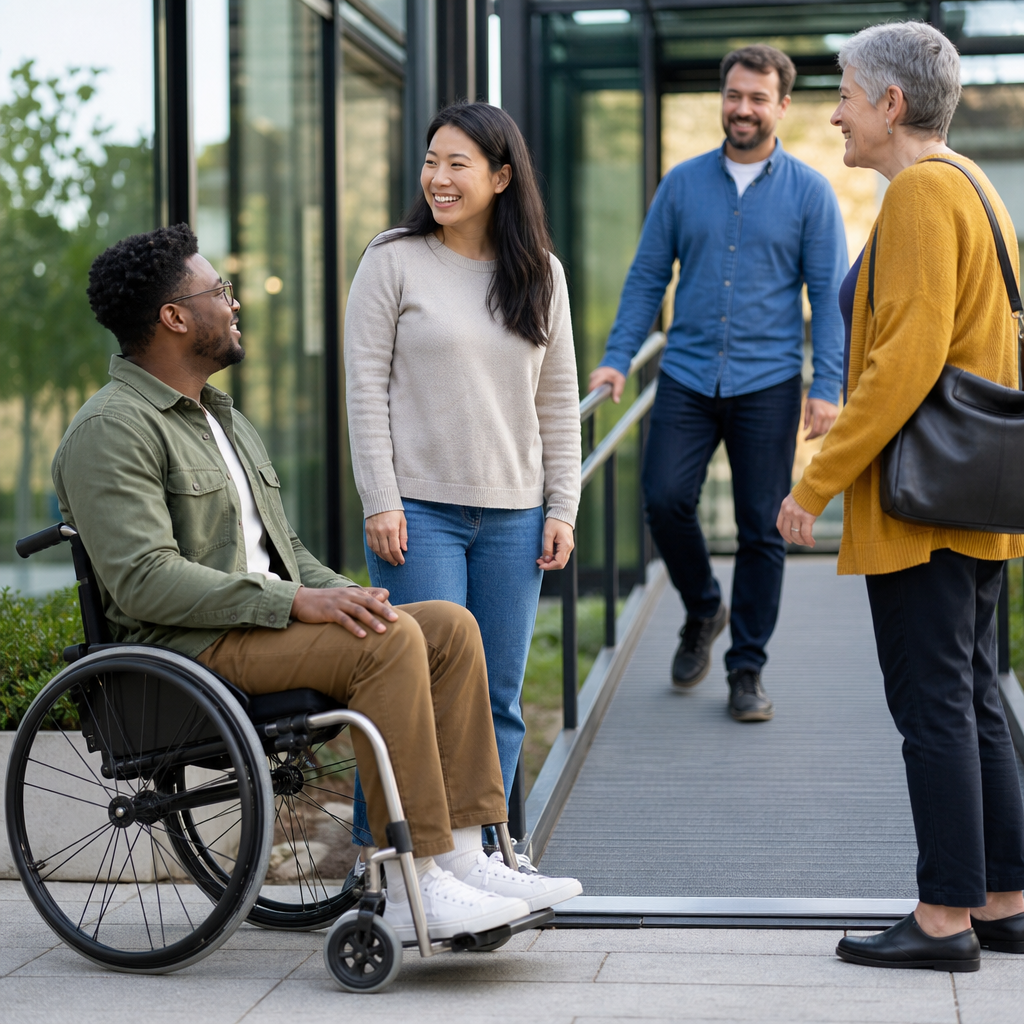
Promoting accessibility in your community starts with a simple shift: treating access as a shared civic responsibility rather than a special accommodation for a few people. In the context of allyship and advocacy for hearing individuals, accessibility means removing barriers that exclude Deaf, hard of hearing, late-deafened, and deafblind neighbors from public life, education, healthcare, employment, worship, recreation, and local decision-making. Community accessibility includes communication access such as captions, assistive listening systems, interpreters, visual alerts, clear signage, inclusive meeting practices, and policies that make participation possible without extra burden. Advocacy is the work of identifying those barriers and changing the conditions that create them. Allyship is how hearing individuals use their position, relationships, and influence to support those changes consistently, respectfully, and under Deaf leadership.
This matters because hearing loss is common, but community planning still assumes spoken information is enough. The World Health Organization has estimated that more than 1.5 billion people worldwide live with some degree of hearing loss, and hundreds of millions have disabling hearing loss. In practical local terms, every school district, city council, clinic, library, neighborhood association, and small business already serves people with different hearing and communication needs. When access is missing, people do not just miss words; they miss safety instructions, job opportunities, social belonging, and legal rights. I have seen well-meaning organizations spend heavily on outreach campaigns while leaving town halls uncaptained, reception desks behind glass, and emergency updates audio-only. Real inclusion is built in the details. A community becomes accessible when hearing people stop asking whether accommodations are necessary and start planning as if communication access is nonnegotiable.
Understand what accessibility means for Deaf and hard of hearing community members
Effective advocacy begins with accurate understanding. Deaf and hard of hearing people are not a single group with identical preferences. Some people use American Sign Language as their primary language. Some rely mainly on spoken language with hearing aids or cochlear implants. Others prefer real-time captioning, text, email, relay services, note-taking support, visual paging, or quieter environments with reduced background noise. Deafblind people may use tactile signing, close vision interpreting, Protactile practices, braille displays, or support service providers. The first rule for hearing allies is not to assume that one solution fits everyone. Ask what access works best, then honor the answer.
It also helps to separate impairment from barrier. Hearing loss itself is not what excludes people from community life; inaccessible systems do. A fitness instructor facing away from the class while giving directions, a doctor speaking through a mask without caption support, or a public meeting held in a reverberant room with no microphone are examples of avoidable barriers. When I audit events for accessibility, the biggest failures are rarely dramatic. They are routine habits: side conversations while an interpreter is working, videos played without captions, and volunteers who answer questions from another room. Once hearing individuals learn to notice these patterns, they can correct them early and prevent exclusion before it happens.
Start with communication access in everyday community settings
If you want to promote accessibility quickly, focus first on communication access because it affects nearly every setting. Public meetings should use microphones for every speaker, even in small rooms, because assistive listening systems and captioners depend on clean audio input. Videos shown in schools, nonprofits, libraries, and social media campaigns should always have accurate captions, not auto-generated captions left unedited. Reception desks should offer paper, pens, text options, and visible signs indicating how to request assistance. Event registration forms should ask about accommodation needs in advance, with enough lead time to book interpreters or Communication Access Realtime Translation providers.
Plain-language meeting practices also make a measurable difference. Share agendas ahead of time. Ask speakers to identify themselves before talking. Keep one person speaking at a time. Repeat audience questions into the microphone. Provide written summaries of key decisions and action items. In noisy community spaces such as gyms, cafeterias, or fairs, reduce background music and improve lighting so people can see faces clearly. These steps help Deaf and hard of hearing participants, but they also improve comprehension for older adults, multilingual audiences, and anyone in a distracting environment. Good access is not a niche feature; it is better communication design.
| Community setting | Common barrier | Practical accessibility fix |
|---|---|---|
| Town hall meeting | Audience questions not heard | Use floor microphones and live captions for all speakers |
| Clinic reception | Names called aloud only | Install visual queue systems and text notifications |
| School event | Video played without captions | Require edited captions before presentation |
| House of worship | Poor acoustics and no assistive listening | Add hearing loop systems and reserved sightline seating |
| Community center class | Instructor talks while turning away | Train staff to face participants and post written instructions |
Know the legal and policy foundations that shape local action
Community accessibility is not only a matter of courtesy. In many settings, it is a legal obligation. In the United States, the Americans with Disabilities Act is the central framework. Title II applies to state and local governments and requires effective communication in public services. Title III covers public accommodations such as businesses, nonprofits serving the public, healthcare offices, hotels, museums, and recreation facilities. Section 504 of the Rehabilitation Act applies to entities receiving federal funding, including many schools, colleges, and healthcare programs. For digital communication, the Web Content Accessibility Guidelines are widely used as the operational benchmark, especially for captions, transcripts, keyboard access, and readable design.
Hearing allies should learn enough of these standards to recognize when a problem is systemic. For example, a city that streams council meetings without captions is not merely being inconvenient; it may be failing effective communication requirements. A hospital that insists a family member interpret instead of providing a qualified interpreter is taking a serious legal and ethical risk. I advise community groups to move from reactive accommodation to written policy. That means budgeting for access services, naming responsibility for arranging them, publishing request procedures, and reviewing complaints for patterns. Policy matters because accessibility fails when it depends on one kind volunteer or one staff member who happens to care.
Practice strong allyship without dominating Deaf-led advocacy
Hearing individuals are most useful when they expand capacity, not when they become the center of the work. Strong allyship begins with listening to Deaf and hard of hearing residents, leaders, parents, students, and employees about the barriers they face. It continues with credit, compensation, and decision-making power. If your organization forms an accessibility committee, include Deaf members from the start and pay community advisors for their expertise. Do not invite feedback after the budget is set and the event design is locked. Access cannot be retrofitted well when key decisions are already made.
Allyship also requires changing everyday behavior. Face the person you are speaking to. Do not cover your mouth. Do not say, “Never mind, it was not important,” when asked to repeat something. Learn how to work effectively with interpreters: speak directly to the Deaf person, pause for interpretation, and share materials in advance. If someone asks for clarification, repeat the full point instead of shortening it. In group settings, use your influence to normalize access by requesting captions, asking presenters to use microphones, and pushing back when organizers call accommodations too expensive. Accessibility budgets are planning choices. Communities fund what they consider essential.
Build accessible schools, workplaces, and public institutions
Schools, employers, and civic institutions have outsized influence because they shape whether accessibility becomes ordinary or exceptional. In schools, hearing allies can advocate for captioned classroom media, interpreters when required, classroom amplification where appropriate, visual emergency alerts, and teacher training on inclusive communication. Students who are Deaf or hard of hearing should not be expected to self-advocate constantly just to follow basic instruction. Parents and educators can also push for extracurricular access so sports, theater, assemblies, field trips, and clubs are included in planning, not handled as afterthoughts.
In workplaces, promotion of accessibility should cover recruitment, meetings, supervision, training, and informal culture. Job interviews need clear accommodation processes. Orientation videos should be captioned. Team meetings should support live captions or interpreting when needed. Emergency procedures must include visual and text-based alerts. Managers should evaluate whether performance problems are actually communication-design problems, such as instructions given only verbally in noisy environments. Public institutions need the same discipline. Libraries can offer hearing loop-equipped rooms and captioned programs. Police and emergency management agencies should use multilingual text alerts, visual information boards, and communication cards. Election offices can train poll workers on communicating with Deaf voters respectfully and effectively.
Use technology wisely, but do not confuse tools with full access
Technology can remove major barriers, but only when selected and used correctly. Captions on video platforms, CART services for meetings, hearing loops, FM and infrared assistive listening systems, speech-to-text apps, video relay services, and visual notification tools all have value. Hearing loops are especially effective in fixed venues because they transmit sound directly to telecoil-equipped hearing aids and cochlear implants with less background noise. CART remains one of the clearest options for lectures, legal proceedings, and complex meetings because a trained captioner produces high-accuracy text in real time. For digital content, edited captions and transcripts improve both accessibility and search visibility.
Still, technology has limits. Auto-captions often mishandle names, technical terms, accents, and fast discussion. A speech-to-text app is not a substitute for a qualified interpreter in legal, medical, or educational contexts where accuracy is critical. Video meetings with captions can still be inaccessible if speakers talk over one another or fail to share documents beforehand. I recommend treating technology as one layer in a broader access plan that includes human support, environment design, and clear protocols. The test is simple: can a Deaf or hard of hearing person participate fully, safely, and independently, not just approximately?
Create lasting change through organizing, budgeting, and accountability
Communities become accessible through systems, not one-off gestures. Start with an access review of your organization, neighborhood group, or institution. Examine meetings, signage, websites, phone workflows, emergency notices, event registration, staff training, and procurement rules. Then set measurable goals: every public video captioned before release, every major event with an accommodation request field, every meeting room equipped with microphones, every emergency alert available in text and visual formats. Assign owners, deadlines, and budget lines. Without budget, accessibility remains optional; without accountability, it disappears under pressure.
Partnerships make this work stronger. Local Deaf organizations, disability rights centers, vocational rehabilitation agencies, schools for the Deaf, interpreter referral agencies, audiologists, and independent living centers often know where community gaps are most severe. Use surveys, listening sessions, and post-event feedback, but do not stop there. Track attendance, complaint patterns, repeat accommodation requests, and missed-service incidents. Publish progress updates. When leaders report publicly on access improvements, accessibility becomes part of normal governance rather than a hidden side issue. That is the goal of effective advocacy: not occasional heroics, but durable community standards that hearing people help build and maintain.
Promoting accessibility in your community is ultimately about making sure Deaf and hard of hearing people can participate on equal terms, without having to fight for access at every turn. The most effective hearing allies learn the range of communication needs, fix everyday barriers, understand legal duties, and support Deaf-led priorities with practical follow-through. They push for captions, interpreters, assistive listening systems, visual alerts, and inclusive meeting practices because these are foundational parts of civic participation, not extras. They also understand that accessibility is not solved by a single device or policy. It requires culture change, staff training, budget commitments, and repeated evaluation.
If you want to strengthen allyship and advocacy for hearing individuals, begin where you already have influence. Review your workplace, school, place of worship, neighborhood association, or local government process this month. Ask Deaf and hard of hearing community members what gets in the way. Fund the fixes that matter. Put expectations in writing. Then keep going. Accessibility grows when hearing people treat it as everyday responsibility, and communities become stronger when everyone can fully receive information, contribute ideas, and belong.
Frequently Asked Questions
What does accessibility really mean in a community setting?
Accessibility in a community setting means making sure everyone can participate fully in everyday civic life, not just enter a building or check a legal compliance box. For Deaf, hard of hearing, late-deafened, and deafblind community members, accessibility includes clear communication, equal access to information, and meaningful inclusion in schools, public meetings, healthcare settings, workplaces, places of worship, neighborhood events, and recreational spaces. It involves practical supports such as qualified sign language interpreters, real-time captioning, assistive listening systems, visual alerts, accessible websites, readable signage, and staff who know how to communicate respectfully and effectively.
Just as important, accessibility is a mindset. It asks communities to stop treating access as an exception or favor and instead recognize it as part of responsible planning. When organizers, local leaders, business owners, teachers, healthcare providers, and neighbors build access in from the beginning, participation becomes more equitable and less stressful for everyone. In other words, accessibility is not only about removing barriers after someone points them out. It is about designing public life so people with different communication needs can belong, contribute, lead, and be heard from the start.
How can hearing allies help promote accessibility for Deaf and hard of hearing neighbors?
Hearing allies play a critical role because they often have access to spaces, decision-makers, and conversations where accessibility is either prioritized or overlooked. A strong ally starts by listening to Deaf, hard of hearing, late-deafened, and deafblind people about what access looks like in real life. That means not assuming one solution works for everyone. Some people use sign language, some rely on captioning, some benefit from assistive listening technology, and some need tactile or visual accommodations. Effective allyship begins with asking, learning, and respecting self-identified needs.
From there, allies can take practical action. They can request interpreters and captioning for public events before anyone has to ask. They can encourage schools, nonprofits, faith communities, employers, and local government agencies to adopt clear accessibility policies. They can advocate for microphones at meetings, ensure speakers face the audience when talking, share written summaries of important information, and push for websites and digital content that are usable with accessibility tools. Allies can also interrupt exclusionary habits, such as speaking over interpreters, dismissing captioning as too expensive, or treating accessibility as optional. The most effective allies use their position to normalize access, not to center themselves, and they stay accountable to the people most affected by barriers.
What are some simple first steps a community can take to become more accessible?
A community does not have to solve everything at once to make meaningful progress. One of the best first steps is to assess where communication barriers currently exist. Look at public meetings, school events, emergency announcements, healthcare communication, business services, and community programs. Ask whether important information is available in plain language, whether videos are captioned, whether interpreters are offered when needed, whether meeting rooms have working sound systems, and whether staff know how to communicate with people who have different hearing and communication needs. An accessibility review like this can quickly reveal patterns that have gone unnoticed.
After that, communities should focus on building consistent habits. Make captioning standard for online content and public presentations. Budget for qualified interpreters instead of waiting for last-minute requests. Install or maintain assistive listening systems in gathering spaces. Use visual alerts and signage where appropriate. Train frontline staff, volunteers, and leaders in accessible communication practices, such as speaking clearly, reducing background noise, confirming understanding, and avoiding the assumption that everyone can hear announcements. It also helps to create a straightforward process for requesting accommodations and to include accessibility information in every event announcement. These first steps signal that access is expected, planned, and valued, which is often the foundation for broader cultural change.
Why is accessibility important beyond legal compliance?
Legal standards matter because they establish minimum protections and make clear that exclusion is not acceptable. But if a community only thinks about accessibility in terms of avoiding complaints or meeting bare requirements, it misses the larger purpose. Accessibility is fundamentally about dignity, participation, and belonging. People should be able to access healthcare, education, employment, community events, and civic decision-making because they are members of the community, not because they successfully argued for an accommodation. When access is treated as a core value rather than a legal burden, communities become more inclusive, responsive, and trustworthy.
There are also broader benefits. Accessible communication improves understanding for many people, including older adults, people learning English, individuals in noisy environments, and anyone who benefits from information presented in multiple formats. Captioned videos, clear signage, written follow-ups, and well-managed sound systems help more than one group. Inclusive planning also strengthens civic engagement by making it easier for more residents to participate in local life. In practical terms, accessibility leads to better services, stronger institutions, and more connected neighborhoods. Communities that embrace access as a shared responsibility are better prepared to serve all residents fairly and effectively.
How can local organizations make accessibility a long-term part of their culture?
For accessibility to last, it must move from occasional accommodation to everyday practice. Local organizations can begin by adopting a clear accessibility policy that covers events, communication, digital content, hiring, customer service, and feedback. That policy should identify who is responsible for implementation, how accommodations are arranged, how costs are budgeted, and how concerns are addressed. Without structure, accessibility tends to depend on individual goodwill, which can be inconsistent. With structure, it becomes part of the organization’s normal operations.
Long-term culture change also depends on training, budgeting, and accountability. Staff and volunteers should be trained not only on technical compliance but also on respectful interaction and inclusive planning. Accessibility should appear in event checklists, procurement decisions, website updates, public communications, and emergency procedures. Organizations should consult Deaf, hard of hearing, late-deafened, and deafblind community members regularly, compensate them when appropriate for their expertise, and use their feedback to improve services over time. It is equally important to measure progress: track what accommodations are being provided, whether requests are handled effectively, and where recurring barriers remain. When organizations treat accessibility as an ongoing commitment informed by community input, they create environments where inclusion is sustainable rather than symbolic.