
Support groups for the Deaf community can be a practical, affirming, and often life-changing part of mental health care, especially when they are designed with full language access, cultural awareness, and consistent peer connection in mind. In this context, Deaf usually refers to people who identify with Deaf culture and use sign language, while deaf may describe the audiological condition of hearing loss; hard of hearing, late-deafened, and DeafBlind people may also seek similar support, though their needs are not identical. I have worked with Deaf clients, interpreters, and mixed hearing-status groups, and the pattern is clear: people do better when communication is direct, not filtered, and when the room understands that access is not a special accommodation but the foundation of care. That matters because isolation, missed information, medical trauma, school exclusion, family communication gaps, and barriers to therapy can all compound stress. A well-run support group helps reduce that load by offering shared language, practical coping tools, and community validation. It can complement Deaf-friendly therapy, crisis planning, family education, substance use recovery, grief work, identity development, and everyday wellness. For many people, joining a group is the first place they feel fully understood without having to explain basic communication needs.
Support groups differ from individual therapy, psychoeducation classes, and case management, although some programs blend these services. A support group usually centers on mutual aid: members share experiences, discuss coping strategies, and build connection around a common concern such as anxiety, parenting, trauma recovery, chronic illness, LGBTQ+ identity, domestic violence survivorship, or college transition. Some groups are peer-led by trained facilitators from the community, while others are led by licensed mental health professionals with fluency in American Sign Language or experience working alongside qualified interpreters and Deaf facilitators. The best groups set clear expectations about confidentiality, turn-taking, visual accessibility, crisis response, and participation style. They also recognize that the Deaf community is not monolithic. Communication preferences may include ASL, Signed Exact English, protactile methods, cued speech, spoken language with captioning, CART, or a combination. Cultural identity, race, age, disability, immigration history, and education level all shape what safety and belonging feel like in the room. When people ask what to expect, the honest answer is this: expect a group to work well only when it is truly accessible and culturally competent from the start.
What a Deaf-friendly support group looks like
A Deaf-friendly support group is built around visual communication, not adapted to it after the fact. In practice, that means lighting is even, faces are visible, seating is arranged in a circle or wide U shape, side conversations are minimized, and the facilitator manages pacing so one person signs or speaks at a time. If interpreters are present, they should be qualified for mental health settings, prepared on terminology, and positioned where members can see both the signer and the interpretation without neck strain. For spoken participants, live captions or CART can help, but captions alone are not enough for many Deaf members because emotional nuance, group rhythm, and signed expression carry meaning that text can flatten.
Good groups usually start with communication agreements. Members may identify their name sign, pronouns, preferred communication mode, whether they want interpretation voiced or signed in first person, and any access needs such as larger print, slower pacing, or tactile support. The facilitator should explain confidentiality in plain language, including limits related to self-harm, harm to others, abuse reporting, and court orders. This is especially important because many Deaf people have had experiences where private information was shared casually by schools, agencies, or even community members who know each other socially. Trust rises when boundaries are explicit and enforced.
You should also expect structure. The strongest groups follow a consistent format: check-in, topic focus, guided discussion, skills practice, and closing. In trauma-informed groups, facilitators may preview sensitive topics, offer opt-out choices, and use grounding exercises before and after difficult sharing. In recovery groups, they may review relapse warning signs, triggers, and accountability steps. In family or parenting groups, they may include role-play around communication access at home, school meetings, or medical appointments. Consistency matters because predictability reduces cognitive load and creates safety, particularly for members who have experienced chronic misunderstanding in hearing-dominant settings.
Common types of support groups and who they help
Not every Deaf person needs the same kind of support, so effective programs are usually organized around a specific goal or life stage. Mental health support groups may focus on anxiety, depression, trauma, grief, or stress management. Identity-based groups might serve Deaf LGBTQ+ members, Deaf people of color, Deaf immigrants, or late-deafened adults adjusting to major life changes. Health-focused groups may center on cancer care, diabetes, chronic pain, or vestibular disorders, where communication access affects both emotional support and health literacy. There are also groups for parents of Deaf children, Deaf parents navigating school systems, college students, elders, and people leaving abusive relationships.
In my experience, the clearest predictor of usefulness is fit. A broad “general support” group can help someone feel less alone, but a targeted group often produces faster relief because members face similar barriers and can exchange highly specific strategies. For example, a Deaf college student with panic symptoms may benefit more from a group that addresses classroom interpreters, testing accommodations, roommate communication, and campus counseling than from a generic anxiety circle. A late-deafened adult may need space to process identity shift, hearing technology decisions, fatigue from listening effort, and relationship strain in ways that a culturally Deaf ASL-first group does not automatically address.
| Group type | Main focus | Best for | What to expect |
|---|---|---|---|
| Peer-led community group | Shared experience and mutual support | People seeking connection and practical advice | Informal discussion, strong validation, fewer clinical interventions |
| Therapist-led support group | Mental health symptoms and coping skills | Members needing structure and clinical guidance | Screening, goals, skill-building, crisis protocols |
| Psychoeducational group | Learning about a condition or strategy | Members who want tools and clear information | Teaching, handouts, discussion, homework or practice |
| Identity-specific group | Cultural affirmation and targeted challenges | Members with shared background or life stage | Focused topics, stronger resonance, narrower eligibility |
These categories can overlap. A Deaf-friendly therapy and support program may offer one-to-one counseling, therapist-led groups, and peer spaces under the same umbrella. That hub model works well because members can move between levels of care without starting over. Someone may begin in a grief group, step into individual trauma therapy, and later continue with a peer community group for long-term connection. For a subtopic hub like Deaf-friendly therapy and support, that integration is the central idea: support groups are not isolated services; they are one part of a broader care pathway that should include assessment, referrals, crisis planning, family outreach, and accessible follow-up.
How access is handled in practice
Access is the deciding factor between a meaningful group and a harmful one. In practical terms, access starts before the first session. Registration materials should be available in plain written language and, ideally, ASL video format. Staff should ask specific questions: Do you prefer ASL, spoken English with captions, or another mode? Do you need a Deaf interpreter in addition to a hearing interpreter? Are you joining online, and if so, do you have enough bandwidth, screen size, and camera placement for visual communication? Generic forms that ask only whether someone is “hearing impaired” signal that the program has not thought deeply enough about real participation.
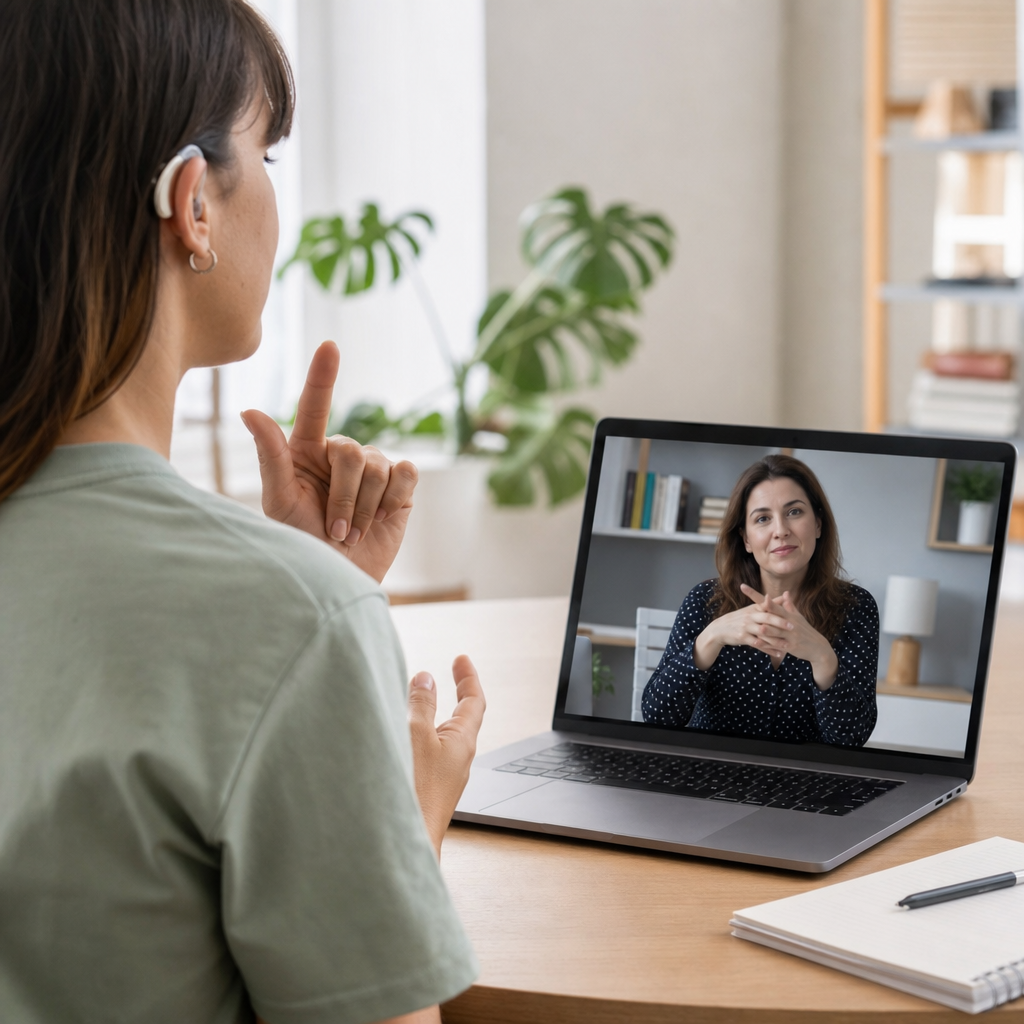
For in-person groups, room setup matters. Backlighting makes signing harder to read. Small chairs packed tightly together limit sightlines. Carpet and acoustics still matter for hard of hearing members using residual hearing or devices. For virtual groups, the platform matters just as much. Zoom is commonly used because spotlighting, pinning interpreters, and gallery view can support group interaction. Captions should be edited for accuracy when possible, and facilitators should know how to pace turn-taking so visual lag does not shut members out. Cameras should remain on except for emergencies; in visual language spaces, a blank screen is not neutral.
Qualified providers also understand the difference between basic interpreting and mental health interpreting. Group discussions involve trauma content, rapid emotional shifts, overlap, slang, and culturally loaded language. Interpreters need training in boundaries, confidentiality, and clinical terminology. The Registry of Interpreters for the Deaf provides professional standards, but credentials alone do not guarantee a good fit for therapy settings. Many programs benefit from working with interpreters who routinely handle behavioral health assignments and from consulting Deaf clinicians or advocates when designing services. If a group relies on family members, friends, or untrained staff to interpret, that is a serious red flag.
Benefits, limits, and signs of a quality program
The benefits of support groups are concrete. Members often report reduced isolation, lower shame, better emotion labeling, stronger self-advocacy, and improved follow-through with therapy or medical care. In Deaf spaces, there is an additional benefit that hearing providers sometimes underestimate: communication ease itself can be therapeutic. When people do not have to spend energy decoding speech, managing interpreter discomfort, or repairing constant misunderstandings, they can finally focus on grief, fear, anger, or hope. That shift is not minor. It changes the depth of conversation and the speed of trust-building.
At the same time, support groups have limits. They are not a substitute for emergency psychiatric care, intensive trauma treatment, or individualized intervention when someone is in acute danger. Some members need one-to-one therapy before group work feels safe. Others may find that a general support group becomes emotionally draining if there is too much uncontained crisis sharing and not enough facilitation. Confidentiality can also feel more complex in smaller Deaf communities where members may know each other through schools, clubs, work, or family networks. A quality program acknowledges these realities rather than pretending they do not exist.
Look for clear signs of quality: trained facilitators, explicit access planning, written and signed group rules, informed consent, referral pathways, and a method for handling conflict or safety concerns. Ask whether the group screens members before admission, how crises are handled between sessions, whether interpreters are briefed on confidentiality, and how feedback is collected. Strong programs measure attendance, engagement, and member satisfaction, then adjust format based on what they learn. They also know when a group is the wrong setting. Ethical facilitators will refer someone to higher care, domestic violence services, substance use treatment, or specialized trauma therapy when needed.
How to prepare for your first meeting and get the most from it
Before your first meeting, ask practical questions. Who leads the group, and what is their background? Is it peer-led, clinician-led, or mixed? What communication access is provided every session? Is the group open or closed, meaning can people join anytime or only at the start of a cycle? How large is it, how long does it last, and what topics are covered? These details shape the experience more than many people realize. A closed eight-week therapist-led anxiety group feels very different from a drop-in community support circle.
It also helps to decide what you want from the group. Some people want emotional support. Others want skill-building, referrals, or a place to talk with people who understand Deaf culture, family communication barriers, or interpreter fatigue. If you know your goals, you can tell quickly whether the group matches them. During the first session, notice whether you can see everyone clearly, whether the pace works for you, whether confidentiality is handled seriously, and whether the facilitator includes quieter members without pressure. Feeling a little nervous is normal; feeling chronically inaccessible is not.
To get the most from a support group, attend consistently, participate at a pace that feels safe, and use the group as one part of a broader wellness plan. Many members benefit from pairing group support with individual Deaf-friendly therapy, psychiatric care when appropriate, sleep and stress routines, and trusted community connections outside formal treatment. If a group is not the right fit, that does not mean support groups are ineffective. It usually means the match was wrong. Keep asking for accessible care, seek providers who understand Deaf-friendly therapy and support, and choose spaces where communication is direct, dignity is protected, and healing is shared.
Frequently Asked Questions
What happens in a support group for the Deaf community?
A support group for the Deaf community is typically a structured space where participants can talk about emotional well-being, daily stress, relationships, identity, access barriers, and life experiences in a setting that is fully accessible and culturally aware. What happens from week to week depends on the group, but most meetings include introductions, shared discussion, peer support, and guidance from a facilitator or therapist. In a well-designed group, communication is never treated as an afterthought. That means members should be able to participate directly in their preferred language or communication mode, whether that is ASL, another sign language, visual communication strategies, tactile signing for DeafBlind participants, CART, captioning, or interpreter support when appropriate.
You can also expect the group to have clear ground rules around confidentiality, respect, turn-taking, and inclusion. Some groups are peer-led, while others are led by a licensed mental health professional who understands Deaf culture and the impact of communication access on mental health. Topics often include anxiety, depression, trauma, isolation, family dynamics, work or school stress, discrimination, and navigating systems that may not be built with Deaf people in mind. The overall goal is not just to “talk about problems,” but to build connection, reduce isolation, strengthen coping skills, and create a space where people do not have to explain or defend their communication needs.
Are Deaf support groups only for people who identify as culturally Deaf?
Not always. Many support groups are created specifically for people who identify as culturally Deaf and use sign language, but others are intentionally broader and may include deaf, hard of hearing, late-deafened, and DeafBlind participants. The key question is not just who is technically allowed to attend, but whether the group is prepared to support everyone in it with meaningful access and respect. A group may be labeled for the “Deaf community” while still welcoming people with different hearing levels, communication backgrounds, and identities, as long as the environment is inclusive and the communication setup is effective for all members.
If you are considering a group and are unsure whether it fits, it is smart to ask a few practical questions before joining. For example: What language is primarily used? Are interpreters or captions available? Does the facilitator have experience with Deaf culture as well as with hard of hearing, late-deafened, or DeafBlind participants? Will everyone be able to participate directly, or will some members be expected to adapt more than others? A good group should be able to answer these clearly. The best fit is usually a group where you can communicate comfortably, feel understood, and participate fully without constant barriers.
How do I know if a Deaf support group is actually accessible and culturally competent?
This is one of the most important questions to ask. A truly accessible and culturally competent support group does more than provide basic accommodations. It is built around the expectation that Deaf people and others with hearing-related differences deserve full, direct, and equal participation. That includes planning for language access from the beginning, not adding it later. In practice, this may mean a fluent signing facilitator, certified interpreters who are experienced in mental health settings, accurate real-time captioning, visual meeting norms, good lighting, seating arranged for sight lines, reduced background distractions, and communication methods that match the needs of the people attending.
Cultural competence also matters just as much as logistics. A strong facilitator understands that Deafness is not simply a medical issue; for many people, it is also tied to identity, language, community, and lived experience. They should recognize how audism, communication deprivation, family misunderstanding, inaccessible services, and chronic exclusion can affect mental health over time. They should also avoid forcing hearing-centered assumptions onto the group. If a provider or organization seems vague about access, minimizes the importance of communication, or expects participants to “make do,” that is a red flag. You should feel confident that the group is designed to support you, not test your ability to adapt to an inaccessible environment.
What are the mental health benefits of joining a support group for the Deaf community?
For many people, the biggest benefit is reduced isolation. It can be deeply relieving to be in a room, virtual or in person, where communication flows more naturally and where other people understand the pressure of navigating inaccessible systems, strained conversations, or feeling misunderstood by hearing family, coworkers, or providers. That sense of recognition can be powerful. It often helps people feel less alone, less ashamed, and more willing to talk honestly about stress, grief, anxiety, depression, burnout, trauma, and relationship challenges.
Support groups can also improve coping skills and emotional resilience. Members often learn practical strategies from one another, including how to advocate for accommodations, set boundaries, manage conflict, respond to discrimination, and build healthier routines. In professionally led groups, participants may also learn tools for emotional regulation, stress management, and communication in relationships. Over time, support groups can strengthen confidence, identity, and belonging. They are especially valuable when they combine peer connection with language access and cultural affirmation, because that combination helps create psychological safety. While a support group is not always a replacement for individual therapy or specialized treatment, it can be an essential part of a broader mental health support system.
How can I find the right Deaf support group for my needs?
Start by thinking about what kind of support you want. Some groups focus on general emotional support, while others are centered on specific concerns such as grief, trauma recovery, addiction, anxiety, parenting, identity, relationships, or life transitions. You may also want to consider whether you would prefer a peer-led group or one led by a therapist, whether virtual or in-person meetings work better for you, and what communication methods you need in order to participate fully. The more clearly you understand your needs, the easier it becomes to identify a group that is both helpful and sustainable.
Good places to look include Deaf service organizations, mental health clinics with Deaf-specialized programs, community centers, advocacy groups, college Deaf resource offices, local interpreter referral networks, and trusted providers who work with Deaf clients. When you contact a group, ask direct questions about accessibility, confidentiality, group size, cost, meeting format, facilitator qualifications, and who the group is intended to serve. It is also reasonable to ask whether you can attend an introductory session or have a brief consultation first. The right support group should feel welcoming, understandable, and genuinely accessible from the first interaction. If it does not, keep looking. A strong match can make a meaningful difference in your mental health, sense of community, and long-term support network.