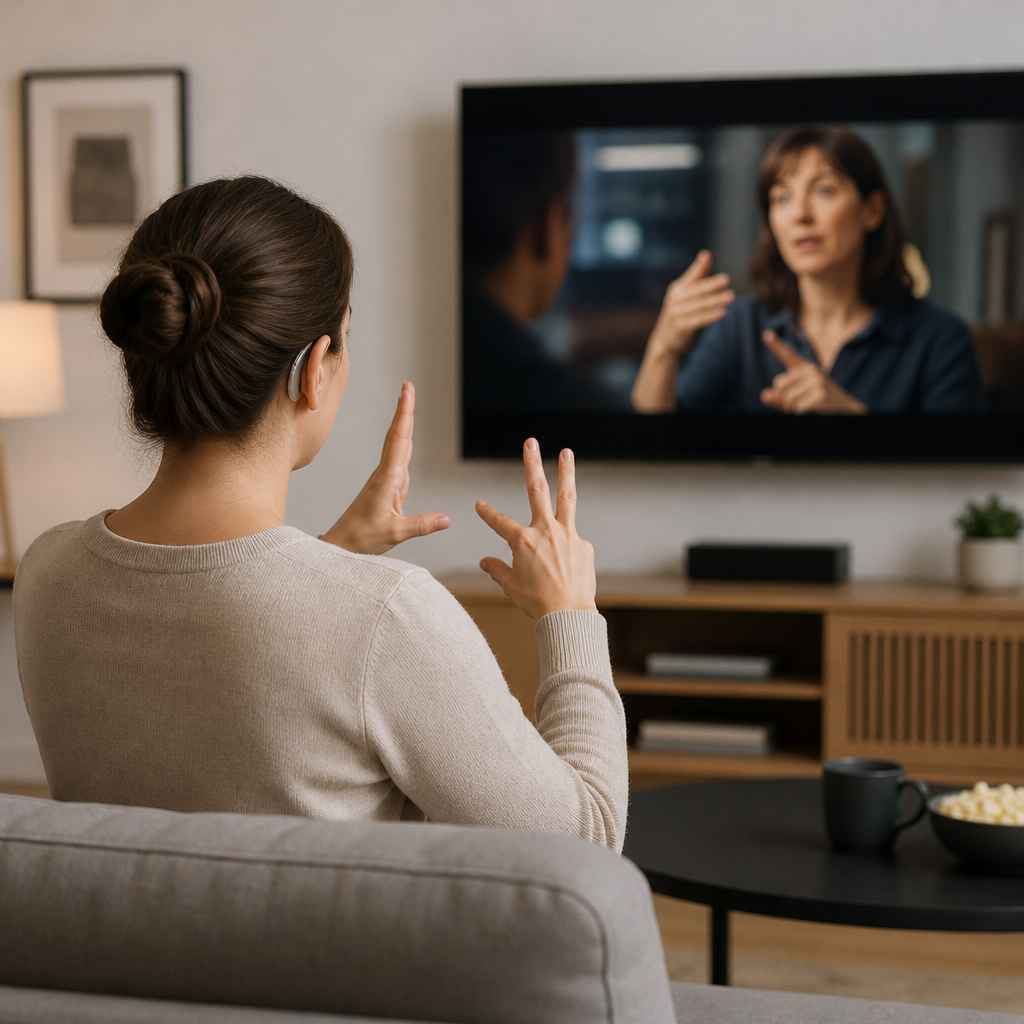

Deaf representation in media shapes how millions of people understand deafness, sign language, disability, and human communication. It matters because film, television, news, publishing, advertising, and digital platforms do more than entertain: they teach audiences what is normal, valuable, and possible. When Deaf people are absent, miscast, or reduced to stereotypes, the public absorbs distorted ideas that affect school policy, workplace access, healthcare interactions, and everyday social behavior. When representation is accurate and led by Deaf creators, media can expand opportunity, normalize accessibility, and reflect the cultural richness of Deaf communities.
The term Deaf, capitalized, usually refers to a cultural and linguistic identity connected to sign languages and shared community experience. Lowercase deaf is often used as a broader audiological description of hearing loss. The distinction is important because deafness is not only a medical condition; for many people, it is also a cultural identity with its own languages, norms, humor, art, and history. Media often collapses these differences, framing deafness only as a deficit to be fixed. In practice, that narrow framing erases sign language users, late-deafened adults, hard of hearing people, cochlear implant users, and DeafBlind individuals, all of whom may have different experiences and access needs.
I have worked on accessibility reviews for media campaigns and have seen the same pattern repeatedly: organizations think adding captions at the end solves representation problems. It does not. Access features matter, but representation is about who gets to tell the story, who is visible on screen, how language is treated, and whether Deaf people appear as complete human beings rather than symbols of tragedy or inspiration. A single well-written Deaf character can challenge assumptions, while one careless portrayal can reinforce harmful myths for years.
This hub article explains what strong Deaf representation looks like, where media has historically failed, why authentic casting and Deaf creative leadership matter, how accessibility and representation intersect, and what producers, journalists, educators, and audiences should do next. If you want a clear foundation for understanding Deaf representation in media, this page provides the essential context.
What Deaf representation in media actually means
Deaf representation in media means more than placing a deaf character in a script. It involves accurate language use, culturally informed storytelling, accessible production practices, and participation by Deaf people at every stage of creation. Good representation shows Deaf individuals with agency, varied personalities, occupations, relationships, and viewpoints. It also recognizes Deaf communities as linguistic minorities, not merely as people defined by hearing loss.
In practical terms, strong representation answers basic questions clearly. Is a Deaf character played by a Deaf actor when sign language fluency and lived experience are central to the role? Are sign languages treated as full languages with grammar and cultural significance? Do storylines avoid making a hearing person the emotional center of every Deaf narrative? Are interpreters, captions, and visual communication shown realistically? These details determine whether portrayal feels authentic or extractive.
Media examples illustrate the difference. Productions such as CODA brought broader public attention to Deaf actors and American Sign Language, with Troy Kotsur’s Academy Award win marking a major milestone. At the same time, many critics noted that the film still centers a hearing daughter as the bridge between Deaf family life and mainstream acceptance. That does not erase its value, but it shows why representation must be evaluated with nuance rather than applause alone.
How media has historically portrayed Deaf people
Historically, mainstream media has relied on a short list of recurring tropes. Deaf characters are often depicted as isolated, pitiable, childlike, miraculously cured, or exceptionally inspirational. Another common trope presents deafness as a plot device that creates danger, misunderstanding, or dependency. In news coverage, Deaf people may appear only during stories about adversity, technology breakthroughs, or legal disputes, rarely in ordinary reporting about politics, sports, business, or culture.
These portrayals did not emerge by accident. For much of modern media history, Deaf creators had limited access to decision-making roles, and hearing writers frequently built stories around medicalized assumptions. The long influence of oralism, which prioritized speech and lip-reading over sign language in education, also shaped popular narratives. As a result, audiences were taught to see sign language as secondary, inconvenient, or evidence of failure, despite extensive linguistic research establishing signed languages as fully developed natural languages.
Older films and television episodes often cast hearing actors in Deaf roles with inconsistent signing, exaggerated facial expressions, or implausible speech patterns. That practice mirrors other forms of misrepresentation: it treats identity as costume. The damage is concrete. When audiences repeatedly see inauthentic performances, they internalize false expectations about how Deaf people communicate, how easy lip-reading is, and whether Deaf adults can act independently in work and family life.
Why authentic casting and Deaf creative leadership matter
Authentic casting matters because sign language performance is not just hand movement. It includes grammar, eye gaze, timing, body orientation, prosody, and cultural knowledge. Deaf actors bring fluency and lived experience that hearing actors usually cannot replicate convincingly. They also understand the social realities behind a scene: how a Deaf person navigates a restaurant, advocates in a medical setting, or responds when others speak without visual access. Those realities influence performance in ways viewers can feel even if they cannot name them.
Creative leadership matters just as much. A script can include a Deaf character and still fail if no Deaf writer, consultant, producer, or director has authority to challenge inaccurate assumptions. In projects I have reviewed, the strongest outcomes came when Deaf professionals were involved early, before scripts locked and budgets narrowed. Consultation at the end typically catches surface errors; leadership from the beginning shapes story logic, visual framing, and character depth.
Consider the difference between a scene written from outside observation and one built from Deaf perspective. An outside script may focus on the frustration of a hearing person who cannot communicate. A Deaf-informed script is more likely to show the structural problem: poor lighting, lack of visual cues, no interpreter, inaccessible audio announcement, or a hearing character who refuses to face the signer. That shift changes responsibility from individual deficiency to environmental design.
Common stereotypes and what accurate stories do instead
Several stereotypes appear so often that they deserve direct correction. The first is the “inspirational overcomer,” where a Deaf character exists mainly to motivate hearing audiences. The second is the “tragic dependent,” where deafness eliminates competence. The third is the “miracle technology” story, where a hearing aid or cochlear implant resolves identity, communication, and discrimination in a single scene. The fourth is the “silent world” myth, which assumes Deaf lives lack richness, humor, music, rhythm, or social complexity.
Accurate stories replace these shortcuts with specificity. They show that cochlear implants and hearing aids can be valuable tools while also requiring training, maintenance, context, and realistic expectations. They show that sign language is not universal; American Sign Language, British Sign Language, and other national sign languages are distinct. They show that Deaf people may enjoy music through vibration, visual rhythm, memory, lyrics, or amplified low frequencies. They show conflict without making deafness itself the villain.
| Stereotype | Why it is misleading | Better media approach |
|---|---|---|
| Deaf person as helpless | Ignores adaptive strategies, technology, and community knowledge | Show practical problem-solving and interdependence like any other character |
| Lip-reading solves communication | Most spoken language is not fully visible on the lips | Show mixed methods: signing, captions, writing, interpretation, and visual cues |
| Cochlear implant equals cure | Outcomes vary widely by age, access, training, and individual preference | Present technology as one tool, not a universal answer |
| One Deaf character represents all | Erases diversity in race, class, gender, education, and language background | Include multiple Deaf perspectives and avoid tokenism |
Accessibility features are essential, but they are not the same as representation
Captions, subtitles, audio description, transcripts, and sign language interpretation are access tools. They are essential for participation, compliance, and audience growth, but they do not automatically create fair representation. A series can be perfectly captioned and still portray Deaf characters inaccurately. Conversely, a film can feature an authentic Deaf cast and still exclude viewers if captions are poor, delayed, or absent. The best media treats accessibility and representation as linked responsibilities.
Standards help clarify this. In the United States, the Americans with Disabilities Act and communications accessibility rules create legal expectations in many settings, while broadcasters and streamers follow additional platform-specific captioning workflows. Professional captioning is not just typing dialogue. It requires speaker identification, timing, sound context when relevant, and quality control. For signed content, camera framing matters as much as text access; cutting away from the signer or using cramped close-ups can make language unreadable.
Newsrooms and social media teams frequently underestimate these basics. I have seen branded videos captioned with automatic speech recognition left unedited, turning names, policy terms, and place references into nonsense. That failure is not minor. It tells Deaf audiences that accuracy was optional. Reliable access requires budget, review, and staff accountability, the same way fact-checking or color correction does.
Representation across film, television, news, advertising, and social platforms
Each media format creates different opportunities and risks. Film has room for character depth but often relies on awards-season narratives that frame disability through uplift. Television, especially long-form series, can normalize Deaf characters over time by giving them careers, humor, flaws, and relationships beyond a single issue episode. Children’s programming is particularly influential because it shapes early assumptions about language difference and inclusion.
News media carries special responsibility because it influences public policy and crisis communication. During emergencies, inaccessible press briefings or missing interpreters can put lives at risk. Visible interpretation and accurate captioning are not cosmetic choices. They are public information infrastructure. Advertising, meanwhile, often defaults to symbolic inclusion: a brief shot of signing in a montage. Better campaigns integrate Deaf people into the core message, not just the diversity checklist.
Social platforms have changed the landscape significantly. Deaf creators on TikTok, YouTube, and Instagram can bypass gatekeepers, educate audiences directly, and build communities around sign language, Deaf humor, politics, parenting, fashion, and daily life. That visibility has real value because it expands the range of stories beyond what mainstream media commissions. However, platform algorithms still reward speed and trend replication, which can flatten nuance or encourage hearing creators to profit from sign language content without proper credit or fluency.
What good Deaf representation looks like in practice
Good Deaf representation is visible in both process and product. In process, Deaf professionals are paid, credited, and empowered in casting, writing, consulting, editing, and marketing. Production schedules allow time for interpreted meetings, accessible call sheets, and visual communication norms on set. In product, characters are not reduced to diagnosis. Their signing is legible on camera. Their relationships reflect real communication choices. Their conflicts arise from life, not from a constant need to teach hearing people basic respect.
Strong examples usually share several traits. First, they present Deaf characters with goals unrelated to deafness alone. Second, they show communication as a shared responsibility. Third, they avoid the false binary that speech is success and signing is failure. Fourth, they make room for joy, humor, conflict, intimacy, and competence. These are ordinary storytelling principles, yet they become powerful when applied to communities long shown through a narrow lens.
For producers and editors, the next step is practical: audit your current content, hire Deaf talent beyond on-screen roles, review accessibility workflows, and build editorial standards for language and framing. For audiences, support work made by Deaf creators, question lazy stereotypes, and share accurate resources within your organization or classroom. Better Deaf representation in media does not happen through intention alone. It happens through consistent decisions about who is heard, who is seen, and who gets authorship. If this topic matters to your team, use this hub as the starting point and turn insight into action.
Frequently Asked Questions
Why does Deaf representation in media matter so much?
Deaf representation matters because media does far more than reflect society; it actively shapes what people believe about communication, intelligence, identity, and belonging. For many hearing audiences, television, film, news coverage, advertising, and online content may be their first or only exposure to Deaf people. That means the stories they see can either expand understanding or reinforce harmful myths. When Deaf characters are shown as complex people with full lives, relationships, careers, humor, and agency, audiences are more likely to understand deafness as a human experience rather than a limitation that defines a person’s worth.
Accurate representation also has real-world consequences. Public attitudes influenced by media can affect how schools approach inclusive education, how employers think about accessibility, how healthcare professionals communicate with Deaf patients, and how everyday people respond to sign language in public spaces. If media repeatedly frames Deaf people as tragic, isolated, or incapable, those portrayals can contribute to bias and low expectations. By contrast, meaningful representation helps normalize interpreters, captions, sign languages, and the idea that communication access is a basic right. In that sense, Deaf representation is not just about visibility; it is about dignity, opportunity, and social understanding.
What are the most common problems with how Deaf people are portrayed in media?
One of the most common problems is stereotyping. Deaf characters are often written as inspirational symbols, objects of pity, or plot devices whose main purpose is to teach hearing characters a lesson. In many stories, deafness is treated as a tragedy to be fixed rather than one aspect of a person’s identity. This narrow framing ignores the diversity of Deaf lives and leaves little room for stories about Deaf joy, culture, humor, family life, ambition, or everyday experience. It also promotes the false idea that Deaf people are defined entirely by what they cannot hear.
Another major issue is inauthentic casting and storytelling. Hearing actors are sometimes cast in Deaf roles, and scripts may be developed without meaningful input from Deaf writers, consultants, or performers. This can lead to unrealistic signing, inaccurate communication dynamics, and characters that feel flat or misinformed. Media also frequently overlooks Deaf culture and treats sign language as a dramatic visual tool instead of a complete language tied to community and identity. Even when representation appears positive on the surface, it can still be limited if Deaf people are not involved in shaping the story. Authentic portrayal requires more than including a Deaf character; it requires a commitment to accuracy, respect, and Deaf participation at every stage of production.
How does authentic Deaf representation improve public understanding of sign language and Deaf culture?
Authentic representation helps audiences understand that sign languages are rich, fully developed languages with their own grammar, structure, and cultural significance. Too often, people assume signing is simply a word-for-word translation of spoken language or a collection of gestures. Media can correct that misunderstanding by showing sign language used naturally in conversations, family relationships, education, work, and community life. When viewers see Deaf characters communicating fluently and expressively, they begin to recognize sign language as a legitimate and powerful form of human communication rather than an accessory to speech.
It also introduces people to the idea that deafness is not only a medical condition but, for many, a cultural identity. Deaf culture includes shared values, traditions, social norms, humor, storytelling practices, and community institutions. Responsible media representation can show that Deaf communities are not defined by lack, but by connection and language. This broader understanding matters because it challenges the assumption that every Deaf person wants to be “fixed” or assimilated into hearing norms. Instead, audiences can learn that accessibility, mutual respect, and language inclusion are what support full participation. When media gets this right, it does more than educate; it makes room for more informed, respectful interactions in everyday life.
What does good Deaf representation in media actually look like?
Good Deaf representation begins with Deaf people being included not just on screen, but behind the scenes as writers, actors, directors, consultants, producers, and creative decision-makers. That level of involvement helps ensure that stories are not filtered entirely through a hearing perspective. Strong representation presents Deaf characters as whole people with goals, flaws, strengths, relationships, and identities beyond their deafness. Their storylines should not revolve exclusively around suffering, cure narratives, or overcoming disability to earn acceptance. Instead, their experiences should feel grounded, specific, and human.
Quality representation also pays attention to communication access in realistic ways. It may show signing, interpreters, captions, visual communication strategies, or the social dynamics that arise when access is present or missing. Just as important, good representation recognizes diversity within the Deaf community itself. Not all Deaf people communicate the same way, have the same cultural ties, or share the same background. Some are born Deaf, some become deaf later in life, some use sign language as their primary language, and others may use a mix of methods. Portrayals that acknowledge this range are more accurate and more respectful. Ultimately, strong Deaf representation feels less like token inclusion and more like a genuine commitment to telling truthful, multidimensional stories.
How can media creators and audiences support better Deaf representation moving forward?
Media creators can start by treating accessibility and authentic inclusion as essential, not optional. That means hiring Deaf talent in meaningful roles, consulting Deaf professionals early in development, and avoiding storylines built on outdated assumptions about disability and communication. Creators should research Deaf culture carefully, work with fluent sign language users when sign language is part of a project, and ensure that casting decisions reflect the lived realities of the characters being portrayed. Accessibility should also extend to the audience through high-quality captions, thoughtful sound design choices, and distribution practices that do not exclude Deaf viewers. Better representation is often the result of better process.
Audiences have a role as well. Viewers can support films, series, books, journalism, and creators that center Deaf voices respectfully and authentically. They can also ask better questions about who gets to tell stories, who is left out, and whether a portrayal relies on stereotypes. Sharing accurate media, following Deaf creators online, and listening to criticism from Deaf communities all help shift the broader cultural conversation. Representation improves when the public values authenticity and holds media industries accountable. Over time, those choices influence what gets funded, what gets praised, and what becomes normalized. In that way, both creators and audiences can help build a media landscape where Deaf people are represented with accuracy, respect, and full humanity.