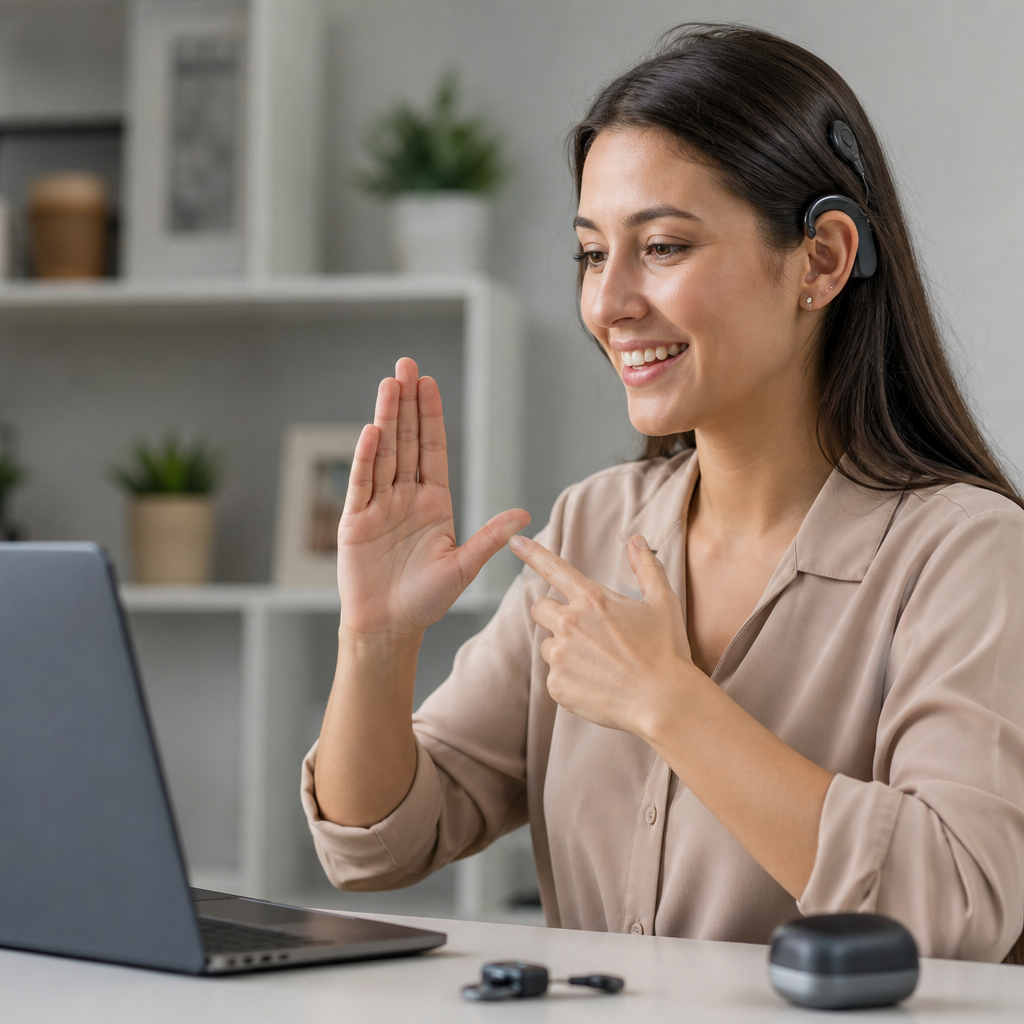

AI-powered sign language recognition is moving from lab demos to practical accessibility tools, and the next phase will shape how deaf and hard of hearing people interact with services, education, work, and public life. In simple terms, sign language recognition uses cameras, sensors, or video feeds plus machine learning to identify hand shapes, movement, facial expressions, and body posture, then translate that input into text, speech, or structured commands. That definition matters because sign languages are not gesture systems layered onto spoken language; they are full natural languages with their own grammar, word order, regional variation, and cultural context. Any serious discussion of AI accessibility has to start there.
I have worked on accessibility-focused language products long enough to see the same mistake repeated: teams assume recognizing hands is enough. It is not. American Sign Language, British Sign Language, Libras, Auslan, and many others rely on non-manual markers such as eyebrow position, mouthing, head tilt, shoulder shift, and signing space. A model that captures only finger positions may perform well in a narrow benchmark and still fail in real communication. That gap between technical accuracy and usable accessibility is exactly why this topic matters now.
The market pressure is obvious. Video communication is standard in customer support, telehealth, remote learning, and workplace collaboration. Governments are also tightening digital accessibility expectations through laws and procurement standards, while schools, hospitals, and employers need scalable ways to serve deaf users beyond scheduled interpreting. At the same time, advances in computer vision, transformer architectures, pose estimation, multimodal learning, and edge AI have made real-time sign analysis far more realistic than it was five years ago. The result is a rare convergence of social need, technical capability, and institutional demand.
As the hub for AI and the future of accessibility, this article maps the field: what sign language recognition can already do, where current systems fail, which tools and standards matter, and what is likely to happen next. If you are evaluating technology for the deaf community, planning accessible services, or building inclusive products, the key question is not whether AI will be involved. It is how to use it responsibly, accurately, and in ways that respect deaf language and culture.
How AI-Powered Sign Language Recognition Works in Practice
Most modern sign language recognition systems combine three technical layers. First, computer vision detects the signer and tracks hands, face, and upper body using methods such as OpenPose, MediaPipe, or custom skeletal models. Second, a feature extraction layer converts those visual signals into data points: finger joint angles, palm orientation, motion trajectories, facial action units, and temporal changes across frames. Third, sequence models such as convolutional recurrent networks, temporal transformers, or graph neural networks classify signs, phrases, or intent over time.
In real deployments, there are usually two different tasks. Isolated sign recognition identifies a single sign from a constrained vocabulary. Continuous sign language recognition handles full signed sentences without explicit pauses between words. The second task is dramatically harder because sign boundaries are fluid, coarticulation changes movements, and grammar is spatial rather than linear. A hospital check-in kiosk may only need a narrow command set like “appointment,” “pain,” or “interpreter.” A classroom support tool must handle rapid, natural signing with far more context.
Translation is a separate challenge from recognition. Recognizing that a user signed a concept is not the same as rendering a natural spoken-language sentence. For example, an ASL utterance may map to several acceptable English outputs depending on context, tense marking, and emphasis. Good systems often use a pipeline: sign recognition first, then language generation tuned for readability. That distinction matters when vendors claim “sign language translation” but are really detecting a limited phrasebook.
The strongest products now use multimodal input. RGB video provides general body motion, depth cameras help with spatial positioning, and wearable sensors can improve hand tracking when fingers overlap or motion blur occurs. However, wearables reduce convenience and are unlikely to become the default for public access tools. In my experience, the most deployable systems are camera-based, privacy-aware, and optimized for imperfect real-world conditions rather than pristine lab footage.
Where Current Tools Deliver Real Value Today
Today’s best use cases are narrow, structured, and high-frequency. Customer service kiosks can support basic signed navigation. Telehealth platforms can flag common intake information before a live interpreter joins. Video relay and remote interpreting platforms can use AI to improve routing, transcription, or meeting summaries without replacing human interpreters. In education, recognition tools can help index signed video content so students can search lessons by topic instead of replaying entire recordings.
A practical example is wayfinding in transportation hubs. An airport can deploy a kiosk that recognizes a limited set of signed requests such as gate number, restroom, baggage claim, and assistance desk. That does not solve all communication needs, but it reduces friction for common questions and creates a faster path to human support when needed. Another useful example is workplace onboarding. Companies can build signed training libraries and use AI tagging to organize modules by policy topic, safety step, or software workflow.
Developers are also using AI to improve captioning and avatar workflows around signed content. A signed video archive can be automatically segmented, indexed, and linked to text summaries. Museums and public agencies can pair sign-language content with searchable metadata, making accessibility assets easier to find and maintain. These are less visible than flashy translation demos, but they produce immediate operational value and better user outcomes.
| Use case | What AI can do now | Main limitation |
|---|---|---|
| Service kiosks | Recognize common requests from a fixed vocabulary | Breaks down in open-ended conversation |
| Telehealth intake | Capture basic symptoms and routing information | Clinical nuance still requires interpreters |
| Education archives | Index, tag, and search signed lesson videos | Subject-specific signs vary by region and school |
| Workplace training | Organize signed modules and support retrieval | Does not replace live discussion or Q&A |
| Public information access | Surface signed answers for routine questions | Needs strong fallback paths for misunderstandings |
The common pattern is clear: AI-powered sign language recognition already works best as an accessibility layer inside a broader service design. When teams position it as augmentation, performance is useful. When they market it as a full replacement for interpreters or bilingual deaf professionals, quality and trust collapse quickly.
The Hard Problems AI Still Has Not Solved
The biggest unsolved issue is linguistic complexity. Sign languages encode meaning simultaneously across hands, face, gaze, and space. Spoken-language systems process mostly sequential tokens; signed languages often combine features at once. That makes annotation expensive and model design more demanding. Public datasets are also limited, fragmented, and often not representative of age, skin tone, signing style, regional dialect, background clutter, lighting conditions, or camera angles seen in actual use.
Bias is another serious concern. Hand tracking accuracy can change with contrast, motion blur, sleeves, jewelry, or camera quality. Facial-expression capture may degrade with low resolution or poor framing, yet those expressions carry grammatical meaning. If a model works best on studio recordings of younger signers but underperforms on older adults or community signers, the accessibility claim is not credible. This is not a minor tuning issue; it is a deployment risk.
Context is equally difficult. Many signs are ambiguous without surrounding information. The same movement may indicate different concepts based on location in signing space, accompanying mouthing, or prior discourse. Human interpreters resolve this with world knowledge and interaction. AI still struggles there. Large multimodal models will improve context handling, but they will not eliminate ambiguity in sensitive settings like legal proceedings, emergency response, or mental health care.
There is also a governance problem. Who owns signed data? Consent, retention, biometric processing, and model training policies need to be explicit. In many jurisdictions, signed video can qualify as sensitive personal data, especially when face, voice, or health context is involved. Organizations should align deployments with privacy law, WCAG-informed accessibility practices, procurement rules, and security controls such as encryption, access logging, and documented deletion schedules.
What the Next Generation of Systems Will Look Like
The next wave will be multimodal, personalized, and domain-aware. Multimodal means combining visual signing data with text prompts, environmental context, prior conversation state, and possibly speech from hearing participants. Personalized means adapting to an individual signer’s pace, preferred framing, and regional variants without forcing retraining from scratch. Domain-aware means a medical system understands appointment language, a school system understands classroom terminology, and a government portal understands service workflows.
Edge processing will become more important. Running inference on-device reduces latency, protects privacy, and keeps tools usable in bandwidth-constrained environments. Smartphones and laptops already contain neural processing hardware capable of supporting lightweight pose estimation and sequence modeling. That will matter for mobile interpreting support, classroom tools, and public-service applications where cloud dependence introduces cost or compliance issues.
We will also see stronger human-in-the-loop design. Instead of fully automatic translation, many systems will present ranked outputs, confidence scores, and escalation options. A receptionist interface might show “Did you mean interpreter, appointment, or pharmacy?” A learning tool might offer multiple text renderings of a signed explanation. This approach mirrors mature speech systems, where confidence-aware workflows outperform blind automation.
Avatar output will improve, but only if developers respect linguistic quality. Rule-based avatars often look robotic because they overemphasize manual signs and underrepresent timing, coarticulation, and non-manual grammar. Better motion synthesis, signer-informed datasets, and rigorous community review can make signed output more intelligible. Still, recorded human signers will remain the preferred format for many high-stakes messages because trust and clarity matter more than novelty.
How Organizations Should Evaluate Sign Language AI
If you are selecting tools, start with the use case, not the demo. Ask what language is supported, whether performance has been tested on continuous signing, how non-manual markers are modeled, what fallback path exists, and whether deaf users were involved in design and validation. Request evidence beyond accuracy headlines. Word error rate, sign error rate, latency, confidence calibration, and out-of-vocabulary handling all matter. So does usability testing with native signers.
Procurement teams should also ask about dataset provenance, model retraining policies, regional language support, and accessibility integration. A useful product should fit into existing communication workflows, not create a separate inaccessible channel. For example, a hospital tool should integrate with patient intake, interpreter scheduling, and audit trails. A university tool should connect with lecture capture, learning management systems, and captioning processes.
From experience, the most reliable implementation strategy is phased deployment. Begin with one narrow scenario, define success metrics, involve deaf staff or community reviewers, and monitor failure modes closely. Expand only after the tool proves useful under ordinary conditions, including poor lighting, mixed backgrounds, and varied signing styles. Accessibility technology succeeds when it reduces friction consistently, not when it performs brilliantly in a pilot video.
The Future of Accessibility Depends on Co-Design
The most important point is cultural as much as technical: the future of accessibility cannot be built for deaf communities without being built with them. Sign language recognition will advance because models are improving, but adoption will depend on trust, transparency, and shared governance. Deaf researchers, interpreters, educators, advocates, and native signers need seats at every stage, from data collection and annotation to evaluation and policy.
AI-powered sign language recognition is next headed toward practical, embedded assistance rather than magical universal translation. Expect better indexing of signed content, smarter public-service interfaces, faster routing to human support, and more context-aware accessibility tools across health care, education, and employment. Expect slower progress in open-ended conversation, legal nuance, and culturally sensitive translation, where human expertise will remain essential.
For organizations in the Technology and Tools for the Deaf Community space, the opportunity is significant. Used well, AI can make signed communication easier to access, search, route, and support at scale. Used poorly, it can misrepresent language, create false confidence, and exclude the very people it claims to help. The path forward is clear: focus on real user needs, evaluate systems rigorously, and design around human communication rather than around a model demo. If you are building your accessibility roadmap, start by auditing where sign language AI can add measurable value today, then expand from that evidence.
Frequently Asked Questions
1. What does the next phase of AI-powered sign language recognition actually look like?
The next phase is less about flashy lab demos and more about reliable, everyday usefulness. In practice, that means sign language recognition systems will need to work in real-world settings such as classrooms, customer service counters, telehealth visits, workplaces, public kiosks, and video calls. Future tools are expected to become better at understanding full signed communication rather than just isolated hand gestures. That includes recognizing hand shape, motion, speed, spatial positioning, facial expression, head movement, and body posture together, because sign languages rely on all of those elements to convey meaning.
Just as importantly, the technology is likely to become more personalized and context-aware. A strong system will need to handle differences in signing style, camera angle, lighting, signing speed, dialect, and regional variation. It will also need to distinguish between command-style gesture recognition and true sign language recognition, which is far more linguistically complex. Instead of simply converting signs into words one by one, next-generation systems will increasingly focus on capturing grammar, intent, and conversational context. That shift is what could move the field from novelty to meaningful accessibility infrastructure.
Another major part of what comes next is integration. Rather than existing as standalone apps, sign language recognition will likely be built into mainstream platforms and services. That could include video conferencing software, public information systems, digital forms, smart devices, transportation hubs, and educational technology. When that happens, the value of the technology expands because it becomes part of how people naturally access services instead of something extra they must request or install separately.
2. Why is sign language recognition so challenging for AI compared with other forms of speech or text recognition?
Sign language recognition is challenging because sign languages are full natural languages with their own grammar, syntax, and expressive structure. They are not simply spoken languages acted out with the hands. A sign can change meaning based on movement, location in signing space, palm orientation, facial expression, body posture, and timing. If an AI system focuses only on hand tracking, it misses a large share of the information needed for accurate interpretation. That makes the problem much more complex than basic gesture detection.
There is also enormous variation across sign languages, including American Sign Language, British Sign Language, French Sign Language, and many others, each with different vocabulary and linguistic rules. Even within a single sign language, there may be regional signs, personal style differences, and contextual shortcuts used by fluent signers. AI systems must be trained on broad, representative datasets to handle that diversity, but collecting such data is difficult, expensive, and sensitive from a privacy and consent perspective.
Technical conditions make things even harder. Real-world video often includes cluttered backgrounds, inconsistent lighting, partial occlusion, camera movement, low frame rates, and limited visibility of the signer’s upper body or face. A system might perform well in a controlled lab but struggle badly in a busy office or on a low-quality phone camera. For that reason, progress depends not only on better machine learning models but also on smarter multimodal design, stronger datasets, and close collaboration with deaf communities and sign language experts who understand what accurate recognition really requires.
3. How could AI-powered sign language recognition improve accessibility in education, work, and public services?
If designed and deployed well, AI-powered sign language recognition could reduce communication friction in many everyday environments. In education, it could support more interactive learning tools, help students navigate digital platforms, and improve access to classroom materials, tutoring systems, and recorded lessons. In workplaces, it could make internal tools, onboarding systems, meetings, and customer-facing workflows more accessible. In public services, it could help people interact with information desks, kiosks, transit systems, healthcare portals, and government services with fewer barriers.
One of the most promising benefits is responsiveness. Instead of relying only on scheduled accommodations or limited human availability, AI systems could offer immediate support in moments where communication access is otherwise delayed or missing. For example, a service kiosk might detect signed input and convert it into a structured request, or a virtual assistant could respond to a signer in a more accessible way. In digital communication environments, sign-aware systems could improve navigation, search, transcription support, and multimodal interaction.
That said, the best role for this technology is often as a support layer, not a universal replacement for human interpreters or direct communication methods. High-stakes situations such as legal proceedings, medical consultations, education planning, and complex workplace discussions still require human judgment, nuance, and accountability. The real opportunity is to close everyday access gaps, extend communication options, and make services more flexible. Accessibility improves most when AI is treated as one tool within a broader inclusive design strategy rather than as a complete substitute for human-centered access solutions.
4. What are the biggest ethical and practical concerns about using AI for sign language recognition?
The biggest concern is accuracy in real-world, high-impact situations. If a system misunderstands a signed question at a hospital check-in desk, a school support meeting, or a job interview, the result is not just a technical error; it can affect rights, opportunities, safety, and trust. That is why claims about performance need to be tested carefully across many users, settings, and signing styles. A tool that works well only for a narrow group of signers is not truly accessible.
Privacy is another major issue. Sign language recognition often depends on video capture of faces, hands, and body movement, which means these systems can process highly sensitive biometric and behavioral data. Users need clear consent, transparent data practices, secure storage, and meaningful control over how recordings are used. There are also concerns about surveillance, especially if sign recognition is embedded into public spaces without strong oversight. Accessibility technology should expand autonomy, not create new forms of monitoring or data extraction.
There is also an important social concern: who builds the system, who defines success, and whose language gets represented. If deaf and hard of hearing communities are excluded from product design, data collection, testing, and governance, the resulting tools may misrepresent sign language or fail to address real communication needs. Ethical progress in this field depends on community involvement from the start. The strongest systems will be those built with deaf leaders, sign language linguists, accessibility experts, and end users shaping both the technology and the rules around how it is used.
5. Will AI-powered sign language recognition replace interpreters, or will it serve a different role?
In most realistic scenarios, AI-powered sign language recognition will serve a different role rather than fully replacing interpreters. Human interpreters do much more than map visible signs to words. They handle nuance, tone, context, turn-taking, ambiguity, cultural mediation, and the complexities of live interaction. They can ask for clarification, adapt to the speaker and signer, and make judgment calls in situations where precision matters. Current and near-future AI systems are not equipped to match that level of linguistic and interpersonal skill across all settings.
Where AI can add real value is in coverage, speed, and convenience. It can support lower-stakes interactions, enable basic access where no interpreter is available, and make digital tools more responsive to signed input. It may be especially useful for navigation, form completion, device control, customer service triage, and other structured tasks. In that role, sign language recognition can fill practical gaps and improve independence without pretending to replace expert human communication support.
The most likely future is a hybrid one. Organizations that take accessibility seriously will use AI where it helps, while still investing in interpreters, captioning, inclusive design, and direct communication options. That balanced approach is important because accessibility is not solved by a single feature. The real goal is to give deaf and hard of hearing people more ways to communicate effectively, more consistently, and on their own terms. When AI is developed with that goal in mind, it becomes far more valuable than a simple translation tool.