
Artificial intelligence is reshaping deaf communication by turning speech, text, video, and environmental sound into information people can access in the format that works best for them. In this context, AI means software systems that learn patterns from data and perform tasks such as speech recognition, language translation, image analysis, predictive text, and conversational assistance. Deaf communication includes sign languages, captioning, transcription, visual alerts, haptic feedback, relay tools, and the many social norms that make interaction clear and respectful. As someone who has evaluated accessibility tools in workplaces, classrooms, and telehealth settings, I have seen one fact repeat across every environment: the best AI tools do not replace human communication choices, interpreters, or community knowledge; they expand options and reduce friction when designed well.
This matters because communication barriers still affect education, employment, healthcare, public services, and daily independence. A missed medication instruction, an uncaptioned training video, or a video meeting without clear turn-taking can exclude a deaf person in seconds. AI can help by generating live captions, improving hearing aid processing, translating signs in narrow use cases, summarizing long conversations, and detecting important sounds like alarms or doorbells. It also raises hard questions about accuracy, privacy, bias, language coverage, and whether developers understand the difference between signed languages and signed versions of spoken languages. For anyone researching AI and the future of accessibility, this article serves as a hub: it explains what AI currently does well, where it still fails, how to evaluate tools, and which trends are likely to shape deaf communication over the next few years.
How AI supports deaf communication today
The most widely used AI applications for deaf communication are automatic speech recognition, machine translation support, computer vision, and context-aware notifications. Automatic speech recognition powers live captions on Zoom, Google Meet, Microsoft Teams, YouTube, smartphones, and dedicated captioning apps such as Ava, Otter, and Nagish. In practical terms, a deaf employee can join a meeting and read a live transcript instead of waiting for notes afterward. A student can follow a lecture in near real time. A patient can review an appointment summary generated from spoken discussion. Accuracy has improved sharply because modern systems use transformer-based language models and large acoustic datasets, but results still depend on microphone quality, speaker pace, accent variation, background noise, and domain vocabulary.
Computer vision supports another layer of access. Smartphones can identify sounds and send visual alerts for sirens, smoke alarms, crying babies, running water, or knocks at the door. Google Sound Notifications and similar features on Android and iOS have made environmental awareness more practical at home and in transit. Some tools also detect who is speaking in a meeting by linking captions to speaker identification, which reduces confusion in group conversations. In customer service and call environments, AI-backed relay systems can route, transcribe, and summarize interactions more quickly than older rule-based software. None of these tools are perfect, but together they have moved accessibility from a specialized add-on toward an everyday operating system feature.
Real-time captioning and transcription: the strongest current use case
If one category defines the present role of AI in deaf communication, it is real-time captioning. The reason is simple: speech-to-text solves a common barrier across work, education, healthcare, entertainment, and public life. In my testing, the difference between a mediocre caption stream and a strong one comes down to latency, punctuation, speaker separation, proper noun handling, and how easily users can correct custom vocabulary. Platforms that allow phrase boosting or vocabulary injection perform better in specialized settings. A hospital discussing medication names, a law firm handling case citations, or a software team using technical acronyms all need models tuned beyond generic conversation.
Real-time captions are not the same as Communication Access Realtime Translation delivered by trained captioners, and that distinction matters. Human captioners still outperform AI in accuracy for high-stakes events, overlapping speech, and specialized terminology. However, AI captions are available instantly, at scale, and often at low cost or no extra cost. That makes them essential for routine interactions. The strongest accessibility strategy is usually layered: AI captions for day-to-day use, human captioning for critical events, and transcripts saved for review. Organizations that treat AI captions as a complete replacement often run into preventable failures, especially during legal proceedings, medical appointments, safety training, and multilingual discussions.
AI and sign language: promise, limits, and persistent misconceptions
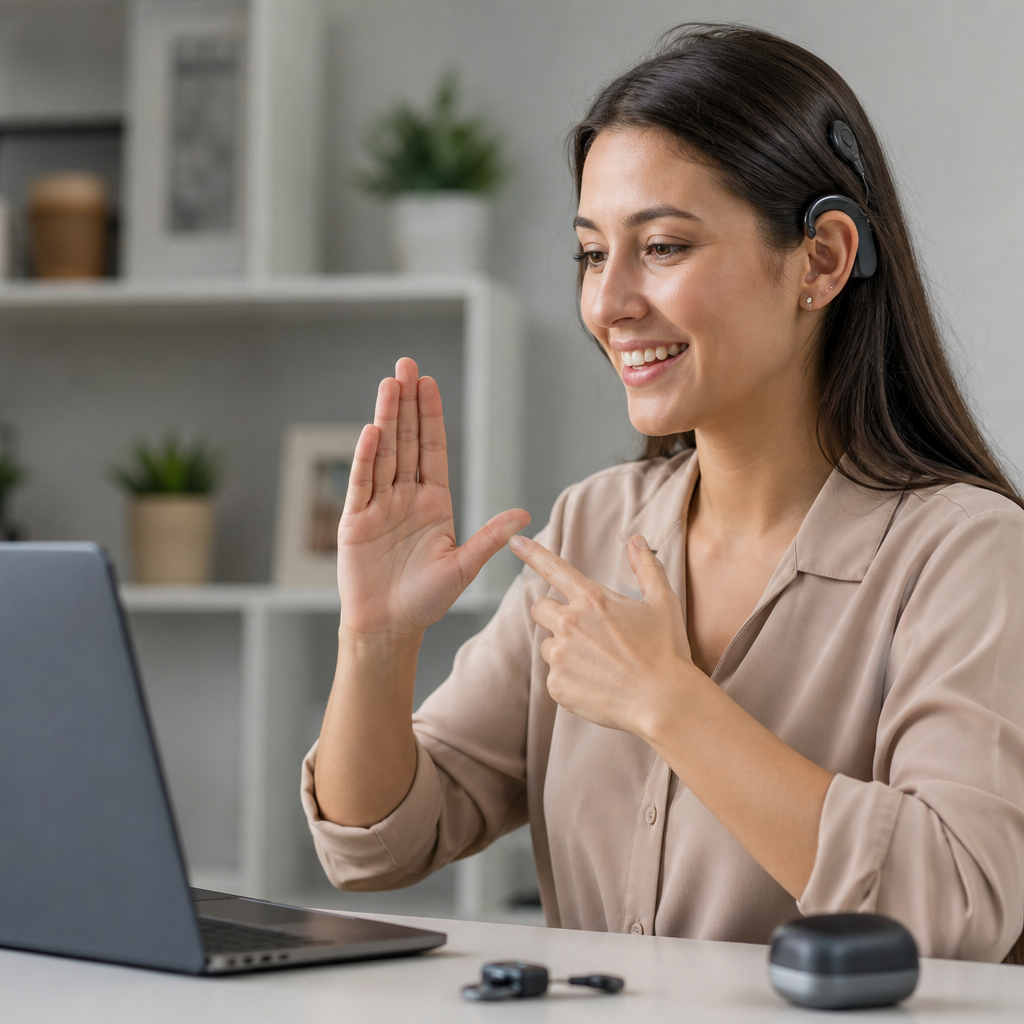
Sign language technology gets attention, but it is also where public understanding is often weakest. Sign languages are full natural languages with their own grammar, word order, morphology, and regional variation. American Sign Language is not signed English. British Sign Language is different from ASL. This means AI sign language tools cannot be built as simple word-for-word substitution engines. Systems need to interpret handshape, movement, palm orientation, facial expression, body position, timing, and context. That is a far harder problem than many product demos suggest.
Current AI tools in sign language fall into a few narrow categories: recognition of a limited vocabulary, avatar-based output for constrained phrases, educational feedback for learners, and research systems trained in controlled environments. These can be useful for wayfinding kiosks, fixed service scripts, or early language practice. They are not yet reliable substitutes for qualified interpreters or fluent direct communication. The biggest obstacles are dataset quality, signer diversity, camera angle variation, occlusion, dialect differences, and the fact that meaning often spans an entire utterance rather than isolated signs. Any serious discussion of AI and deaf communication must be clear on this point: sign language recognition remains promising, but broad real-world deployment is still limited.
Where AI improves daily life beyond conversations
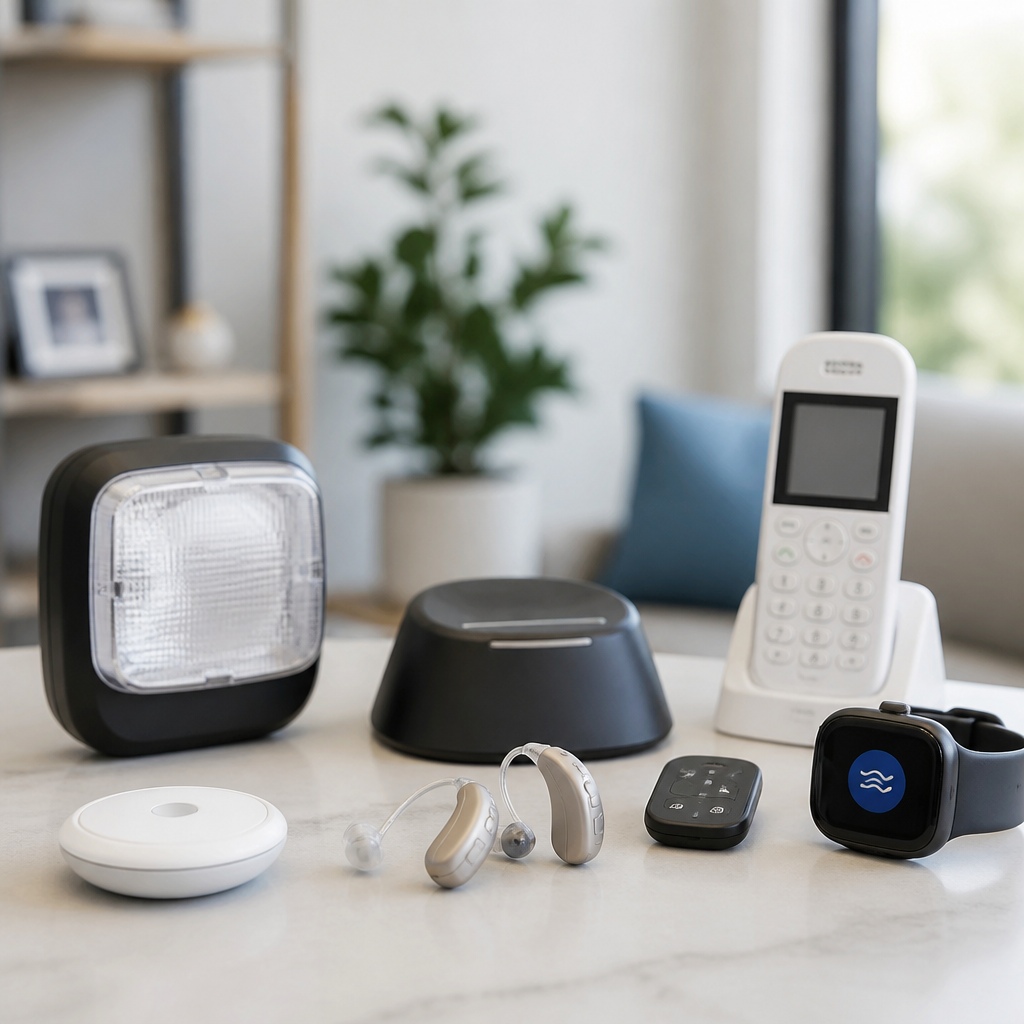
AI helps outside direct person-to-person communication as well. Environmental sound recognition has become one of the most practical accessibility gains for deaf households. A phone or smart display can listen for a smoke alarm, breaking glass, a baby crying, a kettle, or a doorbell, then push a visual alert, smartwatch vibration, or connected light flash. Smart home systems can combine these signals with routines, such as turning on hallway lights at night when a door sensor triggers. For many users, this adds security and independence more consistently than older single-purpose devices.
AI also improves media access. Automated captioning on social platforms has reduced the amount of completely inaccessible video, even if quality remains uneven. Editing tools now suggest caption timing, speaker labels, and punctuation, lowering the burden on creators. In education, note-taking assistants can convert lectures into searchable summaries, action items, and study guides. In employment, AI meeting assistants can create transcripts and recap decisions after a call, helping deaf professionals verify what was said and share records with teams. These features are most valuable when users can edit outputs easily, because accessibility fails when systems produce text that looks polished but contains subtle errors.
How leading AI accessibility tools compare
Choosing the right tool depends on setting, risk level, and communication style. A classroom has different needs from a construction site or a clinic. The comparison below reflects patterns I have seen repeatedly during evaluations.
| Tool category | Best use | Strengths | Key limitations |
|---|---|---|---|
| Built-in video meeting captions | Routine team meetings and webinars | Immediate access, no setup, speaker labels on some platforms | Accuracy drops with noise, jargon, and overlap |
| Dedicated captioning apps | In-person conversations, classes, appointments | Portable, transcript export, custom vocabulary in some apps | Phone microphone limits and privacy concerns |
| Human live captioning | Legal, medical, academic, and public events | Highest accuracy and better handling of nuance | Scheduling and cost |
| Sound recognition tools | Home safety and situational awareness | Useful alerts for alarms, bells, and household sounds | False positives and missed detections |
| Sign language AI tools | Limited scripted interactions and learning support | Promising for narrow workflows | Not reliable for open-ended fluent conversation |
A practical rule is to match the tool to the consequence of being wrong. If a missed phrase creates mild inconvenience, AI-only support may be fine. If a missed phrase could affect safety, consent, grades, legal standing, or employment evaluation, add human support and redundant access methods.
Risks, bias, and privacy challenges
AI accessibility tools can fail in ways that are invisible to hearing users and exhausting for deaf users. Speech recognition often performs worse with accented speech, multilingual code-switching, poor room acoustics, or speakers who talk over one another. It can mis-handle names, medication terms, and domain-specific vocabulary. Sign-related datasets may underrepresent Black signers, older adults, children, regional dialects, and people with mobility differences. That creates uneven performance and reinforces exclusion under the appearance of innovation.
Privacy is just as important. Many AI systems process audio or video in the cloud, store transcripts, and use recordings for model improvement unless settings are changed. In workplaces and schools, that raises questions about consent, retention, data security, and compliance with laws or institutional policy. Healthcare settings must consider HIPAA in the United States. Public agencies and schools may face procurement rules tied to accessibility and records retention. The safest approach is to review where data is processed, whether encryption is used, how long transcripts are stored, who can access them, and whether users can opt out of training. Accessibility should never require surrendering unreasonable amounts of personal data.
What good implementation looks like in schools, workplaces, and healthcare
Successful implementation starts by asking deaf users what communication method they prefer in specific situations. There is no universal solution. In schools, AI captions work best when instructors use quality microphones, share vocabulary in advance, caption all recorded media, and provide notes or transcripts after class. In workplaces, teams should enable captions by default in meetings, train staff to speak one at a time, and choose platforms that save searchable transcripts. In healthcare, providers should not assume auto-captions are enough for informed consent; they should offer interpreters, live captioning, patient portal summaries, and visual communication supports as needed.
Procurement also matters. When organizations buy accessibility tools, they should test them with deaf users before rollout, not after complaints appear. Evaluation should include latency, offline capability, language support, export options, security settings, and performance in realistic acoustic conditions. Ask vendors direct questions about training data, custom terminology, bias testing, and whether the product supports API connections with learning systems, electronic health records, or collaboration platforms. The future of accessibility will not be decided by marketing claims. It will be decided by whether tools perform reliably in the messy conditions of real life.
The future of AI and the future of accessibility
Over the next few years, AI in deaf communication will become more personalized, multimodal, and embedded in everyday devices. Personalized models will adapt to frequent speakers, preferred vocabulary, and recurring contexts such as classrooms or clinics. Multimodal systems will combine audio, video, text, and environmental sensors so that captions, sound alerts, summaries, and visual cues reinforce one another. Earbuds, smart glasses, watches, phones, meeting platforms, and home assistants will increasingly share accessibility signals across a single ecosystem.
Two trends deserve close attention. First, on-device processing is improving, which can reduce latency and strengthen privacy because less data must leave the device. Second, foundation models are making summaries and question answering more useful, allowing a deaf user to search a long transcript for decisions, deadlines, or unclear statements. Still, the central principle will remain the same: AI should support communication choice, not dictate it. The strongest future is one where deaf people can move fluidly between captions, sign language, text, vibration, visual alerts, and human interpretation depending on context. That is what real accessibility looks like.
Artificial intelligence already plays a meaningful role in deaf communication, but its value depends on honest expectations and careful design. Today, its clearest strengths are live captioning, transcription, sound recognition, searchable summaries, and integrated accessibility across mainstream devices and platforms. Its weaker areas include open-ended sign language recognition, performance in chaotic audio, and any setting where stakes are too high to tolerate transcription errors without backup. The practical lesson is not to ask whether AI is good or bad for accessibility. The better question is where it is reliable, where it needs human support, and how organizations can deploy it without compromising privacy, accuracy, or user choice.
As the hub page for AI and the future of accessibility, this article points to the core standard every related tool should meet: it must increase independence while respecting language, culture, and context. When selecting technology for the deaf community, prioritize tested accuracy, transparent data practices, customization, and compatibility with human services such as interpreters and live captioners. If you are building an accessibility stack for a school, workplace, clinic, or household, start with one real communication scenario and evaluate tools there first. Better access begins with practical testing, not assumptions.
Frequently Asked Questions
How is AI changing deaf communication in everyday life?
AI is changing deaf communication by making spoken, written, signed, and environmental information easier to access in real time and in the format that works best for each person. In practical terms, that includes automatic captions for live conversations and video calls, speech-to-text transcription for meetings and classrooms, visual or haptic alerts for sounds such as doorbells, alarms, and sirens, and language tools that help convert text or speech into more understandable forms. Instead of relying on a single access method, AI helps create multiple pathways to the same information.
What makes this shift so important is speed and adaptability. Traditional accessibility tools often required human setup, scheduled services, or manual transcription. AI can respond instantly, learn usage patterns, and improve performance across different settings. For example, a smartphone app may identify a speaker’s voice, reduce background noise, and generate captions on the spot. Video platforms can add live subtitles, while smart home systems can send visual notifications when a baby cries or someone knocks at the door. These tools do not replace the value of sign languages, interpreters, or human support, but they can expand communication options at home, at work, in school, and in public spaces.
Can AI accurately translate sign language and spoken language?
AI can help with translation between spoken or written language and sign language, but accuracy varies widely depending on the technology, the language pair, and the context. Sign languages are full natural languages with their own grammar, structure, facial expressions, body movements, and regional variation. That means sign language is not simply a word-for-word visual version of spoken language. For AI systems, this creates a difficult challenge. A strong translation tool must recognize handshape, movement, location, facial grammar, timing, and context, then produce output that is linguistically and culturally appropriate.
Speech-to-text technology is generally more mature than sign language translation, especially for widely used spoken languages in controlled conditions. Even so, speech recognition can still struggle with accents, fast speech, overlapping voices, industry-specific terms, and background noise. Sign language recognition and generation are developing quickly, but they are still limited in many real-world situations. Some systems work better for a defined vocabulary or scripted interactions than for natural conversation. Because of that, AI translation should usually be seen as a support tool rather than a perfect substitute for fluent signers, certified interpreters, or native-language communication. The most promising future lies in tools designed with deaf communities, linguists, and accessibility experts so that accuracy, usability, and respect for sign language are built into the system from the start.
What are the biggest benefits of AI-powered captions, transcription, and alerts for deaf users?
The biggest benefit is greater independence. AI-powered captions and transcription can make conversations, presentations, calls, and media more immediately accessible without waiting for a transcript to be prepared later. That can improve participation in workplaces, classrooms, healthcare appointments, public events, and everyday social interactions. When captions are clear and timely, users can follow the flow of a conversation, identify key details, and respond more confidently. In recorded content, searchable transcripts also make it easier to review important information, study, or document what was said.
AI-based alerts add another layer of accessibility by turning sound into visual or tactile information. A system might flash lights when a smoke alarm goes off, vibrate a wearable when a phone rings, or send a mobile notification when a name is called in a waiting room. These tools can improve safety as well as convenience. They are especially useful in environments where critical sounds may otherwise be missed. Together, captions, transcription, and alerts help reduce communication barriers by providing access across many situations, not just formal settings. When well designed, they allow people to choose the access method that fits the moment, whether that is reading captions, receiving a vibration, or reviewing a transcript after the fact.
What are the limitations and risks of using AI in deaf communication?
AI can be extremely useful, but it is not flawless, and its limitations matter. One of the biggest issues is accuracy. Captions may drop words, confuse speakers, or mistranscribe technical language. Sound recognition systems may miss important environmental cues or trigger false alerts. Sign language tools may oversimplify grammar or fail to capture facial expressions and context. In high-stakes situations such as medical care, legal communication, education, or emergency response, these errors can create serious misunderstandings. That is why AI should be evaluated based on the specific use case rather than assumed to be reliable in every situation.
There are also concerns about privacy, bias, and representation. Many AI systems depend on large datasets that may not fully represent deaf users, diverse sign languages, regional dialects, or real-world communication styles. If the data is incomplete, the system may perform poorly for the very people it is meant to help. Privacy is another key issue because voice recordings, video feeds, and personal conversations may be processed or stored by third-party systems. Users and organizations should look for tools with transparent data practices, clear consent policies, and strong security protections. Most importantly, accessibility should not be treated as a technical shortcut. AI works best when it complements human expertise, community input, and user choice rather than replacing them.
How can organizations use AI responsibly to improve accessibility for deaf communities?
Organizations can use AI responsibly by treating accessibility as a long-term commitment, not a feature added at the end. That starts with involving deaf people in planning, testing, and decision-making. Businesses, schools, healthcare providers, media companies, and public agencies should ask what kinds of access users actually need, whether that means live captions, better transcripts, sign language options, visual alerts, haptic feedback, or support for relay communication. AI tools should then be tested in realistic conditions, including noisy spaces, group discussions, and specialized subject matter, to make sure they perform reliably.
Responsible use also means keeping human backup and user control in place. For example, an organization may offer AI captions during meetings but still provide professional interpreters or CART services when needed. It may use AI-generated transcripts for speed but give users a way to correct errors. Policies should address accuracy standards, privacy safeguards, staff training, and clear communication about what the technology can and cannot do. The most effective strategy is usually a layered one: combine AI with established accessibility practices so people can choose the format that serves them best. When organizations build with inclusion, transparency, and flexibility in mind, AI can become a powerful tool for expanding access rather than a one-size-fits-all solution.