Real-time translation for sign language is moving from research labs into everyday products, and its future will shape how deaf, hard of hearing, and hearing people communicate at work, in school, in healthcare, and online. In this context, real-time translation means software or devices that interpret signed input into spoken or written language, or convert speech and text into sign output with minimal delay. The field sits at the intersection of computer vision, natural language processing, speech recognition, avatar animation, wearable sensors, and accessibility design. I have worked with accessibility teams evaluating captioning, speech interfaces, and sign-recognition prototypes, and one lesson is consistent: useful accessibility technology is not defined by novelty alone, but by accuracy, speed, cultural fit, and trust. That is why this topic matters so much within AI and the future of accessibility. A strong sign language translation system could reduce friction in customer service, emergency response, telehealth, classrooms, and public information. A weak system could introduce dangerous errors, misread grammar, and sideline human interpreters where they remain essential. Understanding the future requires clarity about what sign languages are, what current systems can do, where they fail, and what responsible progress looks like.
Sign languages are complete natural languages with their own grammar, word order, spatial structure, and cultural context. American Sign Language is not signed English; British Sign Language is different again; many countries and regions have distinct signed languages and dialect variation. Translation is therefore not a simple matter of mapping one hand shape to one word. Systems must recognize hand configuration, movement, palm orientation, facial expression, mouthing, body posture, timing, and location in signing space. They must also process discourse features such as role shift, classifiers, and nonmanual markers that carry grammatical meaning. This complexity explains why the future of real-time translation for sign language depends on better datasets, better multimodal models, and deeper collaboration with deaf communities. It also explains why this article serves as a hub for broader questions about AI accessibility: the same issues of bias, privacy, latency, device design, and inclusive procurement appear across captioning, voice assistants, educational tools, and assistive communication platforms. If organizations want to invest wisely, they need a practical view of the landscape rather than a science-fiction promise.
Where real-time sign language translation stands today
Today’s systems generally fall into two categories. The first is sign recognition, where cameras or sensors analyze a signer’s movements and produce text or speech. The second is sign generation, where speech or text is converted into animated signing through an avatar or prebuilt video segments. Both categories have improved because transformer models, pose estimation, edge computing, and better cameras can capture more detail than earlier systems. Tools built on OpenPose, MediaPipe, and custom keypoint pipelines can track hands and body landmarks in real time. Speech technology from providers such as Google, Microsoft, and Amazon has also reduced the barrier to building multimodal accessibility workflows that combine signing, captions, and spoken output.
Even so, current performance is uneven. Many demonstrations work well only on narrow vocabularies, controlled lighting, front-facing camera angles, and trained signers performing isolated signs. Real communication is messier. In live conversations, people overlap, change speed, sign regionally, switch registers, fingerspell unfamiliar names, and use facial grammar that low-quality webcams may not capture. In evaluations I have seen, systems that look impressive in a demo become unreliable when used in clinics, classrooms, or customer-service counters with background motion and inconsistent framing. That gap between benchmark accuracy and field performance is the central challenge the next generation must solve.
Why sign language translation is technically hard
The difficulty starts with multimodality. Spoken language systems often process a one-dimensional audio stream. Sign language systems must understand synchronized visual channels: both hands, face, torso, gaze, and space. Facial expression is not decoration; it can mark questions, negation, intensity, and topic structure. Classifiers can describe vehicles moving, people walking, or objects being placed through movement patterns rather than dictionary-like signs. Fingerspelling adds another layer, especially when names, brands, and medical terms appear. A model that misses one of these channels may produce grammatically wrong output even if it captures some lexical content.
Another challenge is data. Large language models benefit from vast text corpora. Sign language datasets are smaller, more fragmented, and harder to annotate. High-quality annotation requires fluent signers, multiple camera views, gloss conventions, and metadata about dialect, signer background, and context. Privacy concerns are also sharper because video of signing captures faces and identities. As a result, many publicly available datasets are limited in size or scope, which makes generalization difficult. Without broader, community-approved data collection and better annotation standards, progress will remain uneven across languages and use cases.
Core technologies driving the next wave
The most important advances will come from combining several mature technologies rather than waiting for one breakthrough. Computer vision now extracts body, face, and hand landmarks with lower latency on consumer hardware. Self-supervised learning can use unlabeled video to learn movement patterns before fine-tuning on smaller labeled sign datasets. Multimodal transformers can align video, text, and speech in a shared representation, making translation more context aware. On-device inference through phones, tablets, and dedicated edge chips can reduce cloud dependence, improving privacy and responsiveness in hospitals, classrooms, and public offices.
Sign generation is improving as well. Earlier avatar systems often looked robotic, with unnatural transitions and poor facial grammar, which reduced comprehension and trust. New animation pipelines can produce smoother motion by blending linguistic rules, motion capture, and neural rendering. The best future systems will not simply display signed keywords. They will generate linguistically valid sequences, pause naturally, preserve prosody, and allow users to choose regional variations or slower playback. That matters because accessible output is not just about presence; it is about intelligibility.
| Technology | What it does | Near-term impact on accessibility |
|---|---|---|
| Pose estimation | Tracks hands, face, and body landmarks | Improves recognition on standard cameras and phones |
| Multimodal transformers | Connects video, text, and speech context | Produces more accurate translation in conversation |
| Edge AI chips | Runs models locally with low latency | Supports private use in clinics, schools, and field work |
| Neural avatar animation | Generates smoother signed output | Makes text-to-sign tools more understandable |
| Synthetic data and motion capture | Expands training material | Helps cover rare signs, viewpoints, and environments |
Real-world use cases that will benefit first
The earliest high-value wins will likely appear in structured settings rather than open-ended social conversation. Customer service kiosks, transit information desks, banking workflows, and government forms use repeated vocabulary and predictable intent, which makes translation systems easier to tune and test. In healthcare, speech-to-text plus sign-supported explanation tools could help with intake, appointment logistics, and routine discharge instructions, while human interpreters remain necessary for diagnosis, consent, and complex discussion. In education, lecture capture systems may combine captions, transcripts, and sign-linked glossaries so students can review material in multiple formats. In the workplace, internal tools can support short operational exchanges, training modules, and safety reminders.
Emergency communication is another strong use case, but it demands caution. During evacuations or severe weather alerts, simple, validated messages translated quickly into local sign language could save time. However, emergency systems must meet a higher standard because a mistranslated instruction can cause harm. For that reason, the future is likely to involve layered communication: plain-language text, high-quality captions, prerecorded signed alerts for known scenarios, and live interpreter escalation when events become complex. The best accessibility programs already design this redundancy into their crisis planning.
Human interpreters will remain essential
One of the most important truths in this field is that better AI does not eliminate the need for professional sign language interpreters. It changes where their expertise is used. High-stakes settings including courtrooms, medical consultations, mental health sessions, academic advising, and complex workplace meetings require judgment, cultural mediation, repair strategies, confidentiality, and ethical decision-making that automation cannot reliably provide. Professional standards from interpreter associations exist for good reason. When organizations treat machine translation as a full substitute, they transfer risk to deaf users.
The more realistic future is collaborative. AI can handle triage, routing, basic informational exchanges, glossary support, transcript generation, and post-event search. Human interpreters can focus on nuanced communication, verification, and situations where accuracy outweighs speed. I have seen this division work best when teams frame AI as assistive infrastructure rather than autonomous replacement. That approach also earns more trust from deaf employees and customers because it acknowledges real limitations instead of hiding them behind marketing claims.
Design requirements for systems people will actually use
Useful products must be built around deaf user needs from the first prototype. That includes camera placement guidance, visual feedback when signing moves out of frame, options for regional sign variation, and interfaces that avoid clutter. Latency matters greatly; even a delay of a second or two can disrupt turn-taking. So does error handling. A good system should signal uncertainty, offer alternate interpretations, and let users correct output quickly. In text-to-sign tools, playback controls, sign speed adjustment, and easy repetition are essential. Accessibility also means cross-device consistency, offline fallback, and compatibility with captions, transcripts, hearing aids, and video relay workflows.
Trust is equally important. Users need to know whether video is stored, who can access it, how long it is retained, and whether model training uses their data. Procurement teams should ask vendors about dataset sources, bias testing, dialect coverage, and independent evaluation. Accuracy claims without methodology are not enough. A product that reports ninety-five percent accuracy on isolated classroom signs may perform far worse in a multilingual hospital waiting room. Responsible buyers demand scenario-based testing, not headline numbers alone.
The biggest barriers to broader adoption
Three barriers stand out: language diversity, economics, and governance. Language diversity is obvious but often underestimated. There is no single universal sign language, and local variation exists within national languages. Building robust support across communities requires sustained investment, not one global model trained on a narrow sample. Economics is the second barrier. Collecting video data ethically, hiring fluent annotators, validating output with community reviewers, and maintaining specialized models is expensive. Many startups underestimate this and pivot toward simplified demos rather than durable accessibility tools. Governance is the third barrier. Public institutions need policies for risk classification, privacy, procurement, and human oversight before deploying translation systems in critical services.
There is also a social barrier: fatigue from overpromised accessibility technology. Deaf users have seen products marketed as revolutionary that fail under ordinary conditions. Companies that want adoption must earn it through pilot programs, transparent reporting, and co-design with deaf advisors who can veto poor assumptions. The future belongs to organizations that treat accessibility as operational quality, not public relations.
What the next five years are likely to bring
Over the next five years, expect steady progress rather than a single breakthrough. Recognition for constrained domains will improve first, especially on mobile devices with better cameras and dedicated neural processors. Multimodal assistants will combine captions, speech recognition, translation memory, and sign-aware prompts into unified accessibility dashboards. Text-to-sign output will become more natural for standardized content such as transit notices, benefits information, onboarding material, and product instructions. Benchmarking will mature, with more demand for real-world evaluation across lighting, dialects, signer styles, and age groups. Enterprise buyers will also push for audit trails, confidence scoring, and integration with existing communication platforms.
The long-term prize is not a magic translator that replaces every interaction. It is a flexible communication ecosystem where sign language tools, interpreters, captions, transcripts, and accessible content design work together. Organizations building under the broader Technology and Tools for the Deaf Community umbrella should use this topic as a planning hub: assess needs by context, separate convenience from risk, involve deaf stakeholders early, and invest in systems that can improve over time. Real-time translation for sign language will become more useful, more specialized, and more embedded in daily life. The real opportunity is to deploy it where it expands access without compromising accuracy or dignity. If you are shaping an accessibility roadmap, start by auditing current communication barriers and identifying the moments where sign-aware AI can responsibly make the biggest difference.
Frequently Asked Questions
1. What does real-time translation for sign language actually mean?
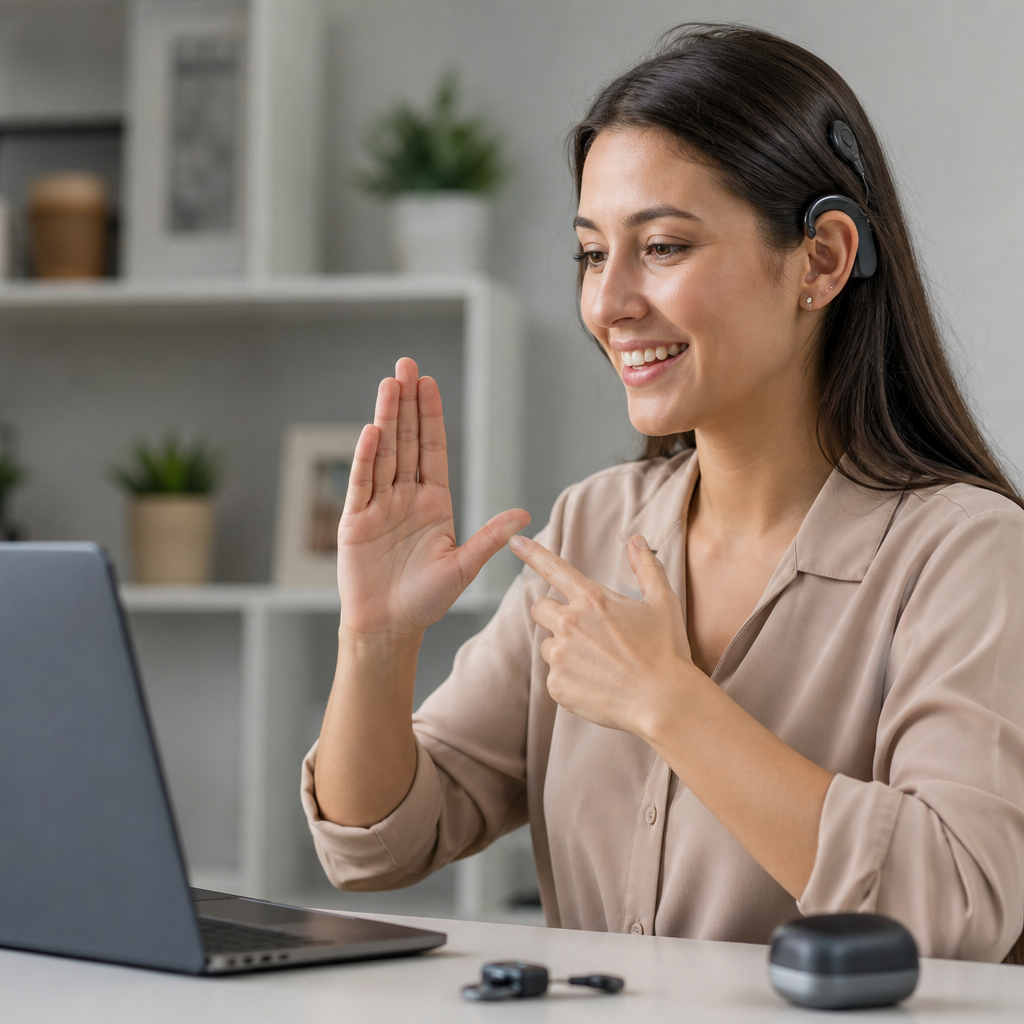
Real-time translation for sign language refers to technology that can interpret communication with very little delay as a conversation is happening. In practice, this can work in two directions. One direction is sign-to-text or sign-to-speech, where a camera-based system detects handshapes, movement, facial expressions, body posture, and signing space, then converts that input into written or spoken language. The other direction is speech-to-sign or text-to-sign, where spoken or written language is transformed into sign output, often through an on-screen avatar, visual interface, or other assistive display.
What makes this field especially important is that sign languages are complete natural languages with their own grammar, syntax, regional variation, and cultural context. They are not simply hand-based versions of spoken languages. That means accurate translation requires far more than tracking hand motions. A reliable system must recognize facial grammar, timing, classifiers, non-manual markers, and context, all of which contribute meaning. Because of that, real-time sign language translation combines computer vision, machine learning, natural language processing, linguistics, accessibility design, and human-centered testing.
As the technology matures, the goal is not just speed, but useful communication in real environments such as classrooms, offices, clinics, customer service counters, video calls, and public spaces. The future of real-time translation will be defined by how well these systems handle natural conversation, turn-taking, nuance, privacy, and accessibility for the people who rely on them most.
2. How accurate is sign language translation technology today, and what still limits it?
Today’s sign language translation systems have made meaningful progress, but accuracy remains uneven and highly dependent on the situation. Controlled demos can perform well when signs are limited to a defined vocabulary, lighting is good, the signer faces the camera, and the topic is predictable. In those settings, a model may successfully identify many common signs and produce useful text output. However, real life is much more complex. Everyday signing includes rapid transitions, regional signs, personal style, overlapping movement, coarticulation, and facial expressions that may completely change meaning. As a result, performance often drops outside ideal conditions.
One major limitation is data. High-quality, representative datasets for sign languages are still relatively scarce compared with the massive datasets available for spoken and written languages. Many sign languages also have multiple dialects and community-specific variations, which means a system trained on one set of signers may not generalize well to another. Another challenge is that translation is not the same as recognition. A system might recognize individual signs correctly but still fail to produce an accurate sentence because it misses grammar, intent, or context. That gap between detecting motion and understanding language is one of the field’s biggest technical hurdles.
There are also hardware and environmental issues. Camera angle, frame rate, occlusion, background clutter, low light, and limited capture of finger detail can all reduce performance. On top of that, text-to-sign systems face their own challenge: generating output that is linguistically natural and culturally appropriate, rather than awkward or overly literal. So while the technology is advancing quickly, it is best understood as promising and improving rather than universally accurate. The future depends on richer datasets, stronger multimodal models, community collaboration, and transparent evaluation standards grounded in real-world use.
3. Where will real-time sign language translation have the biggest impact in everyday life?
Its biggest impact will likely be in places where communication barriers create practical, educational, or emotional consequences. In workplaces, real-time translation tools could support faster interactions in meetings, training sessions, front-desk conversations, and informal collaboration. For deaf and hard of hearing employees, that could mean fewer delays in accessing information and more direct participation in team communication. For employers, it could improve inclusion without treating accessibility as an afterthought.
In education, the potential is especially significant. Real-time translation could help students access lectures, class discussions, tutoring, and digital learning materials more fluidly. It may also support communication between students, teachers, and administrators in situations where a qualified interpreter is not immediately available. In healthcare, the stakes are even higher. Tools that assist with intake questions, appointment logistics, follow-up instructions, and routine communication could reduce friction and improve patient understanding, although they should not be treated as automatic substitutes for professional language access in critical medical contexts.
Online communication is another major area. Video calls, livestreams, virtual events, customer support chats, and social platforms are becoming central to work and daily life. Real-time sign language translation could help make those environments more inclusive by improving access across different modes of communication. Public services, transportation hubs, retail environments, and government offices may also benefit, especially for routine interactions. Over time, the most meaningful impact will come not from one dramatic use case, but from many small moments where communication becomes more immediate, independent, and equitable.
4. Will real-time sign language translation replace human interpreters?
No, and that distinction is important. Real-time translation technology may reduce barriers and expand access, but it is unlikely to replace qualified human interpreters in many high-stakes or nuanced settings. Human interpreters do far more than convert words. They manage tone, intent, cultural context, ambiguity, pacing, and conversational dynamics between people. They can clarify misunderstandings, adapt to regional variation, and respond to emotion or sensitive subject matter in ways current automated systems cannot consistently match.
In legal proceedings, medical consultations, academic accommodations, workplace negotiations, mental health settings, and complex public events, precision and trust are essential. Errors in these contexts can have serious consequences. That is why human interpreters will continue to play a central role, particularly where language access must meet professional, ethical, or regulatory standards. Technology is more realistically positioned as a support layer: helping with basic interactions, offering communication backup, improving accessibility in low-resource moments, or handling routine exchanges when no interpreter is available immediately.
The most realistic future is a hybrid one. In that future, automated tools handle simple or repetitive tasks, while human interpreters remain vital for complex, sensitive, or specialized communication. This approach can expand coverage and convenience without overstating what the technology can do. The key is to frame these tools as assistive systems that should be evaluated based on actual communication outcomes, not as one-size-fits-all replacements for professional expertise or for the language rights of deaf communities.
5. What ethical and design issues will shape the future of this technology?
The future of real-time sign language translation will depend as much on ethics and design as on raw technical performance. Privacy is a major concern because these systems often rely on continuous video capture, motion tracking, and sometimes audio collection. In workplaces, classrooms, clinics, or homes, that raises questions about consent, data storage, surveillance, and who gets access to recordings or model outputs. A strong product in this space must include clear privacy protections, secure data handling, and transparent policies about what is processed locally versus in the cloud.
Bias and representation are equally important. If training data overrepresents certain signing styles, age groups, skin tones, camera conditions, or dialects, the resulting system may work well for some users and poorly for others. That can turn an accessibility tool into a source of exclusion. The same issue applies to sign output. If avatars or visual systems produce unnatural signing, omit facial grammar, or flatten linguistic differences, they may fail to communicate clearly and may not be accepted by users. Inclusive development requires direct involvement from deaf and hard of hearing communities throughout research, design, testing, and deployment.
Usability will also shape adoption. A tool can be technically impressive yet fail if it is slow, tiring to use, visually cluttered, or hard to trust in conversation. Successful systems will need low latency, intuitive interfaces, multilingual support where relevant, robust performance across devices, and the flexibility to work in noisy, mobile, or low-connectivity settings. Just as important, companies and institutions must avoid treating the technology as a shortcut that eliminates the need for broader accessibility commitments. The strongest future for real-time sign language translation is one built around community input, realistic claims, rigorous testing, and a clear understanding that communication access is a human-centered responsibility, not just a software feature.