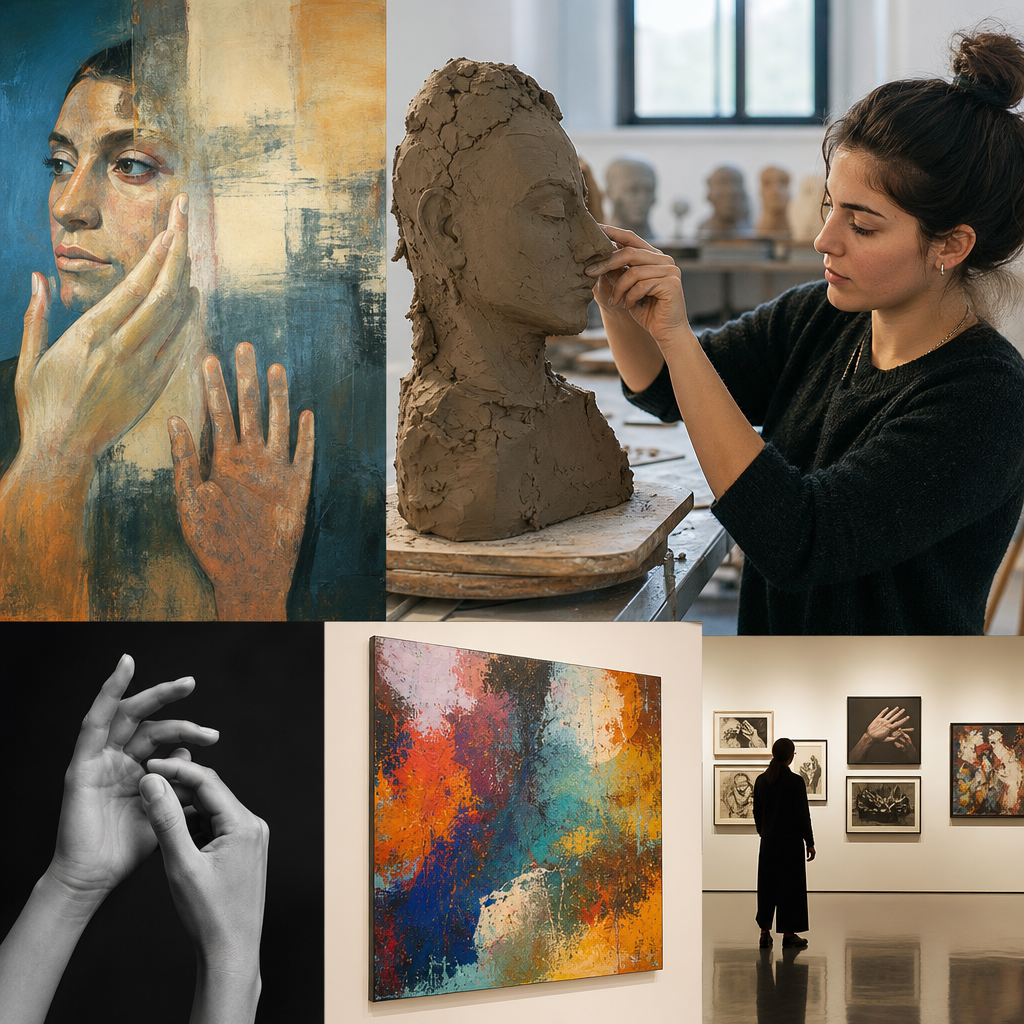
Deaf art is creative expression shaped by Deaf experience, Deaf culture, and the visual, linguistic, and social realities of living in a world organized largely around sound. It includes painting, sculpture, photography, film, theater, poetry, dance, comics, digital media, and interdisciplinary work, but it is not defined only by medium. What makes Deaf art distinct is perspective: it communicates meanings rooted in signed languages, visual attention, community memory, access, resistance, pride, and the everyday textures of Deaf life. In my work reviewing cultural programs and accessibility strategy, I have seen audiences quickly recognize the difference between art that merely includes a Deaf person and art that emerges from a Deaf worldview.
That distinction matters because Deaf art is often misunderstood. Some people assume it refers only to art made by artists who cannot hear. Others reduce it to educational messaging about disability. Both ideas are too narrow. A hearing artist can create work about Deaf themes, but Deaf art as a cultural category usually centers Deaf creators, Deaf audiences, and Deaf ways of knowing. It is closely tied to Deaf culture, especially communities that use sign languages such as American Sign Language, British Sign Language, Langue des Signes Française, or other national signed languages. It can also include work by hard of hearing, late-deafened, and DeafBlind artists when the work engages shared questions of language, identity, embodiment, access, and belonging.
Understanding Deaf art is important for three reasons. First, it preserves history. For generations, Deaf people were excluded from mainstream cultural institutions, misrepresented in film and literature, and pressured by oralist systems to abandon sign language. Art became a way to record what official narratives ignored. Second, it builds identity. Like any cultural art form, it offers symbols, heroes, humor, critique, and beauty that help a community see itself clearly. Third, it changes public understanding. Strong Deaf art does not simply ask for sympathy; it invites viewers to rethink language, communication, time, and space. That shift has practical effects in education, media, policy, and design.
Within Deaf Culture and Identity, art, storytelling, and expression form a central hub because they connect nearly every other subject in the field. Language politics appear in signed poetry and theater. Accessibility appears in captioning, exhibition design, and museum interpretation. Representation appears in film, television, and publishing. Community values appear in festivals, collective making, and intergenerational storytelling. Even debates within the community, such as cochlear implants, mainstreaming, or the use of voice onstage, often surface first through art before they become formal public arguments. To understand Deaf culture deeply, you need to understand how Deaf people create and share meaning.
The Core Meaning of Deaf Art
At its core, Deaf art translates lived visual experience into form. In practice, that means artists often emphasize hands, eyes, facial expression, movement, framing, sightlines, silence, vibration, spatial relationships, and the politics of communication. The work may celebrate sign language, critique exclusion, document Deaf spaces, or explore personal identity. Not every piece by a Deaf artist is automatically Deaf art, just as not every novel written by a member of a cultural group is about that group. The category becomes most useful when the artwork carries recognizable cultural references, visual strategies, or social questions tied to Deaf life.
A well-known framework is De’VIA, short for Deaf View/Image Art, introduced in 1989 by a group of Deaf artists including Betty G. Miller, Paul Johnston, and others. De’VIA describes visual art that intentionally represents Deaf experience and Deaf perspectives. It includes resistance themes, such as oppression, audism, and language deprivation, and affirmation themes, such as cultural pride, ASL beauty, and community strength. De’VIA is not the only way to understand Deaf art, but it remains one of the clearest reference points because it gives curators, teachers, and audiences language for discussing content without flattening artists into stereotypes.
When people ask, “What does Deaf art look like?” the honest answer is that it looks varied. A painting might feature exaggerated hands or broken hearing aids as symbols of conflict. A photograph might stage the intimacy of signed conversation through eye contact and body orientation. A film might use silence strategically, not as lack, but as texture. A performance poem in ASL might create rhyme through repeated handshapes, movement paths, and facial grammar rather than through sound. The unifying principle is not a single style. It is the way form and meaning are shaped by Deaf ways of perceiving and communicating.
How Storytelling Works in Deaf Culture
Storytelling has always been one of the strongest engines of Deaf cultural transmission. Long before institutions archived Deaf history properly, stories carried values, warnings, humor, and memory across generations. In schools for the Deaf, dormitories, clubs, churches, sports events, and family gatherings, stories helped people explain what it meant to navigate both Deaf community life and hearing-majority systems. These stories were not only informational. They were highly crafted performances using timing, spatial mapping, role shift, classifiers, facial expression, and audience interaction. In other words, storytelling itself became an art form.
Signed storytelling differs from spoken storytelling in more than language. It often uses the full body as a narrative instrument. A signer can shift perspective instantly, place characters in different parts of visual space, and show action with kinetic precision. That visual-spatial structure allows stories to communicate complex scenes quickly and memorably. Traditional forms include personal narratives, folklore, fables adapted into sign, number stories, handshape stories, and humorous “ABC stories,” where signs follow a sequence of handshapes. These forms are technically demanding, and skilled performers are judged not only on message but on linguistic elegance, rhythm, and visual clarity.
In the modern media landscape, Deaf storytelling extends across stage performance, YouTube, short film, comics, animation, and social platforms. Creators now publish work directly to Deaf audiences worldwide, often crossing national boundaries through subtitling and shared visual literacy. That expansion has created a richer archive of Deaf expression, but it has also raised new questions about translation, monetization, and context. A signed performance viewed out of community context can be admired aesthetically while its cultural references are missed. Good hub content on art, storytelling, and expression therefore needs to connect technique with history, not treat performances as isolated curiosities.
Major Forms of Deaf Creative Expression
Deaf creative expression spans many genres, and each one reveals different aspects of Deaf life. Visual art often addresses identity and politics through symbols that recur across the field, including eyes, hands, mouths, hearing devices, chains, or barriers. Theater foregrounds language choices, access, and ensemble movement. Film explores point of view, captioning, sound design, and casting. Poetry in sign language demonstrates that signed languages are fully capable of metaphor, rhythm, and complex literary structure. Dance engages vibration, visual cueing, and choreographic systems that do not rely on conventional musical counting. Photography captures intimacy, attention, and the architecture of communication.
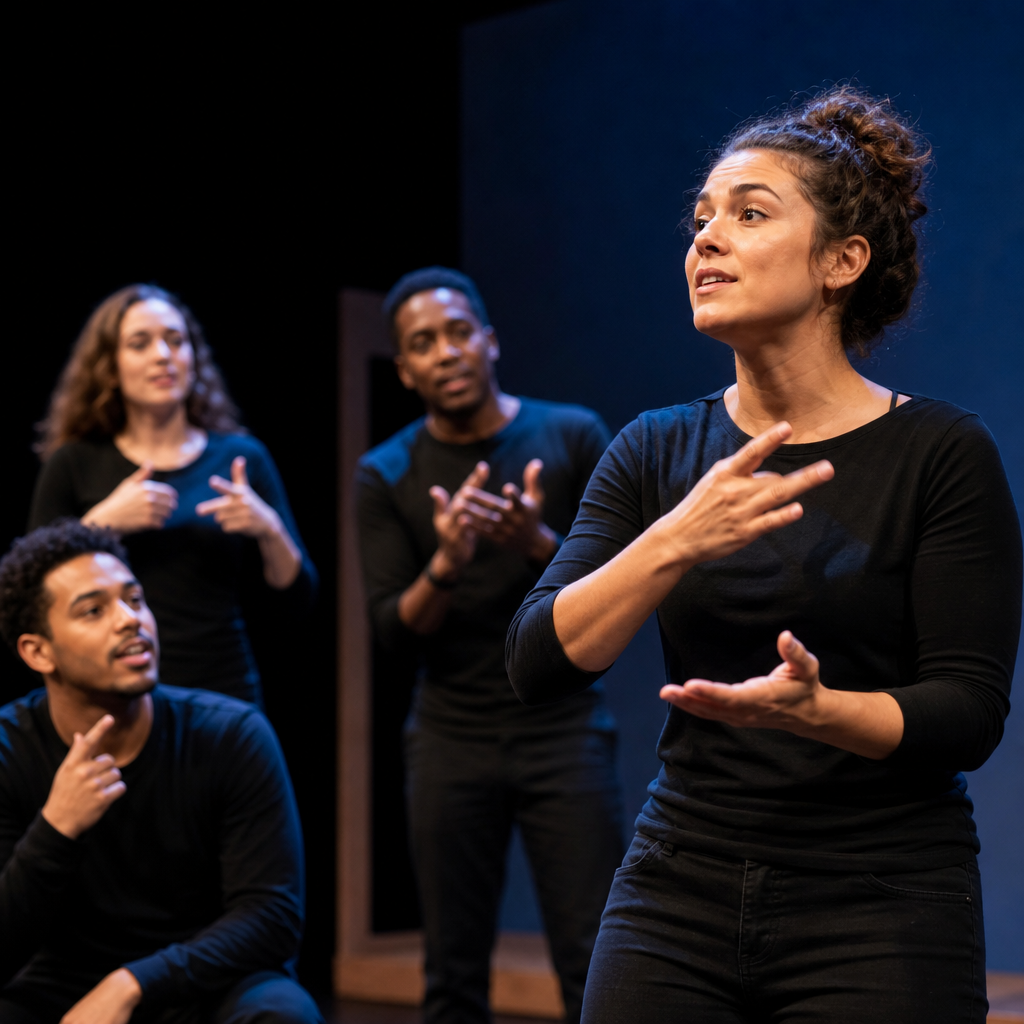
Several institutions and artists have shaped public understanding of these forms. The National Theatre of the Deaf expanded signed performance for broad audiences. Deaf West Theatre became known for bilingual staging that integrates sign language and spoken English with unusual sophistication. Douglas Tilden, a nineteenth-century sculptor who was Deaf, showed that Deaf artists have long contributed to mainstream art history, even when the Deaf dimension of their identity was minimized. Betty G. Miller, often called the mother of De’VIA, made oppression and resistance visible in unforgettable visual symbols. Contemporary creators continue that lineage in museums, festivals, streaming media, and independent publishing.
| Form | What makes it distinct in Deaf culture | Representative example |
|---|---|---|
| Signed poetry | Uses handshape, movement, rhythm, facial grammar, and space instead of sound-based meter | ASL performance poetry at Deaf festivals and university showcases |
| Theater | Builds meaning through bilingual staging, visual timing, ensemble signing, and access design | Productions by Deaf West Theatre |
| Visual art | Employs Deaf cultural symbols, De’VIA themes, and visual metaphors about communication | Works by Betty G. Miller |
| Film | Explores captioning, silence, framing, and Deaf point of view through casting and editing | Independent Deaf short films and festival circuits |
Identity, Politics, and Representation
Deaf art is inseparable from questions of identity and power because Deaf people have historically been represented by others more often than they have been allowed to represent themselves. Many mainstream portrayals treat deafness as tragedy, obstacle, or inspirational device. Deaf artists frequently push back against those narratives by showing Deaf life as ordinary, complex, funny, political, and aesthetically rich. That corrective role is one reason the work often feels urgent. It is not simply decorative. It is a claim to narrative authority.
One recurring issue is audism, the belief that hearing ways of being and communicating are inherently superior. In art, audism can appear in obvious forms, such as casting hearing actors in Deaf roles, but also in subtler choices, such as treating sign language as secondary decoration rather than primary language. Deaf creators respond by centering authenticity in performance, insisting on qualified interpreters and consultants, and developing works that do not translate every meaning into hearing expectations. In curation meetings, I have repeatedly seen the strongest projects begin by asking what Deaf audiences need first, not what hearing audiences will tolerate.
Representation also involves internal diversity. Deaf communities are not monolithic. Race, class, gender, sexuality, nationality, disability, and educational background all shape how artists understand Deaf identity. Black Deaf artists, Indigenous Deaf artists, queer Deaf artists, and DeafBlind artists have expanded the field by challenging narrow community norms and showing that access itself is never one-size-fits-all. A serious hub article must make room for those intersections because they determine who gets funded, exhibited, translated, and remembered.
Why Accessibility Changes the Art Itself
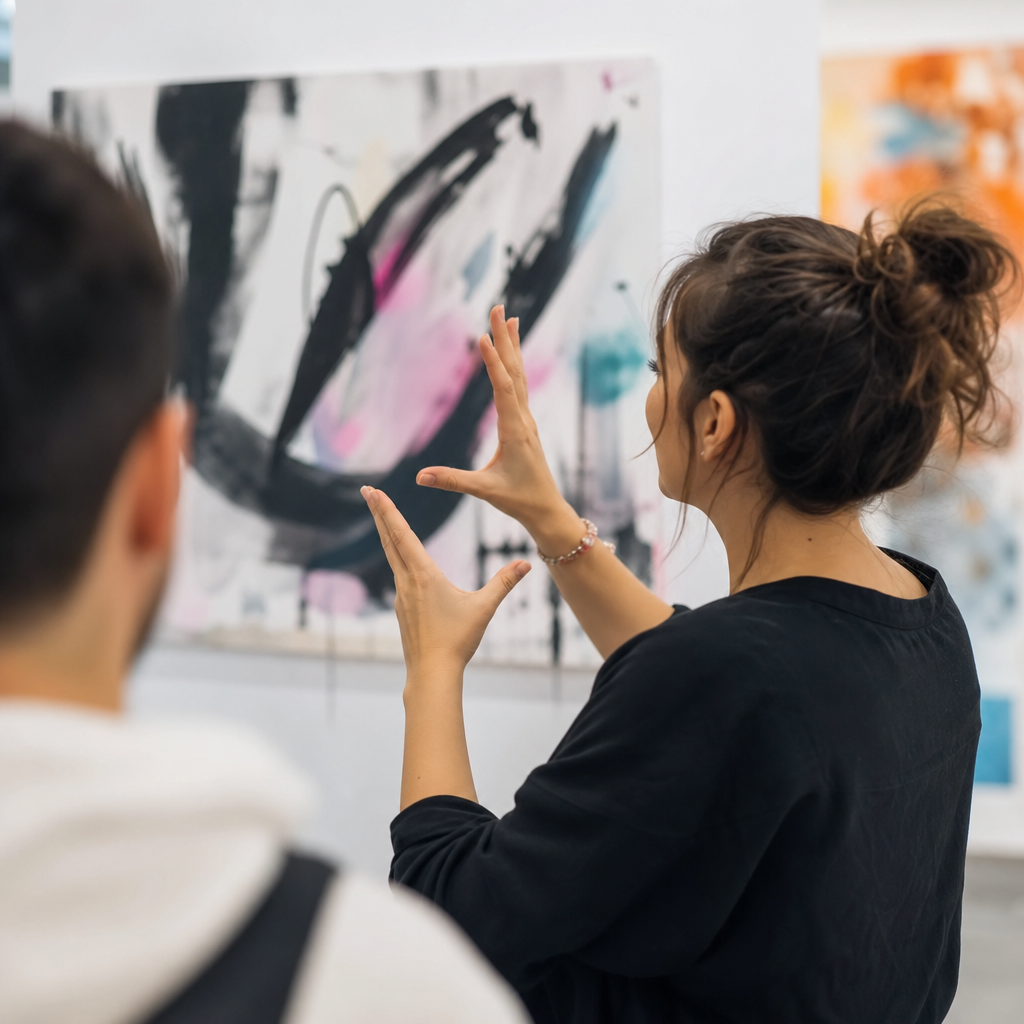
Accessibility in Deaf art is not an afterthought added after the creative work is finished. It often changes the structure of the work from the beginning. In theater, sightlines, lighting, costume contrast, and actor spacing are artistic decisions because they affect intelligibility in sign language. In film, open captions, camera framing, and editing pace influence whether signed dialogue can be followed naturally. In museums, wall text height, video looping, tactile components, interpreter scheduling, and multilingual caption design shape how visitors understand the exhibit. Accessibility is part of authorship.
This point matters because many institutions still treat access as compliance. The legal framework may come from the Americans with Disabilities Act, Section 504, or equivalent standards in other countries, but good practice goes further than minimum accommodation. The best Deaf-centered programs use universal design principles and involve Deaf advisors early. For example, a gallery showing signed video art must consider screen placement, seating, ambient light, and whether captions compete visually with the signing. A public panel with Deaf artists needs clear turn-taking, proper interpreter placement, and moderation that respects signing pace rather than forcing spoken tempo onto everyone.
There are tradeoffs. Open captions can enrich access for many viewers but may alter a director’s visual composition. Voice interpretation can broaden reach but sometimes recenters hearing mediation over signed performance. Tactile interpretation improves access for DeafBlind audiences yet requires specialized planning, staffing, and rehearsal time. These are not reasons to avoid access. They are reasons to treat access decisions as creative and ethical choices that deserve expertise, budget, and respect.
Where Deaf Art Creates Social Impact
Deaf art has measurable impact in education, media, and public life because it changes what people believe is possible. In education, students who encounter Deaf authors, visual artists, and performers gain models of achievement that are not filtered through deficit narratives. That matters especially in contexts where language deprivation has limited academic access. Art can strengthen vocabulary, cultural knowledge, and self-concept simultaneously. In museums and schools, I have watched Deaf students stand taller when they realize their language is not just functional but beautiful and worthy of formal study.
In media industries, Deaf art has pushed standards for casting, captioning, and authorship. Productions with Deaf creative leadership tend to make better choices about sign language authenticity, pacing, and visual storytelling. The success of Deaf performers and Deaf-led projects has also made it harder for institutions to claim that Deaf-centered work lacks audience demand. On the policy side, cultural visibility influences funding, interpreter training, arts education, and preservation. Once a field is recognized as culturally significant, it is easier to argue for archives, grants, residencies, and curriculum support.
The impact extends beyond the Deaf community. Hearing audiences who engage seriously with Deaf art often come away with a more nuanced understanding of communication itself. They see that language is not synonymous with speech, that silence is not emptiness, and that access can produce better design for everyone. That shift is the deepest benefit of Deaf art. It preserves community memory while widening the public imagination.
How to Engage With Deaf Art Respectfully
If you want to explore Deaf art, start by following Deaf creators, attending Deaf-led festivals, visiting exhibitions that include signed interpretation, and reading artist statements before relying on outside summaries. Learn basic context for signed languages and Deaf history so the work is not stripped of meaning. When possible, choose institutions that pay Deaf artists fairly, credit interpreters appropriately, and offer accessible programming designed with community input. Respectful engagement means moving beyond consumption toward informed attention.
This hub page should lead naturally into deeper topics: De’VIA and Deaf visual symbolism, ASL poetry and signed literature, Deaf theater traditions, Deaf film and documentary, museum accessibility, Deaf storytelling forms, famous Deaf artists, Deaf media representation, and the relationship between language rights and artistic expression. Together, those subjects show that Deaf art is not a niche side topic within Deaf Culture and Identity. It is one of the clearest ways the community records its past, debates its present, and imagines its future. Explore those branches, and you will understand not only what Deaf art is, but why its impact continues to grow.
Frequently Asked Questions
What is Deaf art, and how is it different from art made by a Deaf person?
Deaf art is creative work shaped by Deaf experience, Deaf culture, and the visual, linguistic, and social realities of living in a world that is largely organized around sound. That distinction matters. Not every artwork created by a Deaf artist is automatically Deaf art in a cultural sense. A Deaf painter, filmmaker, poet, or performer may create work about many subjects, just as any artist does. Deaf art becomes distinct when its perspective is rooted in Deaf ways of seeing, signing, remembering, communicating, and navigating society.
In other words, Deaf art is not defined only by who made it or by which medium was used. It can appear in painting, sculpture, photography, film, theater, poetry, dance, comics, digital media, or interdisciplinary forms. What gives it its identity is the meaning it carries: visual attention, signed language influence, community memory, accessibility, resistance to exclusion, and pride in Deaf identity. Many Deaf artworks also explore themes such as communication barriers, the politics of access, the richness of signed languages, and the tension between being marginalized and being culturally strong. That is why Deaf art is best understood as a cultural and expressive framework, not just a label attached to an artist’s hearing status.
What themes and ideas are commonly explored in Deaf art?
Deaf art often explores themes that emerge directly from Deaf life and Deaf community knowledge. These may include language, especially the beauty and complexity of signed languages; visual communication; identity formation; exclusion and accessibility; family relationships; education; audism; resistance; belonging; memory; and pride. Many works examine what it means to live in a society where public life, institutions, and expectations are built around hearing people, while also celebrating the creativity and resilience that Deaf communities have developed in response.
Another major theme in Deaf art is visuality. Because Deaf culture often prioritizes sight, movement, spatial awareness, facial expression, and bodily presence, artists may use composition, gesture, silence, light, framing, rhythm, and spatial design in especially deliberate ways. In performance and poetry, signed languages can shape the structure of the work itself, creating meanings that are difficult to fully translate into spoken or written language. Deaf art may also address the emotional and political realities of access, such as interpreters, captioning, oralist education, isolation, or the struggle to be understood on Deaf terms rather than through hearing-centered assumptions. At the same time, it is important not to reduce Deaf art to struggle alone. Humor, intimacy, joy, play, beauty, and collective pride are just as central to the field.
Why is signed language so important to understanding Deaf art?
Signed language is essential to understanding Deaf art because it is more than a communication tool; it is a source of structure, metaphor, rhythm, and worldview. In many Deaf communities, signed languages shape how stories are told, how emotion is expressed, how space is organized, and how attention is directed. This means Deaf art often carries meanings that arise from visual-linguistic experience rather than sound-based language systems. Even in mediums that are not obviously linguistic, such as photography or painting, the influence of signing may appear in gesture, spatial relationships, facial expression, sequencing, and the emphasis on what can be seen rather than heard.
In performance forms especially, signed languages can function as artistic material in their own right. Handshape, movement, pace, directionality, repetition, and visual rhyme can create poetic effects much like sound patterns do in spoken-language poetry. Theater and film may use signing not simply as dialogue but as choreography, narrative structure, or symbolic action. Understanding this helps viewers recognize that Deaf art is not merely “art with sign language included.” Instead, sign language can be central to the artistic logic of the work. It carries culture, history, humor, resistance, and identity, making it one of the most powerful foundations of Deaf artistic expression.
What impact does Deaf art have on society and culture?
Deaf art has a significant impact because it expands how society understands communication, creativity, language, and human experience. It challenges hearing-centered assumptions about what art should sound like, look like, or prioritize. By placing Deaf perspective at the center, it invites audiences to engage with visuality, embodied language, and alternative forms of attention in a deeper way. This can shift public conversations about disability, access, and inclusion from narrow ideas of limitation toward richer ideas of culture, innovation, and perspective.
Within Deaf communities, Deaf art also plays a powerful role in preserving memory, affirming identity, and strengthening collective pride. It documents experiences that may be ignored in mainstream history, gives language to shared struggles and triumphs, and creates spaces where Deaf people can see themselves represented on their own terms. In broader cultural life, Deaf art encourages institutions, educators, curators, and audiences to rethink accessibility not as an afterthought but as part of artistic meaning and participation. Its impact is therefore both artistic and social: it broadens representation, deepens cultural understanding, and demonstrates that Deaf experience is not peripheral to the arts but a vital source of creative knowledge.
How can someone respectfully engage with and support Deaf art?
Respectful engagement begins with approaching Deaf art as a cultural expression with its own histories, languages, values, and artistic traditions. That means avoiding the assumption that Deaf art exists only to inspire hearing audiences or to illustrate disability in a simplified way. Instead, viewers should be open to the idea that some works are rooted in Deaf community knowledge and may ask audiences to learn new contexts, especially around signed languages, visual storytelling, access politics, and Deaf identity. Taking time to read artist statements, learn about Deaf culture, attend Deaf-led events, and experience work in accessible environments can make that engagement far more meaningful.
Supporting Deaf art also means materially and institutionally valuing it. Buy tickets, purchase work, follow and share Deaf artists, cite their contributions, and advocate for museums, galleries, schools, festivals, and theaters to feature Deaf creators in sustained ways rather than as occasional tokens. Access matters as well: interpretation, captioning, Deaf-led curation, and inclusive design should be treated as core parts of presentation, not optional add-ons. Most importantly, listen to Deaf artists on their own terms, including through signed languages and Deaf-led criticism. When audiences and institutions do that, they help create conditions in which Deaf art is not merely accommodated but recognized as a powerful and essential part of contemporary culture.