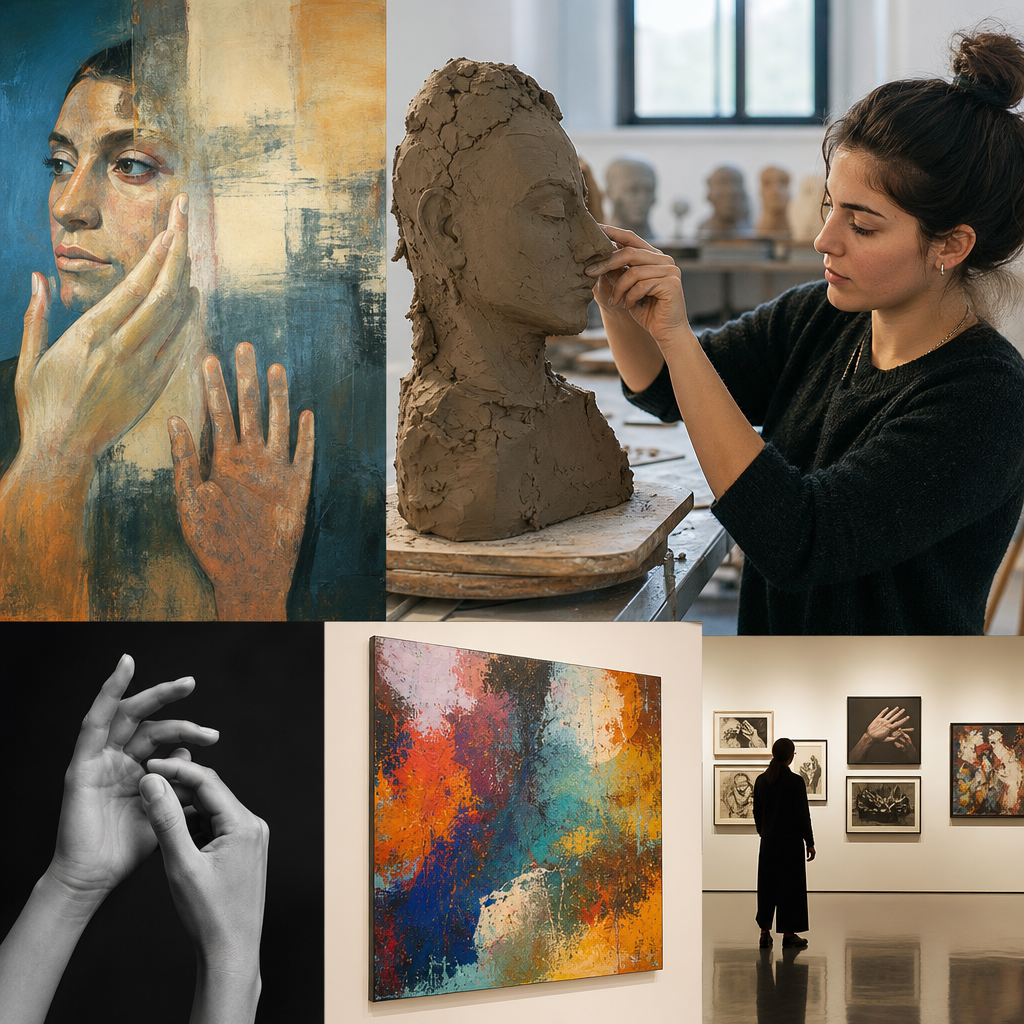

Deaf artists have shaped painting, sculpture, photography, performance, film, and digital media in ways that expand how we understand art, language, and identity. When people search for famous Deaf artists, they often want more than a list of names. They want context: who these artists are, what they created, how deafness influenced their work, and why their contributions matter within Deaf culture and beyond. This hub article covers art, storytelling, and expression across the Deaf experience, bringing together major figures, key themes, and practical starting points for deeper exploration.
In this context, Deaf is more than an audiological description. It often signals cultural identity, shared history, signed languages, and membership in communities with their own traditions and values. Deaf art refers to creative work made by Deaf artists, but it also points to a body of expression shaped by visual communication, access, resistance, and pride. Storytelling includes everything from portraiture and memoir to signed performance, documentary film, theater, and experimental media. Expression covers the personal and political dimensions of making art: visibility, memory, language, exclusion, joy, and self-definition.
I have worked on accessibility-focused content and arts education projects long enough to see the same pattern again and again: Deaf artists are frequently cited in narrow ways, usually as inspirational exceptions, while the depth of their practice gets overlooked. That framing misses the point. These are not artists who happen to be Deaf and then stop at biography. They are serious practitioners whose methods, themes, and influence deserve careful attention. Some center Deaf identity explicitly. Others work across broader artistic concerns while still bringing Deaf ways of seeing into their process. Both approaches belong in any accurate guide.
This topic matters because representation changes what audiences think art can do. It also matters because many Deaf artists have had to overcome structural barriers in education, exhibition, performance spaces, and funding systems. Knowing their work helps correct omissions in mainstream art history. For readers exploring Deaf culture and identity, this subject serves as a hub because visual art, signed storytelling, theater, film, and photography connect to larger conversations about language rights, community memory, technology, and access. If you want to understand Deaf culture in full, you need to understand how Deaf artists express experience and make meaning.
Why Deaf artists matter in art history and culture
Deaf artists matter because they challenge hearing-centered assumptions about communication and aesthetics. In practical terms, many Deaf creators develop a heightened attention to gesture, facial expression, spatial composition, rhythm through movement, and visual narrative structure. That does not mean every Deaf artist works the same way, but it does explain why visual immediacy and embodied meaning appear so often across Deaf creative traditions. In museums, galleries, festivals, and online platforms, this work broadens accepted definitions of literacy and performance.
Art history has not always documented these contributions well. Deaf artists were often excluded from mainstream institutions, trained separately, or discussed primarily in disability terms rather than artistic ones. Yet their impact is clear. They founded schools, created enduring portrait traditions, advanced sculpture and painting, and later transformed performance through sign-centered theater and film. Today, Deaf-led festivals and organizations continue that work by building infrastructure, mentoring younger artists, and preserving archives that would otherwise remain fragmented.
One term worth knowing is De’VIA, short for Deaf View/Image Art. Coined by Deaf artists and scholars in 1989, it describes art that intentionally reflects Deaf experience from a Deaf perspective. De’VIA is not the same as all art by Deaf people. Rather, it identifies work that directly addresses themes such as oppression, language, identity, isolation, empowerment, cochlear implants, oralism, and community. The concept gave critics and artists a shared vocabulary, and it remains one of the most important frameworks for understanding Deaf visual expression.
Famous Deaf visual artists you should know
Among the most important historical figures is Francisco de Goya, who became deaf as an adult after illness. While scholars rightly avoid reducing his entire career to deafness, his later work shows a profound shift toward darker, more introspective imagery. The Black Paintings and many late prints reveal a psychological intensity that continues to influence artists and historians. Goya belongs in this discussion because his deafness shaped his life and likely altered his social world, even if it does not fully explain his art.
John Brewster Jr. is another foundational name. Active in the late eighteenth and early nineteenth centuries in the United States, he was a Deaf portrait painter known for clear compositions, refined clothing details, and calm depictions of New England sitters. His work matters not only for artistic quality but also because it documents early American life while proving that Deaf artists were active professionals long before modern disability discourse. Museums and scholars have increasingly restored Brewster to the canon he deserves.
Douglas Tilden stands out in sculpture. Often called “the Michelangelo of the West,” Tilden was a Deaf American sculptor whose public monuments became prominent in California. Works such as the Mechanics Monument in San Francisco demonstrate technical command, anatomical confidence, and civic ambition. Tilden studied at the California School for the Deaf and later in Paris, showing how Deaf educational networks and international training could support major artistic careers even in the nineteenth century.
In the modern and contemporary period, Chuck Baird is essential. Baird was a leading force in De’VIA and one of the clearest examples of art grounded in Deaf cultural themes. His paintings often use bold color, theatricality, hands, eyes, and sign language imagery to address oppression and affirmation. Because Baird also worked with the National Theatre of the Deaf, his career bridges visual art and performance. For readers building a foundation in Deaf culture, he is one of the first artists to study closely.
Betty G. Miller is widely recognized as the “Mother of De’VIA.” Her work directly confronts audism, language deprivation, and educational injustice. Paintings such as Ameslan Prohibited remain central to discussions of Deaf identity because they depict the suppression of sign language with striking clarity. Miller did not make decorative statements. She made arguments through art. That directness is one reason her work remains so widely taught in Deaf studies and arts programs.
Susan Dupor brought autobiographical depth and feminist insight to Deaf visual art. Her paintings frequently explore family dynamics, communication barriers, and the emotional textures of navigating both Deaf and hearing worlds. Dupor’s work is especially strong at showing what partial access feels like: being present physically while excluded conversationally, visually connected yet socially sidelined. Those scenes resonate with many Deaf viewers because they capture common lived experiences without flattening them into slogans.
Performance, theater, and signed storytelling
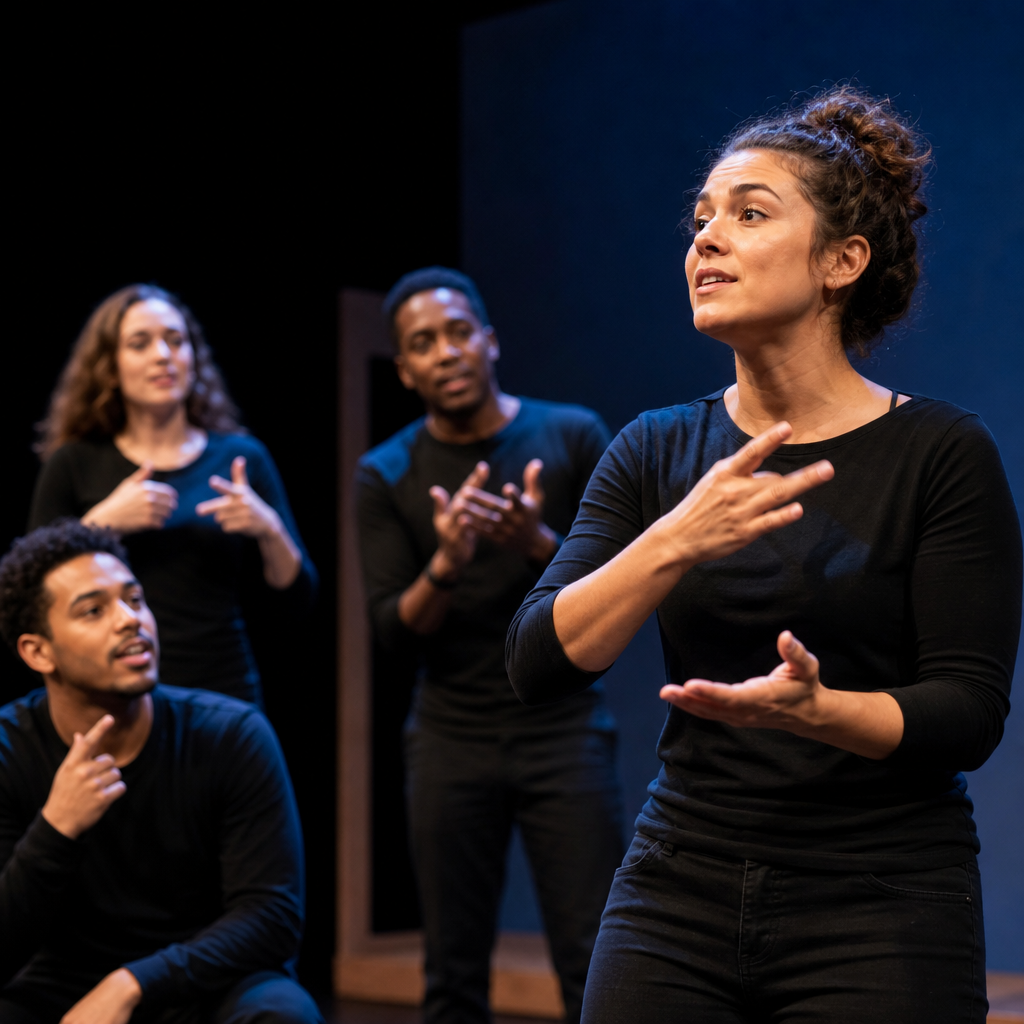
Deaf expression is not limited to canvases or sculpture. Some of the most influential Deaf artists work in theater, signed performance, and film, where language itself becomes movement, image, and narrative. The National Theatre of the Deaf, founded in 1967, changed public understanding of what stage performance could be by integrating sign language, physical storytelling, and bilingual presentation. Its alumni influenced generations of actors, directors, educators, and visual artists.
Bernard Bragg is a key figure here. A cofounder of the National Theatre of the Deaf, Bragg drew from mime, sign language, and stagecraft to create a performance style that was visually precise and emotionally legible. His work demonstrated that signed storytelling is not a secondary substitute for spoken theater. It is a fully developed art form with its own rhythm, grammar, and expressive range. That insight remains vital for anyone studying Deaf performance today.
Phyllis Frelich also deserves recognition. Her stage and screen work, including the landmark play Children of a Lesser God, brought Deaf performers into wider public view. While debates about representation in later adaptations are important, Frelich’s achievement remains significant because she helped establish Deaf actors as interpreters of complex dramatic roles rather than novelty casting. In practical terms, that shifted expectations across theater and television.
Signed storytelling itself is a major artistic tradition. In Deaf communities, stories may use role shifting, classifiers, facial grammar, cinematic pacing, and visual metaphor in ways that differ fundamentally from spoken-language narration. A skilled signer can move between characters instantly, set scenes spatially, and create suspense through controlled visual focus. This is why many Deaf performances are best understood on their own terms, not merely translated into speech or text. Their artistry lies in language choices, spatial design, and embodied timing.
Film, photography, and contemporary media
Film and photography have become especially important for Deaf artists because these media preserve visual language and circulate it widely. Photography allows Deaf artists to explore portraiture, body politics, and communication through stillness and framing. Film adds editing, captioning choices, sound design, silence, and sign-centered composition. Together, these forms let artists address access not only as a practical issue but as an aesthetic one.
Jade Bryan is one contemporary name to know. As a Deaf filmmaker, she has focused on creating opportunities for Deaf talent in front of and behind the camera. Her work and advocacy show that representation is not only about casting. It also involves who writes, directs, edits, captions, funds, and distributes stories. That production-level perspective is essential in Deaf media because access decisions shape the final artwork at every stage.
Photography and digital art have also opened space for younger Deaf creators working outside traditional gatekeepers. Social platforms, video apps, and online exhibitions allow artists to share signed poems, visual essays, portrait series, and experimental shorts directly with audiences. The best of this work is not simply content; it is crafted expression. Strong lighting, deliberate framing, multilingual caption strategy, and culturally informed symbolism all matter. As with any art scene, the medium may evolve quickly, but quality still depends on skill and intention.
| Artist | Primary form | Why they matter |
|---|---|---|
| John Brewster Jr. | Portrait painting | Early American Deaf professional artist with lasting historical importance |
| Douglas Tilden | Sculpture | Created major public monuments and expanded visibility for Deaf artists |
| Betty G. Miller | Painting | Defined Deaf-centered visual protest and identity themes |
| Chuck Baird | Painting, theater | Popularized De’VIA and connected visual art with performance |
| Susan Dupor | Painting | Explored family, exclusion, gender, and Deaf lived experience |
| Bernard Bragg | Theater | Helped establish signed performance as a major art form |
Themes that define Deaf art and expression
Several themes appear repeatedly across Deaf art, and knowing them helps viewers read the work more accurately. Language is central. Many artists address the right to sign, the pain of language suppression, or the richness of bilingual life. Identity is another major theme, especially the difference between being treated as impaired and claiming membership in a cultural community. Hands, eyes, mouths, hearing devices, classrooms, and dinner tables often function as symbolic objects because they sit at the center of access and exclusion.
Another recurring theme is audism, the belief that hearing and spoken language are inherently superior. Deaf artists have documented audism in schools, families, workplaces, and medical settings for decades. They also depict resistance: community gatherings, signed storytelling, Deaf schools, friendships, humor, and collective pride. This balance matters. The most memorable Deaf art does not only show barriers. It shows creativity under pressure and joy built through connection.
Technology adds nuance rather than easy answers. Cochlear implants, hearing aids, captioning systems, video relay services, and social media all appear in contemporary Deaf art, sometimes positively and sometimes critically. The point is not to force a single viewpoint. It is to show that tools are experienced within social systems. Access can empower, but it can also come with pressure to conform. Strong Deaf artists are often at their best when they hold those tensions honestly.
How to explore this topic further
If you want to learn beyond this hub, start by following three paths: museum research, Deaf-led institutions, and direct engagement with artists’ own work. Museum collections and academic archives can help with historical figures such as Brewster, Tilden, and Goya. Deaf-led organizations, festivals, and university programs provide stronger context for contemporary work, especially around sign language, performance, and community history. Whenever possible, watch signed performances in their original language before reading interpretations.
It also helps to compare mediums. Look at a De’VIA painting, then watch a signed poem, then study a Deaf short film. Ask the same questions each time: What is the artist saying directly? What symbols carry the message? How do composition, movement, captioning, or silence affect meaning? This approach reveals that Deaf storytelling is not one genre but a wide field of practices linked by visual intelligence and lived experience.
Famous Deaf artists should be known not because their stories are unusual, but because their work is excellent and historically important. From Goya’s late intensity and Brewster’s portraits to Tilden’s monuments, Miller’s activism, Baird’s visual language, Dupor’s emotional realism, and Bragg’s stage innovation, these artists map a rich tradition of art, storytelling, and expression. Explore their work, support Deaf-led arts spaces, and use this hub as your starting point for deeper study across Deaf culture and identity.
Frequently Asked Questions
Who are some of the most famous Deaf artists people should know?
Several Deaf artists are widely recognized for the depth of their work and their influence on both mainstream art and Deaf culture. One of the most important names is Chuck Baird, an American Deaf painter closely associated with the De’VIA movement, or Deaf View/Image Art. His paintings often centered Deaf experience, American Sign Language, and the emotional realities of navigating a hearing world. Granville Redmond is another major figure. A Deaf landscape painter from the late 19th and early 20th centuries, he became known for luminous California scenes and was admired by hearing and Deaf audiences alike. Redmond also acted in silent films and was a friend of Charlie Chaplin.
In photography, Roger Ballen is sometimes included in conversations about Deaf creatives because of his distinct visual language, though discussions of Deaf identity in art more often highlight artists whose work directly engages Deaf culture. Douglas Tilden, a Deaf sculptor sometimes called “The Michelangelo of the West,” is also essential. He created prominent public monuments and demonstrated that Deaf artists were shaping civic and cultural life long before accessibility and representation became common public conversations. In more contemporary spaces, artists such as Christine Sun Kim have brought Deaf perspective into global art institutions. Kim uses sound, language, musical notation, text, and performance to challenge assumptions about who gets to define sound and communication.
Depending on the scope of the article, other names worth knowing include Betty G. Miller, often called the mother of De’VIA, and Susan Dupor, whose paintings portray Deaf life with psychological depth and cultural specificity. Together, these artists represent a broad range of media and time periods. They are not important simply because they are Deaf and successful; they matter because they changed how art can communicate identity, embodiment, language, exclusion, and belonging.
What is De’VIA, and why is it important when discussing famous Deaf artists?
De’VIA stands for Deaf View/Image Art, a term coined in 1989 to describe artwork that intentionally expresses Deaf experience and Deaf cultural perspectives. It is one of the most important concepts for understanding many famous Deaf artists because it gives viewers a framework for recognizing that Deaf art is not just art made by a Deaf person. Instead, De’VIA refers to art that reflects themes such as sign language, oppression, isolation, community, resistance, identity, and pride. This distinction matters because it places Deaf artists within a cultural and political tradition rather than reducing them to a medical label.
Artists such as Chuck Baird, Betty G. Miller, and later Susan Dupor helped define the visual vocabulary of De’VIA. Their work often includes expressive hands, eyes, mouths, broken hearing devices, classrooms, barriers to communication, and images related to silence or visual language. These elements are not decorative. They often symbolize the pressure Deaf people have historically faced in schools, workplaces, and public life, especially when oralism and exclusion from sign language were imposed. At the same time, De’VIA can celebrate joy, connection, humor, bilingual identity, and the beauty of signed communication.
For readers looking up famous Deaf artists, De’VIA is important because it explains why certain works feel so culturally specific and emotionally charged. It also shows that Deaf artists are not merely participating in the art world; they are building their own artistic discourse. Understanding De’VIA helps readers see Deaf art as a rich field of cultural expression with its own history, themes, and critical importance.
How has deafness influenced the work of well-known Deaf artists?
Deafness has influenced artists in many different ways, and it is important not to assume there is a single Deaf artistic style. For some artists, deafness shapes subject matter directly. They create work about sign language, Deaf schools, communication barriers, family dynamics, interpreters, captions, and the politics of being seen or unheard. For others, deafness influences perception itself. A visually oriented relationship to the world may heighten attention to gesture, facial expression, spatial composition, rhythm in movement, or the social meaning of silence and sound.
Christine Sun Kim offers a strong example of this influence. Her work often questions how sound is represented, owned, and understood. Rather than treating sound as something naturally belonging only to hearing people, she examines it through vibration, text, diagrams, social power, and performance. Chuck Baird used theatrical composition and bold symbolism to make Deaf identity visible and emotionally immediate. Susan Dupor, meanwhile, has explored interpersonal tension, exclusion, and the intimacy of Deaf space through painting, often with a cinematic sense of narrative.
Historically, deafness has also shaped artists’ careers through the obstacles they faced. Limited access to formal training, communication barriers with patrons or institutions, and social prejudice all affected how Deaf artists were received. Yet many transformed those pressures into artistic force. Their work can reveal not only individual creativity but also a broader record of Deaf history. In that sense, deafness influences famous Deaf artists both aesthetically and politically: it informs what they make, how they communicate, and why their work resonates so strongly with audiences inside and outside Deaf communities.
Why do famous Deaf artists matter beyond Deaf culture?
Famous Deaf artists matter beyond Deaf culture because their work expands mainstream understanding of art, communication, and human experience. At the most basic level, they have produced outstanding paintings, sculptures, photographs, performances, and multimedia works that stand on their own artistic merit. But their importance goes further. They challenge narrow ideas about what art is supposed to sound like, look like, or communicate. They often reveal how much of public life is built around assumptions about hearing, and they invite audiences to reconsider those assumptions through form, symbolism, and storytelling.
For example, when a Deaf artist foregrounds sign language, visual rhythm, silence, or inaccessible spaces, they are not only documenting personal experience. They are exposing structures of inclusion and exclusion that affect education, culture, and civic life. This can deepen conversations about disability, language rights, representation, and design. In museums and galleries, their work also broadens curatorial practice by asking institutions to think more carefully about accessibility, interpretation, and whose perspectives are centered.
There is also a universal dimension to their impact. Themes commonly explored by Deaf artists, such as identity, misunderstanding, resilience, family, embodiment, and community, connect with audiences far beyond Deaf spaces. The best-known Deaf artists show that cultural specificity does not limit relevance; it often strengthens it. By expressing the world through Deaf experience, they make art history more complete and help all viewers engage with difference in a more informed and humane way.
What should readers look for when learning about or viewing the work of Deaf artists?
Readers should begin by looking at both the artwork itself and the cultural context around it. Start with the basics: what medium the artist uses, what themes appear repeatedly, and what historical moment shaped the work. Then ask deeper questions. Is the artist simply Deaf, or is the work intentionally expressing Deaf identity or Deaf culture? Are there references to sign language, visual communication, educational trauma, community pride, technology, performance, or translation between Deaf and hearing worlds? These details often reveal layers of meaning that might otherwise be missed.
It is also helpful to pay attention to symbolism. In Deaf art, hands may represent language, agency, or restriction. Eyes may stand for visual attention, surveillance, or connection. Mouths, ears, hearing aids, cochlear implants, classrooms, and interpreters can all carry strong emotional and political meaning depending on the artist’s perspective. In performance and film, movement, timing, silence, and framing may do as much expressive work as dialogue or sound. With artists like Christine Sun Kim, even text, notation, and conceptual systems can become tools for examining power and perception.
Finally, readers should avoid treating Deaf artists as inspirational exceptions and instead engage them as serious cultural producers. Learn about the history of Deaf education, Deaf community life, and movements such as De’VIA. Read artist statements when available. Notice whether museums or articles explain the work through a Deaf-centered lens or only through hearing expectations. The more context readers bring, the more clearly they can appreciate why famous Deaf artists are not just notable figures in a niche category, but vital contributors to the history of art itself.