Theater holds a central place in Deaf culture because it brings language, identity, history, and creative expression into one shared space. In Deaf communities, theater is not simply entertainment. It is a living form of cultural transmission, a place where stories are told through sign language, movement, facial expression, rhythm, and visual design rather than through spoken dialogue alone. When people ask what makes Deaf theater distinct, the clearest answer is this: it is performance shaped by Deaf ways of seeing, communicating, and understanding the world. That includes signed languages such as American Sign Language, British Sign Language, and other national sign languages, but it also includes visual timing, spatial storytelling, and collective experience.
In my work around accessibility and arts programming, I have seen audiences respond to Deaf-led performance with unusual intensity because the form communicates on multiple levels at once. A gesture can function as dialogue, metaphor, and choreography. A pause can carry social meaning. A shift in eye gaze can signal power, intimacy, or exclusion. These choices are not decorative. They are foundational to how many Deaf artists construct narrative. Theater therefore matters in Deaf culture not only because Deaf people deserve representation on stage, but because stagecraft itself becomes richer when built from visual language and Deaf experience.
Understanding the role of theater in Deaf culture also helps explain the broader category of art, storytelling, and expression within Deaf life. Theater connects to poetry in sign language, Deaf visual art, film, community festivals, and educational performance. It serves as a hub because it gathers many art forms at once: language arts, physical performance, costume, lighting, humor, memory, and social critique. For hearing readers, theater offers one of the most direct ways to encounter Deaf culture on its own terms. For Deaf audiences, it can affirm identity, preserve history, challenge stereotypes, and create joy through recognition.
This article explores how Deaf theater developed, why signed performance is culturally significant, how Deaf actors and companies shape artistic standards, and how theater links to the wider ecosystem of Deaf storytelling. It also examines practical issues such as access, casting, translation, education, and the future of digitally distributed performance. As a hub page for art, storytelling, and expression, it maps the core ideas that connect the topic: cultural ownership, language visibility, creative technique, and community impact. Theater is not a side note in Deaf culture. It is one of the clearest expressions of cultural life itself.
What Deaf Theater Is and Why It Matters
Deaf theater is performance created by Deaf artists, centered on Deaf perspectives, or built through signed language and visual dramaturgy. Some productions are entirely in sign language. Others are bilingual, combining sign and spoken or written language. The most effective work does more than add interpretation to a hearing-centered script. It rethinks the structure of performance from the ground up, asking how story changes when language lives in the hands, face, body, and space. That question matters because Deaf culture is grounded in shared language practices, social norms, and collective history, not merely in the medical fact of hearing loss.
In practical terms, Deaf theater makes Deaf audiences first, not last. Sightlines, lighting, ensemble blocking, costume contrast, and pacing all affect comprehension. A dimly lit face can erase meaning. A cluttered background can reduce sign clarity. Directors in Deaf theater treat these factors as language issues as much as design issues. This is one reason Deaf-led production teams are so important. They understand that access is not an add-on delivered after creative decisions are made. It is embedded in performance grammar from the start.
Deaf theater also matters because it resists a long history of exclusion. For decades, Deaf characters were often played by hearing actors, and Deaf people were framed through deficit narratives focused on tragedy or inspiration. Deaf-created theater disrupts that pattern. It presents Deaf people as complex protagonists with humor, conflict, sexuality, ambition, and political agency. In that sense, theater becomes a corrective archive, preserving stories that mainstream stages have often overlooked or distorted.
Historical Roots of Theater in Deaf Culture
The roots of Deaf theater stretch through Deaf schools, community clubs, and signed storytelling traditions. Residential schools for Deaf students, despite the many contradictions in their history, often served as incubators for performance. Students developed skits, pageants, signed recitations, and visual comedy that circulated across campuses and alumni networks. These performances were not always formally documented, but they helped establish conventions of signed narrative, ensemble timing, and Deaf humor. Community clubs later expanded that culture, giving adults places to stage plays, celebrate milestones, and address political concerns.
Modern Deaf theater gained international visibility through dedicated companies. In the United States, the National Theatre of the Deaf, founded in 1967, became a landmark institution. It brought Deaf performers to national and international audiences and showed that signed performance could stand on major stages. Its influence reached beyond individual productions. It shaped training pathways, audience expectations, and the legitimacy of Deaf performance within the wider theater industry. In the United Kingdom, Deafinitely Theatre created space for bilingual and British Sign Language-centered work, proving the same principle in a different linguistic and cultural setting.
Historical context matters because Deaf theater did not emerge as a niche variation of mainstream drama. It developed in response to linguistic suppression, social segregation, and the need for self-representation. Oralist education policies in many countries discouraged or banned sign language for long periods. In that environment, performance became one way to keep signed expression vibrant and public. Theater preserved language, and language preserved community memory. That is why many Deaf audiences see performance not only as art but as cultural continuity.
How Signed Performance Changes Storytelling
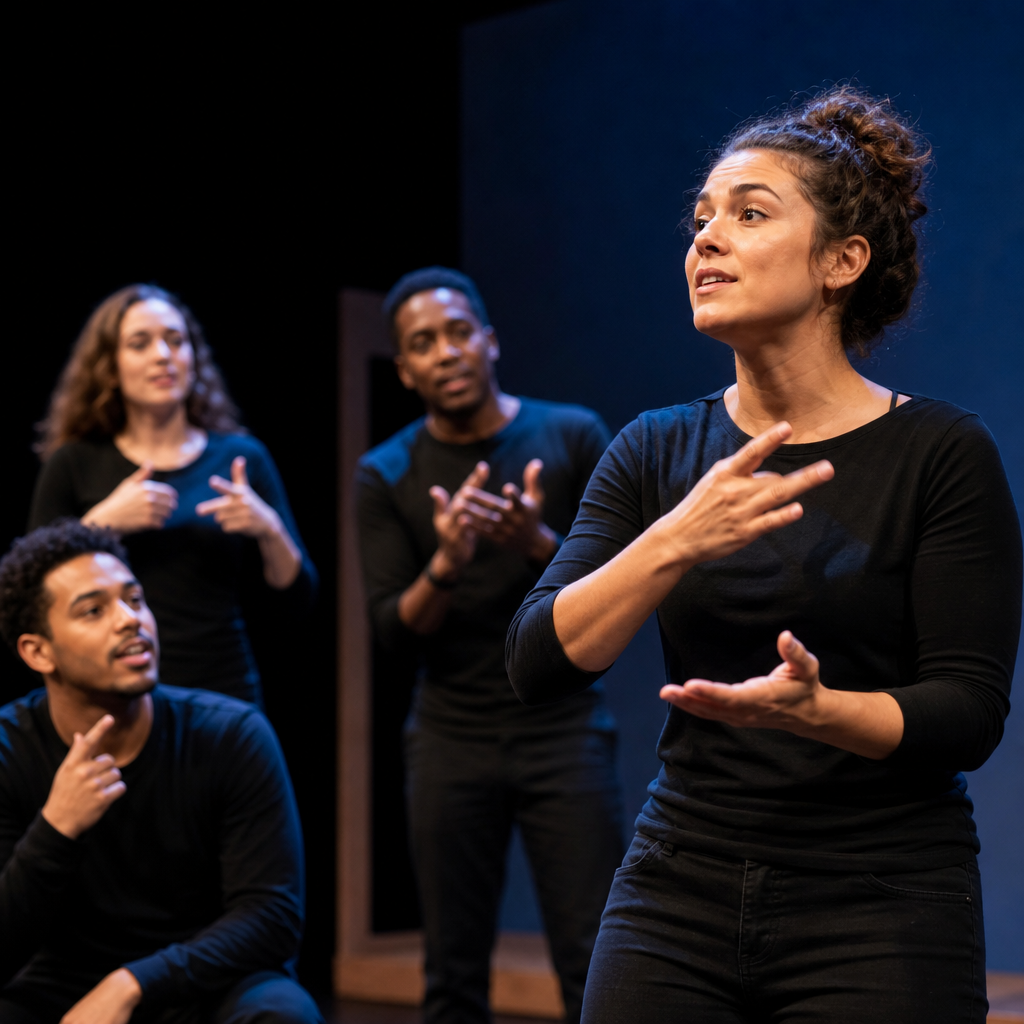
Signed performance changes storytelling by making the visual field the primary narrative channel. In spoken theater, tone and verbal rhythm carry much of the meaning. In Deaf theater, meaning is distributed across handshape, movement, facial grammar, body orientation, speed, repetition, and use of stage space. A performer can shift between characters by changing posture and signing locus. Scale can be exaggerated in an instant. Metaphor can be embodied rather than described. For audiences fluent in sign language, this creates layers of meaning that subtitles alone cannot capture.
One of the most powerful techniques in Deaf theater is role shift, in which the signer adopts different perspectives through eye gaze, torso movement, and facial expression. Another is visual vernacular, a performance form associated with highly cinematic movement, classifier use, and rapid visual transitions. These tools allow artists to depict action, atmosphere, and emotional states with precision. A train is not merely mentioned; its vibration, speed, and visual force can be shown. A memory can be framed as a shift in physical space. Silence itself can become an intentional dramatic device rather than an absence.
Because of these strengths, adaptation requires real skill. A hearing play translated word for word into sign language often falls flat. Successful bilingual productions reshape timing, humor, and imagery so that each language works naturally. That is why dramaturgs, Deaf consultants, and native signers are essential. Translation in Deaf theater is not just semantic transfer. It is artistic reconstruction.
Identity, Community, and Representation on Stage
Representation in Deaf theater is not only about visibility. It is about who controls the narrative and what values are centered. Deaf audiences often recognize details that mainstream productions miss: the politics of communication choices, the social dynamics between Deaf and hearing characters, the experience of interpreters in family life, or the emotional complexity of moving between signed and spoken worlds. When those realities are handled with authenticity, theater validates lived experience. When they are reduced to tropes, audiences notice immediately.
Common themes in Deaf theater include language deprivation, school life, family communication, audism, romance, intergenerational identity, and pride in signed language. Humor is especially important. Deaf humor frequently relies on visual exaggeration, shared cultural references, and the reversal of hearing norms. On stage, that humor builds solidarity while also educating outsiders. It can expose patronizing behavior faster than a speech ever could.
Theater also creates gathering space. Before and after performances, audiences connect, debate, and exchange stories. That social function should not be underestimated. Many cultural traditions survive because people repeatedly meet around them. Deaf festivals, touring productions, and community showcases turn performance into a site of belonging. For younger Deaf people, seeing skilled adult actors sign confidently on stage can be transformative. It offers a future image of creative authority that schools and mainstream media do not always provide.
Key Forms of Deaf Art, Storytelling, and Expression
As the hub within art, storytelling, and expression, theater connects to a wider creative landscape. These forms overlap, share artists, and often influence one another.
| Form | What It Contributes | Example in Practice |
|---|---|---|
| Stage theater | Live collective storytelling through sign, movement, and design | Bilingual productions with Deaf and hearing casts |
| Signed poetry | Condensed visual language, rhythm, and metaphor | Festival performances focused on handshape patterns and repetition |
| Visual vernacular | Cinematic narrative using classifiers, speed, and perspective shifts | Solo performances depicting travel, weather, or urban life |
| Film and video | Editing, framing, and close-up detail that amplify signed storytelling | Short films distributed through Deaf media platforms |
| Storytelling traditions | Community memory, folklore, and humor passed between generations | Club events where elders recount school or family experiences |
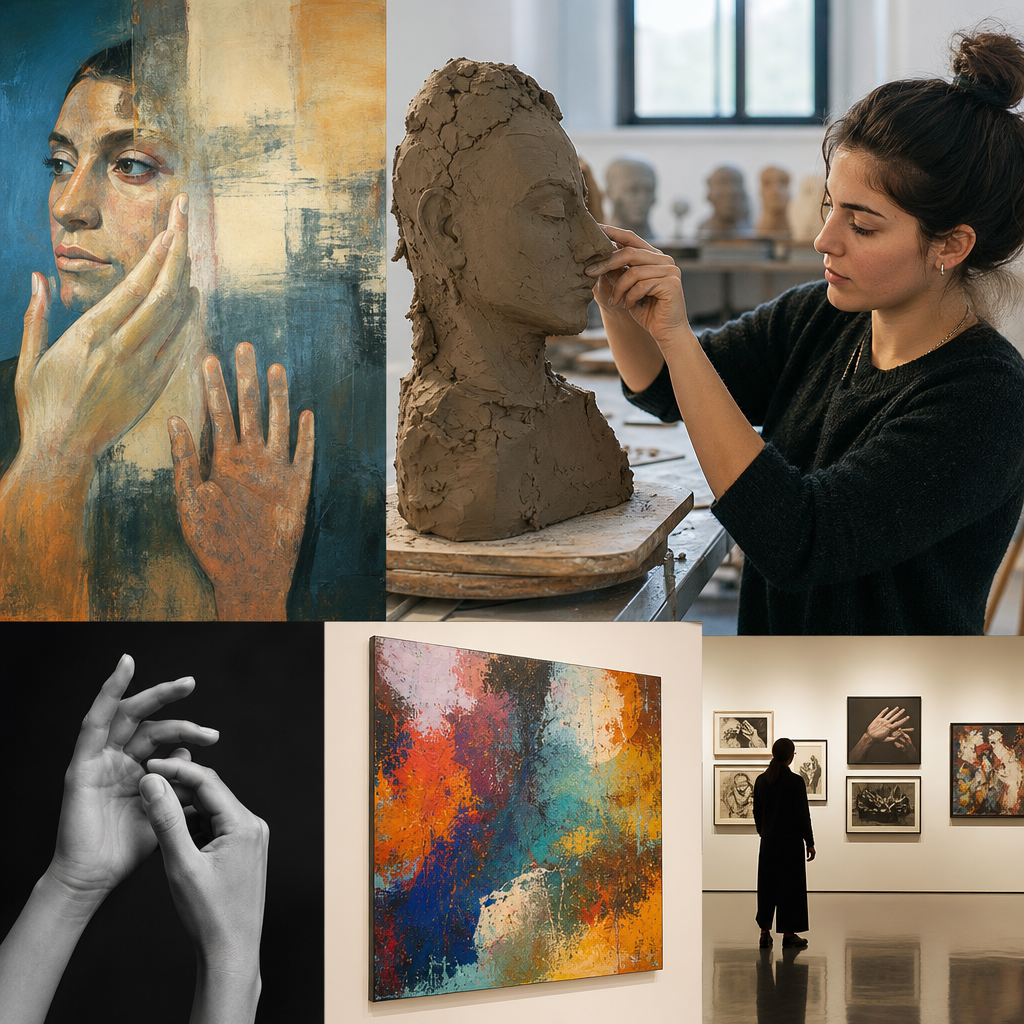
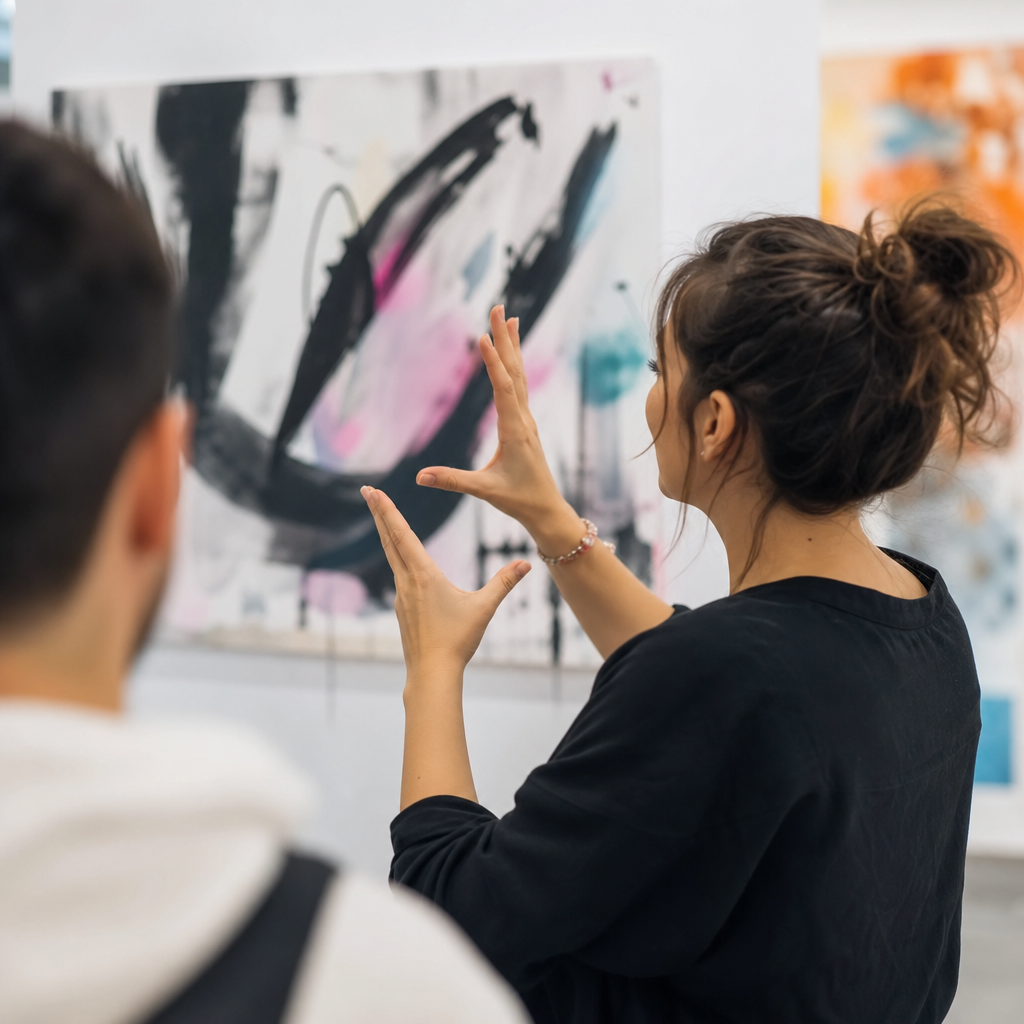
| Visual art | Static images that explore language, identity, and Deaf gain | Artwork featuring hands, eyes, or signed wordplay |
These forms reinforce one another. A stage actor may also perform signed poetry. A visual artist may design sets informed by Deaf symbolism. A filmmaker may borrow timing from live signing. Taken together, they form an ecosystem of expression rather than isolated categories.
Accessibility, Bilingual Production, and Creative Tradeoffs
Accessibility in Deaf theater is a design principle, not a compliance checklist. Productions must decide whom they are centering and how multiple audiences will follow the work. Options include surtitles, projected text, voiced interpretation, shadow interpreters, bilingual casting, and scripts developed simultaneously in sign and spoken language. Each choice creates gains and tradeoffs. Surtitles can help hearing and late-deafened audiences, but they pull visual attention away from performers. Voicing can broaden reach, but poor timing may flatten signed rhythm. Bilingual productions can be elegant, yet they require more rehearsal, stronger direction, and exact coordination.
The strongest companies treat bilingualism as an artistic opportunity rather than a burden. They ask which scenes should be signed only, which should be voiced, and where deliberate asymmetry serves the story. A Deaf character excluded from a spoken conversation may produce productive discomfort in hearing audiences. A hearing character trying to follow a fast signed exchange can reverse the usual power dynamic. These are not accidents. They are dramaturgical choices that reveal social reality.
Physical accessibility also matters. Audience seating, sightlines, lobby communication, program notes in plain language, and staff familiarity with sign language all shape the experience. In my experience, venues often focus on stage access and forget the rest of the building. Deaf-inclusive practice requires consistency from ticketing to curtain call.
Education, Talent Development, and the Future of Deaf Theater
The future of Deaf theater depends on training, funding, and sustained leadership pipelines. Deaf actors need access to conservatories, community workshops, mentors, and casting networks that understand signed performance. Too often, talented Deaf artists are asked to fit hearing-centered methods instead of being trained in approaches that value visual language from the beginning. Institutions such as Gallaudet University have played a major role by supporting Deaf studies, language scholarship, and performance communities, but the field still needs more directors, designers, playwrights, stage managers, and producers who are Deaf themselves.
Play development is another priority. Classic adaptations are useful, yet original scripts rooted in Deaf life are what expand the repertoire. That includes work for children, experimental theater, comedy, documentary performance, and intersectional stories reflecting race, gender, class, and national identity within Deaf communities. Deaf culture is not monolithic, and its theater should not be either.
Digital distribution is widening access. Recorded performances, livestreams, and short-form video allow Deaf artists to reach audiences beyond major cities. At the same time, live theater remains irreplaceable because signed language is spatial and communal. The best path forward is not choosing one over the other. It is building an arts ecosystem where stage work, film, education, archives, and community storytelling support each other.
Theater reveals Deaf culture at its most vivid: language made visible, identity made communal, and art made from lived experience. It preserves history, develops new talent, and gives Deaf people authority over their own stories. It also offers hearing audiences a better framework for understanding Deaf life, not as deficiency but as culture with its own aesthetics, humor, and intellectual traditions.
As a hub for art, storytelling, and expression, this topic begins with theater because theater gathers the full range of Deaf creativity in one form. From signed poetry and visual vernacular to film, folklore, and contemporary stage production, each related art form extends the same core principle: Deaf expression is strongest when it is created in Deaf-centered spaces and evaluated on its own artistic terms. That perspective improves representation, supports language access, and strengthens cultural continuity.
If you are building out your understanding of Deaf culture and identity, use theater as the entry point and then follow the connections outward. Explore Deaf playwrights, attend a signed performance, study how bilingual productions are staged, and read the related articles in this subtopic on storytelling, visual art, film, and performance traditions. The more closely you watch Deaf theater, the more clearly you will see how art sustains culture.
Frequently Asked Questions
Why is theater so important in Deaf culture?
Theater is important in Deaf culture because it brings together language, identity, history, and community in one highly visible and shared experience. In Deaf communities, performance is not limited to entertainment. It is also a cultural space where Deaf ways of communicating and understanding the world are centered rather than treated as secondary. Through sign language, facial expression, body movement, timing, and visual storytelling, theater reflects how many Deaf people naturally experience communication and art.
It also serves as a powerful form of cultural transmission. Stories about Deaf life, collective memory, social barriers, pride, humor, and resilience can be passed from one generation to the next in a format that is immediate and emotionally engaging. For many audience members, Deaf theater validates lived experience by showing Deaf characters, Deaf language, and Deaf perspectives on stage without requiring them to be translated into a hearing framework first. That sense of recognition is one reason theater holds such a central place in Deaf culture.
What makes Deaf theater different from mainstream theater?
Deaf theater is distinct because it is built around visual language and visual expression from the ground up. In mainstream theater, spoken dialogue often carries most of the meaning, while movement and expression support the text. In Deaf theater, the relationship is different. Sign language, gesture, facial grammar, spatial use, rhythm, and stage composition are often the primary vehicles of storytelling. Meaning is shaped not just by what is signed, but by how the body moves through space, how performers establish visual focus, and how emotional nuance appears in the face and hands.
Another key difference is perspective. Deaf theater frequently emerges from Deaf experiences, values, and cultural knowledge, which affects everything from casting and script development to staging and audience engagement. It may explore themes such as language access, identity, education, audism, family relationships, and community belonging. Even when a production adapts a well-known story, Deaf theater often transforms it into something visually richer and culturally specific. The result is a performance style that does not simply substitute signs for speech, but reimagines theater through Deaf cultural and linguistic expression.
How does sign language shape storytelling in Deaf theater?
Sign language shapes storytelling in Deaf theater at every level. It is not only a method of communication; it is an artistic medium with its own grammar, rhythm, imagery, and expressive potential. Because sign languages are visual and spatial, they allow performers to build scenes in three dimensions, show relationships between characters through placement and movement, and create emotional intensity through pace, scale, and facial expression. This gives Deaf theater a dynamic quality that can feel immersive and immediate for audiences.
Sign language also expands the possibilities of characterization and narrative style. A performer can shift quickly between viewpoints, embody multiple roles, or use visual metaphor in ways that are uniquely effective on stage. Facial expressions function as a critical part of meaning, not just an added dramatic layer, and body movement can carry tone, tension, and subtext with remarkable precision. In this way, sign language does not simply deliver the script. It becomes the script’s emotional texture, visual architecture, and creative force.
What role does Deaf theater play in preserving Deaf history and identity?
Deaf theater plays a major role in preserving Deaf history and identity by turning community memory into living performance. Many Deaf stories have not always been fully represented in mainstream cultural institutions, so theater becomes an important place to document and share experiences that might otherwise be overlooked. Productions can explore the history of Deaf education, battles for language recognition, changing attitudes toward Deafness, and the contributions of Deaf artists and activists. When these stories appear on stage, they become more than historical facts. They become shared cultural knowledge.
This matters deeply for identity. Seeing Deaf lives portrayed with depth and authenticity helps individuals understand themselves as part of a larger cultural tradition. It reinforces that Deaf culture is not defined only by barriers or medical narratives, but by language, creativity, resistance, humor, and collective pride. For younger generations especially, Deaf theater can be a place of discovery where they encounter role models, cultural references, and historical experiences that strengthen their sense of belonging. In that way, theater helps preserve not just the past, but the continuity of Deaf identity into the future.
Can hearing audiences appreciate and learn from Deaf theater?
Yes, hearing audiences can absolutely appreciate and learn from Deaf theater, and many productions are designed to welcome a broad audience without sacrificing Deaf cultural integrity. Deaf theater invites hearing viewers to engage with storytelling in a more visual and embodied way, often shifting attention away from spoken language as the default center of meaning. This can be a powerful experience because it challenges assumptions about communication, performance, and what makes a story emotionally effective.
At the same time, Deaf theater offers hearing audiences a valuable opportunity to understand Deaf culture on its own terms. Rather than presenting Deafness as a limitation, it highlights the richness of sign language, the creativity of visual expression, and the strength of Deaf community life. Through that experience, hearing viewers can gain insight into issues such as access, representation, and cultural respect while also enjoying innovative and compelling performance. The best Deaf theater does not ask hearing audiences merely to observe difference. It invites them to rethink theater itself through a Deaf cultural lens.