Visual Vernacular is a distinctive Deaf performance art that blends sign language, mime, cinematic framing, rhythm, and embodied storytelling into a form that is instantly visual, emotionally direct, and culturally grounded. Within Deaf Culture and Identity, it sits at the center of art, storytelling, and expression because it shows how Deaf communities create meaning through movement, facial grammar, space, and perspective rather than through spoken sound. I have worked with signed performances in educational and cultural settings, and the first thing newcomers usually notice is that Visual Vernacular does not look like everyday signing. It is more theatrical, more compressed, and more image-driven. Performers shift roles rapidly, zoom in on details, widen the scene, and guide the viewer’s eye with precise control of body position and gaze.
The term generally refers to a performance style that emerged from Deaf artistic practice, especially in Europe and North America, and developed through festivals, workshops, community stages, and now video platforms. Key terms matter here. Sign language is a full natural language with its own grammar; mime is stylized physical expression; classifier constructions are handshapes used in many sign languages to represent categories of objects, people, and movement; and role shift is the change in body orientation, facial expression, or eye gaze to mark a different character or perspective. Visual Vernacular uses all of these, but it is not simply signed poetry, not ordinary conversation, and not a direct translation of spoken-language theater. It is a separate artistic mode with its own expectations.
This topic matters because Visual Vernacular preserves cultural memory, broadens artistic access, and challenges narrow assumptions about what literature and performance can be. It is also the ideal hub for Art, Storytelling and Expression within Deaf Culture because it connects multiple traditions: Deaf theater, signed poetry, narrative performance, film, comedy, activism, and digital creativity. Understanding it helps hearing audiences appreciate Deaf art on its own terms, while helping Deaf learners and families see that expression in sign language can be expansive, sophisticated, and globally influential. For students, teachers, interpreters, artists, and curious readers, Visual Vernacular offers a powerful entry point into the wider landscape of Deaf creativity.
What Visual Vernacular Is and How It Works
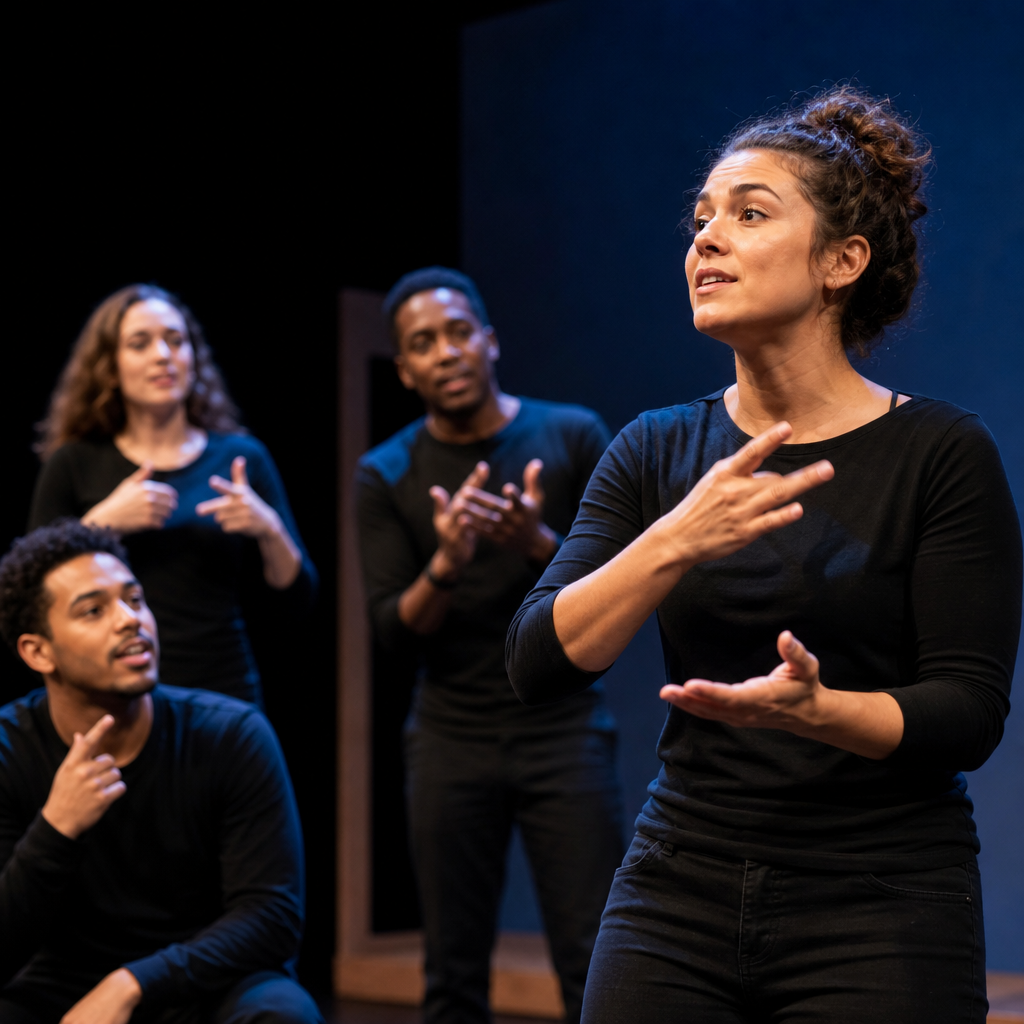
Visual Vernacular is best understood as image-based storytelling performed through the body. Instead of relying primarily on lexical signs in sentence order, the performer creates scenes as if editing a film live in space. A skilled artist can establish a city skyline, become a speeding cyclist, cut to a close-up of a spinning wheel, then switch to the startled reaction of a pedestrian, all within seconds. These transitions are not random. They depend on timing, visual clarity, and control of scale. In workshops, I often describe this as cinematic signing because performers use techniques equivalent to long shot, close-up, slow motion, split perspective, and montage.
Facial expression is not decoration in this form; it is grammar, character, mood, and camera angle all at once. The face can show fear, delight, suspense, irony, or transformation before the hands complete the image. Body shifts indicate who is acting and who is observing. Classifier handshapes may represent a train, a bird, a drop of water, or a crowd, while movement quality shows speed, weight, or danger. Because Visual Vernacular is highly iconic, many scenes can be appreciated across sign language communities, yet mastery still depends on deep fluency in visual language conventions. That balance between broad accessibility and cultural specificity is one reason the form has traveled so successfully.
Another defining feature is economy. Good Visual Vernacular removes unnecessary detail and keeps only what the eye needs. If a performer wants to show a storm at sea, they may not sign every literal element. Instead, they might embody the pitching boat, tighten the jaw, shift horizon lines with the shoulders, and let one hand become the mast snapping under force. The viewer understands the full event because the imagery is structured efficiently. This precision is why the form is often used in festivals and short videos: it can deliver a complete narrative arc quickly without feeling simplistic.
Roots in Deaf Culture, Theater, and Community Storytelling
Visual Vernacular did not appear in isolation. It grew from long-standing Deaf storytelling traditions in clubs, schools, theaters, and family gatherings where visual performance carried humor, history, cautionary tales, and social critique. Before digital media, Deaf communities often depended on in-person networks to share news and art. Storytellers became central figures because they could transform lived experience into something collective and memorable. Many of the techniques now associated with Visual Vernacular were refined in these social spaces: role shifting, exaggeration for clarity, comedic timing, and the art of making an audience “see” a scene unfold.
Deaf theater helped formalize and expand those practices. Companies such as the National Theatre of the Deaf in the United States demonstrated that signed performance could command professional stages and mixed audiences. International festivals later created spaces where Deaf artists exchanged methods across languages and national traditions. European practitioners, especially in France, were influential in naming and shaping the modern style. Artists such as Bernard Bragg are frequently cited in discussions of visually driven Deaf performance, not because one person invented the whole form, but because generations of performers pushed signed storytelling toward increasingly cinematic expression.
Community context remains essential. In Deaf settings, audiences notice details that outsiders may miss: whether a transition is clean, whether a classifier choice is elegant, whether humor comes from shared cultural experience, and whether a piece respects the visual logic of sign language. That is why Visual Vernacular should not be reduced to spectacle for hearing viewers. It is a living Deaf art form rooted in identity, language politics, and community standards. When it is taught well, instructors place technique alongside cultural grounding, reminding students that performance skill without cultural understanding produces imitation rather than authentic expression.
Core Techniques That Make the Form Distinct
The mechanics of Visual Vernacular can be taught, practiced, and evaluated. Performers use framing to decide what the audience sees first, perspective to determine from whose eyes the scene is shown, and tempo to control emotional pacing. One common technique is zooming: the body establishes a wide scene, then narrows attention to a single object or face. Another is morphing, where one image transforms smoothly into another, such as a tree bending into a frightened person. Effective morphing requires muscular control and a clear visual logic, otherwise the audience loses the thread of the story.
Classifier constructions are especially important because they allow compression of complex movement. In American Sign Language, British Sign Language, French Sign Language, and many other signed languages, classifiers can depict vehicles, flat objects, upright figures, or handling actions. In Visual Vernacular, those tools are heightened artistically. A performer may use one hand as a tiny figure crossing a street while the face shows the looming threat of traffic from another angle. Role shift then lets the artist become the driver, the bystander, and the victim in rapid sequence. These shifts create dramatic tension without lengthy exposition.
Rhythm is another technical pillar. Some pieces are comic and syncopated, others lyrical, others deliberately abrupt. Even in silence, the performance has measurable cadence. I have seen beginners focus only on handshape accuracy and miss the larger issue: if rhythm is flat, the piece feels static. Strong performers shape beats with breath, pauses, eye focus, and acceleration. They know when to hold an image and when to cut away. That timing is comparable to editing in film or phrasing in dance. It is one reason Visual Vernacular is frequently taught through repetition, video review, and peer critique rather than through explanation alone.
| Technique | What It Does | Simple Example |
|---|---|---|
| Role shift | Changes character or viewpoint | Turning from cyclist to driver to witness |
| Classifier use | Represents objects and movement efficiently | A handshape shows a car skidding on ice |
| Zoom in/out | Controls visual focus like a camera | City street scene narrows to one dropped coin |
| Morphing | Transforms one image into another | Flower opening becomes a smiling face |
| Rhythmic pacing | Builds suspense, humor, or emphasis | Slow buildup before a sudden reveal |
How Visual Vernacular Differs From Signed Poetry, Mime, and Theater
People often ask whether Visual Vernacular is simply mime with signs. It is not. Mime can be part of the toolkit, but Visual Vernacular is informed by the grammar and discourse strategies of sign languages. It also differs from signed poetry, which may focus more on repetition, handshape patterning, metaphor, and linguistic symmetry. A signed poem can be highly visual, but it does not always use the cinematic scene-building that defines Visual Vernacular. Likewise, stage acting in Deaf theater may include dialogue, ensemble blocking, and scripted interaction, while Visual Vernacular often relies on a single performer carrying the narrative through rapid visual shifts.
The distinction matters for both appreciation and teaching. If an instructor treats the form as generalized pantomime, students may produce broad gestures without linguistic precision. If they treat it only as conversational signing, the result may become too literal and lose its artistry. In practice, strong Visual Vernacular occupies a middle ground: linguistically grounded, theatrically sharpened, and visually edited. That mix is why the best performances can cross language boundaries better than ordinary signing while still being recognizably Deaf in structure and sensibility.
For audiences, the easiest way to see the difference is to watch how meaning is layered. In mime, the body may imitate an action directly. In Visual Vernacular, the performer often shows the action, the observer’s reaction, the object’s movement, and the emotional tone in tightly controlled sequence. A person slipping on a wet floor becomes not just a fall, but a camera pan across the hazard, a split-second facial warning, the loss of balance, and the impact seen from another angle. That multi-perspective compression is a hallmark of the form.
Why It Matters for Identity, Education, and Accessibility
Within Deaf Culture and Identity, Visual Vernacular affirms that signed expression is not secondary to spoken or written art. It proves that visual language can generate its own aesthetics, critical standards, and star performers. That affirmation has social value. Many Deaf children still grow up with limited access to rich language models, especially if they are born into hearing families unfamiliar with sign language. Encountering powerful signed art can change expectations quickly. It shows that language is not merely functional; it is creative, communal, and capable of beauty.
In education, Visual Vernacular supports language development, narrative sequencing, confidence, and cultural literacy. Teachers use it to help students understand perspective, transitions, characterization, and descriptive economy. Because the form is highly engaging, it can motivate reluctant signers to experiment with expression. It also opens doors for cross-curricular work in film studies, literature, drama, and history. A classroom might analyze a signed performance in the same way it would analyze a short film: framing, climax, symbolism, and audience impact. That approach treats Deaf art as academically serious rather than as an optional enrichment activity.
Accessibility is another major benefit. For Deaf audiences, Visual Vernacular can communicate across signing varieties more easily than dense lexical discourse because iconic imagery carries much of the meaning. For hearing audiences, it provides a way to appreciate Deaf artistry even before they learn a sign language, although access is deeper with cultural context. The limitation is important too: broad visual appeal does not eliminate the need for language respect, Deaf leadership, or accurate interpretation when discussion surrounds the performance. Accessibility should expand participation, not flatten the art into something generic.
Visual Vernacular in the Digital Age and Where to Explore Next
Digital video transformed Visual Vernacular. Short-form platforms, festival recordings, online workshops, and Deaf creators’ channels now circulate performances worldwide. The camera suits the form because performers already think in visual cuts and angles. A creator can stage a piece specifically for a vertical screen, use editing to reinforce perspective, or reach audiences far beyond local Deaf clubs. This wider distribution has helped younger artists study masters repeatedly, something earlier generations could not do as easily. It has also increased recognition in museums, universities, and interpreter training programs.
There are tradeoffs. Online popularity can reward speed and novelty over craft, and clips are sometimes reposted without credit or cultural framing. As with any art shared widely, attribution matters. So does context. A striking thirty-second performance may inspire curiosity, but deeper understanding comes from following Deaf-led theaters, attending festivals, studying sign language, and exploring related forms. This hub on Art, Storytelling and Expression should lead readers naturally into signed poetry, Deaf theater, storytelling traditions, visual humor, film, and contemporary Deaf creators because Visual Vernacular connects them all.
The key takeaway is simple: Visual Vernacular is a unique Deaf art form because it turns visual language into cinematic performance with remarkable precision and emotional power. It draws from community tradition, advanced sign language skills, and disciplined artistic choices. If you want to understand Deaf culture beyond surface definitions, start here, then continue through the wider world of Deaf art and expression. Watch Deaf performers, learn the techniques they use, and follow Deaf-led cultural spaces to see the form in its full richness.
Frequently Asked Questions
What is Visual Vernacular, and why is it considered a unique Deaf art form?
Visual Vernacular, often shortened to VV, is a highly visual Deaf performance art that combines elements of sign language, mime, facial expression, body movement, rhythm, and cinematic storytelling. What makes it unique is that it does not simply translate spoken language into signs. Instead, it creates meaning through visual composition. Performers use shifts in perspective, role changes, timing, spatial mapping, and detailed facial grammar to guide the audience through a scene in a way that feels almost like watching a film unfold on the body.
Within Deaf Culture, Visual Vernacular is widely recognized as more than a performance style. It is a form of cultural expression grounded in the lived experiences, communication values, and artistic traditions of Deaf communities. It reflects a way of storytelling that prioritizes what can be seen, felt, and physically embodied. Rather than relying on spoken sound, it uses movement, silence, intensity, and visual rhythm to create emotional depth and narrative clarity. That is why it stands out as a distinct Deaf art form: it is rooted in Deaf ways of perceiving and shaping the world.
How is Visual Vernacular different from sign language interpretation or everyday signing?
Although Visual Vernacular may use features found in signed languages, it is not the same thing as interpretation or casual conversation. Interpretation aims to convey the meaning of spoken or written language accurately from one language into another. Everyday signing is typically focused on direct communication, with signs used to exchange information, ask questions, tell stories, or express opinions. Visual Vernacular, by contrast, is artistic, stylized, and performance-driven. Its goal is not just to communicate content but to create an immersive visual experience.
In Visual Vernacular, the performer may shift rapidly between characters, zoom in and out of imagined scenes, and use the body like a camera lens to frame action from multiple angles. A person might become the rain, a moving vehicle, a frightened child, and a distant observer all within the same performance. This level of transformation is central to VV. It draws from the visual-spatial strengths of Deaf expression and amplifies them into a theatrical and cinematic form. So while signed language knowledge is often part of the foundation, Visual Vernacular operates as an art form with its own structure, aesthetics, and performance techniques.
Why is Visual Vernacular important in Deaf Culture and identity?
Visual Vernacular holds deep importance in Deaf Culture because it demonstrates how Deaf communities create and transmit meaning in ways that are visually rich, emotionally layered, and culturally specific. It affirms that Deaf expression is not a lesser substitute for spoken language, but a powerful artistic system in its own right. Through VV, performers show how stories can be built through gesture, gaze, timing, space, and embodiment. This makes it an especially strong reflection of Deaf identity, where visual awareness and physical expression are central to communication and community life.
It is also important because it preserves and celebrates Deaf creativity. Visual Vernacular often carries themes of resilience, humor, shared experience, social critique, and memory. Performances can speak to the realities of Deaf life while also pushing artistic boundaries. For many audiences, VV is a source of recognition and pride because it centers Deaf ways of seeing rather than adapting to hearing expectations. In that sense, it is both art and cultural affirmation. It helps people understand that Deaf culture is not defined by absence of sound, but by the presence of rich visual language, perspective, and imagination.
What techniques do performers use in Visual Vernacular performances?
Visual Vernacular performers rely on a sophisticated set of techniques that make the performance vivid and dynamic. One of the most important is perspective shifting. A performer may move from a close-up emotional moment to a wide environmental scene, much like a filmmaker changes camera shots. They also use role shifting to become different characters or objects in rapid sequence. Facial grammar is equally essential, because subtle changes in expression can mark mood, tension, pace, and character identity. Even a slight shift in eye focus or head angle can change the meaning of a scene.
Another key technique is the use of rhythm and visual timing. VV is often paced very carefully, with moments of stillness, acceleration, repetition, or sudden contrast used to build suspense and emotional impact. Mime-like precision helps make actions instantly recognizable, while the structure of signed storytelling keeps the narrative coherent. Space is also used deliberately. The performer maps locations, directions, and relationships in the air and around the body, allowing the audience to follow the story visually. When these techniques are combined skillfully, the result is a performance that feels cinematic, expressive, and deeply engaging without needing spoken words.
Can someone appreciate Visual Vernacular without being Deaf or fluent in sign language?
Yes, many people can appreciate Visual Vernacular even if they are not Deaf or fluent in sign language, because VV is designed to be strongly visual and emotionally immediate. Its use of movement, expression, pacing, and visual storytelling often makes the overall narrative accessible across language backgrounds. Audiences can frequently understand the mood, action, and dramatic shifts through the performer’s embodiment alone. That broad accessibility is one reason Visual Vernacular is so compelling in public performances, festivals, classrooms, and digital media.
At the same time, a deeper understanding comes from learning about Deaf Culture, signed languages, and the artistic conventions that shape VV. Certain nuances, cultural references, and linguistic choices may be more fully appreciated by viewers who are familiar with Deaf ways of storytelling. That does not mean outsiders cannot connect with the work. It means that Visual Vernacular operates on multiple levels: it can move viewers immediately through its visual power, while also rewarding those who take the time to understand its cultural and linguistic foundations. For anyone exploring the topic, watching signed performances closely is one of the best ways to see how meaning is built through movement, space, and visual imagination.