
Storytelling shapes Deaf culture by preserving shared history, teaching language, strengthening identity, and creating spaces where Deaf people see their experiences reflected with accuracy and pride. In this context, storytelling means far more than spoken or written narrative. It includes signed performances, visual vernacular, poetry in sign languages, theater, film, jokes, family histories, community folklore, and everyday personal accounts exchanged in schools, homes, clubs, and online spaces. Deaf culture refers to the social, linguistic, and artistic life built around Deaf communities, especially those centered on sign language, visual communication, and collective values such as access, reciprocity, and cultural continuity. Art, storytelling, and expression matter because they do cultural work: they carry memory across generations, explain norms to newcomers, challenge stereotypes from the hearing world, and turn lived experience into something shared, legible, and enduring. I have seen this repeatedly in Deaf spaces, where a single well-told story in sign can teach history, provoke laughter, and affirm belonging all at once.
For a hub article on art, storytelling, and expression, the central point is simple: stories are not decorative extras within Deaf culture; they are one of its core organizing forces. When a Deaf elder recounts school experiences, when a performer uses role shift to dramatize a misunderstanding with hearing people, or when a filmmaker frames captioning and camera perspective to match visual attention, the result is both artistic and cultural. These forms also answer practical questions many readers have. How is Deaf storytelling different from mainstream storytelling? Why are sign languages especially powerful for performance? What role do theaters, festivals, and digital platforms play? How do humor, poetry, and activism intersect? Understanding these questions helps readers see Deaf expression as a complete cultural ecosystem rather than a niche art category. That ecosystem includes community archives, grassroots performances, professional stages, and social media clips, all linked by the same purpose: making Deaf life visible on Deaf terms.
Why storytelling holds Deaf communities together
Storytelling holds Deaf communities together because it transmits cultural knowledge in forms that are accessible, memorable, and emotionally resonant. In many Deaf settings, stories do the work that informal oral tradition does elsewhere, except the medium is visual and embodied. Historical accounts about residential schools for Deaf children, struggles for interpreter access, and the fight to recognize sign languages help younger Deaf people understand that current rights were won through organized effort. Personal stories also model behavior. A newcomer learns when to tap for attention, how to manage visual turn-taking, why eye contact matters, and how humor eases tension in mixed Deaf-hearing situations. These lessons often land more deeply through narrative than through abstract explanation.
Community cohesion also depends on recognition. In hearing-dominated environments, Deaf people are frequently asked to adapt, explain themselves, or accept distorted portrayals. Within Deaf storytelling, those pressures reverse. The audience already understands visual timing, missed cues, interpreter fatigue, and the absurdity of inaccessible design. That shared baseline allows stories to move quickly into nuance. A joke about flickering lights at a community event or a dramatic retelling of a medical appointment without an interpreter can carry layers of meaning because the audience has lived the context. This is why Deaf clubs, school reunions, festivals, and now video-based platforms remain so important. They are not just places to consume content; they are places where community meaning is collectively made.
How sign language transforms narrative art
Sign languages transform narrative art by making the body, face, gaze, and use of space central to meaning. A signed story is not a spoken script translated by hand. It is composed through linguistic features unique to sign languages, including classifiers, role shift, constructed action, spatial mapping, nonmanual markers, and rhythmic timing. In American Sign Language, British Sign Language, and other sign languages, a storyteller can assign locations in space to characters, move between perspectives with a subtle shoulder shift, and show rather than merely tell action through embodiment. That gives signed narrative a cinematic quality, but it is still fully linguistic, not pantomime.
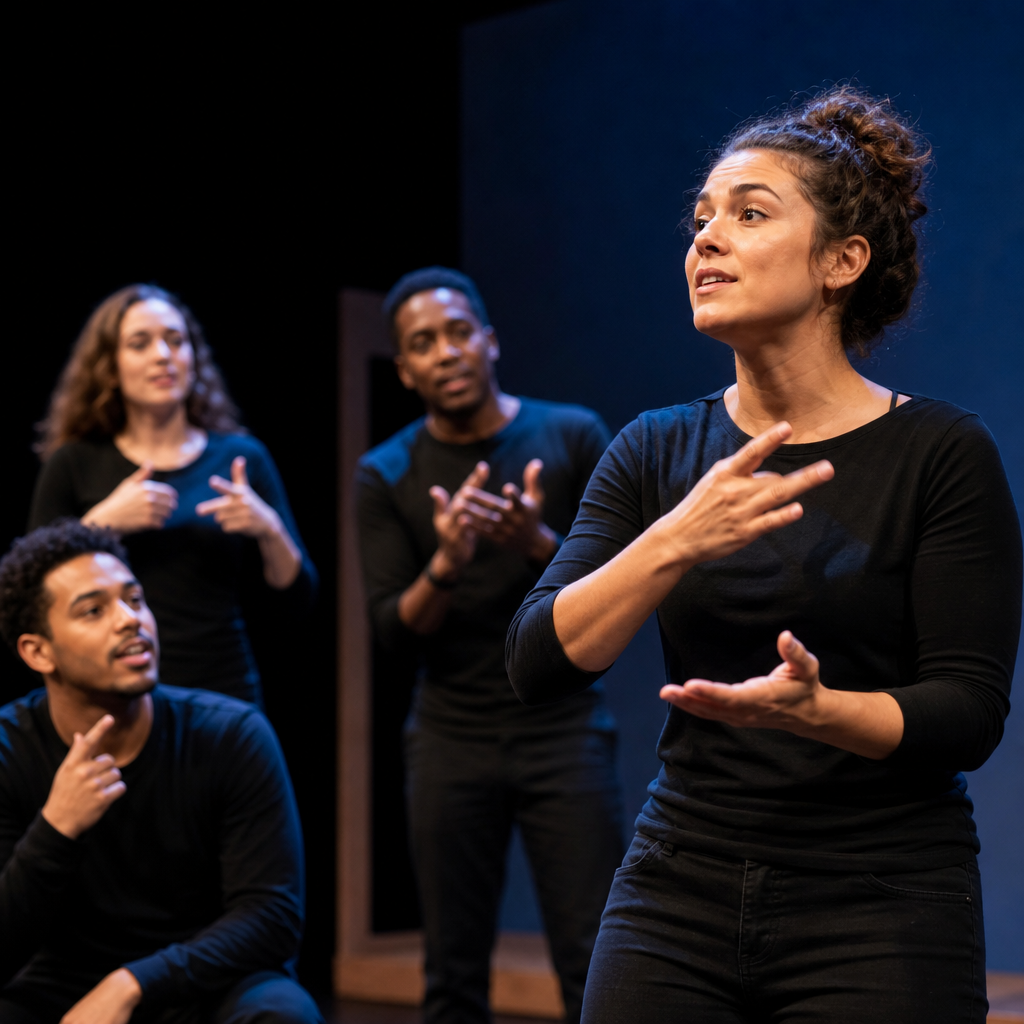
One of the clearest examples is role shift, where the signer adopts the perspective of different characters by changing posture, eye gaze, and facial expression. A skilled storyteller can move between a frustrated teacher, a mischievous child, and an exasperated parent in seconds without confusing the audience. Visual vernacular, developed prominently in Deaf performance traditions, pushes this even further by blending sign language structure with highly visual techniques resembling montage, zoom, and scene cuts. I have watched audiences respond to these performances with the kind of focused silence usually associated with great theater, then erupt into visual applause because the storytelling is precise, layered, and immediate. The artistry lies not only in fluency but in control of visual attention, pacing, and spatial coherence.
Major forms of Deaf artistic expression
Deaf artistic expression spans multiple forms, but several repeatedly serve as anchors within the broader landscape of Deaf culture and identity. Signed storytelling is the foundation because it is portable, communal, and deeply connected to language transmission. Signed poetry builds on that foundation through repetition, handshape patterning, movement symmetry, metaphor, and visual rhythm. Deaf poetry often explores themes of oppression, pride, language politics, technology, and sensory experience. Theater adds ensemble performance, staging, lighting, and translation choices, with companies such as Deaf West Theatre showing how Deaf and hearing performers can collaborate without erasing signed expression. Film expands the frame again, using editing, point of view, and caption design to reflect Deaf ways of seeing rather than treating captions as an afterthought.
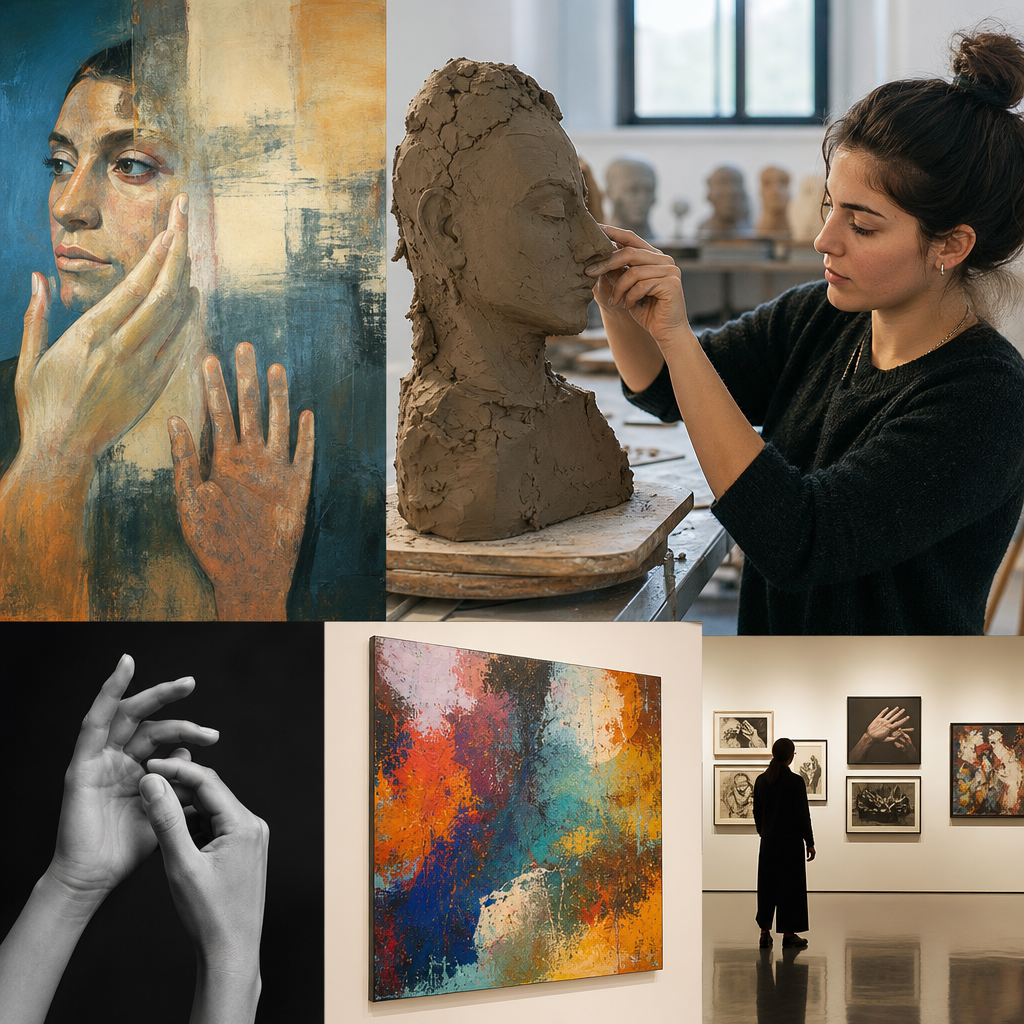
Humor is another major form and deserves equal weight. Deaf jokes are not minor entertainment; they are a social diagnostic tool. They expose hearing assumptions, celebrate visual intelligence, and relieve pressure created by exclusion. Visual art, including painting, sculpture, and digital design, also contributes, particularly through themes associated with the De’VIA movement, or Deaf View/Image Art. De’VIA artists such as Betty G. Miller and Chuck Baird used recurring symbols like eyes, hands, barriers, and amplification devices to examine language deprivation, audism, and Deaf pride. Across all these forms, the common thread is authorship from lived Deaf experience. That is what makes this subtopic a hub: every branch of Deaf art returns to storytelling, and every strong story deepens cultural identity.
| Form | What it does | Representative example |
|---|---|---|
| Signed storytelling | Preserves community memory and teaches language norms | Elders recounting school life, activism, and family histories |
| Signed poetry | Uses rhythm, symmetry, and metaphor for emotional and political expression | Performances by Clayton Valli and contemporary ASL poets |
| Theater | Brings collective narratives to public audiences through staging and ensemble work | Deaf West Theatre productions |
| Film and video | Documents Deaf perspectives and scales storytelling beyond local communities | Festival shorts, documentaries, and creator-led social media series |
| De’VIA visual art | Explores Deaf identity, oppression, and pride through visual symbolism | Works by Betty G. Miller and Chuck Baird |
Storytelling as history, resistance, and cultural memory
Deaf storytelling is one of the most effective tools for preserving history because much of Deaf experience has been ignored, misrecorded, or filtered through hearing institutions. Stories fill those gaps. They document the rise of Deaf schools, the importance of residential education as a site of language transmission, and the damage caused when sign language was suppressed after the 1880 Milan Conference, where educators endorsed oralism and marginalized signed education in many countries. They also preserve more recent turning points, including disability rights legislation, interpreter qualification standards, captioning advocacy, and campaigns for bilingual-bicultural education. In practical terms, stories make these events understandable. A policy change becomes real when someone explains what school felt like before and after access improved.
Storytelling is also a form of resistance to audism, the assumption that hearing ways of communicating are inherently superior. Resistance does not always appear as slogans or protest speeches. Often it appears as a narrative that centers Deaf competence and refuses pity. A film scene that lets signing continue without constant interruption, a poem about refusing to be fixed, or a comic routine about hearing people who say “never mind” instead of repeating themselves can all challenge hierarchy. Because these stories are grounded in everyday life, they are persuasive. They do not need exaggeration. They simply reveal systems that hearing audiences often fail to notice and remind Deaf audiences that their frustrations are shared, patterned, and historically rooted.
The role of Deaf institutions, festivals, and digital media
Stories gain power when institutions help circulate them. Deaf schools have historically been central because they brought Deaf children together, often for the first time, allowing language, folklore, and performance styles to spread horizontally among peers as well as vertically from adults. Deaf clubs later extended that function for adults, creating regular spaces for social storytelling, debate, and performance. Today, even where clubs have declined, festivals, conferences, and arts organizations continue the work. Events such as Deaf film festivals, signed poetry showcases, and theater residencies create standards, audiences, and archives. They also connect local artists to broader transnational networks, which matters because Deaf culture is both locally specific and globally linked through shared visual practices and overlapping political concerns.
Digital media has expanded this circulation dramatically. Short-form video allows Deaf creators to publish stories directly without waiting for gatekeepers. Platforms built around video naturally suit sign language, and creators have used them for comedy, education, memoir, and activism. The change is not merely quantitative. Online storytelling has altered who gets to narrate Deaf life. Instead of relying on hearing journalists or filmmakers, Deaf creators can frame their own experiences, choose captioning styles, and speak to Deaf and hearing audiences simultaneously. There are tradeoffs, of course. Algorithms reward brevity, conflict, and repetition, which can flatten complex issues. Archiving is inconsistent, and platform accessibility features still vary. Even so, digital media has become one of the strongest engines for Deaf cultural expression because it restores control over representation while widening reach.
What makes Deaf storytelling distinct from hearing-centered narratives
Deaf storytelling differs from hearing-centered narratives in structure, emphasis, and audience assumptions. The most obvious difference is modality: signed stories unfold visually, so attention management, spatial organization, and embodiment are built into the form. But the deeper difference is cultural perspective. Hearing-centered narratives about Deaf people often focus on loss, cure, or inspirational overcoming. Deaf storytelling usually shifts the frame toward language access, community belonging, power imbalance, and visual ingenuity. The central question is not “How did this person triumph despite deafness?” but “What does the environment reveal about inclusion, exclusion, and identity?” That distinction changes everything from plot shape to emotional payoff.
Another difference is narrative authority. In Deaf storytelling, details that hearing audiences might treat as marginal become central evidence. Whether a classroom had direct sightlines, whether emergency information was visual, whether an interpreter was qualified, whether family members signed fluently, these are not side notes. They determine the entire meaning of an event. I have found that when readers understand this shift, they stop seeing Deaf art as simply translated mainstream art and start recognizing it as a knowledge system with its own aesthetics and interpretive rules. That recognition is essential for anyone exploring Deaf culture and identity seriously. It also opens the door to related subjects this hub connects to, including Deaf theater, sign language poetry, visual art movements, humor traditions, film, and creator-led digital storytelling.
How to engage with Deaf art respectfully and use this hub well
The best way to engage with Deaf art respectfully is to begin with Deaf-led work, treat sign language as a full language rather than a gesture system, and pay attention to context as carefully as content. If you are new to this subject, start by watching performances by Deaf poets and storytellers, reading about De’VIA, and exploring Deaf theater and film created with Deaf artistic leadership. Notice how the camera frames signing, how captions support rather than replace the original language, and how humor often carries critique. If a piece is translated, ask what may be lost in English gloss alone. Signed poetry especially depends on movement pattern, facial expression, and spatial grammar that cannot be fully captured in text.
This hub works best as a map. Use it to move into deeper articles on signed storytelling, Deaf theater, visual vernacular, humor, film, and Deaf visual art. The key takeaway is that storytelling shapes Deaf culture because it keeps language alive, preserves history, resists erasure, and gives form to collective identity. Every major branch of Deaf artistic expression, from poetry to film, carries that function. For educators, artists, families, and curious readers, the main benefit of understanding this is practical as well as cultural: you become better at recognizing Deaf expertise on its own terms. Keep exploring Deaf-led sources, attend performances when possible, and let the stories teach you how the culture sees itself.
Frequently Asked Questions
Why is storytelling so important in Deaf culture?
Storytelling is central to Deaf culture because it carries history, language, values, humor, and identity from one generation to the next. In Deaf communities, stories do much more than entertain. They preserve shared experiences, explain cultural norms, pass along lessons about advocacy and resilience, and help people understand where they belong within a broader community. Because Deaf history has often been excluded or misunderstood in mainstream spaces, storytelling becomes a powerful way to protect and transmit knowledge that might otherwise be lost.
It is also important to understand that storytelling in Deaf culture is deeply visual and embodied. It includes signed narratives, visual vernacular, performances, poetry in sign languages, theater, film, jokes, and personal accounts shared in homes, schools, clubs, and online spaces. These forms allow Deaf people to communicate nuance, emotion, and perspective in ways that align naturally with visual language. As a result, storytelling does not simply reflect Deaf culture; it actively shapes and strengthens it by creating a living record of Deaf life.
How does storytelling help preserve Deaf history?
Storytelling preserves Deaf history by keeping community memories active and accessible. Stories about Deaf schools, organizations, leaders, family experiences, language struggles, discrimination, and victories for access help document what Deaf people have lived through across different generations. In many cases, these experiences were not fully recorded in written mainstream histories, so personal and community storytelling has played an essential role in preserving truth from a Deaf perspective.
Through signed stories, family histories, public performances, and community folklore, Deaf people pass on knowledge about important cultural moments and everyday realities alike. A story about a grandparent learning sign language, a student navigating an oralist school environment, or a community gathering at a Deaf club can reveal as much about Deaf history as an official document. These narratives give context to larger social changes while also honoring individual lives. They help younger generations understand how Deaf communities formed, how sign languages survived, and why cultural pride and advocacy remain so important today.
What role does storytelling play in learning sign language and cultural values?
Storytelling is one of the most effective ways people learn both sign language and the cultural values connected to it. Stories show how language works in real, expressive contexts. Instead of learning isolated signs, viewers see pacing, facial expression, role shifting, spatial structure, rhythm, and visual emphasis all working together. This makes storytelling an essential language-learning environment, especially for children and new signers who need exposure to fluent, natural communication.
At the same time, stories teach much more than vocabulary or grammar. They communicate what the community values: direct communication, visual attentiveness, mutual support, humor, respect for Deaf experiences, and pride in sign language. A funny story, a family memory, or a performance about overcoming barriers can model cultural expectations and shared meanings in ways that formal instruction alone cannot. In this sense, storytelling is both a language classroom and a cultural archive. It teaches people not only how to sign, but also how to understand the worldview and social bonds that give Deaf culture its depth.
How does storytelling strengthen Deaf identity and representation?
Storytelling strengthens Deaf identity by giving Deaf people opportunities to see their own lives reflected with accuracy, dignity, and pride. Representation matters in every culture, but it is especially meaningful in communities that have often been defined by others through medical, deficit-based, or outsider perspectives. When Deaf people tell their own stories, they shape the narrative around who they are, what they value, and how they experience the world. That process helps replace stereotypes with authentic, community-rooted understanding.
Stories also create belonging. When someone hears or watches a signed narrative about family communication, school experiences, friendship, discrimination, joy, or everyday life, they often recognize parts of themselves in it. That recognition can be deeply affirming, especially for Deaf individuals who may have grown up isolated from other Deaf people. Through storytelling, identity becomes shared rather than solitary. It reminds people that their experiences are part of a larger cultural pattern and that Deaf life is rich, creative, and worth celebrating. In this way, storytelling supports both personal confidence and collective cultural strength.
What forms of storytelling are most meaningful in Deaf communities today?
Deaf communities engage with a wide range of storytelling forms, and many of them remain highly meaningful today. Traditional signed storytelling continues to be important in community gatherings, classrooms, and family settings. Visual vernacular offers a vivid, performance-based style that uses movement, cinematic perspective, and strong visual imagery to create compelling narratives. Poetry in sign languages brings artistic depth and linguistic beauty, while Deaf theater and film provide powerful platforms for cultural expression, representation, and social commentary. Humor and jokes also play a major role, often reflecting shared experiences in ways that are both entertaining and culturally specific.
At the same time, digital spaces have expanded how stories are created and shared. Social media, video platforms, and online Deaf communities allow everyday personal accounts, advocacy messages, creative performances, and educational narratives to reach larger audiences than ever before. This has made storytelling more immediate, more participatory, and more visible across generations and geographic regions. What matters most is not one single format, but the fact that these forms continue to create spaces where Deaf people can communicate visually, preserve community knowledge, and celebrate Deaf perspectives on their own terms.