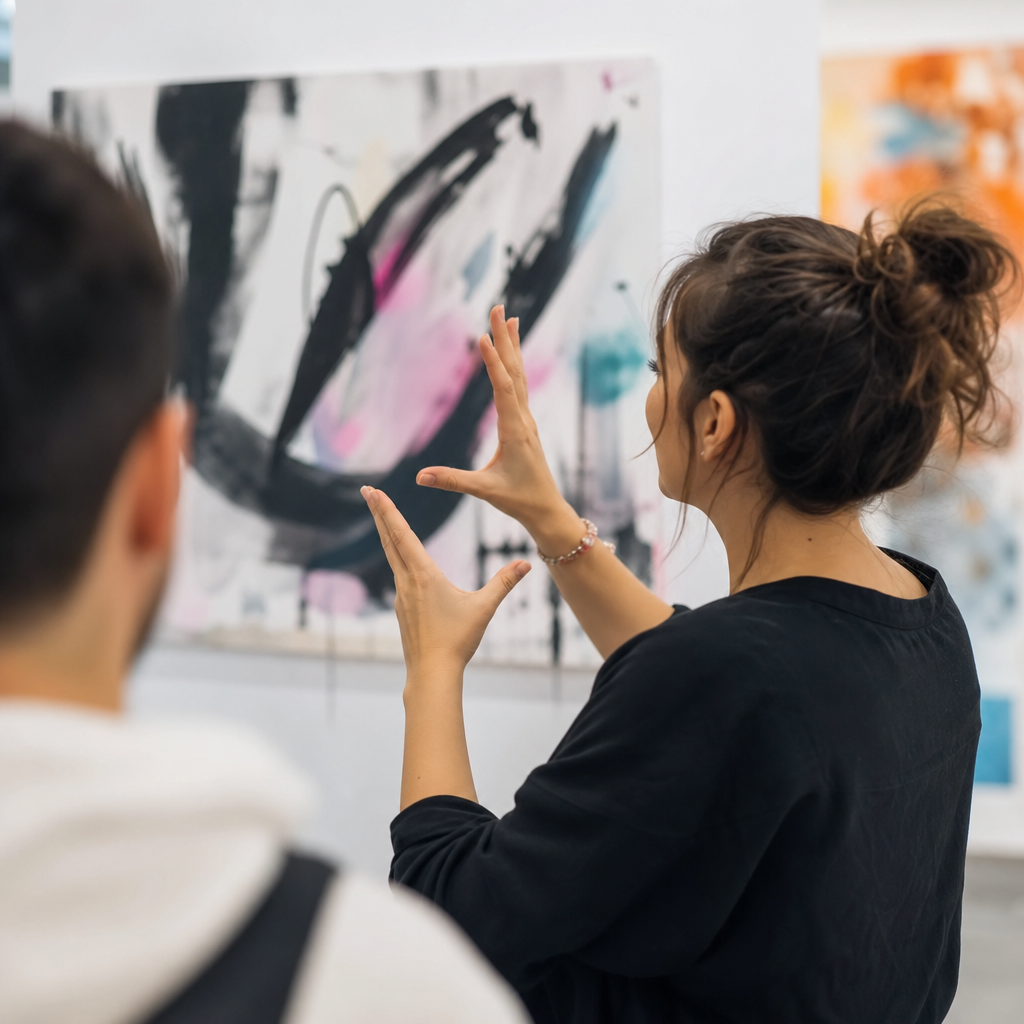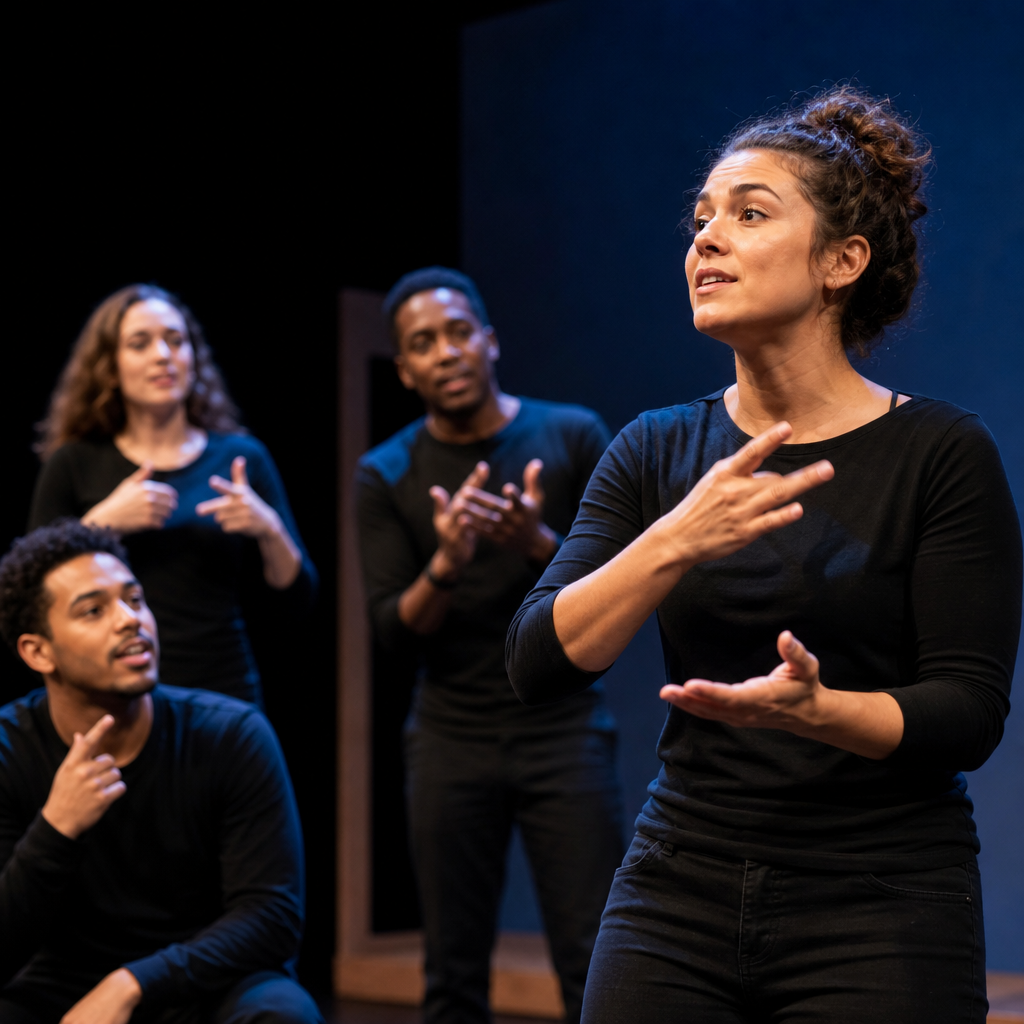
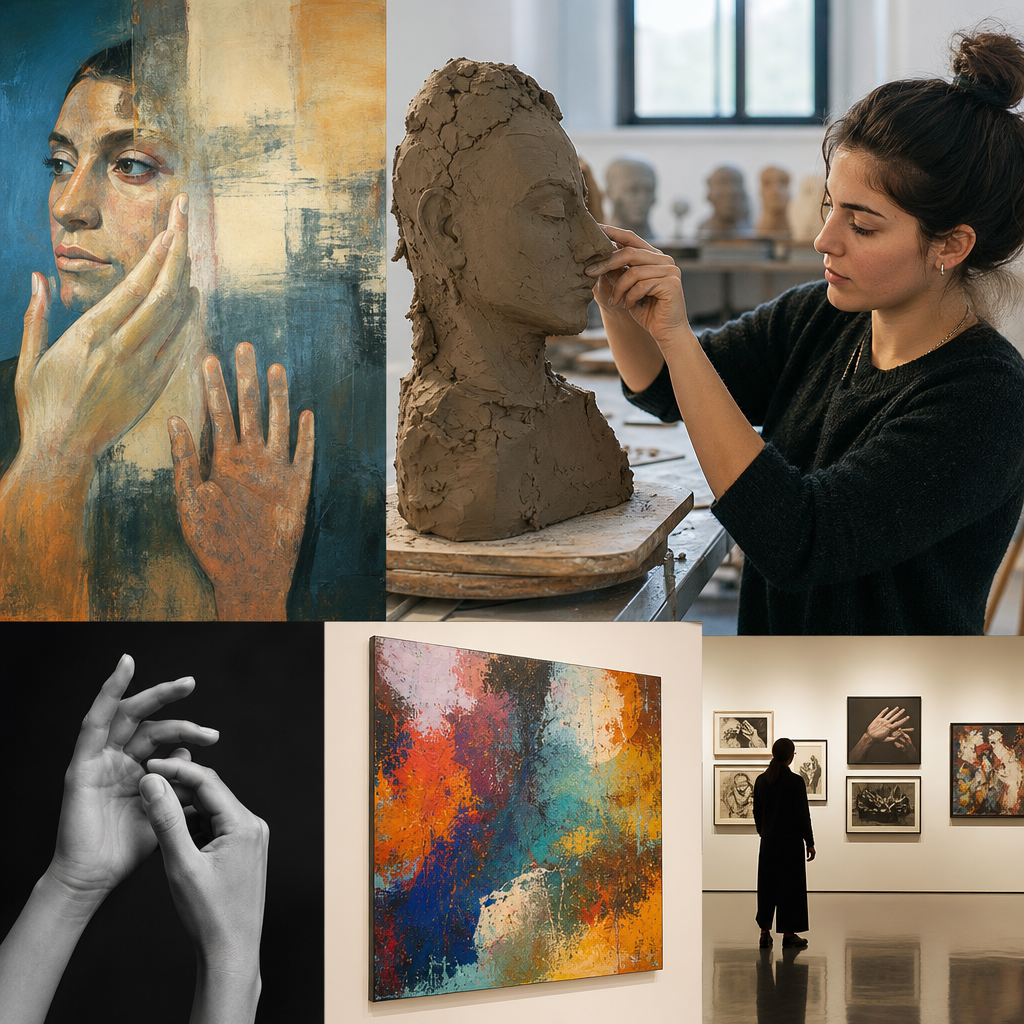
The history of Deaf art and visual expression is a history of language made visible, identity made public, and community memory preserved through images, performance, craft, and design. In Deaf culture, art is not simply decoration or personal style; it is a way of communicating values, recording struggle, celebrating beauty, and asserting the legitimacy of signed languages in societies that have often privileged speech and hearing. Deaf art includes painting, sculpture, photography, filmmaking, digital media, theater, poetry in sign language, illustration, public murals, textile work, and mixed-media practice shaped by visual attention, spatial awareness, and embodied storytelling. Visual expression is the broader field around it, including the ways Deaf people use gesture, movement, framing, rhythm, and space to create meaning that may not depend on sound at all.
This topic matters because Deaf art sits at the center of Deaf culture and identity. When I have worked with Deaf-led cultural programs and museum interpretation projects, the same pattern appears repeatedly: people often encounter Deaf history first through policy, education, or medical narratives, but they understand Deaf lives more fully through art. A poster from a Deaf protest, a signed performance recorded on video, or a painting that plays with hands, eyes, and motion can explain belonging more clearly than a textbook definition. Art also documents major historical shifts, from residential Deaf schools and community clubs to activism around language rights, interpreting access, and representation in mainstream media.
As a hub for art, storytelling, and expression, this subject connects many related conversations. It links to the history of sign languages, Deaf education, Deaf theater, Deaf film, sign poetry, visual vernacular, portraiture, community festivals, and the politics of accessibility in galleries and performance spaces. It also requires precision. Not every artwork by a Deaf person is automatically Deaf art, and not every signed performance fits the same cultural frame. In practice, Deaf art usually refers to work informed by Deaf experience, Deaf ways of seeing, signed language aesthetics, or explicit engagement with Deaf community life. That distinction matters because it moves the discussion beyond biography and toward form, audience, and meaning.
Early foundations: visual culture before formal Deaf art movements
Long before Deaf art was named as a movement, Deaf people were producing visual culture through everyday community life. In the eighteenth and nineteenth centuries, portraits of Deaf individuals, illustrated sign manuals, school publications, carved objects, and handcrafted gifts circulated within Deaf networks in Europe and North America. Residential schools for Deaf students, despite their mixed legacies, became major sites of cultural formation. Students exchanged drawings, staged performances, published newsletters, and developed strong visual habits shaped by shared language. Even when institutions imposed oralist policies that restricted signing, Deaf students often preserved signed communication informally, and that resistance influenced later artistic expression.
Early Deaf storytelling also emerged in spaces not always recognized by traditional art history. Club rooms, banquet halls, school reunions, church gatherings, and community stages hosted signed narratives, humorous performances, and dramatic retellings that relied on facial expression, body shift, timing, and visual clarity. These forms were ephemeral, but they were artistically sophisticated. In many cases, they functioned like oral literature in hearing cultures, except the medium was signed. Before affordable video recording, much of this work disappeared after performance, which is one reason Deaf cultural historians stress documentation today. The absence of early recordings does not mean the art was limited; it means preservation systems were not built for it.
Twentieth-century change: from marginalization to cultural assertion
The twentieth century brought both suppression and creative consolidation. Oralism, reinforced after the 1880 Milan Conference, marginalized signed languages in many schools and shaped public attitudes for decades. Yet Deaf communities continued to build their own artistic spaces. Deaf clubs expanded across cities, Deaf publications circulated visual material, and community events rewarded expressive performance. By the mid-twentieth century, advances in photography, film, and television created new possibilities for recording signed expression, even if access remained uneven. Artists and performers could finally preserve facial grammar, rhythm, and movement in ways print alone could not capture.
A major turning point came with the growing recognition of signed languages as full languages. William Stokoe’s linguistic research on American Sign Language in the 1960s did more than change linguistics; it gave cultural advocates stronger grounding to argue that signed performance had literary and artistic structures of its own. As Deaf President Now erupted at Gallaudet University in 1988, visual expression became inseparable from political action. Banners, posters, photographs, televised images, and embodied public performance helped define the movement. Deaf art increasingly presented Deafness not as deficit but as identity, a shift that reshaped curation, criticism, and public understanding.
De’VIA and the naming of a movement
No overview of Deaf art is complete without De’VIA, or Deaf View/Image Art, formally articulated in 1989 by Deaf artists including Betty G. Miller, often called the mother of De’VIA, and later expanded through the work of artists such as Chuck Baird, Ann Silver, and many others. De’VIA identifies art that intentionally represents Deaf experience and Deaf perspectives, especially around language, oppression, resistance, identity, and sensory orientation. It is not restricted to one style. Instead, it describes a conceptual center: the work arises from Deaf ways of being in the world and often uses recurring motifs such as hands, eyes, mouths, hearing devices, barriers, and spatial tension.
In curatorial terms, De’VIA helped scholars and audiences separate simple inclusion from meaningful interpretation. A painting by a Deaf artist might be landscape, abstraction, or portraiture without addressing Deaf themes directly. De’VIA, by contrast, names work that does. Betty G. Miller’s pieces often explored the violence of language deprivation and the pressure to conform to hearing norms. Chuck Baird’s vibrant images celebrated signing and visual communication while challenging stereotypes. Ann Silver used pop-inflected graphics and text to expose how medical and social systems frame Deaf bodies. Because the movement had a manifesto, it gave Deaf art a critical vocabulary that museums, educators, and students could use consistently.
| Area | What it includes | Representative examples | Why it matters in Deaf culture |
|---|---|---|---|
| Fine art | Painting, printmaking, sculpture, mixed media | Betty G. Miller, Chuck Baird, Nancy Rourke | Visualizes Deaf identity, oppression, and pride |
| Performance | Theater, sign poetry, visual vernacular | National Theatre of the Deaf, ASL poets | Preserves language-based aesthetics in embodied form |
| Film and media | Documentary, narrative film, video art, web content | Deaf filmmakers, festival shorts, signed series | Archives movement, facial grammar, and community stories |
| Public expression | Murals, posters, design, protest graphics | Deaf President Now materials, school and community art | Makes Deaf political presence visible in shared space |
Storytelling traditions: sign poetry, theater, and visual vernacular
Deaf storytelling is one of the richest areas within art, storytelling, and expression because it reveals how signed languages create aesthetics beyond translation. Sign poetry uses handshape, movement, repetition, rhythm, facial grammar, and spatial patterning the way spoken poetry uses meter, sound, and line breaks. Some poems are tightly structured around a single handshape or a sequence of classifier transformations. Others rely on symmetry, role shift, or the visual echo of repeated signs. These works are not lesser versions of written poetry; they are literature in a different mode, and they require audiences to watch with linguistic and artistic attention.
Theater expanded these principles for broader audiences. The National Theatre of the Deaf, founded in 1967, was especially influential in the United States, blending signed performance, spoken language, ensemble staging, and visual dramaturgy. Its legacy is complex, but its impact is undeniable: it trained performers, normalized Deaf presence on stage, and introduced many hearing viewers to signed artistry. Later Deaf theater companies and independent artists pushed further, centering Deaf-led authorship, resisting token casting, and experimenting with bilingual staging. Visual vernacular, a highly cinematic performance form associated with artists such as Bernard Bragg and later expanded internationally, added rapid perspective shifts, close-up effects, and montage-like movement to live signed storytelling.
Film, photography, and digital media as Deaf archives
Film and photography transformed Deaf visual expression by solving a basic problem: movement-based art can vanish if it is not recorded. Photography documented community life in schools, sports clubs, family gatherings, and political demonstrations. It also shaped self-representation. Deaf photographers often frame eye contact, hands, and group formation differently because visual connection is central to social interaction. In exhibition practice, I have seen how a single historical photograph of a Deaf basketball team or a school reunion can open discussion about language transmission, intergenerational ties, and regional identity more effectively than administrative records ever could.
Digital video then changed the scale of preservation and circulation. Signed poems, comedic sketches, educational monologues, and activist commentary could be shared online without being filtered through print. Deaf filmmakers used documentary and fiction to address cochlear implants, mainstreaming, family communication, race, gender, and intersectional identity. Festivals and platforms dedicated to Deaf creators created an ecosystem for criticism and discovery. Social media accelerated this shift further by rewarding concise visual communication, though it also introduced pressure toward simplification. The strongest digital Deaf art balances accessibility with craft, using editing, framing, captioning, and sign performance intentionally rather than treating video as mere content production.
Common themes in Deaf art and what they mean
Across media, several themes appear repeatedly in Deaf art because they reflect shared historical realities. Language deprivation is one of the most powerful. Many Deaf adults grew up without full access to fluent signed language in early childhood, and artists depict that absence through images of bound hands, fragmented mouths, isolated figures, or blocked sightlines. Another major theme is resistance to audism, the belief that hearing and speech are inherently superior. Artists challenge audism by centering expressive hands, expansive signing space, and direct gaze. Rather than presenting assistive technology as automatically liberating, they often explore its social complexity and the power structures surrounding it.
Pride and celebration are equally important. Works by artists such as Nancy Rourke use bold color to affirm Deaf identity and collective strength. School memories, sports, friendship networks, humor, and signed intimacy all appear as subjects. Family communication is another frequent topic, especially the tension between Deaf children and hearing relatives who may or may not sign. Contemporary artists also address race, disability justice, queerness, migration, and class, showing that Deaf culture is not monolithic. The best hub coverage of Deaf storytelling and expression must therefore keep two truths in view at once: there are shared cultural motifs, and there is wide diversity in how Deaf people interpret them.
How institutions are changing and where the field is going
Museums, publishers, universities, and arts organizations have improved their treatment of Deaf art, but unevenly. Better practice now includes Deaf curators, signed exhibition tours, open captioning, tactile and visual wayfinding, and interpretation that treats signed languages as primary rather than supplemental. Some institutions also commission Deaf artists instead of only exhibiting existing work, which changes the power balance. Academic programs in Deaf studies, performance, and visual culture have produced stronger scholarship, while archives at places such as Gallaudet University help preserve fragile materials that once lived only in personal collections, club basements, or obsolete videotape formats.
The field is moving toward broader recognition, but growth depends on informed audiences and sustained support. Deaf art should be studied as a central expression of Deaf culture and identity, not as a niche add-on to disability history. For readers exploring art, storytelling, and expression, the key takeaway is simple: follow Deaf creators, learn the history of signed performance, and pay attention to how visual language shapes form as well as content. When you do, paintings, films, poems, and performances reveal a coherent cultural tradition built on sight, movement, memory, and community. Start with Deaf-led artists and organizations, then keep exploring the many linked stories that grow from this hub.
Frequently Asked Questions
What is Deaf art, and how has it developed over time?
Deaf art refers to visual, performance-based, and media arts shaped by Deaf experience, Deaf culture, and the central importance of signed language. It includes painting, sculpture, photography, printmaking, filmmaking, performance, craft, graphic design, and other forms of visual expression that communicate ideas about identity, language, access, memory, and community. While individual Deaf artists have existed for centuries, Deaf art became more visible as a cultural movement when Deaf communities began organizing schools, clubs, theaters, advocacy spaces, and later festivals and exhibitions that allowed artists to create for one another rather than only for hearing audiences.
Historically, the development of Deaf art is closely tied to the history of Deaf education and language politics. In many places, Deaf communities formed around schools for Deaf students, where sign languages circulated and where social, intellectual, and artistic traditions grew. These institutions helped preserve stories, humor, values, and visual ways of thinking. At the same time, oralist movements that tried to suppress sign language also influenced Deaf art by creating a need for cultural resistance. As a result, many Deaf artists used their work to affirm signed languages, document exclusion, and push back against the idea that deafness was merely a medical condition rather than a cultural and linguistic identity.
Over time, Deaf art expanded from portraiture, craft traditions, and community performance into powerful contemporary forms that engage politics, aesthetics, and theory. In the late twentieth century, terms such as De’VIA, or Deaf View/Image Art, helped define a body of work rooted explicitly in Deaf experience. Today, Deaf art continues to evolve through digital media, video platforms, installation art, and cross-disciplinary collaboration, but its core remains consistent: it makes language visible, preserves community memory, and presents Deaf life on Deaf terms.
Why is visual expression especially important in Deaf culture?
Visual expression holds a special place in Deaf culture because signed languages are visual-spatial languages, and much of Deaf social life is organized around seeing, being seen, and communicating through movement, facial expression, gesture, and shared visual attention. This means that art in Deaf communities often carries more than aesthetic value. It can reflect the structure of sign language itself, the emotional richness of facial grammar, the use of space for meaning, and the lived experience of navigating a world designed primarily for hearing people.
Because Deaf people have often had to assert the legitimacy of signed languages in the face of misunderstanding or discrimination, visual art has also served as a form of cultural evidence and self-definition. Images, performances, and designs can show what it feels like to live between Deaf and hearing worlds, to experience barriers in education and public life, and to find belonging in community. Visual expression communicates quickly and powerfully across generations, and it allows artists to capture nuances of Deaf identity that spoken-language descriptions may miss.
This importance is also practical and historical. In many periods, Deaf people had limited access to mainstream publishing, broadcasting, and institutional representation. Visual forms such as posters, theater, photography, murals, and later film became ways to teach, organize, celebrate, and resist. Even now, visual expression remains central because it aligns naturally with the values of direct communication, embodied language, and collective presence. In Deaf culture, art is often not separate from communication; it is communication, memory, and identity working together.
What is De’VIA, and why does it matter in the history of Deaf art?
De’VIA stands for Deaf View/Image Art, a term created to describe artwork that intentionally expresses Deaf experience and Deaf perspectives. It is one of the most important concepts in the modern history of Deaf art because it gave artists, curators, scholars, and audiences a framework for recognizing work that emerges from Deaf cultural identity rather than simply being made by an artist who happens to be deaf. In other words, De’VIA focuses on viewpoint, not just biography.
De’VIA matters because it helped make Deaf art more visible as a distinct cultural tradition with recurring themes, symbols, and political concerns. Common elements in De’VIA include hands, eyes, mouths, barriers, silence imposed from outside, signed language, and the tension between oppression and empowerment. Some works confront painful histories, such as language suppression, forced assimilation, or social isolation. Others celebrate Deaf pride, intimacy, humor, resilience, and the beauty of visual language. This range is important because it shows Deaf life as complex and creative, not reducible to a single narrative.
Its historical significance is also tied to self-representation. For a long time, deafness was defined publicly by medical authorities, educators, or hearing institutions. De’VIA shifted authority back to Deaf creators, allowing them to interpret their own realities and establish their own artistic vocabulary. That move had a lasting impact on exhibitions, academic study, and public understanding. Today, De’VIA remains a vital part of Deaf art history because it clearly connects aesthetics with identity, activism, and cultural continuity.
How have Deaf artists used art to respond to discrimination and preserve community memory?
Deaf artists have long used art as a response to exclusion, misrepresentation, and the silencing of signed language. In societies where hearing norms often dominate, Deaf people have faced barriers in education, employment, media, and public life. Art has provided a way to document those struggles and transform them into testimony, critique, and cultural strength. Paintings, films, photographs, performances, and installations can make visible what discrimination feels like, whether that means isolation in a classroom, pressure to abandon sign language, or being treated as broken rather than culturally whole.
At the same time, Deaf art is not only reactive; it is deeply preservational. Community memory is kept alive through portraits of leaders, depictions of Deaf schools and social spaces, visual references to shared stories, and works that honor intergenerational transmission of sign language and values. Performance traditions, filmmaking, and photography have been especially important in recording movement, expression, and social connection that might otherwise be lost. This matters because Deaf history has not always been fully documented in mainstream archives, so artistic production often becomes an archive in its own right.
Many Deaf artists also preserve memory by showing everyday beauty and community joy, not just oppression. Celebrations, friendships, signed conversations, theatrical performances, and moments of visual humor all appear in Deaf artistic traditions. These images counter the historical tendency to define Deaf people only through lack or limitation. By preserving both struggle and flourishing, Deaf art creates a fuller record of community life and ensures that future generations can see themselves reflected in a history made visible.
What role do film, photography, and performance play in Deaf visual expression today?
Film, photography, and performance play a major role in contemporary Deaf visual expression because they are especially well suited to movement, embodiment, and the visual dynamics of signed language. Photography can capture hands, gaze, posture, and emotional intensity in ways that highlight the expressive power of Deaf communication. Film adds timing, rhythm, spatial relationships, and narrative flow, making it possible to present signed storytelling, visual metaphor, and lived Deaf experience with great richness. Performance, including theater, signed poetry, and interdisciplinary stage work, allows artists to use the full body as a communicative and artistic instrument.
These forms are also significant because they broaden access to audiences while retaining cultural specificity. Deaf filmmakers and performers can create work for Deaf audiences that centers sign language without apology, but they can also reach hearing viewers through subtitles, interpretation, and visual storytelling techniques. This dual capacity has helped Deaf artists expand their influence in festivals, online media, museums, and educational contexts. It has also challenged older assumptions that serious art must privilege speech or sound to be complete.
In today’s creative landscape, digital tools have made Deaf visual expression more immediate and more global. Artists can share signed performances, short films, photo essays, and collaborative projects across international Deaf networks, connecting local histories with broader cultural conversations. Even as technologies change, the underlying significance remains the same: these mediums make visible the intelligence, beauty, and complexity of Deaf life. They continue the long tradition of using art to communicate values, defend language, and imagine new possibilities for representation.