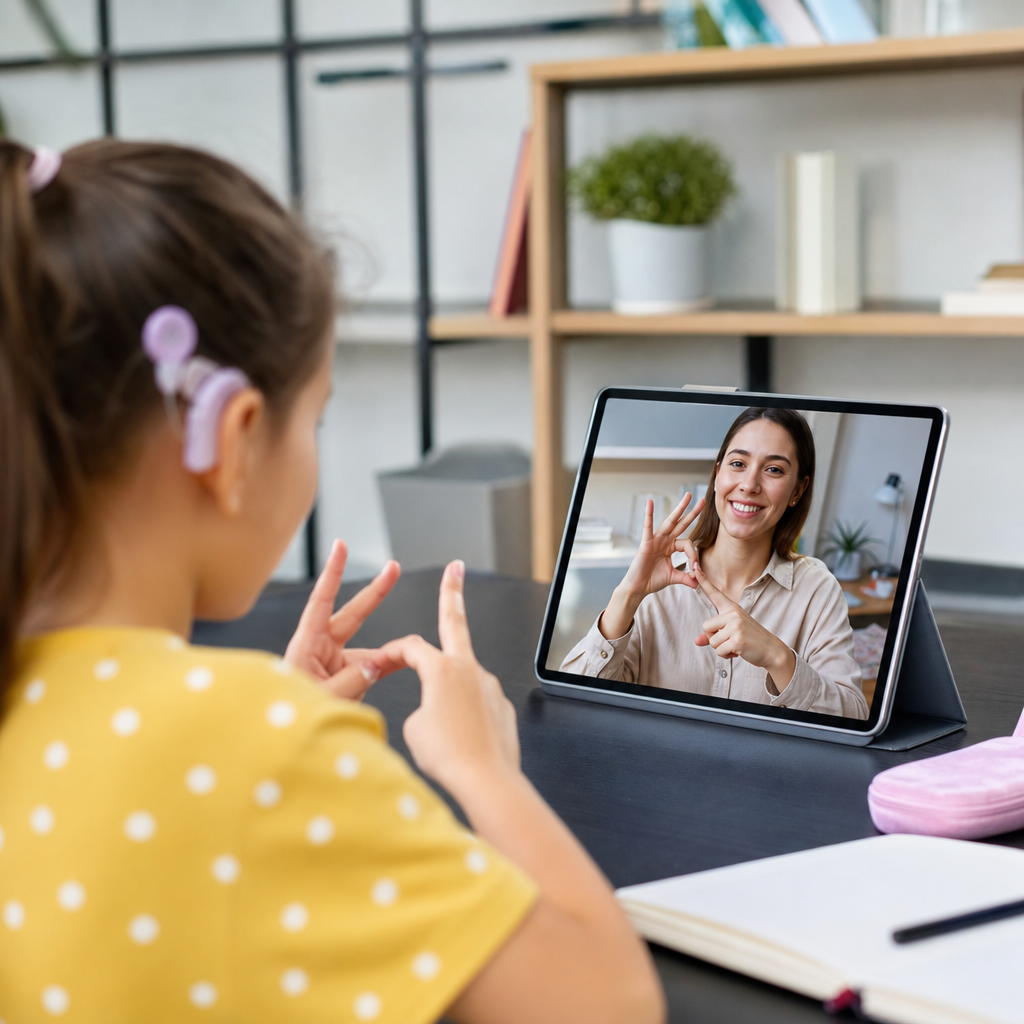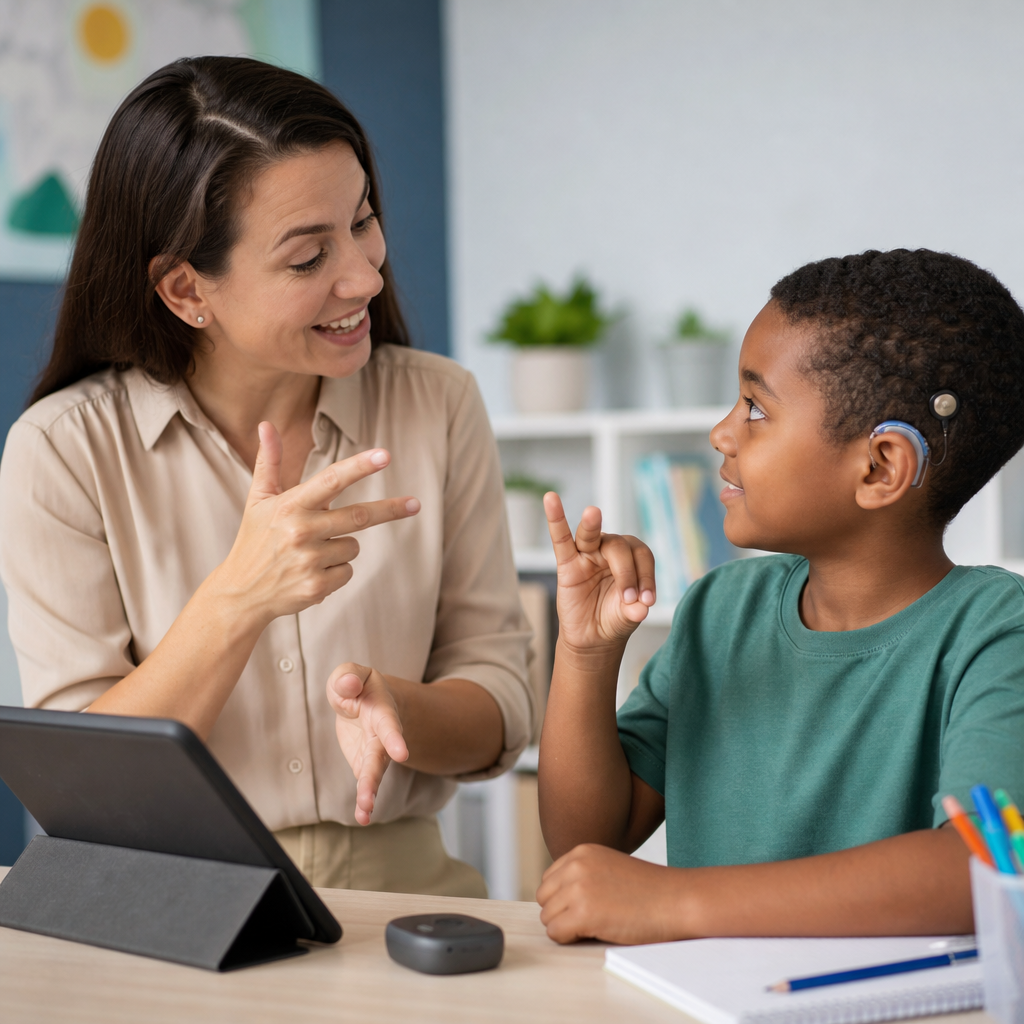
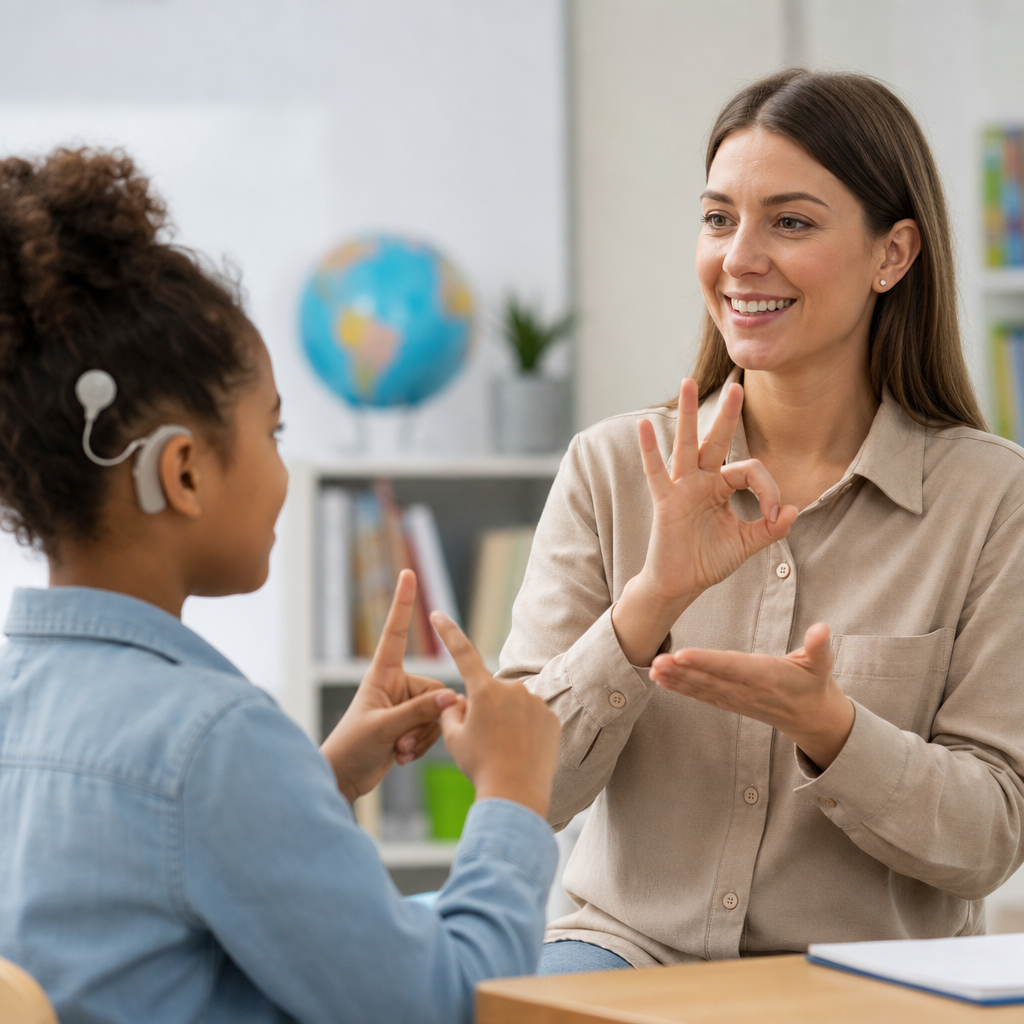
How Teachers Can Improve Communication with Deaf Students begins with a simple truth: communication is the foundation of learning, belonging, and safety in every classroom. When a deaf student misses directions, peer discussion, humor, feedback, or transitions, the loss is not only academic. It affects confidence, behavior, relationships, and long-term achievement. In my work supporting inclusive classrooms, I have seen strong teachers transform outcomes for deaf students not by lowering expectations, but by making communication deliberate, visible, and consistent across every part of the school day.
Teaching deaf students effectively starts with defining terms clearly. Deaf students are not one uniform group. Some students identify as Deaf and are part of a cultural and linguistic community centered around sign language. Others are hard of hearing, use spoken language, rely on hearing aids or cochlear implants, or use a combination of speech, sign, captions, and visual supports. Communication access refers to the methods and conditions that allow a student to receive and express information fully, whether through American Sign Language, another national sign language, spoken language with amplification, cued speech, captioning, note support, visual schedules, or assistive listening technology.
This topic matters because classroom communication is continuous, fast, and layered. Teachers give whole-group instruction, answer side questions, redirect behavior, explain assignments, check understanding, and manage transitions, often while students are moving or speaking at the same time. For a hearing student, much of that information is absorbed incidentally. For a deaf student, incidental access is often limited unless the classroom is intentionally designed for visual clarity and predictable turn-taking. Research and school practice consistently show that access improves when teachers combine direct instruction, visual supports, coordinated services, and strong family collaboration rather than relying on one accommodation alone.
A hub article on teaching deaf students must therefore cover more than seating charts or speaking clearly. Teachers need practical guidance on language choices, interpreters, classroom acoustics, captions, peer interaction, assessment, and inclusion. They also need to understand what not to assume: hearing technology does not restore typical hearing, lip reading is incomplete and tiring, and a student who appears attentive may still miss key details. The most effective communication strategies are proactive, respectful, and individualized. They create access before confusion happens, and they treat deaf students as full participants in academic and social learning.
Know the Student’s Language, Access Needs, and Educational Profile
The first step in improving communication with deaf students is to identify how each student actually receives and expresses information best. I never start with a generic checklist. I start by reviewing the student’s individualized education program or support plan, speaking with the family, consulting the teacher of the deaf, and observing the student in real class conditions. Two students with the same audiogram can have very different classroom needs. One may follow spoken instruction well with remote microphone support and captions. Another may depend primarily on sign language and need an interpreter for full access.
Important questions should be answered early and revisited often. What is the student’s primary language? Does the student use ASL, another sign language, spoken English, bilingual communication, or translanguaging across modes? What technology is used, and in which settings does it help most? Does the student need captioned video, pre-taught vocabulary, visual notes, or explicit turn-taking structures? Teachers who know these details can plan instruction that reduces communication breakdowns instead of reacting after the student has already fallen behind.
Educational profiles also include language development, background knowledge, and fatigue. Many deaf students spend more cognitive effort than hearing peers just accessing basic information. By afternoon, that listening or interpreting load can affect processing speed and participation. Recognizing listening fatigue is not making excuses; it is good instructional judgment. Clear routines, posted objectives, and multimodal materials help preserve energy for learning.
Build a Visually Accessible Classroom Environment
Deaf students learn best in classrooms where information is easy to see, follow, and revisit. Visual accessibility begins with room setup. Seat the student where sightlines to the teacher, board, projected content, and classmates are unobstructed. Avoid standing with bright windows behind you, because backlighting makes facial expressions and signs harder to read. During discussion, teachers should pause before speaking, gain attention first, and keep their face visible. Talking while writing on the board, walking around with your head turned, or speaking from behind a laptop creates preventable barriers.
Lighting and noise control matter even for students who primarily use sign language, because many use multiple cues. Good lighting supports speechreading, sign visibility, and attention. Carpets, tennis balls on chair legs, acoustic panels, and closed doors can reduce competing noise for students using hearing aids or cochlear implants. The goal is not silence. It is signal clarity. In mainstream classrooms, I have seen simple acoustic adjustments dramatically improve a student’s ability to catch instruction, especially during whole-group teaching.
Teachers should also make key information persist visually. Post agendas, directions, deadlines, discussion prompts, and new vocabulary. Use diagrams, sentence frames, exemplars, and color coding. If instructions change verbally mid-task, update them on the board too. Deaf students should not have to depend on peers to relay essential information that should have been visible to everyone.
Use Direct, Explicit, and Multi-Modal Instruction
Clear communication with deaf students depends on instructional design as much as on delivery. Effective teachers say less at once, organize ideas logically, and make hidden steps visible. Start lessons with the objective, define new terms explicitly, model the task, and check understanding before independent work begins. Chunking instruction is especially useful because it reduces the chance that a student misses one dense explanation and then struggles through the entire activity.
Multi-modal instruction means presenting content through more than one channel, not duplicating everything mechanically. A science teacher might explain evaporation, show a labeled diagram, demonstrate the process with a lab setup, pre-teach terms like condensation and water vapor, and provide a written procedure. That combination helps deaf students access both language and concept development. It also benefits multilingual learners and students with processing differences.
Teachers should avoid overreliance on idioms, rapid paraphrasing, and ambiguous pronouns. If you say, “Do this like we did it yesterday,” some students may not know which part of yesterday’s lesson you mean. Precision improves access. Name the exact page, strategy, or step. In my experience, the strongest classroom communicators are not necessarily the most talkative. They are the most structured and explicit.
Work Effectively with Interpreters, Captioning, and Assistive Technology
When a student uses an interpreter, communication success depends on teamwork. The teacher should speak directly to the student, not to the interpreter, and should share lesson materials in advance whenever possible. Interpreters need time to prepare technical vocabulary, proper nouns, and specialized concepts. In history, chemistry, coding, and literature classes, advance access to slides or readings improves interpretation accuracy significantly. The interpreter is not the teacher, disciplinarian, tutor, or substitute note-taker unless those roles are specifically assigned.
Captioning is equally important. All videos shown in class should include accurate captions, not auto-generated captions used without review when content is instructionally important. Live captions can support lectures, assemblies, and virtual lessons, but teachers should recognize their limits with names, accents, and subject-specific terms. Assistive listening systems such as FM or DM remote microphones can improve signal-to-noise ratio by sending the teacher’s voice directly to hearing technology. However, they work only when used consistently and correctly, including during class discussions if pass-around microphones or repeat-back strategies are needed.
| Support tool | Best use in class | Common mistake | Better practice |
|---|---|---|---|
| Interpreter | Access to spoken instruction and discussion | Teacher talks to interpreter instead of student | Maintain eye contact with student and pace speech naturally |
| Captions | Videos, lectures, online lessons | Using inaccurate automatic captions without checking | Preview captions and correct key vocabulary when possible |
| Remote microphone | Whole-group instruction in noisy rooms | Forgetting to wear or mute device appropriately | Build a daily routine for charging, clipping, and monitoring |
| Visual notes | Directions, vocabulary, review | Giving important updates only verbally | Post and revise instructions where all students can see them |
Technology should support communication, not create false confidence. A cochlear implant, for example, can provide major access to sound, but it does not eliminate the need for visual support, quiet conditions, or comprehension checks. Teachers who understand this avoid the harmful assumption that “the device fixes it.” Access remains a shared instructional responsibility.
Improve Discussion, Peer Interaction, and Classroom Participation
Many communication barriers appear during discussion rather than lecture. In fast-moving conversations, speakers overlap, change topics quickly, laugh, and refer to earlier comments indirectly. Deaf students can be excluded even in otherwise supportive classrooms unless turn-taking is taught and reinforced. Teachers should establish norms: one speaker at a time, raise hands or use clear visual cues, identify the speaker, and pause before calling on someone. In circles or seminars, arrange seating so faces are visible to everyone.
Peer interaction needs structure too. Group work is often praised as inclusive, but without planning it can isolate a deaf student. Assign roles, provide written discussion prompts, and teach peers how to communicate effectively: face the student, avoid talking over one another, and make sure shared materials are visible. In project-based learning, digital collaboration tools such as shared documents and live notes can give deaf students full access to planning and decision-making that might otherwise happen in fragmented speech.
Teachers should also protect social access. Jokes, informal comments, and side conversations are part of belonging. While every moment cannot be interpreted or captioned perfectly, teachers can create a culture where classmates naturally include the deaf student, repeat missed comments, and value communication equity as a normal classroom expectation.
Check Understanding, Teach Vocabulary, and Assess Fairly
Teachers cannot assume understanding based on eye contact, nodding, or completed work copied from peers. Effective checking for understanding is specific. Ask the student to explain the task, summarize the concept, sequence the steps, or show where to find the information. Brief written responses, visual exit tickets, and one-minute conferences often reveal misunderstandings early enough to fix them.
Vocabulary instruction is especially important in teaching deaf students because academic language may not be acquired incidentally. Pre-teach essential terms, connect them to visuals and examples, and revisit them across contexts. Morphology, multiple-meaning words, and figurative language deserve explicit attention. In math, words such as product, volume, and mean have precise meanings that differ from everyday use. In literature, metaphors and idioms require direct explanation.
Fair assessment does not mean easier assessment. It means measuring the intended skill without unnecessary communication barriers. If a science test is meant to assess understanding of ecosystems, confusing syntax should not be the obstacle. Teachers can simplify directions, allow signed responses where appropriate, provide extended time when language processing demands justify it, and coordinate with specialists to ensure that accommodations align with the instructional mode used during learning.
Partner with Families and Specialists for Consistent Access
The best results come when teachers, families, interpreters, speech-language professionals, audiologists, and teachers of the deaf work from a shared plan. Families know how the student communicates across settings, what causes frustration, and which strategies already work. Specialists contribute technical expertise on language development, hearing technology, auditory access, and accommodations. Classroom teachers contribute daily instructional insight. When those perspectives stay connected, communication improves faster and problems are solved earlier.
Consistency across settings matters. If the student uses visual schedules, captioned media, previewed vocabulary, or a communication log in one class, those supports should be considered across the school day. Transition points such as assemblies, field trips, substitute days, and emergency drills need planning too, because they often break normal communication routines. Strong schools prepare for those moments instead of discovering gaps during them.
Teachers who want to improve communication with deaf students should begin with one principle: access must be designed, not improvised. Learn the student’s language and profile, make the classroom visually clear, teach explicitly, use interpreters and technology well, structure discussion, and verify understanding often. These practices support academic growth, independence, and belonging at the same time. As the hub for teaching deaf students, this guidance points to a larger truth: inclusion works when communication is treated as essential instruction. Review your current classroom routines this week, identify one barrier a deaf student may face, and change it deliberately.
Frequently Asked Questions
1. What are the most effective ways teachers can improve communication with deaf students in everyday classroom instruction?
The most effective approach is to treat communication access as a basic part of instruction, not as an add-on. Teachers can start by making sure the student can clearly see the speaker, the board, visual materials, and any interpreter or captioning support at all times. Face the class when speaking, avoid talking while turning away to write on the board, and keep your mouth visible for students who use speechreading. It also helps to speak naturally and clearly rather than exaggerating words, because over-pronouncing can actually make speech harder to understand.
Strong classroom communication also depends on visual clarity and predictability. Teachers should provide written directions, key vocabulary, lesson outlines, and summaries in addition to spoken explanations. When transitioning between activities, give visual cues as well as verbal ones. Repeat or rephrase peer comments before responding so the deaf student does not miss important parts of discussion. In group work, establish turn-taking norms so only one person speaks at a time, which makes conversations easier to follow for students using interpreters, hearing technology, or speechreading.
Finally, effective teachers check for understanding in meaningful ways. Instead of asking, “Did you get that?” ask the student to explain the next step, summarize the instruction, or show what to do. This helps distinguish real understanding from polite agreement. Consistency matters more than perfection. When teachers build visual supports, intentional pacing, and accessible discussion routines into everyday instruction, deaf students gain fuller access not only to content, but also to classroom culture, humor, collaboration, and belonging.
2. How can teachers communicate clearly with a deaf student if they do not know sign language?
Teachers do not need to be fluent in sign language to be effective communicators, but they do need to be intentional, flexible, and respectful. Clear communication begins with learning the student’s preferred communication methods. Some deaf students use American Sign Language, some rely on interpreters, some use spoken language supported by hearing technology, some use captioning, and many use a combination of methods depending on the setting. The key is not to assume one approach works for every student. Ask the student and, when appropriate, the family and support team what helps most during instruction, discussion, testing, transitions, and social time.
Even without sign language skills, teachers can improve access through strong visual communication. Use written directions, slides, diagrams, schedules, keywords, demonstration, and modeled examples. Keep instructions brief and organized, and pause long enough for the student to process information through their access supports. If an interpreter is present, speak directly to the student rather than to the interpreter. Maintain eye contact with the student, not the adult support person. This sends an important message that the student is the intended participant in the conversation.
It is also valuable for teachers to learn a small set of relevant signs or communication cues if that matches the student’s communication style, especially for common classroom routines such as “wait,” “finished,” “question,” “line up,” or “good job.” While this should not replace qualified language access, it can build connection and reduce barriers during the day. Most importantly, teachers should create an environment where asking for repetition, clarification, or visual support is normal and welcome. Students thrive when they see that their teacher is committed to mutual understanding, even while still learning.
3. What classroom strategies help deaf students participate more fully in discussions, group work, and social interaction?
Participation improves when teachers design for access before the discussion begins. In whole-class conversations, establish clear rules such as raising hands, waiting to be called on, and speaking one at a time. These routines help deaf students track who is talking and give interpreters or captioning systems a better chance to keep pace. It also helps to identify speakers by name before responding, especially in fast-moving discussions. For example, a teacher might say, “Jordan made an important point about the character’s motivation,” which gives context that may otherwise be missed.
In group work, seating arrangements matter. A circular or semicircle setup allows the deaf student to see all speakers more easily. Small groups should be taught communication norms just as explicitly as academic expectations: face the group when speaking, do not cover your mouth, avoid talking over one another, and make sure materials are visible. Assigning clear roles can also help structure conversation. When students know who is leading, recording, presenting, or checking steps, the interaction becomes easier to follow and more equitable. Teachers should monitor group dynamics to make sure the deaf student is not being unintentionally sidelined from decision-making or informal conversation.
Social participation is just as important as academic participation. Deaf students often miss jokes, side comments, or rapid exchanges that shape peer relationships. Teachers can support inclusion by modeling respectful communication, building cooperative routines, and making classroom culture less dependent on overheard information. Visual agendas, posted reminders, and explicit transition signals help all students stay connected. When teachers treat access as a shared classroom responsibility rather than an individual burden, deaf students are more likely to participate confidently, build friendships, and experience genuine belonging.
4. How should teachers work with interpreters, captioning services, and other support professionals to help deaf students succeed?
The best partnerships begin with understanding that support professionals improve access, but they do not replace the teacher’s responsibility for instruction or relationship-building. Teachers should meet early with interpreters, captioning providers, teachers of the deaf, or other specialists to discuss class routines, lesson structure, student preferences, and upcoming challenges. Sharing materials in advance is especially helpful. Vocabulary lists, slides, reading assignments, videos, and lesson objectives allow support staff to prepare accurate language access and anticipate concepts that may require clarification.
During instruction, teachers should communicate directly with the student, not through the interpreter. The interpreter is a communication bridge, not the student’s representative. Teachers should also pace instruction thoughtfully. Fast speech, sudden topic shifts, and simultaneous talking can reduce access, even with excellent support services. If a video is shown, it should be captioned. If class discussion becomes lively and overlapping, the teacher may need to pause and re-establish one-speaker-at-a-time expectations. These are not special favors. They are practical teaching moves that preserve access and comprehension.
Collaboration also means being open to feedback. Support professionals often notice patterns that affect communication, such as poor lighting, difficult seating arrangements, missed side conversations, or unclear turn-taking. When teachers view these insights as part of strong instructional practice, everyone benefits. At the same time, confidentiality and professionalism matter. Discuss concerns through appropriate channels, and include the student’s perspective whenever possible. The most successful teams keep the focus on full participation: access to instruction, access to peers, access to feedback, and access to the life of the classroom.
5. How can teachers tell whether a deaf student is truly understanding instruction and feeling included, rather than just appearing to follow along?
This is one of the most important questions a teacher can ask. Deaf students, like many students, may nod, copy peers, or begin a task without fully understanding directions. Because missed information is often invisible, teachers need to check comprehension in specific and observable ways. Ask the student to restate directions, preview the next step, summarize a concept, or demonstrate the task. Short written responses, quick visual checks, and structured conferences can reveal misunderstandings that a simple yes-or-no question would miss. It is also wise to review whether the student had access to all parts of the lesson, including peer comments, spontaneous announcements, and transition cues.
Inclusion should be monitored just as carefully as academic understanding. A deaf student may complete work successfully yet still feel isolated from class discussion, humor, or social interaction. Teachers can watch for patterns such as delayed responses, dependence on peers for missed information, limited participation in spontaneous conversation, or signs of frustration during fast-paced activities. Private check-ins can be very revealing. Ask open-ended questions such as, “Which parts of class are easiest to follow?” and “When do you miss information?” These conversations help identify barriers that may not be obvious from performance alone.
It is also helpful to collect insight from the broader support team and family while keeping the student’s own experience central. If the same concerns arise across settings, such as difficulty following discussions or fatigue from sustained listening effort, classroom adjustments may be needed. Ultimately, true success is not just that the student is present or compliant. It is that the student understands what is happening, can participate fully, feels respected, and has equal access to learning, safety, relationships, and the everyday rhythm of classroom life.