Interpreters are essential at public events because access to information is not optional; it is a basic condition for participation, safety, and belonging. In the accessibility and inclusion field, public events include conferences, festivals, school board meetings, city council hearings, museum programs, sports ceremonies, press briefings, community forums, and live performances held in shared civic or commercial spaces. Interpreters, in this context, may be sign language interpreters, spoken language interpreters, tactile interpreters for deafblind attendees, or relay professionals working through remote platforms. Their role is to convert meaning accurately and quickly so people can follow, respond, ask questions, and make informed decisions in real time. When organizers overlook interpreting, they do more than create inconvenience. They exclude residents from democratic processes, customers from services, visitors from cultural life, and workers from professional opportunities. I have worked on event accessibility planning where one well-placed interpreter changed the entire experience from passive attendance to genuine participation. That shift matters because public spaces and events shape who feels welcome in a community and who does not.
The importance of interpreters at public events sits at the intersection of legal compliance, communication quality, risk management, and audience growth. Accessibility means designing environments and experiences so people with disabilities and people using different languages can engage without avoidable barriers. Inclusion goes a step further by ensuring those people are expected, respected, and able to contribute fully. Public spaces and events are where these principles become visible. If a city hosts a disaster preparedness briefing without spoken language interpretation, immigrant communities may miss lifesaving instructions. If a university stages a graduation without sign language interpretation, deaf families may be present physically but excluded from the meaning of the ceremony. If a museum offers guided tours only in one language, it limits educational reach and revenue. Interpreters solve a practical problem, but they also signal institutional competence. This hub article explains why interpreters matter, which types are used in public spaces and events, how they improve safety and engagement, what planners must do to deliver quality access, and where interpretation fits into a broader accessibility strategy.
Why interpreters matter in public spaces and events
Interpreters matter because public events depend on real-time understanding. Unlike translated brochures or captioned recordings, live communication requires immediate access to meaning, tone, and intent. At a town hall, attendees need to follow policy details, understand public comment rules, and respond on the spot. At a medical outreach fair, families need to ask clarifying questions before consenting to screenings. At a concert announcement or awards ceremony, the emotional content matters as much as the factual message. Interpreters make that possible. They support autonomy, allowing people to engage directly instead of relying on friends, family members, or improvised summaries. That distinction is critical. Using relatives as ad hoc interpreters can create privacy issues, increase errors, and place unfair responsibility on children or companions.
There is also a strong operational case for interpretation. Events with communication access have better audience satisfaction, stronger reputation, and fewer complaints. In my experience, organizations that consistently provide interpreters begin to attract more diverse attendance because communities notice who plans for them in advance. This is especially true for recurring public events such as library programs, neighborhood meetings, theater seasons, and civic consultations. Access builds trust over time. It also reduces friction on event day. Staff members are not scrambling to explain missed announcements, attendees are not leaving early due to confusion, and speakers are less likely to be interrupted by preventable misunderstandings. For hub-level planning across public spaces and events, interpretation should be treated as core event infrastructure, alongside audio, seating, signage, lighting, and emergency procedures.
Types of interpreters used at public events
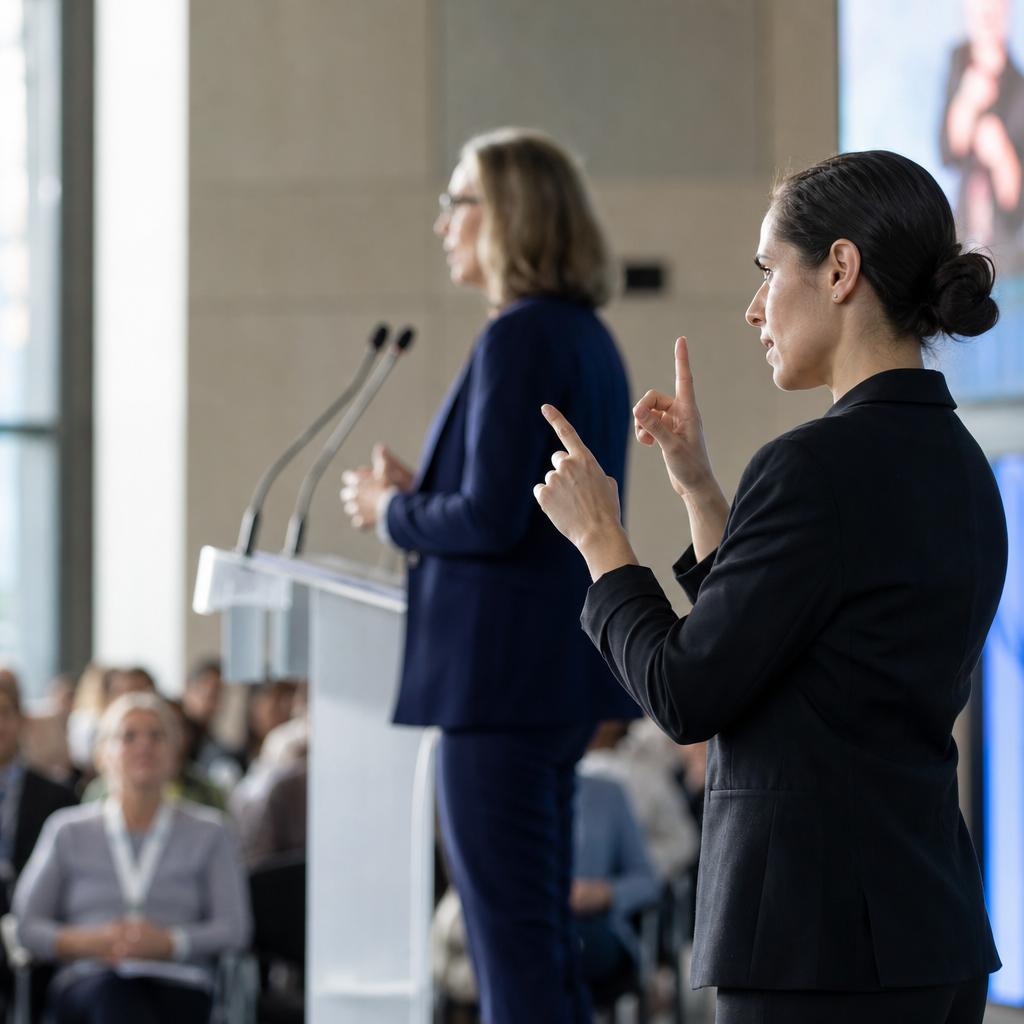
Different events require different forms of interpreting, and choosing correctly affects both access and quality. Sign language interpreters support deaf attendees who use languages such as American Sign Language or British Sign Language. Spoken language interpreters assist attendees who communicate in languages other than the event’s primary spoken language, whether through simultaneous interpreting with headsets or consecutive interpreting during pauses. Deafblind attendees may need tactile interpreting, close vision interpreting, or support service providers depending on context. In multilingual settings, remote interpreting can extend access when qualified local professionals are unavailable, though bandwidth, audio routing, and screen visibility must be tested carefully.
Planners should never assume one accommodation fits all. Not every deaf attendee uses sign language, and not every multilingual audience needs the same language combination. Registration forms should ask specific access questions early, then confirm preferences before the event. For example, a large public lecture may need two ASL interpreters rotating every twenty to thirty minutes because signed interpretation is cognitively and physically demanding. A city open house serving Arabic, Spanish, and Mandarin speakers may need a combination of roving interpreters and a staffed language access desk. A museum workshop with a deafblind guest may require tactile interpretation and seating adjustments near the presenter. Matching the service to the setting is what turns compliance into meaningful access.
How interpreters improve safety, equity, and engagement
Interpretation is often discussed as a courtesy, but at public events it is frequently a safety measure. Emergency announcements, evacuation instructions, weather alerts, security updates, and health advisories must be understood immediately. During one large outdoor event I supported, the accessibility briefing included interpreter placement, backup lighting, and a plan for stage announcements if weather forced evacuation. That preparation mattered because access during calm conditions does not guarantee access during disruption. Interpreters must be integrated into emergency communication planning, not added only for keynote speeches or ceremonial moments.
Equity is the second major benefit. Interpretation allows attendees to ask questions, challenge assumptions, and influence outcomes. In civic settings, that directly affects democratic participation. In education and workforce events, it affects opportunity. In cultural spaces, it affects who gets to experience art, heritage, and public memory. Engagement also improves measurably when people can follow nuance. Humor lands, technical explanations become usable, and Q&A sessions become truly public rather than selectively accessible. Organizers often focus on attendance numbers, but inclusive events should measure participation quality: who asked questions, who stayed through the full program, and who returned for future events.
| Event type | Interpreter need | Why it matters | Planning note |
|---|---|---|---|
| City council meeting | Sign and spoken language interpreters | Supports civic participation and public record understanding | Share agenda, speaker list, and terminology in advance |
| Festival main stage | Sign language interpreters with sightline planning | Makes announcements and performances accessible | Provide raised platform, lighting, and video feed if needed |
| Press conference | Simultaneous interpreting and captioning coordination | Improves media accuracy and public reach | Test audio splits, camera framing, and remote backups |
| Museum tour | Spoken or sign interpretation tailored to group | Expands educational access and visitor satisfaction | Brief interpreter on route, pacing, and object names |
What quality interpretation requires from event planners
Good interpretation does not happen by accident. It depends on procurement, briefing, logistics, and respect for professional standards. Organizers should hire qualified interpreters with subject matter experience, confirm credentials where relevant, and avoid asking bilingual staff to interpret outside their role. Professional associations and established booking agencies can help verify experience and specialization. For technical events, interpreters need preparation materials including scripts, speaker names, acronyms, slides, and glossaries. I have seen interpretation quality improve dramatically when planners share materials even forty-eight hours in advance. Without that preparation, avoidable errors increase, especially with specialized vocabulary, proper nouns, and fast panel discussions.
Physical setup matters just as much. Interpreters need clear sightlines to speakers and screens, appropriate lighting, stable audio feeds, and visible placement for the audience using them. For virtual or hybrid events, pinned video, platform compatibility, and latency testing are essential. Scheduling also matters. Long sessions usually require team interpreting to maintain accuracy and reduce fatigue. Contracts should address breaks, cancellation terms, travel, rehearsal needs, and contingency coverage. Finally, interpretation should be announced in pre-event communications, registration pages, signage, and opening remarks so attendees know access is available and how to use it. Accessibility buried in small print is accessibility that many people will miss.
Common mistakes that undermine access
The most common mistake is treating interpretation as a last-minute add-on. Qualified interpreters are often booked well in advance, especially for major festivals, legislative sessions, and graduation seasons. Late booking narrows options and increases the risk of poor fit. Another frequent error is assigning interpreters a poor location, such as a dim corner, floor-level position behind seated attendees, or off-camera placement during livestreams. If users cannot see the interpreter clearly, the service exists on paper but fails in practice. Organizers also underestimate how many interpreters are needed. A full-day conference with high cognitive load may require multiple teams across sessions, not one person covering everything.
Content errors create another layer of failure. Speakers who ad-lib rapidly, change slides without warning, speak over one another, or refuse to use microphones make interpretation less accurate. Event managers should brief presenters on accessible speaking practices: one person at a time, verbalize visual content, share remarks ahead of time, and pause for audience questions. A final mistake is assuming interpretation replaces other accessibility features. It does not. Public spaces and events still need captioning, assistive listening systems, wheelchair access, sensory considerations, readable signage, accessible restrooms, and trained front-of-house staff. Interpretation is a pillar of inclusion, but it works best inside a complete access plan.
Building interpretation into a broader accessibility and inclusion strategy
For this public spaces and events hub, the key principle is integration. Interpreters should be planned alongside venue accessibility audits, transportation guidance, ticketing access, digital event information, emergency protocols, and post-event feedback. That wider system determines whether people can arrive, navigate, participate, and leave safely. A well-run event might include an accessibility statement on the registration page, maps showing accessible entrances, captioned promotional videos, interpreter requests built into forms, quiet spaces, companion seating, and staff trained to direct attendees to language access services. Each element supports the others.
Interpretation also connects to community relationships. Organizations should not wait for complaints to identify needs. They should consult deaf communities, disability advocates, immigrant-serving groups, and local accessibility specialists when designing recurring programs. Track attendance patterns, request data, and user feedback to improve future events. If budget is a concern, prioritize the highest-impact events first, create annual accessibility line items, and build vendor relationships early. The long-term benefit is clear: more people can engage with public life on equal terms. That is the real importance of interpreters at public events. They transform access from a promise into something people can actually use. If you manage public spaces or events, review your next program now, identify where live communication can exclude people, and secure the interpreting support needed before invitations go out.
Frequently Asked Questions
Why are interpreters so important at public events?
Interpreters are important at public events because access to information is not optional; it is a basic requirement for full participation, safety, dignity, and belonging. When people gather for conferences, festivals, school board meetings, city council hearings, museum programs, sports ceremonies, press briefings, community forums, or live performances, they need a reliable way to understand what is being said in real time. Interpreters make that possible for attendees who are Deaf, hard of hearing, or who use a different spoken language than the primary language of the event. Without interpretation, critical announcements, policy discussions, artistic content, emergency directions, and audience interactions can become inaccessible, leaving some attendees excluded from experiences that are meant to be public.
Interpretation also supports equal participation, not just passive attendance. People need to be able to ask questions, respond to speakers, engage in public comment, network with others, and make informed decisions. At a city council hearing, for example, interpretation can determine whether a resident is able to understand a proposed ordinance and voice a meaningful opinion. At a press briefing or community forum, it can affect whether people receive accurate information about health, housing, education, or public safety. At a cultural or entertainment event, it allows audiences to experience the content as it unfolds rather than through delayed summaries or partial understanding. In short, interpreters help turn an event from something that is merely open to the public into something the public can truly access.
What kinds of public events typically need interpreters?
A wide range of public events benefit from interpreters, especially any event where information is shared live, audience participation is expected, or public access is part of the event’s purpose. This includes civic and government settings such as city council meetings, school board meetings, planning hearings, public consultations, court-adjacent proceedings, and press conferences. It also includes educational and professional gatherings such as conferences, panel discussions, trainings, lectures, and community workshops. Cultural and recreational events often need interpretation as well, including museum talks, gallery openings, festivals, concerts, theater performances, sports ceremonies, and public celebrations. If an event is designed for a broad audience, interpretation should be considered early in planning rather than treated as an afterthought.
The need for interpreters is not limited to formal meetings or legal contexts. Community-facing events often include essential information, spontaneous dialogue, and social interaction that can be difficult or impossible to access without language support. A neighborhood forum may involve emotionally charged discussion and public testimony. A museum program may include nuanced historical interpretation and audience questions. A festival may feature stage announcements, safety instructions, and vendor interactions in multiple languages. Even when organizers assume the audience will be “mostly English-speaking,” that assumption can overlook actual community needs. The best practice is to evaluate who the event serves, what communication demands it creates, and whether participants can meaningfully engage without interpretation. In many cases, the answer is clear: interpreters are not a luxury but a practical part of inclusive event design.
What types of interpreters might be needed at a public event?
The type of interpreter needed depends on the audience, the event format, and the communication goals. Sign language interpreters are often essential for Deaf attendees who use American Sign Language or another signed language. Spoken language interpreters may be needed for attendees who speak languages other than the primary language used by presenters, staff, or officials. In multilingual communities, this can mean providing interpretation in Spanish, Mandarin, Arabic, Haitian Creole, or other languages commonly used by local residents. Some events may require simultaneous interpretation, where the message is interpreted in real time through headsets or audio systems, while others may use consecutive interpretation, where the speaker pauses to allow interpretation. The right choice depends on the pace, structure, and audience expectations of the event.
It is also important to recognize that interpretation is a professional skill, and matching the right interpreter to the right setting matters. A fast-paced press briefing, a technical conference session, a public hearing with legal terminology, and a live performance all demand different types of preparation and expertise. Organizers should think beyond simply “having an interpreter present” and consider visibility, sound quality, subject matter familiarity, and whether attendees will need access for both receiving and contributing information. In some cases, multiple interpreters are necessary to manage duration, fatigue, or multiple languages. Planning for the correct interpreting service from the start leads to better communication, fewer misunderstandings, and a more respectful experience for everyone attending.
How do interpreters improve safety and inclusion during public events?
Interpreters improve safety by ensuring that attendees can understand urgent instructions, schedule changes, warnings, emergency announcements, and on-site protocols as they happen. At large events, people may need clear direction about entrances and exits, crowd movement, severe weather, medical emergencies, or security issues. If that information is only delivered in one language or in a format inaccessible to part of the audience, the consequences can be serious. Interpretation helps reduce confusion and allows more people to respond quickly and appropriately. This is especially important in crowded venues, government meetings, public demonstrations, or community gatherings where conditions can change rapidly and accurate communication is essential.
Inclusion goes beyond safety, but safety is part of inclusion. People are far more likely to feel welcome when they are able to follow the event, understand expectations, and participate without having to rely on guesswork or informal support from strangers. Interpreters communicate that organizers have considered the needs of the full audience, not just the majority. That message matters. It tells attendees that their presence is expected and valued. It also improves the experience for speakers, moderators, and staff, who can interact more confidently when communication systems are intentionally built into the event. In practical terms, interpretation can lead to better questions, broader participation, stronger community trust, and a more accurate exchange of ideas. In human terms, it helps create events where people are not merely admitted, but genuinely included.
When should event organizers arrange for interpreters, and what should they plan for?
Event organizers should arrange for interpreters as early as possible, ideally during the initial planning stage rather than after registration opens or requests begin arriving. Early planning gives organizers time to identify audience needs, book qualified professionals, budget appropriately, and integrate interpretation into the event setup. Waiting until the last minute can limit availability, increase costs, and create avoidable problems with placement, technology, or communication flow. For public-facing events, it is also wise to announce interpretation services in promotional materials and registration forms so attendees know what access is available and can communicate additional needs in advance.
Good planning involves more than hiring an interpreter. Organizers should consider where interpreters will stand or sit, whether they will be clearly visible, what lighting and sound conditions they will need, whether presentation materials can be shared in advance, and how audience questions will be managed. If spoken language interpretation is being provided, organizers may need headsets, receivers, microphones, or a quiet interpreting space depending on the format. If the event is long or complex, more than one interpreter may be necessary. Speakers should also be briefed to pace themselves, use microphones properly, and avoid talking over one another. When interpretation is treated as part of the event infrastructure rather than an add-on, communication is smoother and the event becomes more accessible, professional, and responsive to the public it serves.