
Language sits at the center of Deaf culture because it does far more than transmit information; it shapes identity, community norms, history, humor, and access to the world. When people ask, “What is Deaf culture?” they are really asking how a linguistic minority built rich social traditions around signed communication and shared experiences of navigating hearing societies. Deaf culture refers to the values, behaviors, artistic expression, institutions, and collective identity that emerge among Deaf people, especially those who use sign language as a primary language and view deafness not simply as a medical condition, but as a human difference.
In practice, I have seen this distinction change entire conversations. Families often begin with a clinical model focused on hearing levels, devices, and speech outcomes. Then they attend a Deaf event, meet fluent signers, and realize they are encountering a culture with its own etiquette, storytelling traditions, political priorities, and intergenerational networks. That shift matters because it affects education, mental health, family communication, and a person’s long-term sense of belonging. A child who has full access to language early, whether through Deaf adults, signing peers, or bilingual education, is positioned very differently from a child whose communication is delayed while adults debate methods.
Understanding the role of language in Deaf culture is essential because language access is the foundation of participation. Signed languages are complete natural languages with grammar, syntax, and regional variation. American Sign Language, British Sign Language, and French Sign Language are separate languages, not signed versions of English or French. Around them, Deaf communities develop social rules such as maintaining visual attention, valuing direct communication, and sharing information in ways adapted to visual environments. To understand Deaf culture fully, you have to start with language, then trace how language shapes identity, education, art, institutions, and advocacy.
Language as the foundation of Deaf cultural identity
Deaf culture is best understood as a language-centered community rather than a group defined only by audiological status. Not every person with hearing loss identifies as culturally Deaf, and not every culturally Deaf person has the same hearing profile, technology use, or family background. What unites the community most consistently is participation in a shared signed language and the social world built around it. In many countries, that language is the clearest marker of membership, much like spoken language binds other cultural groups across regions and generations.
Language carries cultural memory. In Deaf spaces, stories about school life, communication barriers, famous advocates, and everyday misunderstandings are passed down through sign. Folklore, jokes, poetry, and visual storytelling preserve collective experience in ways written summaries cannot fully capture. Name signs, introductions that include school or community ties, and references to local Deaf clubs all signal belonging. I have watched newcomers become less isolated once they gained enough sign fluency to follow rapid group conversation; suddenly, they were not just receiving information, they were participating in a culture.
The identity dimension also explains why many Deaf people capitalize Deaf when referring to cultural identity. Lowercase deaf often describes an audiological condition, while uppercase Deaf points to affiliation with a linguistic and cultural community. The distinction is useful, though not absolute. Some people move between identities over time, especially late-deafened adults, hard of hearing signers, and children of hearing families who encounter the community later. Language often determines whether that connection becomes deep and sustaining.
Why sign languages are complete languages, not substitutes
One of the most persistent misunderstandings is the idea that sign language is a simplified support system for spoken language. Linguistic research has disproved this for decades. Signed languages have their own phonological parameters, including handshape, movement, location, palm orientation, and nonmanual markers such as facial expression. They use morphology and syntax in structured ways and can express abstract, technical, and emotional content with precision. In American Sign Language, for example, topic-comment structure, spatial mapping, role shift, and classifiers allow signers to build meaning efficiently and vividly.
Sign languages are also independent from the surrounding spoken language. British Sign Language and American Sign Language are not mutually intelligible, even though the dominant spoken language in both countries is English. ASL historically descends in part from French Sign Language and local signing systems, which is why it differs strongly from English word order. This matters culturally because language difference is not cosmetic. It reflects separate histories, educational traditions, and community development.
Visual grammar influences communication style. Signers use space to establish referents, shift perspective to show dialogue, and rely on eye gaze for turn-taking. These features affect how stories are told, how jokes land, and how meetings are organized. When hearing institutions treat sign as a lesser tool, they usually misread what it actually is: a fully developed linguistic system that supports thought, learning, and culture on its own terms.
How language access shapes childhood, education, and belonging
Early language access is one of the most important factors in healthy development for Deaf children. Most Deaf children are born to hearing parents, many of whom have no prior exposure to sign language. If families receive only medical guidance and little cultural or linguistic support, children can experience language deprivation during critical years. That risk is well documented by educators, developmental specialists, and Deaf advocates. The issue is not whether a child uses technology or speech; the issue is whether the child has complete, consistent access to a natural language from the start.
In schools, the language environment often predicts social outcomes as much as academic ones. Deaf schools historically served as cultural hubs where children met peers, learned community norms, and encountered Deaf adult role models. Mainstream placements can work well when interpretation, direct communication access, and peer connection are strong, but isolation is common when a student is the only signer in class. I have seen students with excellent grades still feel culturally adrift because every lunch period, joke, and side conversation happened beyond reach.
A bilingual approach often offers the strongest foundation: sign language for full access and identity development, plus reading and writing in the majority language, and speech when appropriate for the child. This is not an ideological compromise. It is a practical recognition that language fluency fuels cognition, literacy, and social confidence. When families learn to sign, children gain something larger than communication support. They gain uninterrupted belonging at home.
Deaf cultural values emerge from visual communication
Because signed communication is visual, Deaf culture developed social norms that may seem subtle to outsiders but are deeply important inside the community. Attention-getting methods such as tapping a shoulder, waving in someone’s visual field, or flicking lights are normal and polite. Maintaining eye contact is not merely courteous; it is necessary for language reception. Directness is often valued because signed conversation favors clarity, and access to contextual information matters when incidental overhearing is limited.
Information sharing is another strong cultural value. In hearing settings, people casually absorb background details from radio, hallway talk, or announcements. Deaf people frequently have to work harder to access the same information, so communities often compensate by making news, context, and practical details more explicit. This can create a strong norm of collective awareness. Deaf events, clubs, schools, and now digital spaces function not just as social venues but as information networks.
These norms are not universal rules for every Deaf person, yet they are common enough to define interaction patterns across many communities. Visual orientation also shapes aesthetics. Seating arrangements, lighting, room layout, and sightlines all affect inclusion. A space can be physically accessible and still be culturally poor if people cannot see one another clearly. Language does not simply occur within culture here; it actively designs the environment culture prefers.
Language, institutions, and community continuity
Deaf culture has been sustained through institutions where language is transmitted consistently across generations. Residential schools for the Deaf, Deaf clubs, sports leagues, churches, theater groups, advocacy organizations, and university programs have all played major roles. In the United States, Gallaudet University remains a landmark institution because it centers signed communication at every level of academic and social life. Similar institutions elsewhere anchor local and national community networks.
These spaces matter because many Deaf children do not grow up in signing families. Community institutions become places where they first meet fluent adult signers and see successful lives modeled in their own language. Historically, Deaf clubs were also sites of political organizing, employment networking, and cultural production. Although some clubs declined with mainstreaming and digital communication, online spaces now perform part of the same work, spreading language, debate, humor, and activism through video-first formats.
| Institution | Language role | Cultural impact |
|---|---|---|
| Deaf schools | Provide daily immersion in sign language | Build peer identity and intergenerational continuity |
| Universities like Gallaudet | Support advanced academic discourse in sign | Create leadership pipelines and preserve history |
| Deaf clubs and associations | Offer informal community communication spaces | Strengthen networks, advocacy, and social norms |
| Online video platforms | Expand access to signed content across distance | Connect dispersed signers and amplify new voices |
Without these institutions, language transmission becomes fragile. With them, Deaf culture remains dynamic, not archival. The community adapts, but it does so through its languages and shared spaces.
The tension between medical views and cultural-linguistic views
Many debates around deafness become polarized because they start from different assumptions. The medical view tends to define deafness as hearing loss to be treated, managed, or corrected. The cultural-linguistic view sees Deaf people as members of a minority language community whose primary need is access, not normalization. These frameworks are not always mutually exclusive. A Deaf person may use hearing aids or a cochlear implant and still identify strongly with Deaf culture. The real question is whether technology supports communication without displacing language rights and cultural belonging.
In my experience, conflict grows when families are told that sign language will hinder speech or reduce motivation to use devices. That claim is not supported by the broader understanding of language development. A child with strong sign access is not linguistically behind because they sign; they are protected from deprivation because they have language. Technology outcomes vary, device access can be uneven, and auditory environments remain inconsistent. Sign language provides reliable access regardless of battery life, background noise, or surgical candidacy.
This balanced view matters for policy and family decisions. The best outcomes come when children are surrounded by rich communication, realistic expectations, and connection to Deaf adults who can offer lived guidance rather than abstract reassurance.
Art, storytelling, and political advocacy through language
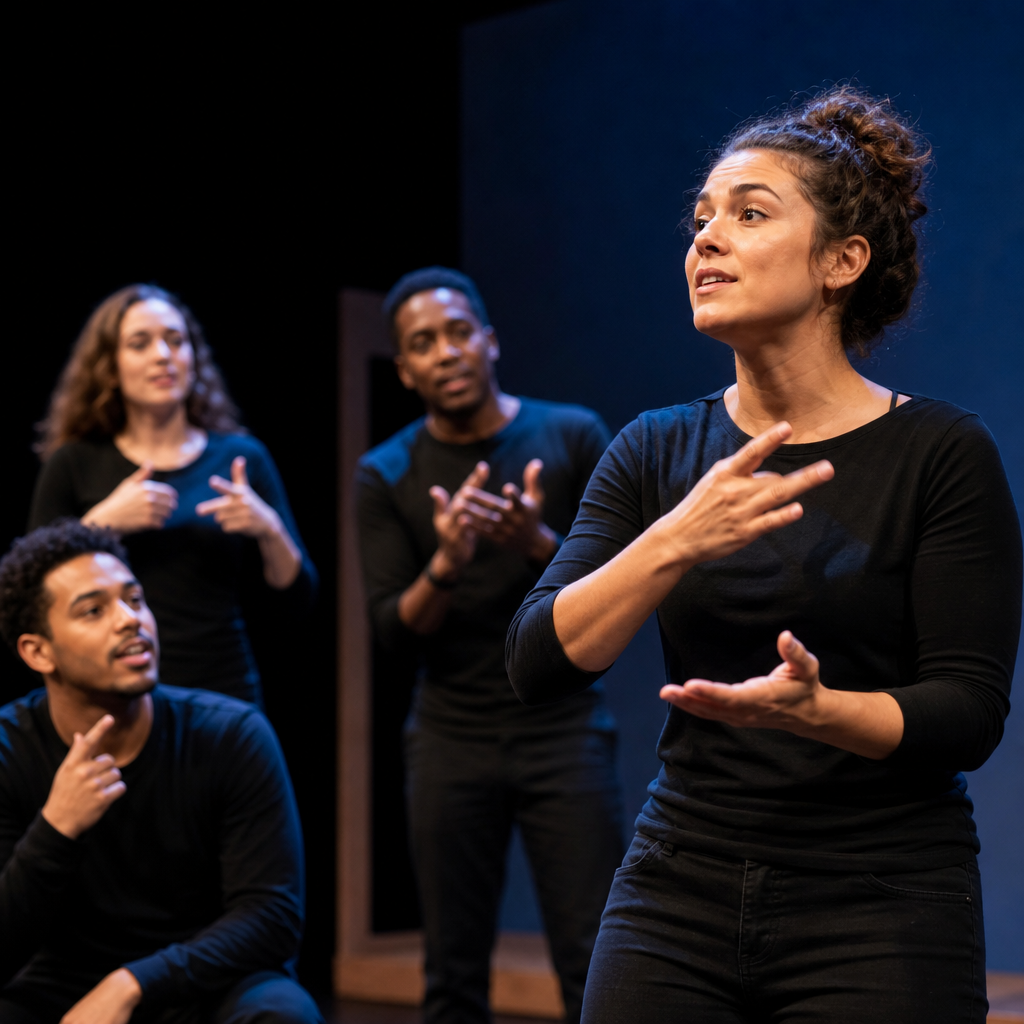
Language is also the engine of Deaf artistic and political life. Signed storytelling uses rhythm, space, timing, and embodiment in ways that differ fundamentally from spoken performance. Deaf poetry often depends on visual patterning, symmetry, repetition of handshapes, and expressive movement. Theater companies and filmmakers have expanded these forms, showing that sign language is not only functional but artistically generative. Humor, especially, reveals cultural fluency: many Deaf jokes rely on visual misperception, translation tension, or shared experiences with hearing institutions.
Advocacy is equally language-driven. Campaigns for interpreter access, captioning, bilingual education, emergency communication, and legal recognition of national sign languages all rest on the principle that language access is a civil and cultural right. The 1988 Deaf President Now movement at Gallaudet demonstrated this publicly, linking leadership, representation, and language pride. More recent activism has addressed healthcare communication failures, inaccessible public briefings, and the rights of Deaf children to learn sign from the beginning.
When people understand Deaf culture only through accommodation checklists, they miss the full picture. Language is not merely a service need. It is the medium through which a community creates art, organizes politically, and defines itself on its own terms.
Deaf culture becomes much clearer when language is placed at the center rather than treated as an afterthought. Signed languages are complete natural languages, and they are the main pathway through which Deaf people build identity, transmit values, educate children, create institutions, and sustain community across generations. If you want to answer the question “What is Deaf culture?” accurately, the strongest definition is this: it is a cultural and social world grounded in shared signed language, visual ways of communicating, and collective experience.
That understanding has practical consequences. Families can prioritize early language access. Educators can support bilingual environments and meaningful peer connection. Employers and public institutions can design communication access that respects Deaf people as language users, not just service recipients. Readers exploring Deaf culture and identity should treat language as the hub that connects every related topic, from education and technology to art and advocacy.
The main benefit of this perspective is simple: it replaces deficit thinking with informed understanding. Learn about the sign language used in your region, seek out Deaf-created resources, and if this topic matters in your home, school, or workplace, start building communication access now.
Frequently Asked Questions
Why is language considered central to Deaf culture?
Language is central to Deaf culture because it does much more than help people exchange information. Signed languages such as American Sign Language (ASL), British Sign Language (BSL), and many others provide the foundation for identity, belonging, storytelling, humor, social norms, and community life. In Deaf communities, language is often the shared thread that connects people across families, schools, social networks, and generations. It shapes how people interact, how they pass down history, and how they define themselves within a world that is often designed for hearing people.
For many Deaf individuals, signed language is also tied to cultural pride. It reflects a way of experiencing and organizing the world visually rather than aurally. Facial expressions, body movement, eye contact, and spatial structure are not extras in signed communication; they are essential parts of meaning. Because of this, language becomes a visible expression of cultural values, including attentiveness, directness, shared visual awareness, and collective participation. That is why discussions about Deaf culture almost always return to language first: it is the heart of community connection and cultural continuity.
How do signed languages shape identity within Deaf communities?
Signed languages play a major role in shaping both personal and collective identity within Deaf communities. For many people, learning and using a signed language can be a powerful moment of self-recognition. It may provide access to fluent communication, shared experiences, and a sense of belonging that was previously missing, especially for those raised in environments where spoken language dominated and Deaf identity was not affirmed. Through signed language, many Deaf individuals come to understand themselves not simply through a medical lens of hearing loss, but as members of a linguistic and cultural minority.
At the community level, language creates bonds based on shared experience and mutual understanding. People who sign often recognize common cultural references, jokes, values, and social practices. They may share stories about Deaf schools, advocacy, accessibility challenges, or the experience of moving between Deaf and hearing spaces. Language helps make those experiences legible and meaningful. It also supports intergenerational identity, allowing older community members to mentor younger ones and pass along cultural knowledge, history, and traditions. In this way, signed language does not just reflect Deaf identity; it actively helps build and sustain it.
Is Deaf culture the same everywhere, or does language vary across communities?
Deaf culture is not the same everywhere, and signed languages vary widely across countries, regions, and communities. Just as spoken languages differ around the world, signed languages are distinct natural languages with their own grammar, vocabulary, and cultural context. American Sign Language is not universal, nor is it simply English expressed through the hands. The same is true for other signed languages. Each developed within specific historical and social circumstances, often influenced by local schools, migration patterns, and community networks.
Even within one country, there may be regional signs, generational differences, and cultural variation shaped by race, ethnicity, class, education, and family background. Deaf culture is therefore both shared and diverse. Many Deaf communities have common values related to visual communication, access, and collective identity, but the expression of those values can look different depending on place and history. This diversity is important because it reminds readers that Deaf culture is not a single monolithic experience. Language reveals that richness, showing how communities adapt, create meaning, and preserve distinct traditions while still participating in a broader global Deaf world.
How does language influence storytelling, humor, and artistic expression in Deaf culture?
Language deeply influences the creative life of Deaf culture. Storytelling in signed languages is often highly visual, dynamic, and spatial. Signers may use movement, role shifting, facial expression, rhythm, and the positioning of people or objects in space to create vivid narratives. This gives Deaf storytelling a unique aesthetic power that is not simply a translation of spoken-language traditions. Stories can be intimate, dramatic, playful, or political, and they often preserve community memory, cultural lessons, and shared experiences in a form that feels immediate and embodied.
Humor in Deaf culture also depends heavily on language. Many jokes draw on visual misunderstandings, signing styles, exaggerated expressions, or familiar situations involving communication barriers with hearing society. Because signed languages are rich in visual detail and timing, they offer distinctive comic possibilities that may not translate neatly into spoken or written form. The same is true for poetry, theater, film, and performance art created by Deaf artists. These forms often celebrate the expressive possibilities of signed language while exploring identity, resistance, access, and pride. In this sense, language is not just a tool for creativity in Deaf culture; it is one of its most important artistic mediums.
Why does access to signed language matter so much for Deaf children and families?
Access to signed language matters because early, full communication is essential for cognitive development, emotional well-being, education, and social connection. Deaf children thrive when they can access language from the beginning of life, and signed language provides that access in a direct and natural way. When children are able to communicate fluently with parents, siblings, teachers, and peers, they are better positioned to develop literacy, confidence, self-expression, and strong relationships. Language deprivation, by contrast, can create lasting barriers that affect learning and mental health.
For families, learning a signed language can transform the home environment. It allows deeper communication, reduces frustration, and helps children feel seen and understood. It also opens the door to Deaf role models, community events, cultural knowledge, and support networks that many families would not otherwise discover. From a cultural perspective, access to signed language gives Deaf children the opportunity to participate in a living tradition rather than growing up isolated from it. That is why advocates and educators often emphasize that signed language is not a fallback option; it is a vital pathway to human connection, cultural belonging, and full participation in the world.