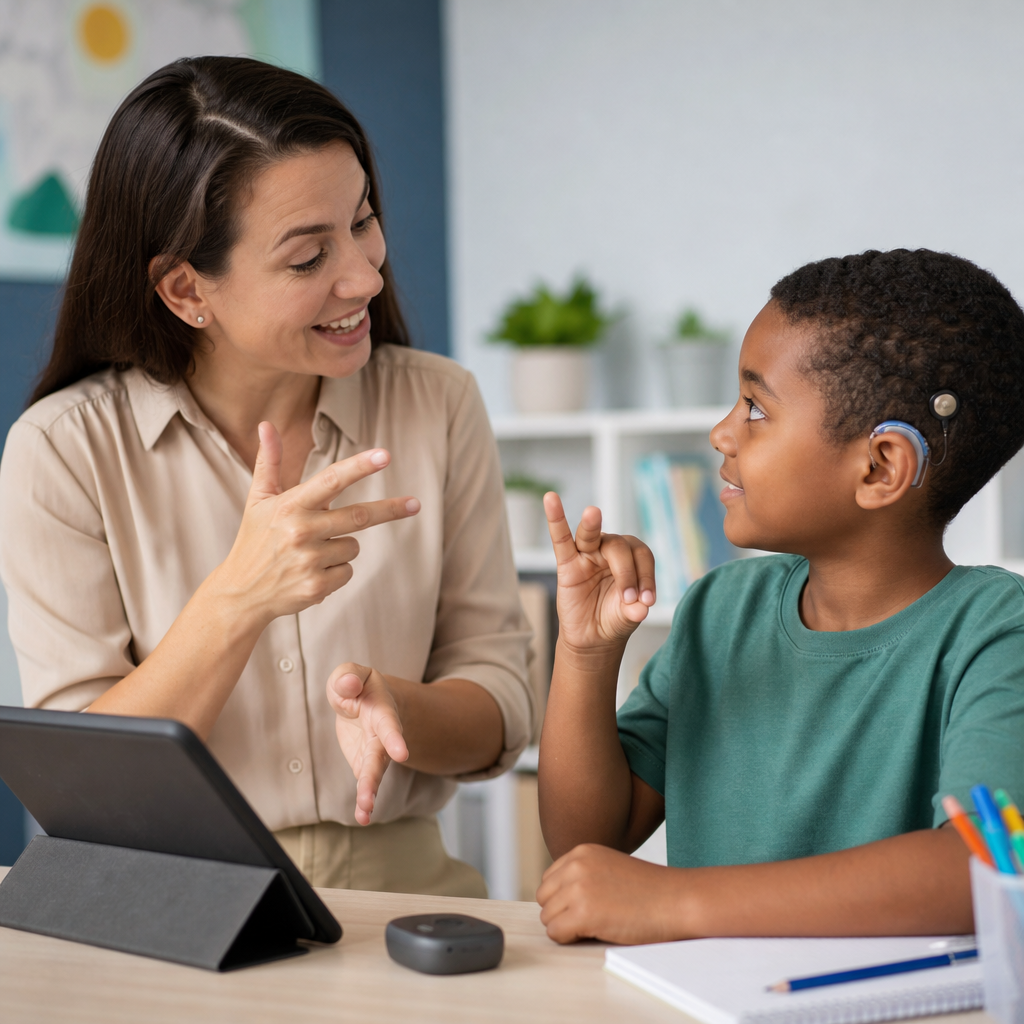

Early language exposure for deaf children shapes cognitive growth, literacy, emotional security, and long-term academic success. In practical terms, early exposure means a child has consistent access to a complete language from infancy, whether through a signed language such as American Sign Language, spoken language supported by technology and therapy, or a bilingual approach that uses both. The critical point is access. A child cannot learn from language that is partial, inconsistent, or unavailable during the first years of life.
Parents often arrive at this topic after a newborn hearing screening, a delayed speech concern, or a diagnosis that feels overwhelming. I have worked with families at each of those moments, and the same question appears quickly: what should we do first? The evidence-based answer is clear. Deaf children need rich, frequent, meaningful language input immediately. Waiting to see whether speech develops on its own, or delaying sign exposure while testing devices, creates preventable risk. Language deprivation is not the same as hearing loss. Hearing loss describes reduced access to sound. Language deprivation describes reduced access to language itself, and its effects can reach attention, learning, memory, behavior, and mental health.
This matters because early childhood is a period of extraordinary brain development. Neural pathways for language are built through interaction long before school starts. The Centers for Disease Control and Prevention emphasizes early intervention for developmental outcomes, and organizations such as the American Academy of Pediatrics, the Joint Committee on Infant Hearing, and the National Association of the Deaf have all supported prompt, accessible communication planning. For families seeking resources for parents, this hub explains why early language exposure matters, what approaches exist, which services help most, and how to build a home environment where a deaf child can thrive.
Why early language access is a developmental necessity
Language is not just vocabulary. It is the framework children use to organize thought, ask questions, regulate emotions, build relationships, and later learn to read and write. When deaf children have full access to language early, they are better positioned to meet developmental milestones in social communication, executive functioning, and school readiness. When access is delayed, the problem often spreads beyond communication. I have seen children mislabeled as inattentive or oppositional when the real issue was that too little of daily life was linguistically accessible to them.
The first three years are especially important because the brain is highly responsive to patterns in communication. Repeated turn-taking, facial expression, shared attention, and meaningful words or signs strengthen language networks. Deaf children can develop these networks on time, but only when adults provide accessible input every day. Research across signed and spoken pathways shows the same principle: children learn language through quantity, quality, and consistency of interaction. The modality can differ. The need for early access does not.
For parents, this means language exposure should begin as soon as deafness is identified, and ideally even while medical decisions are still underway. A family does not need to settle every long-term choice before starting communication. In fact, the safest path is to ensure the child has a fully accessible language immediately while audiology, hearing technology, and educational planning continue.
What counts as effective early language exposure
Effective exposure is direct, frequent, and complete. Direct means the child can actually perceive the language without guessing. Frequent means communication happens throughout the day, not only in therapy. Complete means the language has full grammar and real conversational use, not isolated labels or drills. For many deaf children, signed language provides the most reliable immediate access because it does not depend on residual hearing, device tolerance, listening conditions, or perfect speech perception. Spoken language may also be part of the plan, especially with hearing aids, cochlear implants, auditory-verbal therapy, or cued support, but it must be evaluated honestly based on what the child can access now, not what adults hope may happen later.
In home visits, the strongest predictor of progress was rarely a single device or program. It was whether caregivers communicated constantly during meals, play, routines, and transitions. A parent signing “wash hands, then snack,” pausing for the child’s response, and repeating that pattern twenty times a week is building language. So is a caregiver narrating bath time with spoken language that the child can hear and process through appropriate amplification. Children need thousands of these moments, embedded in real life.
Parents should also understand that exposure from one source is not enough. A deaf child benefits from seeing language used by parents, siblings, relatives, teachers, peers, and deaf adults. Multiple models expand vocabulary, conversational flexibility, and cultural belonging. This is why strong parent resources usually include family classes, early intervention coaching, community playgroups, and contact with deaf mentors.
Communication approaches and the case for flexible planning
Families are often presented with communication choices as if they are mutually exclusive identities rather than tools for access. In reality, deaf children have different hearing levels, neurologic profiles, family languages, and educational settings. Good planning starts with one standard: does this approach give the child reliable language now? American Sign Language offers immediate visual access and a complete linguistic system. Listening and spoken language approaches focus on maximizing auditory input through hearing technology and therapy. Bilingual models combine sign and spoken or written language to support broad communication and literacy. Total communication may incorporate speech, sign systems, gestures, print, and visual supports.
No single option fits every child, but one principle should be nonnegotiable: never reduce accessible language while waiting for uncertain outcomes from technology or speech training. Cochlear implants and hearing aids can be life-changing tools, yet outcomes vary based on age at fitting, anatomy, additional disabilities, consistency of use, auditory access, mapping quality, family support, and specialized therapy. Even children with strong implant outcomes benefit from visual communication, especially during device-off times, illness, fatigue, noisy environments, or equipment failure.
| Approach | Main Strength | Common Limitation | Best Parent Resource Focus |
|---|---|---|---|
| American Sign Language | Immediate full visual language access | Family must actively learn and use it daily | ASL classes, deaf mentors, signing playgroups |
| Listening and Spoken Language | Builds auditory and speech skills with technology | Depends on consistent auditory access and therapy quality | Audiology follow-up, auditory-verbal coaching, device support |
| Bilingual approach | Protects language access while supporting literacy and speech goals | Requires coordinated planning across home and school | Dual-language coaching, visual books, mixed-modality routines |
| Total Communication | Flexible use of multiple supports | Can become inconsistent if goals are unclear | Structured home routines, teacher alignment, progress monitoring |
For most families, flexible planning is more realistic than rigid ideology. Parents can monitor what the child understands, how often they initiate communication, and whether language is growing across settings. If access is weak, the plan should change quickly.
Resources for parents: where support should begin
The best resources for parents are practical, timely, and multidisciplinary. Start with pediatric audiology for diagnostic testing, amplification management, and device verification using real-ear measures when hearing aids are involved. Ask for plain-language explanations of the audiogram, aided thresholds, and what sounds your child can actually access. Families should also connect with early intervention under Part C of the Individuals with Disabilities Education Act in the United States. Early intervention can provide home-based coaching, developmental monitoring, speech-language services, and referrals to signing instruction or deaf education specialists.
Parents also need language-specific support. If the family is pursuing sign, enroll immediately in ASL classes designed for beginners and ask about deaf mentor programs. A deaf mentor is not an optional extra. In my experience, these relationships often change family confidence faster than any handout because parents see fluent communication modeled in real time. If the family is emphasizing spoken language, seek a speech-language pathologist or listening and spoken language specialist with documented experience in pediatric hearing loss, not general speech delay alone.
Community organizations matter as much as clinical services. State schools for the deaf, Hands & Voices chapters, parent-to-parent networks, local deaf service centers, and library story times with visual communication supports often provide the most durable help. The Laurent Clerc National Deaf Education Center, the National Deaf Center, and the Alexander Graham Bell Association are commonly consulted organizations, though families should compare perspectives and choose resources that preserve language access rather than restrict it. Reliable parent resources answer immediate questions about communication, schooling, rights, transportation, financial aid, and emotional adjustment.
Building a language-rich home from the first day
Parents do not need perfect fluency to create a language-rich home. They need consistency, responsiveness, and routines. Start by making communication visible and interactive. Get the child’s attention before signing or speaking. Position yourself in good light. Use facial expression naturally. Repeat key words and signs during daily routines such as dressing, eating, bath time, and bedtime. Label feelings, actions, and choices. Read picture books every day, even to infants. Pause so the child can look, point, vocalize, sign, or imitate. Communication grows in turn-taking, not in one-way performance.
Visual access should shape the environment. Reduce backlighting so faces are clear. Arrange seating so everyone can be seen. Use mirrors, gesture, photos, captions, labels, and picture schedules. If the child uses hearing aids or implants, check equipment every morning and monitor battery life, retention, and listening response. Keep a simple notebook of new signs, words, and questions to discuss with therapists or teachers. The goal is to make language available all day, not to confine it to appointments.
Siblings and extended family need training too. Grandparents who learn ten useful signs and use them warmly can increase a child’s sense of belonging dramatically. Families who establish one nightly shared activity, such as signed songs or a visual story routine, often sustain language growth better than those relying only on weekly lessons.
School readiness, literacy, and long-term outcomes
Early language exposure affects school readiness long before formal academics begin. Children who enter preschool with a strong first language are better able to follow directions, ask for help, understand stories, and build phonological or visual pattern awareness for reading. For deaf children, literacy does not emerge from print alone. It grows from a language foundation that supports vocabulary, narrative structure, sequencing, inference, and background knowledge. Signed language users can become strong readers because reading depends on language competence, not on hearing status.
Parents should ask future schools direct questions: how will staff ensure full classroom access, what communication modes are used, how is progress measured, and who on the team has expertise in deaf education? Appropriate supports may include interpreters, teachers of the deaf, captioned media, FM or DM systems, visual alerts, preferential seating, and explicit vocabulary instruction. The Individuals with Disabilities Education Act and Section 504 can shape these services, but legal rights only help when families understand them.
Long-term outcomes improve when children see deaf adults living full professional and social lives. Representation matters. It expands expectations and reduces the subtle message that deafness is only a problem to be fixed. Children do best when they have language, access, and identity support together.
Common mistakes parents can avoid
The most common mistake is delaying accessible language while pursuing a single hoped-for outcome. Others include relying on therapy sessions instead of daily interaction, accepting vague reassurances without measurable progress data, underestimating the importance of deaf role models, and treating sign as a last resort rather than a proactive resource. Another frequent error is assuming device use equals language access. A child may wear hearing aids consistently and still miss large parts of conversation in noise, at distance, or during rapid speech.
Parents should watch for concrete indicators of progress: increasing understanding, more spontaneous communication, broader vocabulary, stronger turn-taking, and engagement across settings. If these are not growing, the plan needs adjustment. Seeking a second opinion is responsible, not disloyal.
Early language exposure gives deaf children the foundation every child deserves: a way to understand the world and be understood within it. For parents, the central lesson is simple. Start immediately, choose approaches that provide real access, use trusted professionals and deaf community resources, and make communication a constant part of home life. When language comes early, children gain far more than words or signs. They gain learning, connection, confidence, and opportunity. Explore the parent resources in this Education & Learning Resources hub, build your support team, and begin creating a language-rich environment today.
Frequently Asked Questions
Why is early language exposure so important for deaf children?
Early language exposure is essential because the first years of life are a critical period for brain development. During this time, children build the foundation for thinking, learning, memory, attention, and social connection through language. For deaf children, the issue is not simply hearing versus not hearing. It is whether they have reliable, consistent access to a complete language from infancy. When that access is present, children are better positioned to develop strong communication skills, emotional security, and readiness for school.
Language exposure also supports literacy and academic success over the long term. Children who can fully access language early are more likely to develop vocabulary, comprehension, and the ability to understand how communication works. Those skills later support reading, writing, and classroom learning. By contrast, delayed or inconsistent access to language can create gaps that become harder to close over time. That is why experts emphasize early intervention and language-rich environments that meet the child where they are and give them full access every day.
What does “early language exposure” actually mean for a deaf child?
Early language exposure means a deaf child has dependable access to a complete language as early as possible, ideally from infancy. This can happen through a signed language such as American Sign Language, through spoken language when it is made accessible with the right technology and support, or through a bilingual approach that includes both signed and spoken language. The key idea is not the specific path alone, but whether the child can consistently receive and use language in a way that is clear, frequent, and meaningful.
In practice, this means language should be available throughout the child’s day, not only during therapy sessions or limited activities. A child benefits when communication happens naturally during play, meals, routines, storytelling, and family interactions. If access is partial, inconsistent, or unavailable, the child may miss critical opportunities to absorb language. Early exposure is successful when the child can understand communication, respond to it, and participate in relationships and learning without barriers that leave them guessing or disconnected.
Can deaf children learn language through sign language, spoken language, or both?
Yes. Deaf children can learn language through signed language, spoken language, or a bilingual approach, and each of these pathways can support healthy development when the child has real access to the language being used. Sign languages such as American Sign Language are complete, natural languages with their own grammar and structure. They provide direct visual access to language, which makes them especially powerful for many deaf children from the earliest months of life.
Some deaf children also develop spoken language with support such as hearing technology, auditory therapy, speech services, and consistent practice. For some families, a bilingual approach offers the benefits of both signed and spoken language, allowing the child to build communication skills across different settings and needs. What matters most is not choosing a method based on assumption or ideology, but ensuring the child is actually gaining language. Families and professionals should focus on outcomes: Is the child understanding, communicating, connecting, and learning? If the answer is yes, the language plan is working. If not, more complete and accessible language support is needed right away.
What are the risks of delayed or limited language access for deaf children?
When a deaf child does not have full access to language early in life, the effects can extend far beyond communication. Limited language access can affect cognitive development, emotional regulation, social relationships, literacy, and academic progress. Children learn about the world through language. They use it to ask questions, understand cause and effect, build memories, express feelings, and make sense of daily experiences. Without sufficient access, development in these areas can be slowed or disrupted.
There can also be long-term consequences. Children with delayed language access may struggle with reading comprehension, writing, classroom participation, and self-advocacy. They may experience frustration, isolation, or behavioral challenges that are rooted not in ability, but in communication barriers. Importantly, these risks are preventable when families act early to create a language-rich environment. The goal is to avoid language deprivation by making sure the child is surrounded by accessible communication from the start, with ongoing monitoring to ensure real language growth is happening.
How can parents support strong early language development in a deaf child?
Parents can support early language development by prioritizing access, consistency, and interaction. The most important step is to ensure the child is exposed to a complete language every day from as early as possible. That may mean learning and using sign language at home, following through with hearing technology and therapy when appropriate, or combining approaches to give the child multiple ways to connect and learn. What matters is that communication is frequent, clear, and fully accessible to the child.
Parents should also create a language-rich home environment. Talk, sign, read, play, sing, label objects, describe routines, and respond to the child’s attempts to communicate. These everyday interactions are where language grows. It is also helpful to work with qualified professionals, including early intervention providers, deaf educators, speech-language specialists, and members of the Deaf community when possible. Regularly tracking whether the child is truly understanding and using language is essential. Strong support does not mean waiting to see what happens. It means actively building communication from the beginning so the child can develop with confidence, connection, and the tools needed for lifelong learning.