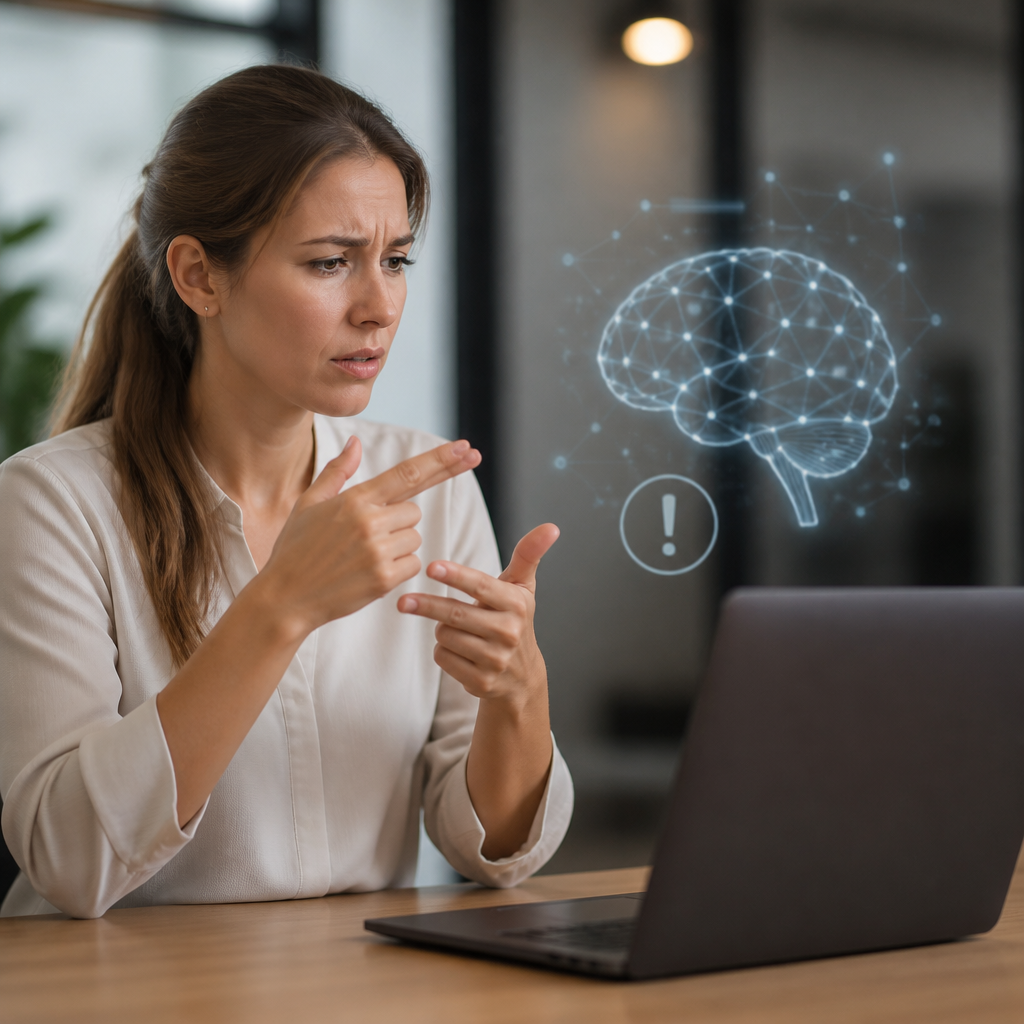
Artificial intelligence is transforming accessibility, but its limits become clear fastest in deaf accessibility, where communication depends on language, timing, culture, context, and trust. In this field, AI usually refers to machine learning systems that generate captions, transcribe speech, detect speakers, summarize meetings, translate text, or attempt sign language recognition and synthesis. Deaf accessibility includes the tools, practices, and standards that allow deaf and hard of hearing people to participate fully in education, work, healthcare, government, media, and everyday life. The promise is real: faster captions, lower costs, wider distribution, and new assistive features built into phones, browsers, video platforms, and conferencing tools.
Yet the limitations of AI in deaf accessibility matter because errors are not minor inconveniences. A missed medication instruction, a mistranslated classroom discussion, or an inaccurate emergency alert can exclude people or create direct harm. I have seen teams celebrate strong headline accuracy rates while deaf users immediately point out what the system missed: names, accents, jargon, turn-taking, sarcasm, visual context, and the social meaning carried by signing style. Accessibility is not only about converting sound into text. It is about preserving meaning and enabling equal participation. That makes this topic central to any serious discussion of AI and the future of accessibility.
This article serves as a hub for the broader AI and accessibility landscape within technology and tools for the deaf community. It explains where AI works well, where it breaks down, and what organizations should do before replacing human expertise with automation. It also connects the technical issues to policy and procurement questions that decision-makers often overlook. If you are evaluating captioning software, meeting tools, sign language avatars, speech-to-text apps, or accessibility workflows, understanding these limitations will help you choose technology that supports deaf users rather than creating new barriers.
At a practical level, the core question is simple: what can AI reliably do for deaf accessibility today, and what still requires human interpretation, design, and accountability? The answer varies by use case. Automated captions can be helpful for casual content and basic note capture. They are far less dependable in legal settings, classrooms, medical appointments, live performances, multilingual workplaces, and conversations involving deaf signers whose communication includes visual grammar, fingerspelling, or code-switching. Understanding those distinctions is the foundation for responsible adoption.
Where AI helps today and why that help is still conditional
AI improves deaf accessibility most consistently in high-volume, predictable environments. Automatic speech recognition performs best when audio is clean, speakers take turns, microphones are close, and vocabulary is common. Major platforms such as Zoom, Microsoft Teams, Google Meet, YouTube, and Otter offer live transcription that can make meetings more usable immediately. On smartphones, Apple Live Captions, Google Live Transcribe, and built-in dictation features help with spontaneous interactions like ordering food, checking in at a desk, or following short videos. For many deaf and hard of hearing users, these tools provide useful partial access where previously there was none.
The condition is that partial access is not equivalent to equal access. Accuracy claims often sound impressive, but aggregate percentages can hide critical failures. A system that reaches 90 to 95 percent word accuracy in a product demo may still miss the one sentence that matters most. Proper nouns, medication names, technical terminology, speaker changes, and overlapping talk are common failure points. In practice, I have seen live captions render “cochlear implant mapping” as unrelated phrases, drop whole lines during applause, and flatten questions into statements by removing punctuation and timing cues. The result is understandable enough for a hearing observer but inadequate for a deaf participant making decisions in real time.
Latency also matters. Captions that appear several seconds late disrupt turn-taking and make group discussion exhausting. Even when words are mostly correct, delayed captions can prevent someone from entering a conversation at the right moment. This is why AI can improve convenience while still failing the standard of full participation. The technology is useful, but only when teams understand the operational limits and build backup processes around it.
Why speech-to-text still misses meaning
Speech-to-text systems convert acoustic signals into probable words. That sounds straightforward, but human conversation contains much more than words. Tone, emphasis, interruptions, hesitation, laughter, and visual references all shape meaning. Deaf accessibility depends on preserving as much of that meaning as possible. Current AI models struggle because they optimize for likely transcription, not complete communicative context. They can identify the surface text of a sentence while losing whether it was a joke, a warning, a side comment, or a question directed at someone across the room.
Domain specificity makes the problem worse. In education, captions must handle subject vocabulary from chemistry to constitutional law. In healthcare, they must capture symptoms, dosage, consent language, and acronyms. In manufacturing, they need to recognize product names, safety terms, and accented speech in noisy spaces. Generic models trained on broad datasets often underperform in these environments unless they are adapted with custom vocabularies and monitored carefully. Even then, adaptation helps only part of the problem because nonverbal context is still missing.
Speaker diarization, the task of identifying who said what, is another weak point. In meetings with crosstalk, remote participants, and room microphones, captions can assign statements to the wrong person or merge multiple speakers into one stream. For deaf users, this is not a cosmetic issue. Knowing who said a comment is essential for accountability, relationship management, and comprehension. A transcript without reliable speaker attribution can distort the social structure of a conversation.
The hard problem of sign language and visual grammar
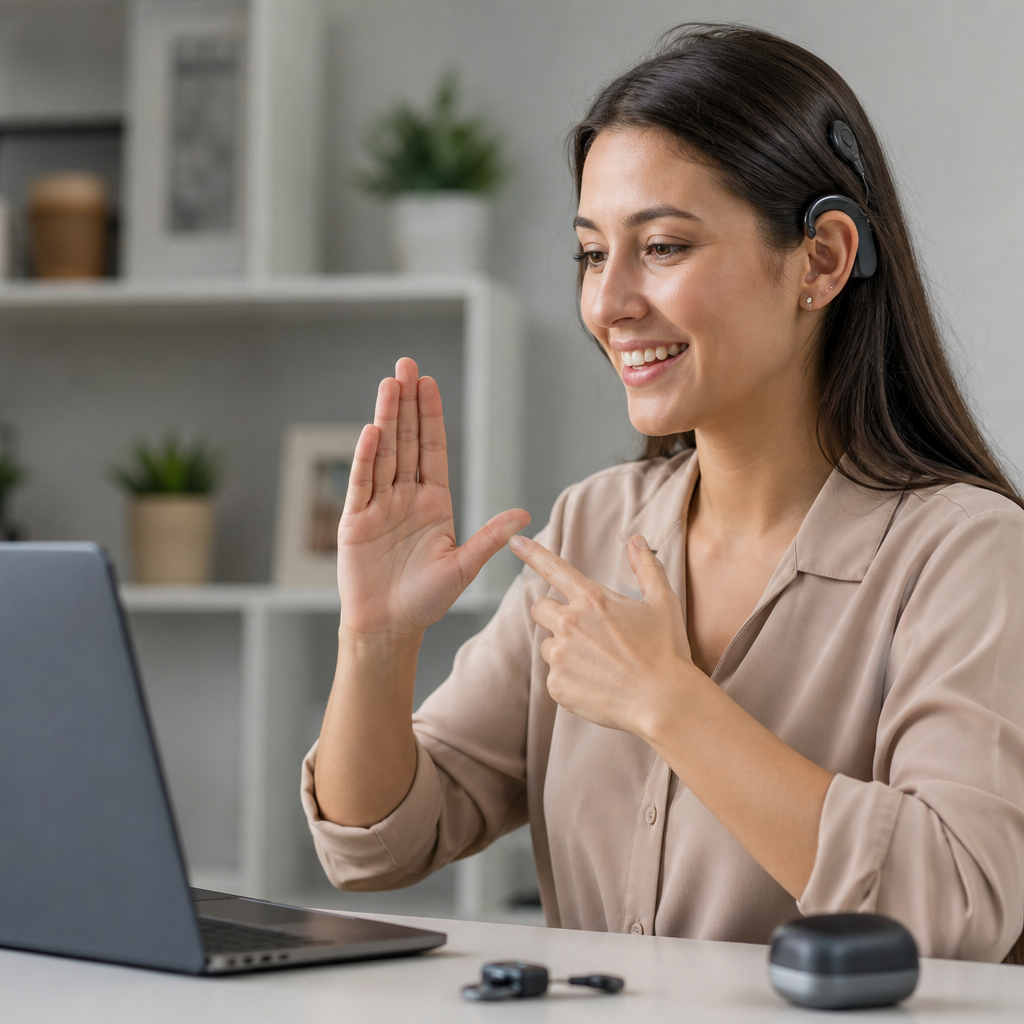
One of the biggest misconceptions in AI and deaf accessibility is the belief that sign language is simply spoken language on the hands. It is not. Sign languages are natural languages with their own grammar, morphology, syntax, and discourse structures. American Sign Language is not signed English. British Sign Language is distinct from both ASL and spoken English. Sign languages also rely on facial expressions, body posture, movement, signing space, and timing. These features carry grammatical information. A text model or motion model that ignores them cannot represent the language accurately.
Sign language recognition remains difficult because datasets are limited, labels are expensive, and variation is immense. Regional signs, individual signing styles, speed, camera angle, occlusion, clothing contrast, lighting, and fingerspelling all affect performance. A model trained on isolated citation signs in a lab usually collapses in real conversations. Continuous signing introduces coarticulation, where signs influence each other across motion, much like connected speech. Systems that look impressive in short demos often fail when faced with natural dialogue, children, elders, or multilingual deaf signers who code-switch.
Sign language synthesis has parallel issues. Avatars may generate acceptable dictionary-style signs for a narrow vocabulary, but they often look unnatural, omit nonmanual markers, and produce timing that deaf signers find awkward or misleading. In public information contexts, that can undermine trust immediately. Many deaf users prefer a human signer on video over an avatar because authenticity and linguistic accuracy are easier to judge. AI-generated signing may have a role in limited announcements, but it is not a substitute for qualified human translation in complex or high-stakes communication.
High-stakes settings expose the real risks
The limitations of AI in deaf accessibility become most visible in settings where precision, privacy, and legal compliance matter. Hospitals are a prime example. A captioning app may help with simple intake questions, but it is not enough for informed consent, diagnosis discussions, mental health care, or emergency instructions. In the United States, healthcare providers face obligations under the Americans with Disabilities Act and Section 504 to provide effective communication, not just any communication. If the method used does not work for the individual, it is insufficient.
Education presents similar concerns. Automated captions can support lecture review and improve baseline access, yet they routinely miss student questions, specialized terminology, and classroom discussion dynamics. For deaf students who rely on interpreters, captions, note-taking, or combinations of services, AI should be an enhancement rather than a replacement. Universities that deploy auto-captioning without quality review risk creating an appearance of access while shifting the burden of correction onto students.
Workplaces, courts, and public services face comparable tradeoffs. In employment, inaccurate captions can affect performance reviews, interviews, training, and team belonging. In legal contexts, error tolerance is extremely low because wording determines rights and obligations. Government agencies using automated systems for public meetings or emergency briefings must think beyond convenience and consider reliability under stress, background noise, and multilingual communication. When organizations treat AI as a cheaper substitute for human support, the failure usually appears first in these high-stakes settings.
| Setting | Useful AI Role | Main Limitation | Recommended Safeguard |
|---|---|---|---|
| Healthcare | Basic intake captions | Missed clinical terms and consent details | Provide qualified interpreters or CART for complex care |
| Education | Lecture transcripts and review notes | Weak handling of discussion and jargon | Human review plus accommodations tailored to the student |
| Workplace meetings | Routine meeting transcription | Speaker confusion and delay | Use trained captioners for important meetings |
| Public information | Fast first-pass accessibility | Translation quality and trust concerns | Editorial checks and human-signed alternatives |
Bias, data gaps, and the myth of universal performance
AI systems reflect the data and assumptions behind them. In deaf accessibility, that creates predictable bias. Speech models often perform unevenly across accents, dialects, ages, and recording conditions. Sign language systems may overrepresent younger signers, standard variants, or studio-quality footage while underrepresenting regional usage, Black signing traditions, deafblind communication methods, or multilingual signers. When vendors claim broad accessibility, buyers should ask exactly which populations were included in testing and which were not.
Benchmark scores can mislead if they are based on controlled datasets that do not reflect real use. I have reviewed product evaluations where the model performed well on clean webinar audio yet dropped sharply in hybrid meetings with side conversations and poor microphones. The same pattern appears in sign research. A model may classify isolated signs accurately but fail at continuous narrative signing. Universal performance is a myth. Accessibility technology must be judged in the context where it will actually be used.
Bias also appears in product design choices. Some apps assume speech is the central input and treat signing, gestures, or visual attention as secondary. Others optimize for individual use but ignore multi-party interaction, which is where many access barriers arise. Inclusive testing with deaf users is not optional. It is the only reliable way to find the gap between technical performance and lived usability.
What responsible adoption looks like
Organizations can use AI effectively for deaf accessibility if they treat it as one layer in a broader access strategy. Start by mapping communication scenarios by risk level. Low-risk uses include casual videos, internal notes, and noncritical routine meetings. Medium-risk uses might include staff training or customer support with a clear escalation path. High-risk uses include healthcare, legal proceedings, disciplinary meetings, emergency communication, and graded education activities. The higher the risk, the stronger the case for human interpreters, Communication Access Realtime Translation, or manual quality assurance.
Procurement should be specific. Ask vendors about word error rates in noisy environments, speaker diarization accuracy, custom vocabulary support, latency, data retention, encryption, and whether captions can be corrected live. For sign-related tools, ask which sign language, which dialects, what camera setup, what demographic coverage, and whether deaf signers evaluated output quality. If a vendor cannot answer clearly, the product is not ready for critical access needs.
Responsible adoption also means preserving user choice. Deaf people are not a monolith. Some prefer live captions, some prefer interpreters, some use both, and some rely on texting, visual alerts, or bilingual workflows. The best accessibility programs avoid one-size-fits-all deployment and build flexible systems that can adapt by person and context. That is where AI adds value: not by replacing human access professionals, but by expanding the toolkit when used with transparency and clear limits.
The future of accessibility will depend on governance, not just models
AI will continue improving, especially in multimodal systems that combine audio, text, and video. Better microphones, personalized vocabularies, larger datasets, and on-device processing will make some tools faster and more private. But the future of deaf accessibility will not be decided by model size alone. It will depend on governance: standards for accuracy, disclosure about limitations, human oversight, inclusive design, and procurement rules that define effective communication as the goal.
The key lesson is straightforward. AI can reduce friction, widen baseline access, and support daily interactions, but it cannot yet guarantee equal access across the full range of deaf communication. Speech-to-text still loses meaning. Sign language technologies still struggle with natural variation and grammar. High-stakes settings still require human expertise and accountability. Teams that understand these limits make better technology choices and avoid the common mistake of confusing automation with accessibility.
For anyone building, buying, or deploying accessibility tools, the next step is simple: audit your current AI features against real deaf user needs, then strengthen the gaps with human support, testing, and policy. That approach delivers the real benefit of technology and tools for the deaf community: access that is reliable enough to trust.
Frequently Asked Questions
Why does AI struggle so much with deaf accessibility compared with other accessibility tasks?
AI struggles in deaf accessibility because this area is not just about converting sound into text. It involves language accuracy, timing, speaker intent, conversational context, visual communication, and cultural understanding. Automatic captions and speech-to-text systems may appear impressive in controlled settings, but real-world communication is rarely clean or predictable. Background noise, overlapping speakers, regional accents, technical terminology, sarcasm, names, and fast turn-taking can all reduce accuracy. Even small errors matter when someone relies on captions as their primary access point to a conversation, class, meeting, or event.
Another major limitation is that deaf accessibility often depends on more than words alone. A deaf person may need to know who is speaking, when a speaker changes, whether the audience is laughing, whether a side conversation is happening, or whether a comment is being delivered seriously or jokingly. Many AI systems still fail to represent these details consistently. In sign language contexts, the challenge becomes even greater because signed languages have their own grammar, spatial structure, facial expressions, and cultural conventions. AI is generally much better at recognizing patterns in text than it is at understanding the full richness of human communication across visual and social dimensions.
Trust is also central. If a hearing user gets a flawed transcript, it may be an inconvenience. If a deaf user gets a flawed caption stream during a medical appointment, legal proceeding, classroom lecture, or workplace discussion, the consequences can be serious. That is why the limitations of AI become especially visible in deaf accessibility: the margin for error is smaller, and communication access has to be dependable, not merely impressive in a demo.
Are automatic captions accurate enough to replace human captioners or interpreters?
In most important settings, no. Automatic captions can be useful as a supplemental tool, but they are not a full replacement for trained human captioners or sign language interpreters. AI-generated captions often perform reasonably well for clear, single-speaker audio in quiet environments, especially when the subject matter is general and predictable. However, performance often drops when conversations become more dynamic, technical, emotional, or fast paced. Errors frequently appear in names, industry terms, acronyms, multilingual speech, and overlapping dialogue. AI can also omit words, confuse speakers, or produce polished-looking text that is still wrong in meaning.
Human captioners bring judgment that AI does not reliably have. They can clarify terminology in context, identify speakers accurately, preserve important non-speech information, and adapt in real time when the communication environment changes. Sign language interpreters add another level of expertise because they are not simply converting one language into another word for word. They are interpreting meaning across languages and cultures, accounting for tone, pace, register, and the communication preferences of the deaf person involved. That kind of adaptive, relational work is still far beyond what current AI can do consistently.
This does not mean AI has no role. Automatic captioning can improve access in informal settings, provide rough drafts for editing, support archived video content, and help fill gaps when human services are unavailable. But replacing humans entirely creates risk, especially in education, healthcare, employment, government, and legal contexts. The more the setting depends on precision, nuance, confidentiality, and accountability, the less realistic it is to treat AI as an adequate substitute.
Why is sign language especially difficult for AI to recognize or generate?
Sign language is especially difficult for AI because it is a complete natural language expressed through movement, space, facial expression, body position, timing, and visual emphasis. It is not simply “spoken language on the hands.” Many AI systems are built on assumptions that work better for text or audio than for visual-spatial language. To recognize sign language accurately, a system must track handshape, movement, location, orientation, facial grammar, mouthing, and context, all at once. Even then, meaning can change depending on signer style, signing speed, camera angle, lighting, clothing contrast, background conditions, and regional language variation.
There is also a major data problem. High-quality sign language datasets are harder to build than text or speech datasets, and many are limited in size, diversity, or linguistic coverage. A model trained on a narrow set of signers or constrained vocabulary may seem effective in research conditions but fail in everyday communication. Signed languages also vary by country and community, so a system designed around one language or one dialect cannot be assumed to work broadly. In addition, much of sign language meaning depends on discourse context and shared understanding, which is difficult for AI to infer reliably from isolated clips.
Generating sign language is equally challenging. An avatar or synthesized signer may produce movements that look plausible to hearing developers but unnatural, unclear, or even misleading to fluent signers. If facial grammar, timing, transitions, or spatial references are wrong, the output may not actually be accessible. This is why many deaf advocates and language experts caution against oversimplified claims about “AI sign language translation.” The technical challenge is real, but so is the linguistic and cultural complexity. Progress may continue, yet current systems remain limited and should be evaluated carefully with deaf users and native signers.
What risks do AI accessibility tools create for deaf and hard of hearing users?
The biggest risk is false confidence. AI tools often present their output in a clean, authoritative format, which can make errors easy to miss and difficult to challenge in real time. A transcript may look complete while leaving out critical qualifiers, reversing meaning, misidentifying a speaker, or dropping entire sections of dialogue. For deaf and hard of hearing users, that can lead to missed instructions, exclusion from decision-making, misunderstandings in the workplace, or unequal access in classrooms and public services. When organizations assume that turning on an AI feature automatically solves accessibility, they may stop investing in more reliable support.
There are also privacy and bias concerns. Many AI accessibility systems process sensitive speech data, meetings, or personal interactions through third-party platforms. In healthcare, education, HR, or legal settings, that raises questions about consent, data retention, confidentiality, and compliance. Bias is another issue: systems may perform worse for certain accents, speech patterns, languages, or communication styles, meaning access quality can vary unfairly across users. If the people evaluating the tool are not the ones relying on it for access, these disparities may go unnoticed.
A further risk is reducing accessibility to a product feature instead of treating it as an ongoing practice. Deaf accessibility depends on planning, standards, human support, and responsiveness to user needs. AI can help, but it can also encourage shortcut thinking: using automated captions instead of hiring CART services, relying on summaries instead of ensuring full participation, or deploying sign language avatars without consulting deaf communities. The result is often partial access framed as complete access. That gap between promise and reality is where many of the most serious harms occur.
How should organizations use AI responsibly in deaf accessibility?
Organizations should treat AI as a support tool, not a complete accessibility strategy. The best starting point is to ask what level of communication accuracy and reliability the situation requires. For a casual internal video, AI captions may be a reasonable baseline if they are reviewed and corrected. For live events, classrooms, public-facing webinars, medical interactions, or legal meetings, higher-stakes access usually requires human captioners, interpreters, or both. Responsible use begins with matching the tool to the risk level rather than assuming one solution fits every context.
It is also important to involve deaf and hard of hearing users directly in evaluation. Accessibility should not be judged only by whether a feature exists, but by whether it actually works for the people who depend on it. Organizations should test for accuracy, latency, speaker labeling, readability, technical vocabulary, and usability across different communication conditions. They should also provide backup options when AI fails. That means having escalation paths, offering human support, and making it easy for users to request accommodations without friction or stigma.
Finally, responsible use requires humility. AI vendors often market accessibility tools as transformative, but organizations should look beyond promotional claims and ask practical questions: How accurate is the tool in noisy live settings? How does it handle overlapping speech? Can captions be edited quickly? What data is stored, and for how long? Has the system been validated by deaf users? Real accessibility is built through consultation, testing, standards, and accountability. AI can absolutely contribute to that work, but it should be deployed with care, transparency, and a clear understanding of its limits.