
Deaf expression is deeply visual and cultural because it grows from shared language, lived experience, and community memory rather than from sound alone. In Deaf communities, expression includes signed storytelling, theater, poetry, visual art, film, dance, humor, and everyday conversation shaped by the grammar and aesthetics of sign languages. When people ask why Deaf art looks different, the direct answer is that it reflects a distinct way of perceiving, organizing, and communicating meaning through space, movement, rhythm, gaze, and collective history. This matters because Deaf culture is too often reduced to disability, access needs, or medical frameworks, while its artistic traditions reveal a full cultural world with its own standards of beauty, performance, and identity.
In practice, I have seen that many hearing readers approach Deaf expression by focusing first on interpretation or accommodation. That starting point misses the core issue. Deaf expression is not simply spoken culture translated into signs. It is a creative system shaped by visual attention, signed languages such as American Sign Language, British Sign Language, Langue des Signes Française, and many others, plus schools, clubs, activism, technology, and intergenerational teaching. The result is a cultural ecosystem in which form and meaning are inseparable. A facial expression is not decoration; it can carry grammar, emotion, irony, and stance at the same time. A pause in signed storytelling is not empty space; it directs the viewer’s eye and builds dramatic timing.
As a hub page for art, storytelling, and expression within Deaf culture and identity, this article maps the major forms, ideas, and debates that define the field. It explains what makes visual communication central, how Deaf storytelling works, why Deaf theater and poetry matter, how visual art encodes identity, what Deaf gain means in creative practice, and where technology expands or distorts representation. It also addresses a practical question many readers have: how can someone appreciate Deaf expression without flattening it into inspiration, translation, or novelty? The answer begins with respecting Deaf cultural authority, learning how signed performance creates meaning, and recognizing that visual expression is not a substitute for speech. It is a primary mode of culture.
Why visual communication sits at the center of Deaf culture
Visual communication sits at the center of Deaf culture because signed languages use the body and space as the medium of thought. Linguists have long established that sign languages are full natural languages with their own phonology, morphology, syntax, and discourse structures. In ASL, for example, handshape, movement, location, orientation, and nonmanual markers work together much like sound patterns and intonation do in spoken languages, but with one crucial difference: the visual field is the channel through which grammar becomes visible. That changes not only how language is produced but also how stories, jokes, and artistic performances are built.
Daily Deaf social life trains visual awareness in ways that shape art. Attention-getting may involve waving, tapping, flashing lights, or coordinated gaze. Seating arrangements favor sightlines. Group conversations rely on turn-taking cues that can be seen across a room. These habits are cultural, not merely functional. Over time they produce a shared visual intelligence: people notice body shift, eye focus, tempo, and spatial mapping with unusual precision. In creative work, that intelligence becomes an aesthetic standard. Strong performers know how to direct viewers through a scene, establish characters in space, and switch perspective cleanly enough that the audience follows without verbal explanation.
The concept often called Deaf gain is useful here. Instead of seeing deafness only as loss, Deaf gain highlights the cognitive, social, and artistic knowledge that emerges from visual ways of being in the world. In expression, that means heightened attention to movement, framing, visual rhythm, and embodied metaphor. A signed poem can make symmetry, repetition, and handshape patterning feel almost architectural. A Deaf visual artist may center line of sight, silence, vibration, or the politics of gaze in ways hearing audiences rarely anticipate. The cultural point is not that all Deaf people perceive identically, but that communities organized around signed communication develop recognizable expressive norms grounded in vision.
How Deaf storytelling creates meaning through space, role shift, and audience connection
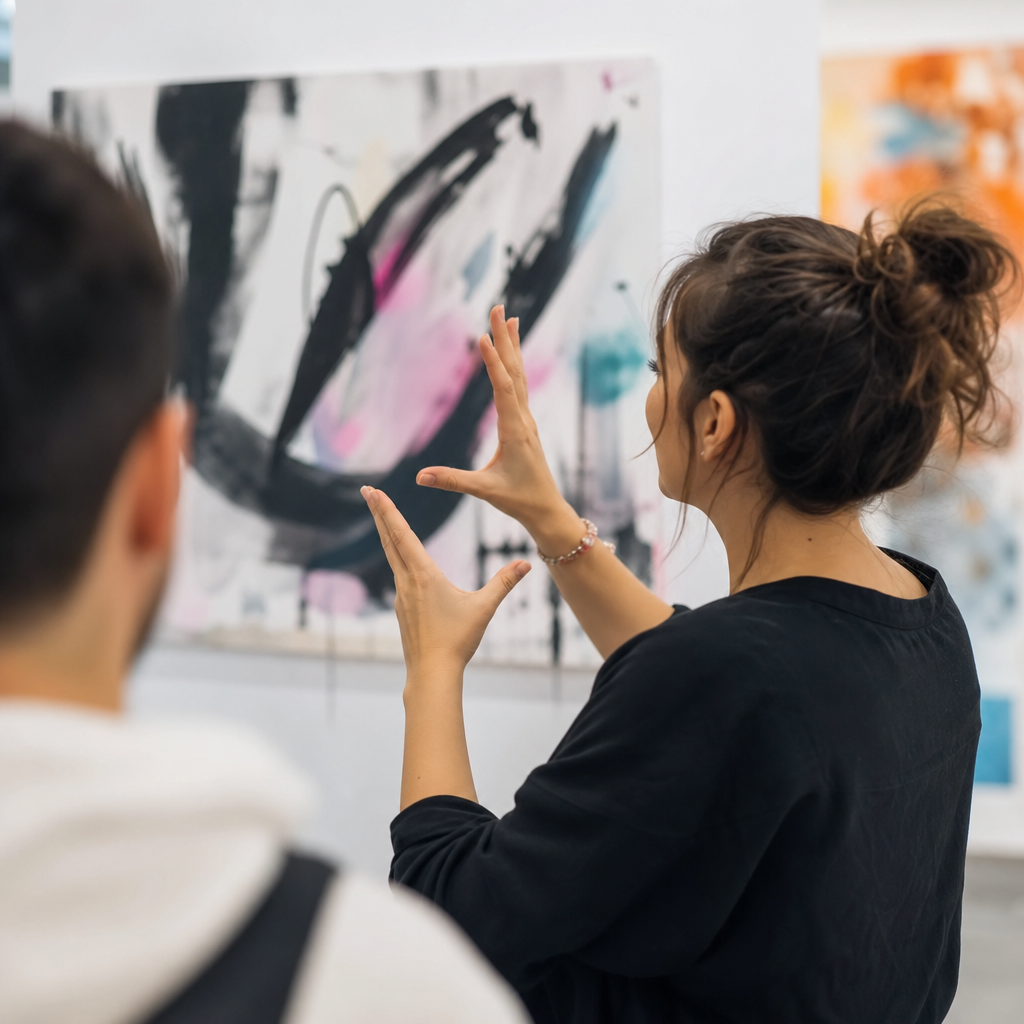
Deaf storytelling is one of the clearest examples of why Deaf expression is both visual and cultural. A skilled signer does not simply recount events in sequence. They map scenes into space, assign locations to people or ideas, shift body position to mark changes in speaker, and use classifier constructions to show movement, scale, texture, and action. Role shift allows the storyteller to embody multiple characters, often changing facial expression, eye gaze, and torso orientation in a fraction of a second. This creates immediacy that is difficult to replicate in print. The audience is not only hearing about an event, but visually entering it.
Classic forms of Deaf storytelling include personal narratives, folklore, tall tales, historical pieces, and humorous performances rooted in Deaf experience. Many stories center on school life, family misunderstandings, interpreter mishaps, audism, or moments of visual ingenuity. The humor often depends on timing and shared cultural knowledge. A joke about a hearing person talking from another room lands because the audience instantly recognizes the absurdity of expecting communication without line of sight. In Deaf clubs and residential schools, these stories have traditionally circulated as social memory, preserving lessons about resilience, etiquette, and identity.
One famous performance tradition is ABC or manual alphabet storytelling, in which a signer creates a narrative using handshapes in alphabetical order. Number stories do something similar with numbered handshapes. These pieces demand extraordinary linguistic control and creativity. They are not children’s games. At their best, they demonstrate virtuosity comparable to formal poetry, because the artist works within strict structural constraints while maintaining clarity, humor, and emotional impact. Watching masters such as Bernard Bragg’s generation or contemporary festival performers makes the point obvious: Deaf storytelling is a high art built from linguistic features unique to signed language.
Audience connection is essential. Deaf storytellers constantly read the room. If viewers miss a visual cue, the performer may adjust pace, enlarge a movement, or restage a scene. This dynamic feedback loop is part of the culture. Storytelling is communal, embodied, and responsive. That is why recorded video expands reach but does not fully replace live performance. In person, shared attention becomes part of the art.
Deaf poetry, theater, and performance traditions
Deaf poetry and theater show how signed languages generate their own performance conventions rather than borrowing everything from spoken literature. Signed poetry often uses handshape rhyme, rhythmic repetition, symmetry, movement contrast, and visual metaphor. Instead of sound-based alliteration, poets may repeat a parameter such as handshape or movement path. Instead of meter measured by syllables, rhythm may emerge from motion, pause, body pulse, and pattern. Clayton Valli’s work in ASL poetry is frequently cited because it helped establish critical vocabulary for discussing signed verse as literature in its own right.
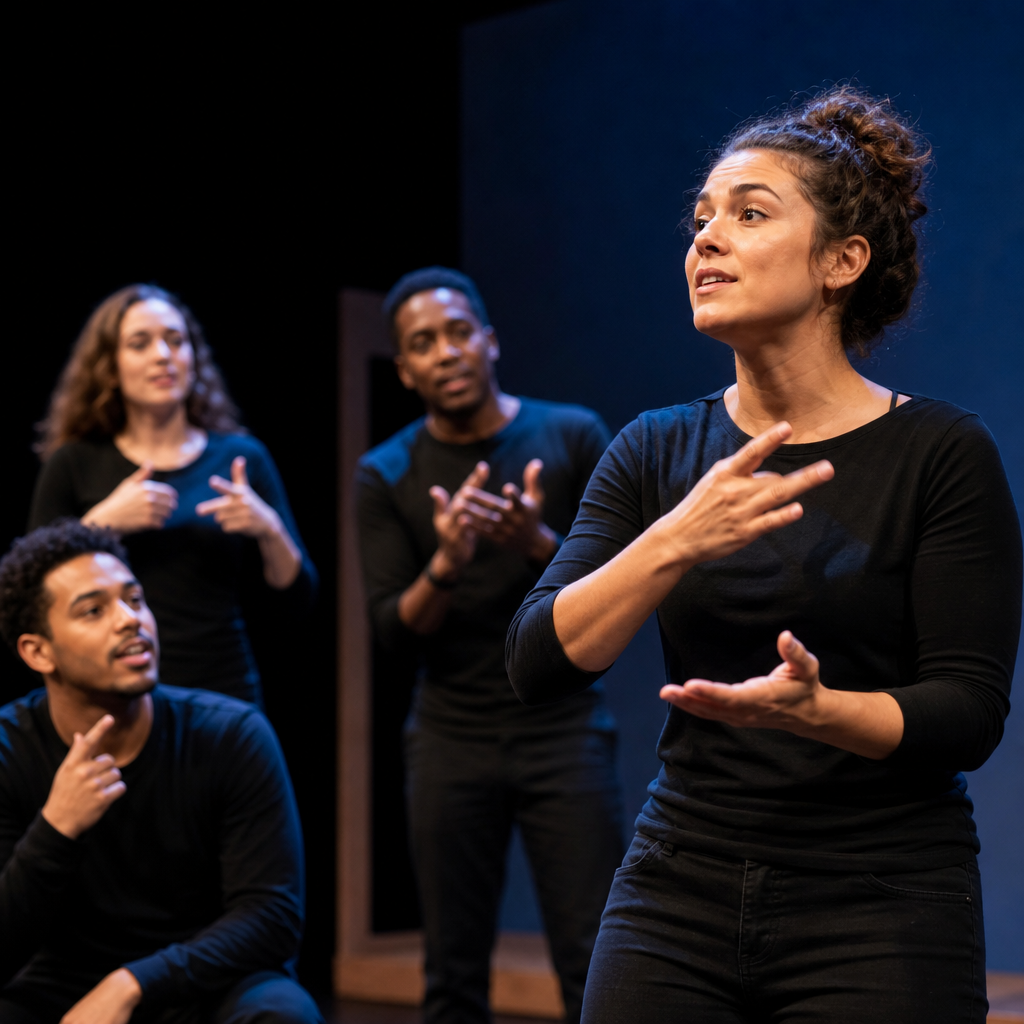
Deaf theater combines language, gesture, staging, and community politics. Companies such as the National Theatre of the Deaf in the United States changed expectations by presenting sign-centered performance to broad audiences. Deaf West Theatre later became widely recognized for productions that integrated Deaf and hearing performers, including a celebrated revival of Spring Awakening. The best Deaf theater does not treat signing as an accessory. It builds blocking, lighting, sightlines, and narrative emphasis around visual language. Directors must think carefully about where an audience’s eyes will go at every moment. Poor visual composition weakens the story even if the script is strong.
Performance traditions also include visual vernacular, a form associated with cinematic storytelling techniques in signed performance. Visual vernacular uses montage-like shifts, close-up effects, and stylized movement to create highly visual scenes that can travel across language boundaries more easily than lexical signing alone. International Deaf festivals often feature this work because it showcases physical precision and cross-cultural accessibility. Still, visual vernacular should not be mistaken for a universal language. It is an art form shaped by Deaf practice, not a replacement for distinct national sign languages.
| Form | Core Features | Cultural Role |
|---|---|---|
| Signed storytelling | Role shift, classifiers, spatial mapping, audience feedback | Preserves memory, teaches norms, builds community |
| Signed poetry | Handshape patterning, rhythm, repetition, visual metaphor | Explores language beauty and identity |
| Deaf theater | Sign-centered staging, visual timing, ensemble performance | Public representation and cultural debate |
| Visual vernacular | Cinematic imagery, stylized motion, minimal lexical dependence | Festival performance and transnational exchange |
| Deaf film and media | Camera-aware signing, captions, editing for visual clarity | Archives stories and expands reach |
These forms matter because they give Deaf people control over representation. For decades, mainstream media cast deafness as isolation, tragedy, or heroic overcoming. Deaf performance counters that narrative by centering fluency, wit, and shared cultural references. It tells audiences that Deaf life is not silent emptiness. It is full of language, style, and point of view.
Visual art, identity, and the politics of representation
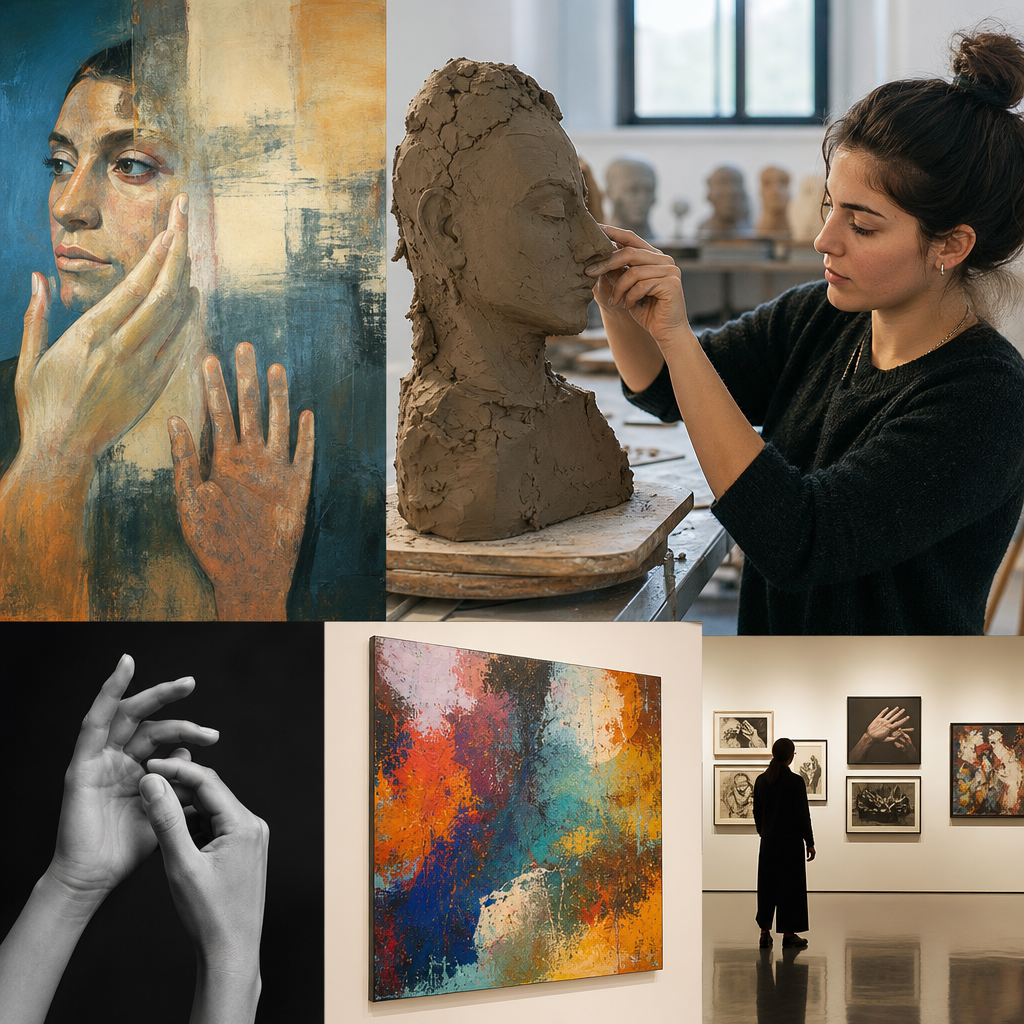
Deaf visual art extends beyond signed performance into painting, sculpture, photography, printmaking, installation, and digital media. Here again, the cultural dimension is central. Artists often address language deprivation, oralist education, cochlear implant debates, community belonging, or the tension between medical and cultural models of deafness. The De’VIA movement, short for Deaf View/Image Art, is especially important. Coined in 1989 by artists including Betty G. Miller, Paul Johnston, and Chuck Baird, De’VIA names artwork that intentionally represents Deaf experience and perspective. It is not simply art made by a Deaf person; it is art informed by Deaf consciousness.
Common De’VIA motifs include hands, eyes, mouths, barriers, hearing aids, and classroom imagery. These symbols are not random. A bound hand can signify language suppression. Oversized eyes may reflect visual vigilance and insight. Distorted mouths can critique speech-centered expectations imposed on Deaf children. Chuck Baird’s bold, accessible imagery made these themes visible to wide audiences, while Betty G. Miller’s work confronted exclusion with sharper political force. In exhibitions, I have noticed that hearing viewers sometimes read these images only as personal struggle. That interpretation is incomplete. Much of Deaf visual art is collective critique, documenting policies and attitudes that shaped entire generations.
Representation remains contested. Some artists foreground pride and community joy; others emphasize trauma, marginalization, or hybrid identity. Neither approach is more authentic by default. The strongest work usually holds complexity. A photograph series about cochlear implant users, for instance, may acknowledge both expanded access to sound and the pressure to assimilate into hearing norms. A film about sign language may celebrate beauty while also exposing educational inequity. Serious criticism must leave room for contradiction because Deaf lives are not uniform across race, class, nationality, gender, or additional disabilities.
Technology, media, and the future of Deaf expression
Technology has transformed Deaf expression, especially through video. Before affordable recording and online distribution, many signed performances lived mainly in memory, community events, or limited archives. Video made preservation possible at scale because sign language is best documented in motion, not only through glosses or transcription systems. Today, platforms such as YouTube, Instagram, TikTok, and Vimeo allow Deaf creators to publish sketches, poetry, commentary, tutorials, and short films directly to global audiences. This has broadened visibility and accelerated exchange among sign language communities.
The benefits are significant, but so are the tradeoffs. Short-form algorithms reward speed, novelty, and broad legibility, which can flatten culturally dense material. Captions improve access for many viewers, yet translation choices may strip out linguistic artistry. Camera framing matters enormously: crop the torso too tightly and classifiers disappear; cut too fast and visual rhythm collapses. Good Deaf media production therefore requires more than adding captions. It requires visual literacy in editing, composition, lighting, and pacing. Organizations that produce sign-centered content successfully understand this, whether in documentary film, educational platforms, or bilingual theater marketing.
Technology also raises questions about ownership, attribution, and training data. Signed performances circulate easily, and creators do not always receive credit when clips are reposted, translated, or adapted. At the same time, institutions increasingly use automated signing avatars for public information. These tools can be useful in limited contexts, but they are not substitutes for native signers, interpreters, or Deaf artists. Avatars often fail at natural prosody, facial grammar, and cultural nuance. If the future of Deaf expression is to remain culturally grounded, technology must support human creators rather than replace them.
The practical takeaway for readers exploring Deaf culture and identity is simple. Start with Deaf-made work. Learn how visual language operates. Notice how community history shapes genre, humor, and symbolism. Follow Deaf theaters, artists, filmmakers, poets, and archives. When you do, art, storytelling, and expression stop looking like side topics and become what they truly are: one of the clearest entry points into Deaf culture itself.
Across storytelling, theater, poetry, visual art, and digital media, the same principle holds: Deaf expression is visual because signed languages and Deaf social life are organized through sight, movement, and shared attention. It is cultural because those forms carry collective memory, values, humor, conflict, and pride. This is why Deaf art cannot be understood as spoken culture with gestures added on top. Its structures are different, its aesthetics are different, and its authority comes from communities that have developed these traditions over generations.
For a hub page on art, storytelling, and expression, the key themes are clear. Signed storytelling uses space, classifiers, and role shift to create vivid narrative worlds. Deaf poetry and theater turn linguistic features into performance craft. De’VIA and related visual art movements make identity and politics visible. Digital media expands reach while introducing new risks around simplification and control. Together, these forms show that Deaf culture is not defined by absence of sound but by the presence of language, creativity, and social knowledge rooted in visual experience.
If you want to understand Deaf culture and identity more deeply, spend time with Deaf-created performances and artworks, not just summaries of them. Watch a signed poem, study a De’VIA piece, attend a Deaf theater production, and follow Deaf filmmakers and storytellers. The more directly you engage with these forms, the more clearly you will see that Deaf expression is not peripheral to culture. It is one of its strongest, richest, and most enduring foundations.
Frequently Asked Questions
Why is Deaf expression considered deeply visual rather than primarily sound-based?
Deaf expression is considered deeply visual because it is shaped through seeing, spatial awareness, movement, facial expression, and shared visual attention rather than through sound alone. In Deaf communities, meaning is often organized through sign languages, which use handshape, location, motion, body posture, rhythm, and facial grammar to communicate ideas with precision and nuance. This creates forms of expression that are not simply “spoken language translated into gestures,” but complete linguistic and artistic systems with their own structures, aesthetics, and emotional force. Visual experience also influences how stories are told, how humor is timed, how emphasis is created, and how memory is shared. As a result, Deaf expression often feels vivid, embodied, and spatial because it grows out of a way of communicating that naturally prioritizes what can be seen, felt, and collectively witnessed.
How does Deaf culture influence the way art, storytelling, and performance are created?
Deaf culture influences expression by providing a shared framework of values, experiences, history, and communication practices that shape both content and form. Deaf artists and storytellers often draw from community life, language access, identity, resilience, misunderstanding from the hearing world, intergenerational knowledge, and pride in belonging. This means Deaf storytelling is not only about topic, but also about perspective: who is telling the story, how the audience receives it, and what cultural references are understood without explanation. In signed storytelling, for example, performers may shift roles visually, map scenes in space, and use facial expression as part of the grammar itself. In theater, poetry, film, dance, and humor, Deaf creators frequently build work around visual timing, body-centered expression, and the dynamics of attention, silence, visibility, and connection. Community memory matters as well. Shared experiences across schools, families, advocacy, language transmission, and social spaces give Deaf expression a cultural depth that goes far beyond aesthetics. It is not just visual because Deaf people use their eyes; it is cultural because those visual forms carry collective meaning.
Why does Deaf art often look different from hearing art traditions?
Deaf art often looks different because it reflects a distinct way of perceiving, organizing, and communicating meaning. Rather than centering sound, voice, or purely text-based conventions, many Deaf artistic traditions center movement, spatial structure, visual metaphor, signed language, embodiment, and audience sightlines. A Deaf poet may create patterns through repeated motion and facial intensity instead of rhyme and spoken meter. A Deaf filmmaker may frame scenes to preserve signed communication and visual tension rather than relying heavily on off-screen dialogue. A Deaf actor may use stillness, gaze, and physical transitions in ways that carry linguistic and emotional information at the same time. Even humor can function differently, often drawing on visual misunderstanding, language play in sign, or experiences specific to Deaf life. What makes Deaf art distinct is not simply that Deaf people made it, but that the work often emerges from Deaf ways of knowing and communicating. That is why it can feel immediately different in pacing, composition, symbolism, and emotional delivery.
Is Deaf expression only about sign language, or does it include other creative forms too?
Deaf expression absolutely includes sign language, but it is not limited to it. Sign languages are central because they are rich cultural and linguistic foundations in many Deaf communities, yet Deaf expression extends across a wide range of creative forms. These include signed storytelling, stage performance, visual vernacular, poetry, film, painting, sculpture, digital media, dance, comedy, community ritual, and everyday conversation. Even in forms that do not use explicit signing throughout, Deaf ways of seeing and structuring meaning often remain present. A visual artist may explore themes of identity, communication, isolation, access, or pride through imagery rooted in Deaf experience. A filmmaker may prioritize visual clarity, body language, and the emotional power of silence. A dancer may explore vibration, rhythm through movement, and ensemble coordination through sight rather than sound cues alone. In this sense, Deaf expression is best understood as a broad cultural ecosystem. Sign language is a major foundation, but the larger expressive world includes many art forms shaped by Deaf experience, visual intelligence, and community connection.
Why is it important to understand Deaf expression as both cultural and linguistic?
It is important to understand Deaf expression as both cultural and linguistic because reducing it to either category alone misses what gives it its full meaning. If people see Deaf expression only as a language issue, they may recognize sign language but overlook the traditions, humor, values, aesthetics, and shared history that give that language life in community. If they see it only as culture, they may fail to appreciate that sign languages are complete languages with grammar, nuance, and creative potential equal to any spoken language. The two are deeply connected. Language carries culture, and culture shapes how language is used artistically, socially, and emotionally. Recognizing this connection helps explain why Deaf poetry, theater, storytelling, and everyday conversation can be so distinct and powerful. It also encourages greater respect for Deaf people not as individuals defined by lack of hearing, but as members of communities with their own expressive traditions, intellectual heritage, and artistic standards. Understanding Deaf expression in this fuller way leads to better interpretation, better inclusion, and a more accurate view of Deaf life as rich, creative, and culturally grounded.