Deaf culture is a rich social, linguistic, and historical community shaped by shared language, values, traditions, and lived experience rather than by hearing level alone. When people ask, “What is Deaf culture?” they are asking about far more than audiology. They are asking how Deaf people build community, communicate, pass down knowledge, celebrate identity, and navigate a world designed mainly for hearing people. Understanding the key characteristics of Deaf culture matters because it changes the conversation from disability alone to belonging, heritage, and human diversity.
In practice, I have found that many hearing readers first encounter Deaf culture through sign language classes, school inclusion discussions, workplace accessibility, or friendships with Deaf colleagues. A common misunderstanding is assuming that all deaf people share the same identity or use the same communication style. That is inaccurate. Some people identify as culturally Deaf, some as hard of hearing, some as deafblind, and some move between communities depending on language, family background, education, and technology use. The capitalized word “Deaf” usually refers to a cultural identity, while lowercase “deaf” often refers to the audiological condition of hearing loss. That distinction is foundational because it signals whether the focus is on ears or on culture.
Like any culture, Deaf culture includes norms, institutions, humor, art, etiquette, social expectations, and collective memory. It is sustained through sign languages such as American Sign Language, British Sign Language, and many others worldwide, each with its own grammar and history. It is reinforced through Deaf schools, community organizations, sports events, theater, advocacy movements, and everyday interaction. This hub article explains the defining traits of Deaf culture in plain terms so readers can understand how language, identity, community, values, and accessibility connect. The goal is not to flatten differences, but to provide a reliable foundation for deeper learning about Deaf culture and identity.
Language as the core of Deaf culture
The clearest characteristic of Deaf culture is the central role of sign language. Sign languages are full natural languages, not simplified versions of spoken language and not universal systems. American Sign Language, for example, has its own syntax, morphology, spatial grammar, and discourse conventions. A signer can establish subjects in space, shift perspective with body position, and layer facial expression to mark questions, emphasis, or conditional meaning. That linguistic richness is one reason language is at the center of Deaf identity. It is not merely a communication tool; it is the medium through which stories, values, humor, and social bonds are created.
Language access also shapes life outcomes. Deaf children who receive early exposure to a fully accessible language generally have stronger foundations for cognitive development, literacy, and social connection than children whose language access is delayed. Researchers and educators have long emphasized that language deprivation, not deafness itself, creates many avoidable barriers. In real settings, I have seen the difference clearly: when meetings, classrooms, and family conversations are genuinely accessible, Deaf people participate fully and lead confidently. When access is partial, people are expected to work harder just to keep up. That gap affects education, employment, health care, and family relationships.
Because language carries culture, many Deaf communities work actively to preserve and teach sign language across generations. Storytelling, poetry, performance, and everyday conversation all transmit cultural knowledge. In the United States, institutions such as Gallaudet University and the National Association of the Deaf have played major roles in protecting language rights and promoting public understanding. Similar institutions exist in other countries. For anyone asking what Deaf culture is, the most direct answer is this: it is a language-centered community built around visual communication and shared social experience.
Community, belonging, and shared identity
Another defining feature of Deaf culture is the importance of community. Many Deaf people grow up in hearing families, which means they may not inherit cultural knowledge at home in the same way children often inherit language and tradition in other communities. As a result, schools for the Deaf, local Deaf clubs, advocacy groups, sports leagues, religious gatherings, and online spaces often become key places where identity takes shape. These settings provide more than friendship. They offer belonging, role models, information exchange, and the feeling of being in an environment where communication is effortless rather than negotiated.
Shared identity does not mean uniform identity. Deaf culture includes people from every racial, ethnic, religious, and national background. It also includes variation in signing fluency, educational history, cochlear implant use, and family language choices. Some Deaf people come from multigenerational Deaf families and are deeply immersed in community norms from childhood. Others discover Deaf culture later, perhaps after years in oral education or mainstream schools. Both journeys are real. What often connects them is recognition of common experiences: missing information in hearing spaces, valuing visual access, and finding relief in environments where no one apologizes for signing.
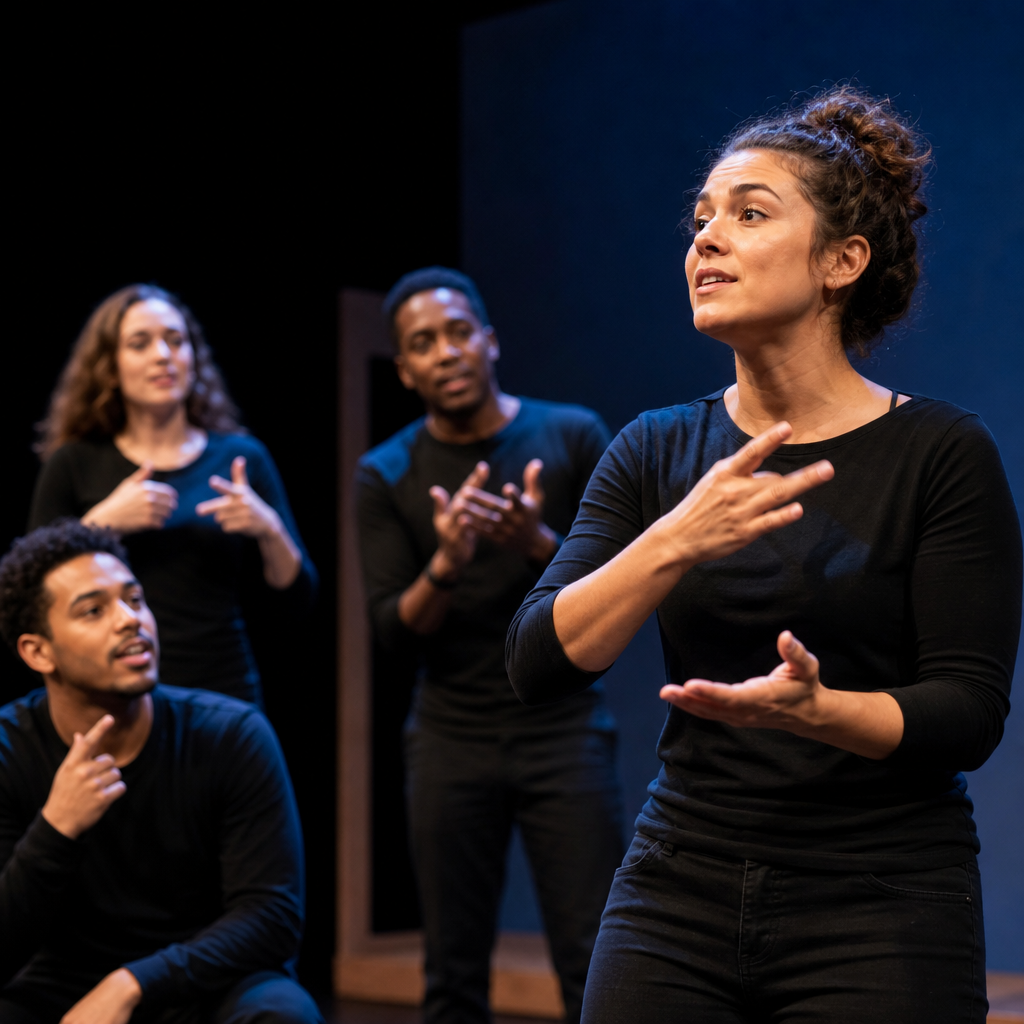
Community belonging is often strengthened through events and institutions that make Deaf life visible. Deaf theater companies, Deaf film festivals, regional conferences, and Deaflympics-style competitions create spaces where talent and leadership are centered. These gatherings also sustain social networks that help people find interpreters, jobs, mentors, and advocacy resources. In that sense, Deaf culture is not abstract. It is lived through recurring relationships, trusted institutions, and a shared commitment to making visual communication the norm rather than the exception.
Visual communication and social norms
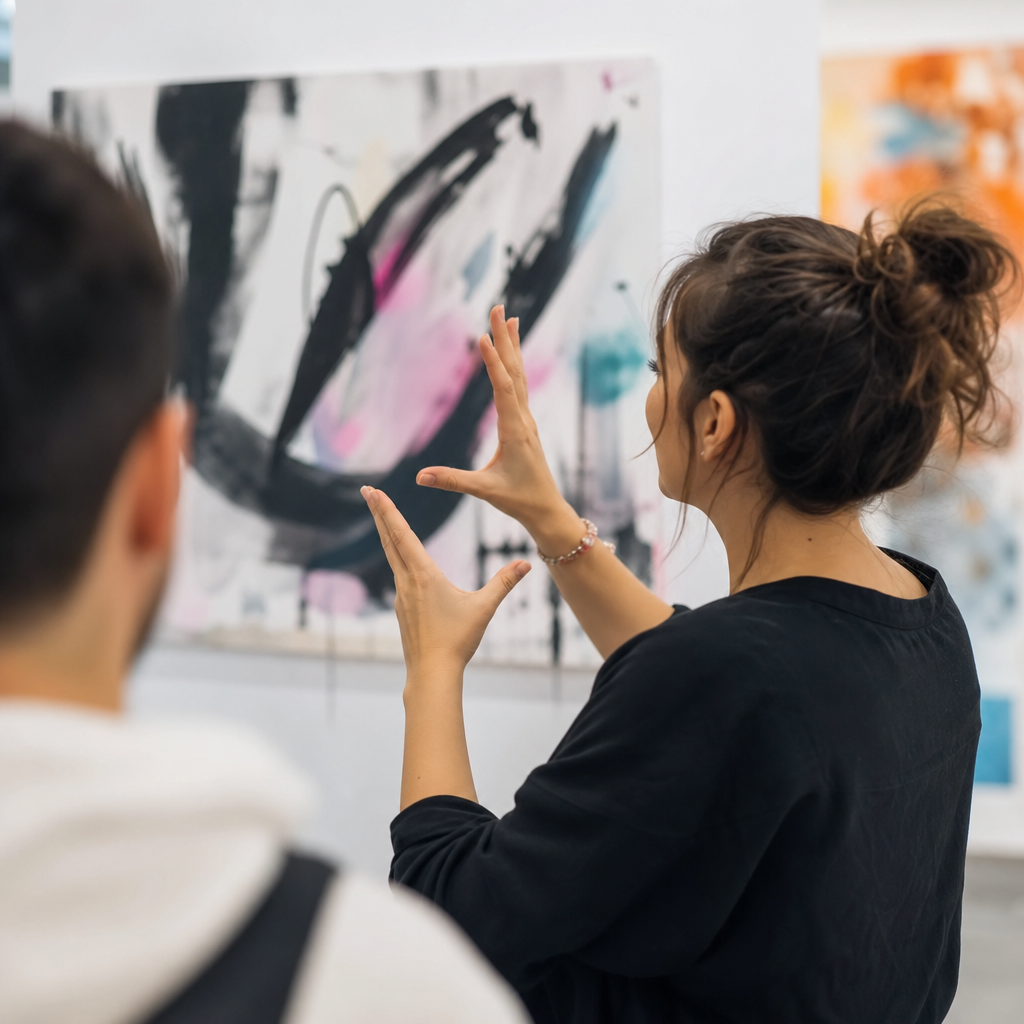
Deaf culture is fundamentally visual, and that shapes everyday etiquette. In Deaf spaces, gaining attention may involve waving, tapping a shoulder, or flicking lights, rather than calling someone’s name. Good lighting, clear sight lines, circular seating, and unobstructed faces matter because communication depends on seeing one another. Eye contact is not a minor courtesy; it is part of active participation. Looking away while someone signs can be equivalent to turning your back on spoken conversation. These norms are practical, but they also express respect.
Visual orientation influences conversational style as well. Signed conversations can be direct and information-rich because context must be made visible. Details that hearing people may leave implicit are often clarified spatially or through explicit description. Turn-taking is managed through gaze, hand position, and body cues. Group conversations require coordination so everyone can see who is signing. In professional settings, this has concrete accessibility implications. Meetings work better when one person signs at a time, interpreters are placed where everyone can see them, captions are accurate, and background movement is minimized.
These norms can surprise hearing newcomers, especially those unfamiliar with expressive signing, close attention to facial grammar, or frank discussion of access needs. Yet once understood, they are logical. A visual culture develops practices that protect shared attention and reduce communication friction. That is why accessible design is not a bonus feature in Deaf culture; it is part of social organization. Whether in a classroom, workplace, home, or public event, environments that support visual communication usually support fuller participation.
Values, pride, and perspectives on deafness
One of the most important characteristics of Deaf culture is a perspective that views deafness primarily as a human difference, not simply a medical problem to be fixed. This does not mean Deaf people reject medicine, hearing technology, or individual choices. It means identity is not defined by deficit. Cultural pride grows from language, history, resilience, and contribution. Many Deaf adults describe the turning point in their lives not as hearing more, but as finding other Deaf people, learning sign language deeply, and realizing they belonged to a community with its own standards of success.
That perspective often contrasts with a strictly medical model, which focuses on diagnosis, intervention, and normalization. Medical care can be valuable, especially for hearing health, assistive technology, and informed family support. The tension appears when professionals treat spoken language as the only desirable outcome or imply that a Deaf life is inherently lesser. In my experience, families make better decisions when they hear both sides clearly: technology may help some individuals access sound, but it does not replace culture, effortless visual language, or the need for accessible environments.
| Concept | Within Deaf culture | Common outside assumption |
|---|---|---|
| Deafness | A cultural and linguistic identity for many people | Only a medical condition |
| Sign language | A complete natural language and community bond | A backup system or last resort |
| Accessibility | A basic requirement for equal participation | An optional accommodation |
| Success | Defined by communication access, agency, and belonging | Defined by sounding or hearing more like hearing people |
Deaf pride is therefore not denial. It is a refusal to reduce a whole person to hearing status. This value shapes advocacy, parenting discussions, educational philosophy, and public representation. It also helps explain why identity-first language may be preferred by many Deaf people: the term reflects membership in a respected community, not an apology for difference.
History, institutions, and collective memory
Deaf culture has a distinct history, and that history informs present-day identity. Major turning points include the rise of Deaf education, the suppression of sign language in oralist periods, the founding of Deaf organizations, and civil rights campaigns for access. In the United States, the 1880 Milan Conference is widely remembered because educators there endorsed oralism and marginalized sign language in many schools. The long-term effect was profound: generations of Deaf children were denied direct language access in the classroom, even though Deaf communities continued signing outside official policy.
Collective memory also includes moments of resistance and pride. The 1988 Deaf President Now movement at Gallaudet University remains one of the most cited examples. Students demanded a Deaf president for the world’s leading Deaf university, and their victory became a landmark in disability rights and cultural self-determination. That event still matters because it demonstrated that Deaf people were not passive recipients of policy; they were leaders defining their own institutions. Similar struggles over interpreter access, captioning, educational placement, and language recognition continue internationally.
Institutions preserve this memory and turn it into continuity. Deaf schools, archives, museums, advocacy groups, and media platforms all help maintain cultural knowledge. They document leaders, record stories, and teach younger generations where current rights came from. Without that history, accessibility can look like a recent convenience instead of a hard-won civil right. Understanding Deaf culture therefore requires understanding both joy and struggle: art, friendship, and humor on one hand, and exclusion, language suppression, and activism on the other.
Arts, storytelling, humor, and cultural expression
Every durable culture expresses itself through art, and Deaf culture is no exception. Signed storytelling, visual vernacular performance, Deaf theater, poetry, comedy, film, and digital media all reflect the aesthetics of a visual language community. In signed poetry, rhythm may be created through movement pattern, handshape repetition, facial intensity, and spatial symmetry rather than sound. In Deaf theater, staging often uses sight lines, ensemble movement, and bilingual techniques to communicate to mixed audiences. These forms are not side notes to culture; they are among its clearest expressions.
Humor is especially revealing. Deaf jokes often center on visual misunderstandings, interpreter mishaps, hearing people’s assumptions, or the everyday creativity required to navigate inaccessible settings. The humor works because it is rooted in shared experience. I have seen how a room shifts when Deaf storytellers perform for a Deaf audience: the timing, facial grammar, and collective recognition produce a kind of immediacy that written summaries cannot capture. That is one reason recorded sign language content and in-person gatherings remain so important even in the age of text-based media.
Cultural expression also serves an educational function. Stories teach norms, preserve historical memory, and model resilience. A narrative about a child discovering sign language can communicate identity development more powerfully than a clinical explanation. A comedy sketch about poor captioning can expose systemic problems in minutes. For readers trying to understand what Deaf culture is, art provides one of the strongest answers: it shows how a community transforms shared language and experience into meaning, memory, and joy.
Accessibility, education, and life in a hearing world
Deaf culture develops within a hearing-majority society, so accessibility is always part of the picture. Equal participation depends on interpreters, captioning, alert systems, visual signage, accessible customer service, and language-rich education. Laws such as the Americans with Disabilities Act have improved access in many settings, yet legal compliance does not always produce genuine inclusion. A workplace may provide an interpreter for a formal meeting but still exclude a Deaf employee from hallway conversations, fast-moving calls, or social events where decisions are informally made.
Education is one of the most consequential areas. Families often face competing advice about sign language, speech training, mainstream placement, Deaf schools, hearing aids, and cochlear implants. The most reliable principle is straightforward: children need full language access early and consistently. Bilingual approaches that include sign language can support development even when families also pursue spoken language or technology. By contrast, waiting to see whether speech alone will be enough can cost valuable developmental time. Deaf culture has emphasized this point for decades because the stakes are educational, emotional, and social, not merely linguistic.
For hearing people who want to engage respectfully, the essentials are practical. Learn the local sign language if possible. Ask for communication preferences. Face the person, ensure lighting is good, and do not treat one Deaf person as spokesperson for everyone. Support captioning and interpreting as routine standards. Most important, understand that Deaf culture is not defined by lack. It is defined by language, community, values, history, and creativity. The more clearly institutions recognize that fact, the more fully Deaf people can participate on equal terms.
Deaf culture is best understood as a language-based community with its own social norms, history, institutions, values, and forms of expression. Its key characteristics include the central role of sign language, the importance of community belonging, a visual approach to communication, pride in identity, collective memory shaped by activism, and a constant focus on meaningful access. These characteristics explain why “What is Deaf culture?” cannot be answered by discussing hearing loss alone. The subject is culture in the fullest sense: how people live, relate, create, remember, and define themselves.
For readers exploring Deaf culture and identity, the main benefit of understanding these characteristics is perspective. You begin to see why access is a civil right, why language exposure in childhood matters so much, why representation by Deaf leaders matters, and why many Deaf people reject deficit-based assumptions. You also become better equipped to build respectful relationships at school, at work, in health care, and in public life. Misunderstandings decrease when Deaf culture is recognized on its own terms rather than filtered entirely through hearing expectations.
If you want to go deeper, keep learning through Deaf-created sources, local community events, sign language study, and topic-specific guides on Deaf identity, education, accessibility, and history. Start with one practical step today: make your next interaction, classroom, meeting, or piece of content more visually and linguistically accessible.
Frequently Asked Questions
1. What is Deaf culture, and how is it different from simply having hearing loss?
Deaf culture is a shared social, linguistic, and historical way of life built around the experiences of Deaf people, not just a medical description of hearing level. This distinction is important. A person can be medically deaf or hard of hearing without identifying with Deaf culture, while another person may strongly identify with the Deaf community because of shared language, values, traditions, and relationships. In other words, Deaf culture is about belonging, identity, and participation in a community that has developed its own norms over generations.
One of the clearest differences is that Deaf culture does not define deafness as something that automatically needs to be fixed. Instead, many Deaf people view themselves as members of a cultural and linguistic minority. That perspective shifts the conversation away from limitation and toward community, pride, and access. Sign language, visual communication, storytelling, social networks, and shared lived experience all play central roles. So when people ask what Deaf culture is, they are really asking about a complete cultural framework that shapes how people communicate, connect, celebrate identity, and move through a hearing-centered world.
2. Why is sign language considered such a central characteristic of Deaf culture?
Sign language is central to Deaf culture because it is far more than a communication tool; it is the heart of cultural expression, social connection, and identity. In many Deaf communities, a national sign language such as American Sign Language (ASL), British Sign Language (BSL), or another signed language serves as a primary shared language. These languages have their own grammar, syntax, rhythm, and storytelling traditions. They are complete natural languages, not simplified versions of spoken language.
Because Deaf culture is strongly visual, sign language supports a communication style that reflects how many Deaf people experience the world. Facial expressions, body movement, eye contact, and spatial use all carry meaning. This creates a rich, direct, and highly expressive form of communication that shapes community norms and daily interactions. Sign language also helps transmit values, humor, history, and cultural knowledge from one generation to another. Community events, performances, storytelling, and even casual conversations often rely on this visual-linguistic foundation.
Just as importantly, sign language often plays a major role in cultural pride. For many Deaf people, access to sign language is tied to access to education, family communication, self-expression, and belonging. When sign language is respected, Deaf people are better able to participate fully and authentically. That is why language is not just one characteristic of Deaf culture; it is one of its strongest defining features.
3. What values and social norms are commonly associated with Deaf culture?
Deaf culture is often associated with values that emphasize visual access, direct communication, mutual support, and strong community ties. Since many Deaf people navigate environments built mainly for hearing people, accessibility is not treated as an extra convenience but as a basic necessity. This shapes many social norms. Good lighting, clear sightlines, visible attention-getting methods, and communication that includes everyone in the room are often considered standard and respectful.
Directness is another commonly noted feature. In Deaf culture, straightforward communication is often appreciated because it reduces confusion and ensures clarity. What may seem blunt in some hearing contexts can actually be seen as practical and considerate in Deaf spaces. Eye contact is also especially important, since visual attention is essential for successful signed communication. Looking away during a conversation may be interpreted as disengagement in a way that differs from hearing norms.
Community interdependence is also a key value. Many Deaf people rely on shared networks for information, advocacy, and social connection, especially in systems that may not always provide full access. As a result, Deaf culture often places importance on inclusion, information sharing, mentorship, and collective resilience. Cultural traditions such as storytelling, social gatherings, Deaf clubs, performances, and community events help reinforce these values. While not every Deaf person has the same experiences or preferences, these norms are widely recognized as important characteristics of Deaf cultural life.
4. How do history and shared lived experience shape Deaf identity and community?
History plays a major role in Deaf culture because the community has been shaped by generations of collective experience, including both achievement and exclusion. Deaf schools, community organizations, sign language traditions, and advocacy movements have all contributed to a strong sense of cultural continuity. In many places, Deaf communities formed around schools and social institutions where Deaf people could communicate freely, build friendships, develop leadership, and pass down cultural knowledge. These spaces helped preserve language and identity across generations.
At the same time, Deaf history also includes barriers such as language suppression, limited educational access, stigma, and pressure to conform to hearing norms. Those experiences have influenced how many Deaf people think about autonomy, rights, and the importance of access. Shared struggles often strengthen community bonds because they create a common understanding of what it means to live in a world where communication is frequently taken for granted by others.
This shared lived experience helps explain why Deaf identity can be deeply meaningful. It is not only about whether a person can hear; it is about recognizing a connection to a broader cultural story. Many Deaf people grow up learning about important community milestones, role models, and advocacy efforts that helped protect sign language and expand civil rights. That historical awareness reinforces pride, belonging, and a sense of responsibility to support future generations.
5. Why is it important for hearing people to understand the key characteristics of Deaf culture?
Understanding Deaf culture helps hearing people move beyond stereotypes and interact with greater respect, awareness, and effectiveness. Too often, deafness is viewed only through a medical lens, which can lead people to focus on what Deaf individuals supposedly lack rather than on the culture, language, and strengths they bring. Learning the key characteristics of Deaf culture encourages a more accurate and human understanding. It reminds hearing people that Deaf people are not simply navigating silence; they are often participating in a vibrant community with its own values, traditions, and ways of communicating.
This understanding also improves everyday communication and inclusion. When hearing people recognize the importance of visual access, sign language, eye contact, and accessible environments, they are better able to create respectful interactions at work, in school, in healthcare settings, and in social life. That may mean using qualified interpreters, ensuring captions are available, facing the person while speaking, or learning basic signed communication when appropriate. These actions are not just polite; they help remove barriers that otherwise exclude Deaf people from full participation.
On a broader level, understanding Deaf culture supports equity. It helps hearing people see why accessibility, representation, and language rights matter. It can also challenge assumptions that hearing ways of communicating are automatically the norm everyone should adapt to. The more people understand Deaf culture as a legitimate and valuable cultural identity, the easier it becomes to build communities that are more inclusive, informed, and respectful for everyone.