
Deaf culture is a living social tradition built around a shared language, common experiences, and values shaped by visual communication rather than hearing. When people ask, “What is Deaf culture?” they are not simply asking about hearing loss. They are asking about identity, community, history, norms, art, education, and the ways Deaf people organize life in a world designed mainly for hearing people. In my work with Deaf educators, interpreters, and community advocates, the clearest starting point has always been this: Deaf culture is not defined by an audiogram. It is defined by people who share a visual way of being in the world.
The term Deaf culture usually refers to the customs, beliefs, language practices, institutions, and social expectations that have developed within Deaf communities, especially those centered on signed languages such as American Sign Language, British Sign Language, Langue des Signes Française, and many others. The capitalized word Deaf often signals cultural identity, while lowercase deaf may describe the audiological condition of not hearing fully. That distinction matters because many culturally Deaf people do not see themselves as broken or incomplete. They see deafness as a human difference with its own strengths, history, and meaning.
This topic matters because misunderstandings about Deaf culture remain widespread. Hearing people often frame deafness only through a medical lens, focusing on impairment, treatment, and technology. Those issues can be relevant, but they are not the whole story. A cultural perspective explains why signed languages are complete natural languages, why Deaf schools have been central to identity formation, why access is a civil right rather than a courtesy, and why community values influence everything from introductions to storytelling to political advocacy. For anyone exploring Deaf culture and identity, understanding its core values creates a stronger foundation for respectful communication, better inclusion, and more accurate education.
Language as the center of Deaf culture
The core of Deaf culture is language. Signed languages are not simplified versions of spoken languages, and they are not universal. They have their own grammar, syntax, regional variation, idioms, and literary traditions. American Sign Language, for example, is historically related to French Sign Language and is structurally distinct from English. That linguistic reality is one of the most important facts to understand, because language is how culture is transmitted. In Deaf communities, sign language carries humor, storytelling styles, social expectations, and collective memory.
Direct communication is valued deeply. In hearing spaces, Deaf people are often expected to adapt through lipreading, speech, note writing, captioning, or interpreters. Within Deaf spaces, signed communication removes that constant burden and allows for full participation. I have repeatedly seen how quickly a room changes when communication becomes visually accessible: conversation becomes richer, turn-taking becomes more dynamic, and people contribute with less hesitation. That is why protecting sign language access in schools, workplaces, healthcare, and public services is not symbolic. It is essential to equal participation.
Language values also shape social norms. Clear sightlines matter. Good lighting matters. Tapping a shoulder, waving, or flicking lights to get attention are normal practices, not rude interruptions. Eye contact signals engagement. Leaving abruptly without saying goodbye to everyone can be viewed differently in Deaf spaces because social connection is highly visible and interactive. These norms may seem small, but together they reflect a culture organized around visual presence and mutual accessibility.
Community, belonging, and shared experience
Deaf culture is sustained through community. For many Deaf people, especially those born into hearing families, discovering the Deaf community can be transformative. It often provides the first environment where communication is effortless, identity is affirmed, and lived experiences are understood without long explanation. That sense of belonging is why community institutions matter so much. Deaf schools, clubs, athletic associations, churches, theater groups, social media networks, and advocacy organizations have long served as gathering places where culture is passed from one generation to the next.
Shared experience is a powerful bond. Many Deaf adults can describe similar moments: being excluded from family conversations at the dinner table, being underestimated in school, or feeling exhausted from navigating inaccessible systems. They can also describe the opposite: the relief of entering a Deaf event where everyone signs, jokes land instantly, and no one has to ask for access. Those repeated experiences create collective understanding. They help explain why Deaf culture often emphasizes mutual support, mentorship, and pride in community survival.
Belonging in Deaf culture is not always simple or uniform. People enter the community through different paths. Some are born to Deaf parents and grow up signing from infancy. Some find Deaf identity later in life after mainstream schooling, cochlear implantation, or years of oral-only education. Some are hard of hearing, late-deafened, DeafBlind, or multilingual signers. The community includes variety, and there can be debates about identity, language use, and access choices. Even so, the overarching value is connection through shared visual communication and respect for Deaf ways of living.
Core values that shape Deaf cultural identity
Several values appear consistently across Deaf communities, even though practices differ by country and generation. These values are visible in education, social interaction, political advocacy, and everyday etiquette. Understanding them helps answer not just what Deaf culture is, but how it works in practice.
| Core value | What it means in practice | Everyday example |
|---|---|---|
| Sign language access | Full communication in a natural signed language is prioritized over forced adaptation to speech | A Deaf meeting is organized with clear sightlines and no expectation that participants rely on lipreading |
| Collective belonging | Community ties are treated as essential sources of support, information, and identity | Young Deaf adults seek mentors through Deaf schools, sports leagues, or local associations |
| Visual orientation | Spaces, etiquette, and storytelling are designed around what can be seen clearly | People circle seating arrangements so everyone can watch the conversation |
| Directness | Information is often shared clearly and openly, without the indirect style common in some hearing settings | A person signs plainly that an interpreter setup is not working and needs to be fixed now |
| Reciprocity | Members help one another navigate institutions that often exclude them | Someone explains how to request workplace accommodations or file an access complaint |
| Pride and resilience | Deaf identity is valued as a culture, not treated only as a deficit | Artists and activists celebrate Deaf history during community events and festivals |
These values do not mean every Deaf person thinks the same way. Culture describes patterns, not rigid rules. Still, these themes recur across research, community testimony, and direct observation. They are why many Deaf people resist narratives that define success solely as becoming as hearing-like as possible. Success, from a cultural viewpoint, means having language, access, self-determination, and community connection.
History, education, and the fight for recognition
Deaf culture cannot be separated from its history. In many countries, Deaf communities grew around residential schools where students met peers, learned signed language, and developed lasting social networks. These schools were often far from perfect, yet they became major centers of cultural transmission. Alumni associations, sports competitions, and local Deaf clubs often trace their roots to those educational settings.
At the same time, Deaf history includes prolonged attempts to suppress signed languages. The 1880 Milan Conference, dominated by hearing educators, endorsed oralism and helped legitimize policies that pushed speech and lipreading while marginalizing sign language in classrooms. The effects were long lasting. Many Deaf children were punished for signing or denied full language access during critical developmental years. Modern linguistic research, especially William Stokoe’s work on American Sign Language in the 1960s, helped challenge those assumptions by demonstrating that signed languages are fully structured languages.
Education remains a defining issue because language deprivation has serious consequences. Children need accessible language early, whether through sign, speech, or both, but accessible signed input is the most reliable route for many Deaf children. Public health and education experts increasingly recognize that delayed language exposure affects literacy, cognitive development, and social-emotional growth. Bilingual-bicultural models, which teach signed and written languages together while affirming Deaf identity, have shown strong promise. The central lesson is straightforward: when Deaf children have rich language access and high expectations, they thrive.
Art, storytelling, and social norms in Deaf life
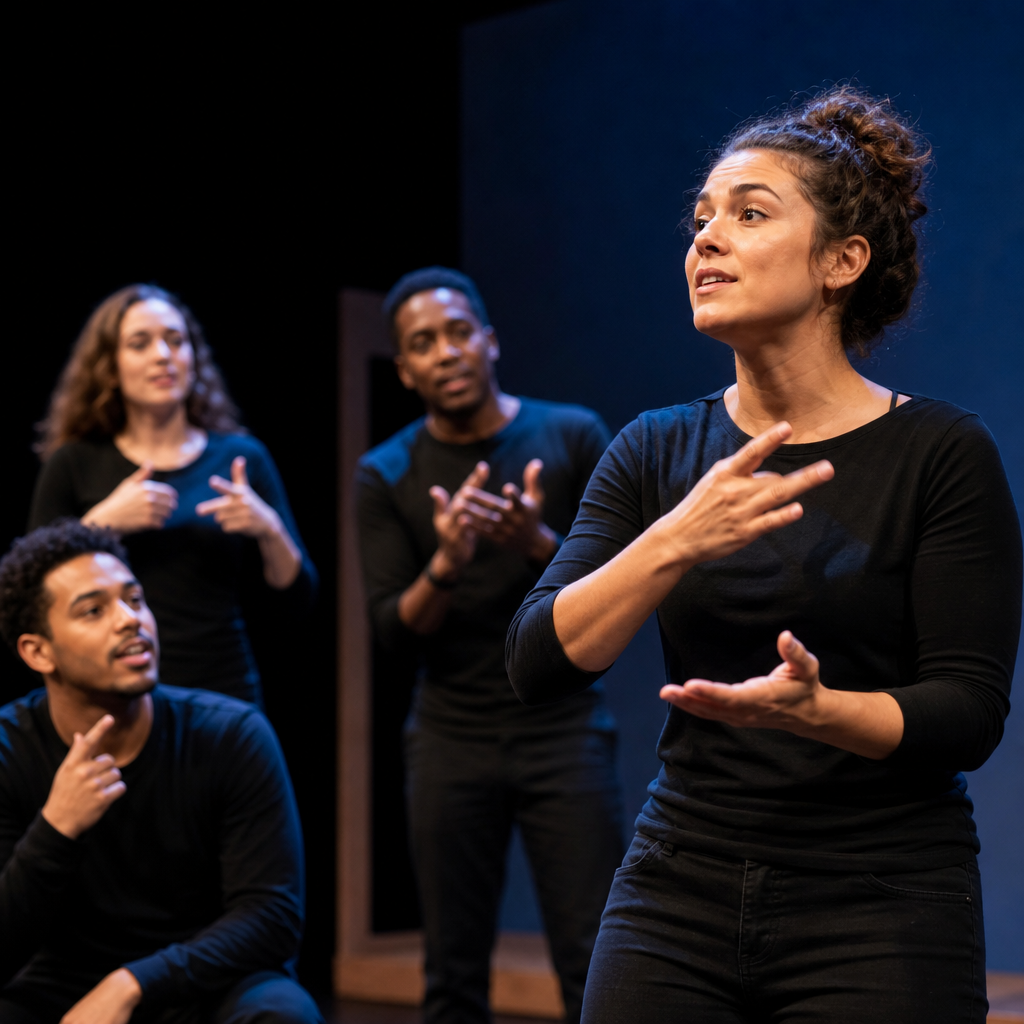
Deaf culture expresses itself vividly through art and performance. Storytelling in signed languages uses space, movement, timing, facial expression, and role shifting in ways that cannot be fully translated into print. Deaf poetry, theater, film, and visual vernacular all demonstrate how artistic form grows from a visual language base. Performers such as Clayton Valli advanced ASL poetry, while Deaf theater companies created stages where Deaf narratives could be told by Deaf artists for Deaf and hearing audiences alike. These works do more than entertain. They preserve memory, critique oppression, and celebrate community intelligence.
Social norms also reveal cultural values. Introductions in Deaf settings can be longer and more relational than hearing people expect, often including where a person learned to sign, school affiliations, family connections, or community networks. This is practical as well as social; it helps establish shared context quickly in a dispersed community. Information-sharing may feel unusually direct to hearing newcomers, but directness supports clarity in environments where missing information has real costs. The same principle applies to accessibility. If the interpreter is blocked, the captioning is late, or the lighting is poor, people usually say so plainly because communication cannot wait.
Technology plays a role, but it does not replace culture. Video relay services, videophones, texting, captions, and social platforms have expanded connection across distance and reduced some barriers that older generations faced. Cochlear implants and hearing aids may help some individuals significantly, yet devices do not erase the need for cultural belonging or sign language access. One of the most common misconceptions I encounter is the idea that improved technology makes Deaf culture less relevant. In practice, many Deaf people use technology and remain deeply rooted in cultural values, language, and community life.
Why Deaf culture matters for inclusion today
Understanding Deaf culture leads to better decisions in schools, workplaces, healthcare, media, and public policy. Inclusion fails when institutions assume that a hearing-centered model is neutral. It is not. A classroom without signing access, a medical appointment without an interpreter, or a workplace meeting held in darkness during a slideshow all communicate the same message: participation is conditional. A culturally informed approach starts by recognizing that Deaf people do not need charity. They need accessible communication, informed planning, and respect for their language and identity.
This has practical implications. Employers should provide qualified interpreters, captioning, and visual communication protocols rather than relying on ad hoc fixes. Educators should understand that Deaf students are not a monolith and may need bilingual approaches, Deaf role models, and explicit access planning. Healthcare providers should follow legal and ethical standards for effective communication, because handwritten notes are often inadequate for complex medical discussions. Media organizations should treat captions, signing, and Deaf consultation as production basics, not optional extras. These choices improve outcomes because they align environments with how people actually communicate.
The deeper benefit is broader than compliance. Deaf culture expands common ideas about language, intelligence, and human connection. It shows that speech is not the only path to fluency, that visual communication can be sophisticated and expressive, and that communities built around difference can generate strong traditions of resilience and creativity. If you are exploring Deaf culture and identity, start with the values at its center: sign language, community, visual accessibility, direct communication, and pride. Then keep learning from Deaf people, Deaf-led organizations, and Deaf-created work. That is the most reliable way to understand what Deaf culture is and why it continues to matter.
Frequently Asked Questions
1. What are the core values that define Deaf culture?
Deaf culture is grounded in a set of shared values that go far beyond the medical fact of not hearing. At its center is the belief that Deaf people are part of a cultural and linguistic community, not simply individuals with a disability. One of the most important values is the central role of sign language, which is not treated as a substitute for speech but as a complete, expressive language that carries history, humor, identity, and community knowledge. Visual communication is another defining value. In Deaf culture, people often organize space, attention, and interaction in ways that prioritize sight, clarity, and shared visual access.
Community connection is equally important. Deaf culture places strong value on belonging, mutual support, and interdependence. Because many Deaf people grow up in hearing families, Deaf community spaces often become places where they find cultural affirmation, role models, and a sense of home. There is also a deep respect for shared history, including the struggle for language rights, access to education, and recognition of Deaf people as a minority culture. Pride, directness in communication, storytelling, visual art, and collective responsibility all play major roles as well. Together, these values shape how Deaf people build relationships, pass on traditions, and define themselves on their own terms.
2. Why is sign language considered so central to Deaf culture?
Sign language is central to Deaf culture because it is the primary way culture is expressed, preserved, and transmitted. In Deaf communities, sign language is more than a practical tool for communication. It carries shared meanings, social norms, humor, emotional nuance, and cultural memory. Just as spoken languages connect hearing communities to their histories and traditions, sign languages connect Deaf people to one another across generations. They are living languages with their own grammar, structure, and regional variation, and they serve as the foundation for identity and belonging.
Sign language also shapes the way Deaf culture understands the world. Because it is visual and spatial, it supports a communication style built around eye contact, body language, facial expression, and shared visual attention. This affects everything from conversation flow to social etiquette. In many Deaf spaces, the use of sign language creates immediate connection because it removes barriers and allows people to communicate naturally and fully. It also represents resilience. For generations, many Deaf people faced pressure to rely only on speech or lip-reading, often at the expense of full language access. The continued strength of sign language in Deaf communities reflects cultural pride, resistance to assimilation, and a commitment to preserving a distinct and vibrant way of life.
3. How does visual communication shape everyday life in Deaf culture?
Visual communication shapes everyday life in Deaf culture in practical, social, and deeply meaningful ways. Since communication depends heavily on sight, Deaf people often organize environments to make visual access easier and more inclusive. Seating arrangements may be chosen so everyone can see one another clearly. Lighting matters because facial expressions and hand movements must remain visible. Attention-getting strategies are often visual or tactile, such as waving, tapping a shoulder, or flicking a light briefly. These are not random habits; they are part of a communication system built to ensure full participation.
Visual norms also influence social behavior and etiquette. In Deaf culture, maintaining eye contact is usually essential because looking away can mean missing information. Facial expression carries grammatical and emotional meaning in sign language, so it is often more central than hearing people expect. Group conversations may be managed with clear turn-taking and visual awareness so that everyone can follow what is being said. Storytelling, humor, and performance are also strongly visual, often making use of movement, timing, expression, and space in highly creative ways. These patterns demonstrate that Deaf culture is not simply hearing culture without sound. It is a culture with its own communication logic, one that values visibility, presence, and shared access in every part of community life.
4. Is Deaf culture mainly about hearing loss, or is it about identity and community?
Deaf culture is primarily about identity and community, not just hearing loss. This distinction is one of the most important things for hearing audiences to understand. A medical perspective may define deafness in terms of what a person cannot hear, but a cultural perspective focuses on what Deaf people share: language, lived experience, traditions, values, and social networks. In that sense, Deaf culture is similar to other cultural communities that are defined by common history and belonging rather than by deficit. Many Deaf people view being Deaf as a source of pride and identity, not as a condition that needs to be fixed.
Community plays a major role in that identity. Deaf clubs, schools, events, performances, advocacy spaces, and online networks have long helped people connect, build friendships, and pass down cultural norms. These spaces are where many Deaf people learn not only language but also etiquette, humor, collective history, and the unspoken rules of community life. Deaf identity can be deeply personal and can vary from one person to another, especially depending on family background, language access, education, and use of technology. Even so, the broader culture emphasizes that Deaf people are part of a rich social tradition. Understanding Deaf culture means understanding that it is not defined by absence of sound alone, but by the presence of a strong, enduring, and self-defined community.
5. Why are history, education, and advocacy so important within Deaf culture?
History, education, and advocacy are essential within Deaf culture because they have directly shaped the survival and strength of the community. Deaf history includes both achievement and struggle. Deaf people have created schools, art forms, leadership networks, and institutions that helped preserve language and culture. At the same time, they have often faced exclusion, language suppression, and policies designed without Deaf voices at the center. Because of that history, many values in Deaf culture today are tied to protecting sign language, expanding access, and ensuring that Deaf children and adults have the right to fully participate in society.
Education holds special importance because language access in early life can shape identity, learning, confidence, and connection to community. Many Deaf advocates emphasize the importance of environments where Deaf children can acquire language fully and naturally, especially through sign language. Advocacy grows from this same concern for equity and self-determination. Whether the issue is interpreter access, captioning, employment opportunity, healthcare communication, or representation in leadership, advocacy in Deaf culture is about more than accommodation. It is about recognition, dignity, and the right to shape systems that affect Deaf lives. This is why history is remembered so carefully and why education and activism remain central. They are not side topics within Deaf culture; they are part of the culture’s foundation and its future.