
Choosing the right communication app can determine whether a deaf user gets a smooth, independent conversation or a frustrating exchange filled with missed context, lag, and inaccessible design. In this guide, I review the top communication apps for deaf users and explain which tools work best for captioned phone calls, live transcription, video conversations in sign language, messaging, and day-to-day accessibility. Communication apps, in this context, include relay platforms, speech-to-text tools, video meeting software, text-based messengers, and multipurpose accessibility apps that help bridge spoken, signed, and written communication. This topic matters because deaf and hard of hearing people do not all communicate the same way. Some prefer ASL or another signed language, some rely primarily on real-time captions, some use text only, and many switch methods depending on the situation. After testing and comparing these tools in practical scenarios, I have found that the best app is rarely the one with the most features. It is the one that matches the user’s communication style, the other person’s capabilities, the device being used, and the setting, whether that is work, school, healthcare, travel, or family life.
What makes a communication app genuinely useful for deaf users
A strong communication app for deaf users must do more than add captions to a screen. It should reduce friction before, during, and after the interaction. In practice, that means accurate speech recognition, low latency, readable text formatting, dependable notifications, and support for video when sign language is the primary mode. It also means cross-platform compatibility, because conversations often break down when one person is on iPhone, another is on Android, and a third joins from a desktop browser. Privacy matters as well. If an app handles sensitive conversations, especially in healthcare, education, or employment, users should understand whether transcripts are stored, whether calls are encrypted, and how data is used for model training.
I evaluate these apps by looking at six criteria: accessibility design, caption accuracy, ease of onboarding, reliability in real-world conditions, pricing, and flexibility across communication styles. Accessibility design includes font size controls, visual contrast, clear button labeling, and whether key actions can be completed without relying on audio prompts. Caption accuracy depends on microphone quality, speaker clarity, accent handling, background noise, and the transcription engine itself. Onboarding is crucial because a technically capable app still fails if a family member, receptionist, teacher, or coworker cannot figure out how to join the conversation quickly. The most useful apps remove setup complexity and make the next step obvious.
One important distinction is between direct communication apps and mediated services. Direct apps, such as messaging and video chat tools, connect people without an operator. Mediated services, such as video relay and captioned calling platforms, add trained interpreters or captioning systems that enable communication between deaf and hearing users in conventional call environments. Neither category is universally better. Direct apps often feel faster and more private when everyone involved is comfortable with text or video. Mediated services become essential when a hearing person expects a standard voice call or when sign language interpretation is required for accuracy.
Best apps for captioned calls and relay communication
For users who need phone access with captions or sign language interpretation, the strongest options are Nagish, Innocaption, Olelo, and Sorenson. Each solves a different problem. Nagish focuses on AI-powered captioned calling with a polished mobile experience. Innocaption is widely known in the United States for fast setup and reliable call captioning, especially for users who prefer to speak and read responses. Olelo combines relay functions with a clean interface that many users find less intimidating than legacy systems. Sorenson remains a major choice for sign language users who want video relay with professional interpreters and a service model built around fluent signed communication.
Nagish stands out for convenience. In testing, its onboarding is smoother than many traditional relay tools, and the caption display is easy to follow during long conversations. It is particularly useful for calling businesses, scheduling appointments, and managing routine service interactions. Innocaption performs similarly well for many users, with strong reputation and broad recognition in accessibility circles. It is often recommended for adults who need dependable captioned telephone access without a steep learning curve. Sorenson, by contrast, is less about automated text and more about high-quality interpreter-mediated communication. For ASL-first users, that distinction is critical. A hearing office may not understand texting etiquette, but it understands a phone conversation facilitated through a relay interpreter.
| App | Best For | Key Strength | Main Limitation |
|---|---|---|---|
| Nagish | Captioned phone calls | Fast setup and readable live captions | Accuracy varies in noisy environments |
| Innocaption | Routine personal and business calls | Established captioned calling workflow | Less useful for sign-first conversations |
| Olelo | Accessible relay and call support | Simple interface for mixed communication needs | Availability may depend on region and service rules |
| Sorenson | ASL users needing video relay | Professional interpreters and strong VRS infrastructure | Requires stable video quality for best experience |
The tradeoff with captioned call apps is that speech recognition still struggles with overlapping voices, names, industry jargon, and poor audio. The tradeoff with relay services is that call flow can take longer and depends on interpreter availability and network stability. For many deaf users, the practical answer is to keep more than one app installed and choose based on the situation. A quick pharmacy call may work best in Nagish or Innocaption. A nuanced insurance conversation may be better handled through Sorenson with an interpreter who can preserve tone and meaning more accurately than raw captions.
Best live transcription apps for in-person conversations
When the conversation happens face to face, live transcription apps often matter more than calling apps. The leading options here are Google Live Transcribe, Ava, and Microsoft Group Transcribe, with Otter also useful in meetings where transcripts need to be saved and shared. Google Live Transcribe remains one of the most practical tools for Android users because it is simple, fast, and tightly integrated with the operating system. It supports many languages, handles continuous speech well, and presents text in a large, easy-to-read format. For spontaneous conversations at a front desk, in a classroom, or during errands, that simplicity is a major advantage.
Ava is stronger when multiple speakers are involved and collaboration matters. In group meetings, workshops, or classrooms, it can label speakers, support shared captions, and create a transcript that participants can review later. Otter is especially useful in professional settings because it combines transcription with searchable notes, summaries, and export options. I have seen Otter work well in team meetings where a deaf employee wants both real-time access and a record of what was said afterward. Microsoft Group Transcribe, while less widely discussed, can be effective in organizations already using Microsoft tools, especially when everyone carries a mobile device and wants a shared transcript on the spot.
No live transcription app is perfect. Accuracy drops with crosstalk, fast turn-taking, specialized vocabulary, and rooms with echo. Users should know that microphone placement matters almost as much as software quality. A phone set flat on a noisy table will underperform compared with a device placed close to the speaker or connected to an external microphone. In healthcare, legal, and education settings, these apps can improve access, but they should not be treated as equal substitutes for professional CART or qualified interpreting when precision is nonnegotiable. The best use case is everyday communication where speed, convenience, and cost make a personal transcription tool the most practical option.
Best video communication apps for sign language conversations
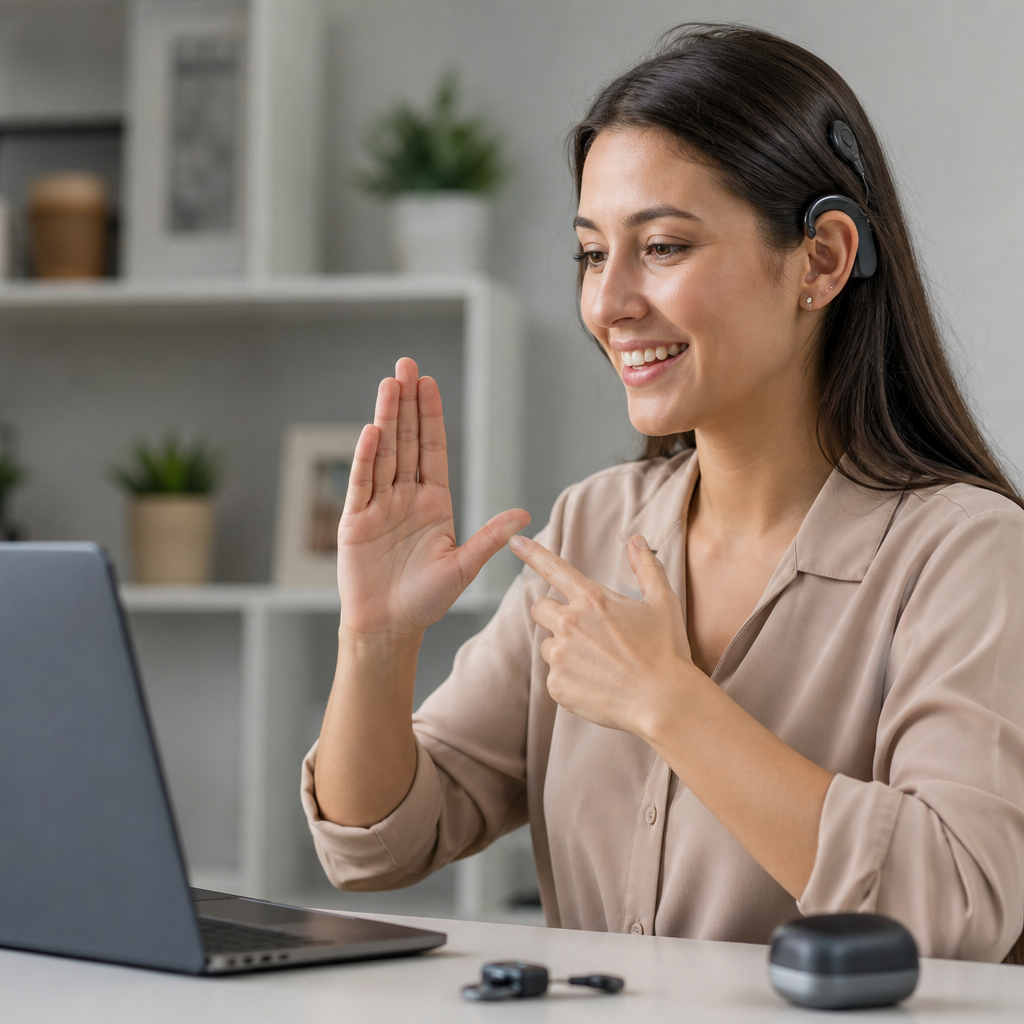
For deaf users who communicate primarily in sign language, video quality is not a luxury feature. It is the foundation of comprehension. The best video communication apps for signed conversations are FaceTime, Zoom, Google Meet, and WhatsApp, depending on who needs to connect and what device they use. FaceTime is exceptionally strong for Apple users because it offers sharp video, low setup friction, and a familiar interface that many families already use. If both parties are in the Apple ecosystem, it is often the easiest answer. Zoom remains a top choice for scheduled meetings, classes, telehealth sessions, and group conversations because it handles multiple participants well and includes features like pinning interpreters and spotlighting speakers.
Google Meet works well for browser-based access and mixed-device groups, especially in education and workplace environments already using Google Workspace. WhatsApp is widespread globally and valuable when a deaf user needs a simple, commonly installed video app for family, community, or international communication. The reason app popularity matters is straightforward: the best accessibility features mean little if the other person refuses to install the software. In real-world use, adoption often beats elegance.
For sign language conversations, the quality checklist is specific. Users need stable frame rates, adequate lighting, minimal compression artifacts, and camera framing that captures hands, face, and upper body. Apps that aggressively optimize bandwidth by lowering video quality can make fingerspelling hard to read. Group calls introduce another challenge because gallery layouts may shrink participants until signing becomes difficult to follow. Zoom’s interpreter-related controls help, but users still need to configure pinning and screen layouts intentionally. Deaf users who rely on video should test camera angle, background contrast, and connection speed before important calls. Those setup details consistently matter more than marketing claims about HD video.
Best messaging apps for everyday text-based communication
Messaging remains the most universally accessible communication method because it does not depend on audio, accents, or interpreter availability. The strongest everyday choices are WhatsApp, iMessage, Signal, and Telegram, with each suited to different priorities. WhatsApp is often the default recommendation because of its massive user base, reliable group chat features, media sharing, and broad international reach. iMessage is excellent within Apple-only circles thanks to device integration, clean interface design, and smooth sharing of photos, videos, and location. Signal is the best pick for users who prioritize privacy, since it offers end-to-end encryption and collects relatively little metadata compared with many competitors.
Telegram earns attention for large groups, channels, and cloud-based access across devices, but its privacy model varies by feature and is not as straightforward as Signal’s. For deaf users, the most important messaging features are not flashy. They include dependable message delivery, visible read status when appropriate, support for short video clips in sign language, easy photo annotation, and simple voice-note alternatives such as typed replies or instant video. Group chats matter too, because many deaf users coordinate interpreting, transportation, school communication, or family logistics across multiple people at once.
The limitation of messaging apps is speed during urgent or emotionally complex exchanges. Tone can be misread, long threads become hard to follow, and someone who does not type well may respond slowly. That is why the strongest communication setup usually blends tools. A user might coordinate by text in WhatsApp, move to FaceTime for an ASL conversation, and use a captioned call app when contacting a hearing business. Reviewing communication apps as isolated products misses that reality. The better question is not which single app wins. It is which set of apps covers the widest range of communication situations with the least friction.
How to choose the right app for work, school, healthcare, and daily life
The best app depends on context. For work, I usually recommend a combination of Zoom or Microsoft Teams for meetings, Otter or Ava for live captions and notes, and Signal or WhatsApp for direct follow-up. In school, Google Meet, Zoom, Ava, and Live Transcribe can cover lectures, office hours, and classroom discussion, though formal accommodations may still require CART or interpreters. In healthcare, reliability and privacy become more important than convenience. A captioned call app can help schedule appointments, but critical clinical conversations often require professional interpreting or institution-supported captioning rather than consumer software alone.
For daily life, simplicity usually wins. Families often communicate best with whatever app every member already checks constantly. That may be iMessage in one household, WhatsApp in another, and FaceTime for signed video. Older adults or new smartphone users may do better with fewer apps and larger interface elements rather than a stack of specialized tools. Cost also matters, though many core communication apps are free. The hidden costs are time, battery use, data consumption, subscription upgrades, and the emotional effort of teaching hearing contacts how to use the tool correctly.
If you are building your own communication toolkit, start by mapping your most common scenarios: calling businesses, group meetings, one-on-one family chats, travel, medical visits, and emergency coordination. Then match one primary app to each scenario and test backups. That practical approach consistently works better than downloading every accessibility app and hoping one becomes universal. The strongest choice is the one you can rely on quickly, explain easily to others, and use confidently when the conversation matters most.
The top communication apps reviewed for deaf users each solve a distinct problem, and the smartest choice comes from matching the tool to the communication method rather than chasing a single all-in-one solution. Captioned call platforms such as Nagish and Innocaption help with routine phone access. Relay services such as Sorenson remain essential for many ASL users. Live transcription tools such as Google Live Transcribe, Ava, and Otter improve face-to-face conversations and meetings. Video apps including FaceTime, Zoom, Google Meet, and WhatsApp support signed communication when visual quality is strong. Messaging apps such as WhatsApp, iMessage, Signal, and Telegram remain the backbone of everyday contact because they are flexible, familiar, and widely adopted.
The main benefit of reviewing these products side by side is clarity. Deaf users do not need generic recommendations. They need to know which app works for a medical call, which one performs best in a group meeting, which one a hearing relative will actually install, and where automated captions still fall short. That is the standard I have used throughout this hub article on product reviews and comparisons within technology and tools for the deaf community. As you explore related articles in this subtopic, use this page as your starting point, compare features against your real communication needs, and build a toolkit that makes conversations easier, faster, and more independent every day.
Frequently Asked Questions
What features should deaf users prioritize when choosing a communication app?
The best communication app for a deaf user depends on how they communicate day to day, but a few features consistently matter more than anything else. Accuracy is at the top of the list. If an app offers live captions or speech-to-text, those captions need to keep up with natural conversation and handle different speaking styles, accents, and background noise reasonably well. Speed matters just as much as accuracy, because even a short delay can make a conversation feel disjointed and difficult to follow. For many users, low-latency captioning is the difference between participating confidently and constantly feeling one step behind.
Video quality is another major factor, especially for users who communicate in sign language. Clear resolution, stable frame rates, and reliable connectivity are essential because dropped frames or blurry video can erase important facial expressions and hand movements. If the app is meant for sign-based conversations, a strong camera layout, easy screen positioning, and dependable performance on both Wi-Fi and mobile data are important practical details. Messaging tools also matter. Some users want a communication app that includes simple text chat, saved transcripts, or the ability to switch quickly between video, text, and captions depending on the situation.
Accessibility design should never be treated as a bonus feature. The interface should be easy to navigate, visual alerts should be strong and customizable, and controls should be clearly labeled and simple to reach during an active call. Deaf users may also benefit from vibration notifications, transcript storage, typing support during calls, and compatibility with assistive tools or accessibility settings built into a phone. Privacy and reliability are also worth serious attention. If an app handles sensitive conversations, users should look at whether transcripts are stored, how secure messages are, and whether the service is dependable enough for medical, work, or emergency-related communication. In short, the best app is not just the one with the longest feature list. It is the one that matches the user’s preferred communication style while delivering accuracy, speed, accessibility, and consistent real-world performance.
Are captioned calling apps the same as live transcription apps?
No, and understanding the difference is important when comparing communication tools for deaf users. Captioned calling apps are designed specifically for phone conversations. They typically allow a deaf or hard of hearing user to place or receive a call while reading near-real-time captions of what the other person is saying. In some services, this is done through automated speech recognition. In others, relay infrastructure or trained communication assistants may be involved depending on the platform and service model. The main goal of a captioned calling app is to make voice calls more accessible without requiring the hearing caller to install anything special.
Live transcription apps serve a broader purpose. Instead of focusing only on phone calls, they convert spoken language into text during in-person conversations, meetings, classrooms, appointments, presentations, and other face-to-face situations. A live transcription tool can be extremely useful when a deaf user needs quick access to what someone nearby is saying, but it may not provide the same call management features as a true captioned calling platform. Some apps now blur the line by offering both live captions and calling support, but the user experience can still be very different depending on the app’s primary purpose.
When choosing between them, the real question is how the tool will be used most often. If the goal is accessible telephone communication, a captioned calling app is usually the better fit because it is built around call flow, caller audio, and conversation timing. If the goal is understanding speech in meetings, daily interactions, or public settings, a live transcription app may be more practical. Many deaf users end up using both: one for phone access and another for in-person communication. That combination often provides much better coverage than expecting a single app to handle every situation equally well.
What makes an app good for sign language video communication?
An app that works well for sign language communication needs to do more than simply offer video calling. Sign language depends on visual clarity, motion accuracy, and facial expression, so the platform has to preserve those details consistently. High-resolution video is important, but resolution alone is not enough. A strong frame rate is equally critical because choppy motion can make signs harder to understand. Wide camera framing helps users keep their hands, upper body, and facial expressions visible at the same time, which is essential for natural signing. Good lighting support and stable image handling can also make a major difference, especially during longer conversations or group calls.
Screen layout matters more than many hearing-first apps seem to recognize. If video windows are too small, constantly rearranged, or covered by interface elements, communication becomes tiring very quickly. The best apps for deaf signers make it easy to pin a participant, enlarge the active signer, and maintain a stable visual setup. This is especially helpful in group conversations, interpreted meetings, or remote appointments where a user may need to watch one person sign while keeping an eye on another participant. Reliable connectivity is also essential. Video freezing, lag, or syncing issues can interrupt the flow of signed conversation in ways that are just as disruptive as dropped audio in a voice call.
Other features can improve the experience even further, including built-in chat, easy link sharing, cross-device compatibility, and support for captions when a conversation includes both signed and spoken communication. Some users also value recording options, transcript tools, and integration with relay or interpreting services. Ultimately, a good sign language video app is one that respects visual communication as the primary mode, not as a secondary use case. It should feel natural for signing, not like a generic video platform that deaf users have to work around.
Can one communication app meet all of a deaf user’s needs?
Sometimes, but usually not perfectly. Many apps now try to combine messaging, video calling, captions, speech-to-text, and accessibility features into one package, and for some users that may be enough. However, communication needs are often highly situational. An app that is excellent for live transcription in meetings may not be the best option for video conversations in sign language. A relay or captioned calling platform may handle phone access well but feel limited for messaging or face-to-face communication. Because deaf users navigate different environments throughout the day, one tool rarely delivers the strongest experience in every category.
That is why many experienced users build a small toolkit rather than relying on a single app. For example, one app might be best for captioned phone calls, another for quick real-time transcription in public spaces, and another for high-quality video conversations with family, friends, interpreters, or coworkers. This approach gives users more flexibility and helps avoid the compromises that come with all-in-one platforms. It also makes it easier to choose the right tool for the context instead of forcing every conversation into the same format.
When reading reviews, it helps to think less about which app is “best overall” and more about which app is best for a specific task. Users who prefer sign language may prioritize video performance first. Users who rely heavily on spoken-language access may care most about caption speed and transcription accuracy. Others may put messaging convenience, affordability, or privacy first. So while one app can cover a lot of ground, the most effective setup is often a combination of tools chosen around real communication habits.
How can deaf users tell whether a communication app is truly accessible before committing to it?
The fastest way is to evaluate the app in real-world scenarios rather than relying only on marketing claims. Accessibility language on a product page can sound impressive, but what matters is how the app performs during an actual conversation. If possible, users should test the app in the situations that matter most to them: a phone call with captions, a video call in sign language, a noisy in-person setting using speech-to-text, or a group conversation where fast turn-taking happens. During testing, they should pay close attention to lag, caption accuracy, video stability, ease of navigation, and whether the app creates extra stress instead of reducing it.
User control is another strong indicator of true accessibility. A well-designed app should let users adjust notification methods, text size, caption appearance, screen layouts, and conversation settings without digging through confusing menus. It should also work smoothly with the device’s built-in accessibility options. If the app feels visually cluttered, hides essential controls, or forces a hearing-centric workflow, that is often a sign that accessibility was added late instead of being built into the design from the beginning. Reviews from deaf and hard of hearing users can be especially valuable here because they tend to reveal day-to-day strengths and frustrations that standard app store descriptions leave out.
It is also worth checking practical issues such as cost, platform compatibility, customer support, language availability, and transcript privacy. Some apps are excellent technically but become less useful if key features are locked behind subscriptions, unavailable on certain devices, or difficult to troubleshoot. The most trustworthy communication apps tend to show a consistent pattern: strong performance, thoughtful visual design, useful customization, and positive feedback from the deaf community itself. If an app helps a user communicate more independently, more comfortably, and with less guesswork, that is usually the clearest sign that it is genuinely accessible.