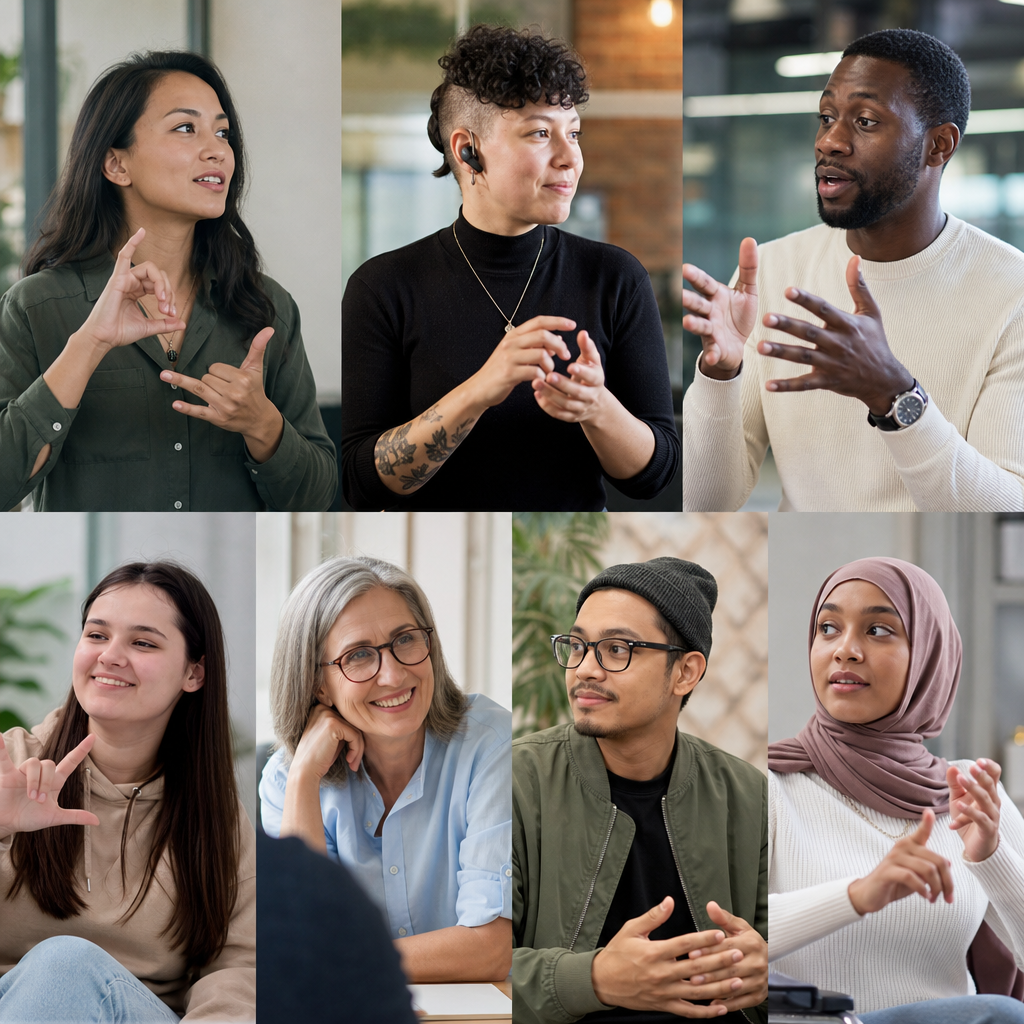
Deaf identity is not one-size-fits-all because it is shaped by language, family, education, community, technology, race, disability, and personal choice rather than by hearing level alone. In practice, two people with similar audiograms may describe themselves in completely different ways: one may identify proudly as Deaf with a capital D, use a signed language daily, and center community belonging, while another may see themselves as hard of hearing, rely mainly on speech, and move between hearing and Deaf spaces. Both experiences are real. Understanding that range is essential to any serious discussion of Deaf identity and pride.
The term Deaf identity refers to how a person understands their relationship to deafness, signed and spoken languages, culture, access, and community. It can include cultural identity, linguistic identity, disability identity, social identity, and political identity. Capital-D Deaf often signals identification with Deaf culture and a signed language such as American Sign Language, British Sign Language, or another national sign language. Lowercase deaf is sometimes used as an audiological description. Hard of hearing may describe people with partial hearing who may or may not identify with Deaf culture. These labels are useful, but they are not fixed boxes, and many people shift among them over time.
This topic matters because identity affects education, mental health, communication access, family relationships, employment, and civic participation. I have seen the difference that a strong, affirmed identity makes in classrooms, workplaces, and community organizations. People who are given language access early and who meet peers and role models often develop confidence faster than those who are isolated or treated only through a medical lens. When professionals, educators, and families assume there is only one correct way to be deaf, they usually miss the person in front of them. A better approach starts with a simple truth: Deaf people are not a monolith.
This hub article explains the main dimensions of Deaf identity and pride so readers can understand the field as a whole and explore related topics in more depth. It covers cultural and linguistic identity, family background, schooling, intersectionality, technology, media representation, and common myths. It also answers practical questions searchers often ask, including what Deaf pride means, whether someone can be both disabled and culturally Deaf, and why some people reject labels entirely. If you want a clear foundation for the wider Deaf Culture and Identity topic, start here.
Deaf identity begins with language, not just hearing level
The most important fact to understand is that deafness is not only an audiological condition. For many people, identity forms around language access. A child exposed early to a natural signed language gains the building blocks of communication, cognition, and belonging. Research from language deprivation studies and position statements from groups such as the National Association of the Deaf and the World Federation of the Deaf consistently stress that full language access in early childhood is nonnegotiable. That access can come through sign, spoken language with strong support, or both, but delayed access carries lasting costs.
Language shapes identity because it determines where a person can participate with ease. Someone who signs fluently may feel fully themselves in Deaf spaces and exhausted in environments that require constant lipreading. Someone raised orally may feel at home in spoken settings yet curious, conflicted, or newly empowered when discovering sign language later. Neither path is simple. In my experience, adults who find sign language after years of communication strain often describe the moment as less like learning a hobby and more like finally entering a room where the lights are on.
That is why Deaf identity and pride cannot be measured by decibels. Hearing level matters medically, but it does not predict community affiliation, communication style, or values. A late-deafened adult, a cochlear implant user, a deaf child of Deaf parents, and a hard of hearing professional may all occupy different points on the identity map. The common thread is not sameness; it is the right to define oneself on informed, accessible terms.
Deaf culture and Deaf pride are rooted in community
Deaf pride means valuing deafness as a human difference with its own languages, traditions, humor, social norms, art, and history rather than seeing it only as a deficit to be fixed. In Deaf communities, shared experience matters. People trade practical information about interpreters, schools, employers, technology, and health care. They also build social rituals through storytelling, visual attention norms, name signs, theater, sports, and advocacy. This is culture in the full sense of the word, not a niche interest group.
Community ties often become strongest where communication is effortless. Deaf clubs historically played this role in many countries before digital media changed social patterns. Today, community may form in person at schools for the Deaf, conferences, sports events, theater programs, and local meetups, or online through signed video platforms and social networks. The form changes, but the need remains the same: people want spaces where they do not have to fight for basic understanding.
Deaf pride is also historical. It carries memory of oralist policies, exclusion from mainstream institutions, and long campaigns for interpreters, captioning, and legal recognition of sign languages. Pride is not denial of barriers. It is a refusal to let those barriers define human worth. That distinction matters when discussing advocacy, because many Deaf people seek both cultural respect and enforceable accessibility rights.
Family background and early access shape identity trajectories
Family is often the first and most powerful influence on Deaf identity. Around 90 to 95 percent of deaf children are born to hearing parents, while a smaller share are born to Deaf parents who may already know signed language and Deaf cultural norms. The difference in early environment can be dramatic. Deaf children of Deaf parents typically have immediate language models and early exposure to community life. Many hearing parents, by contrast, receive medicalized information first and may not meet Deaf adults until much later, if ever.
That gap matters. When parents are encouraged to pursue communication methods without complete information about sign language, children can grow up with fragmented access at home. I have repeatedly seen families improve relationships once they begin signing consistently, even at a basic level. Identity often strengthens when communication becomes less effortful and more emotionally rich. Pride rarely grows in silence, confusion, or chronic misunderstanding.
Still, family influence is not destiny. Some people from hearing families become deeply connected to Deaf culture, while some people from Deaf families form hybrid or independent identities. What matters most is whether the person has real options, strong models, and room to choose.
| Factor | How it shapes identity | Real-world example |
|---|---|---|
| Family hearing status | Affects early language exposure and cultural contact | A deaf child of Deaf parents may learn sign from birth and attend community events early |
| School placement | Influences peer group, role models, and access | A student in a Deaf school may build confidence through direct communication with peers |
| Technology use | Changes communication methods but not identity by itself | A cochlear implant user may still identify strongly as culturally Deaf |
| Age of onset | Shapes whether identity is inherited, discovered, or rebuilt | A late-deafened adult may move from hearing identity to a mixed disability identity |
| Race and class | Affects access to diagnosis, services, and representation | A Black Deaf student may navigate both Deaf marginalization and racial bias in schools |
Education can affirm identity or undermine it
Schooling is one of the clearest predictors of how Deaf identity develops. Students educated in accessible environments usually gain language, peer connection, and self-advocacy faster than those who spend years trying to catch fragments of speech in inaccessible classrooms. This is true whether the setting is a school for the Deaf, a bilingual program, or a mainstream school with high-quality interpreting, captioning, and Deaf-aware staff. The issue is not one placement universally; it is whether the student can fully participate.
Historically, education policy often treated deaf children as problems to normalize. The 1880 Milan Conference, where educators endorsed oralism and marginalized sign languages, had long-lasting effects in Europe, North America, and beyond. Many Deaf adults still describe schooling where signing was discouraged or punished. That history explains why identity conversations can feel politically charged. They are not abstract. They are tied to what happened in real classrooms.
Today, best practice recognizes direct communication, language-rich environments, and Deaf role models as core assets. Students need access not only to curriculum but also to incidental learning, friendship, humor, and leadership opportunities. When those elements are missing, academic placement may look successful on paper while the student remains socially isolated. Strong Deaf identity often emerges where access is broad, not merely technical.
Technology influences identity, but it does not determine it
Hearing aids, cochlear implants, remote microphones, captioning apps, video relay services, and telehealth tools have expanded communication options. They can reduce fatigue, improve safety, and support education or work. But technology does not settle the identity question. A cochlear implant is a device, not a personality. Some users identify as Deaf, some as hard of hearing, some as disabled, and some move among categories depending on context.
This point is frequently misunderstood. Public debate often frames technology as a choice between cure and culture. Real lives are more complex. I have worked with implant users who sign, use interpreters, and participate fully in Deaf events, as well as people with little residual hearing who prefer spoken language and hearing-centered social circles. The deciding factor is not the tool. It is how the person experiences communication, belonging, and self-definition.
Technology also has limitations. Speech perception varies across environments, batteries fail, mapping requires follow-up, and background noise remains a major obstacle even with advanced devices. Captioning quality varies widely, especially in live settings. Anyone discussing Deaf identity responsibly should acknowledge these realities instead of implying that innovation has erased the need for signed language or accessibility law.
Intersectionality explains why there is no single Deaf experience
Deaf identity is also shaped by race, ethnicity, gender, sexuality, immigration status, religion, class, and additional disabilities. A white Deaf professional in a major city may have access to interpreters, mentors, and cultural institutions that a rural Deaf immigrant does not. A Black Deaf student may navigate anti-Black racism within broader society and underrepresentation within Deaf spaces. A DeafBlind person may relate to Deaf community while also needing tactile language and distinct access supports. These are not side issues. They are central to how identity is lived.
Intersectionality matters because broad statements about Deaf people often reflect only the most visible subgroup. In practice, communities contain many languages, signing styles, educational backgrounds, and political priorities. Some people emphasize disability justice, some language rights, some racial equity, and many all three. The healthiest identity frameworks make room for layered belonging instead of demanding purity.
Common myths about Deaf identity deserve direct answers
Several myths persist. First, not all deaf people know sign language. Many were never given the chance early enough. Second, using speech or technology does not make someone less authentically Deaf. Third, identifying as disabled does not cancel cultural pride; people can claim both because social discrimination and cultural belonging can coexist. Fourth, there is no universal Deaf opinion on implants, mainstreaming, or medicine. Communities hold debates, just like any other group.
Another myth is that Deaf pride means rejecting help. In reality, Deaf advocacy has long pushed for interpreters, captions, visual alarms, accessible public services, and legal protections under frameworks such as the Americans with Disabilities Act and the Convention on the Rights of Persons with Disabilities. Pride is compatible with accommodation. In fact, confidence in identity often strengthens self-advocacy because people are more willing to ask for what access requires.
How to support healthy Deaf identity development
The clearest support is full language access from the start, plus regular contact with Deaf adults and peers. Families should meet multiple role models, learn signed language if possible, and avoid treating one communication method as a moral test. Schools should provide qualified interpreters, direct instruction access, captioning, and Deaf-informed staff practices. Employers should think beyond minimum compliance and remove everyday barriers in meetings, training, and promotion pathways.
For individuals exploring identity later in life, the best next step is exposure. Attend community events, take a sign language class from Deaf instructors, read Deaf writers, and notice which environments reduce strain and increase connection. Identity becomes clearer through experience, not pressure. No one should have to earn belonging by fitting a stereotype.
Why Deaf identity is not one-size-fits-all comes down to a practical principle: people need the freedom and support to define themselves at the intersection of language, culture, disability, and lived experience. Some identities are strongly cultural, some primarily audiological, some political, and many mixed. What unites them is the need for access, respect, and informed choice.
For anyone building knowledge in Deaf Culture and Identity, this hub should anchor the subtopic of Deaf Identity and Pride. The key takeaway is simple: stop asking which label is correct in the abstract and start asking what conditions let a person communicate fully, belong meaningfully, and live with dignity. Use that question to guide family decisions, educational planning, workplace policy, and personal learning. Then continue exploring the related articles in this subtopic to deepen your understanding and put that insight into practice.
Frequently Asked Questions
Why is Deaf identity considered more than just a person’s level of hearing?
Deaf identity is broader than hearing level because identity is shaped by lived experience, not only by an audiogram. Two people can have very similar hearing loss and still understand themselves in completely different ways. One person may grow up using a signed language, have Deaf family members, attend Deaf schools, and feel deeply connected to Deaf culture and community. Another may be raised in a hearing household, use spoken language as their main form of communication, and identify as hard of hearing or simply as a person with hearing loss. In other words, hearing level may influence daily life, but it does not automatically determine culture, language, values, or belonging.
This is why many discussions distinguish between medical descriptions and identity-based descriptions. A medical label may describe hearing thresholds, but identity reflects how someone relates to language, communication, education, family background, and community. It can also reflect pride, politics, accessibility needs, and personal history. For some people, being Deaf with a capital D signals a strong connection to Deaf culture and signed language. For others, terms like deaf, hard of hearing, late-deafened, or hearing-impaired may feel more accurate, although not everyone prefers the same words. The key point is that Deaf identity is personal, layered, and shaped by far more than how much sound a person can detect.
What is the difference between “Deaf,” “deaf,” and “hard of hearing”?
These terms are often related, but they are not interchangeable. “Deaf” with a capital D is commonly used to describe a cultural identity. It often refers to people who see themselves as part of the Deaf community, use a signed language such as ASL, BSL, or another national sign language, and value shared history, cultural norms, and community connection. This identity is not based only on hearing status. It is also about belonging, language, and participation in a cultural world that has its own traditions, humor, social practices, and institutions.
“deaf” with a lowercase d is more often used as a general or audiological description of hearing loss, without necessarily implying cultural affiliation. Some lowercase-deaf people later become active in Deaf community spaces, while others do not. “Hard of hearing” is typically used by people who have partial hearing and may rely on speech, hearing aids, lipreading, captions, or a combination of tools and strategies. However, these are broad patterns, not strict rules. Some hard of hearing people are deeply involved in Deaf spaces, and some Deaf people use speech regularly. Identity terms are most respectful when they follow the individual’s own preference. Asking how someone identifies is usually better than assuming based on hearing devices, speech, or hearing level.
How do family, education, and language influence how someone identifies?
Family, education, and language often have a major impact because they shape a person’s earliest experiences of communication and belonging. A child born into a Deaf family may grow up with sign language from birth, see deafness as normal, and learn from the beginning that there is a vibrant Deaf world with its own culture. By contrast, a deaf child in a hearing family may be the only deaf person they know, especially if the family has limited exposure to sign language or Deaf adults. That difference can strongly affect whether the child feels culturally Deaf, socially isolated, comfortably bilingual, or more aligned with hearing environments.
Education matters as well. Students who attend Deaf schools may gain regular access to signed language, Deaf peers, Deaf role models, and a strong sense of community. Students mainstreamed into hearing schools may build identity differently, sometimes moving between hearing and Deaf spaces or feeling like they belong fully in neither at first. Language access is especially important. When a person can communicate freely and be understood, that often supports confidence and identity development. When access is limited, identity may be shaped by frustration, exclusion, or delayed connection to community. Over time, many people revise how they identify as they encounter new communities, learn sign language, meet Deaf mentors, or better understand their own experiences. Identity can remain stable, but it can also evolve.
Can technology like hearing aids or cochlear implants change whether someone is Deaf?
Technology can affect communication options, but it does not automatically define or erase Deaf identity. Hearing aids, cochlear implants, captioning tools, speech-to-text apps, and other assistive technologies may change how a person navigates the world, but identity is still shaped by personal meaning, culture, language, and lived experience. A person with a cochlear implant may identify as Deaf, hard of hearing, both, or something else entirely. Similarly, a person who does not use hearing technology may still identify in different ways depending on their family background, communication preferences, and community connections.
It is important not to assume that technology places someone “closer” to hearing identity or “farther” from Deaf identity. Many Deaf people use technology pragmatically while remaining firmly rooted in Deaf culture. Others may see devices as central to how they participate in spoken-language settings. The larger issue is agency: people should be able to decide what tools they use and how they describe themselves without having their identity judged by outsiders. Technology can support access, but it does not settle questions of culture, belonging, or self-definition. Those are personal and often shaped over many years.
Why is it important to recognize that Deaf identity is also shaped by race, disability, and personal choice?
Recognizing these factors matters because no one experiences deafness in isolation from the rest of who they are. Race, ethnicity, gender, class, immigration history, disability, and religion can all influence access to language, education, healthcare, community spaces, and representation. For example, a Black Deaf person, a Deaf immigrant, a DeafDisabled person, and a late-deafened adult may all encounter very different opportunities and barriers. Their experiences within Deaf and hearing communities may not be the same, and those differences can affect how safe, welcomed, visible, or understood they feel. Treating Deaf identity as a single universal experience oversimplifies real lives.
Personal choice is equally important because identity is not something outsiders get to assign. Some people embrace a strong cultural Deaf identity. Others prefer hard of hearing, deaf, late-deafened, or identity-first or person-first language that feels right to them. Some move fluidly between communities and describe themselves differently depending on context. Respecting that complexity leads to better communication, stronger inclusion, and more accurate representation. It also prevents harmful assumptions, such as thinking there is one “correct” way to be Deaf. A more informed approach recognizes that Deaf identity can be cultural, linguistic, social, political, intersectional, and deeply personal all at once.