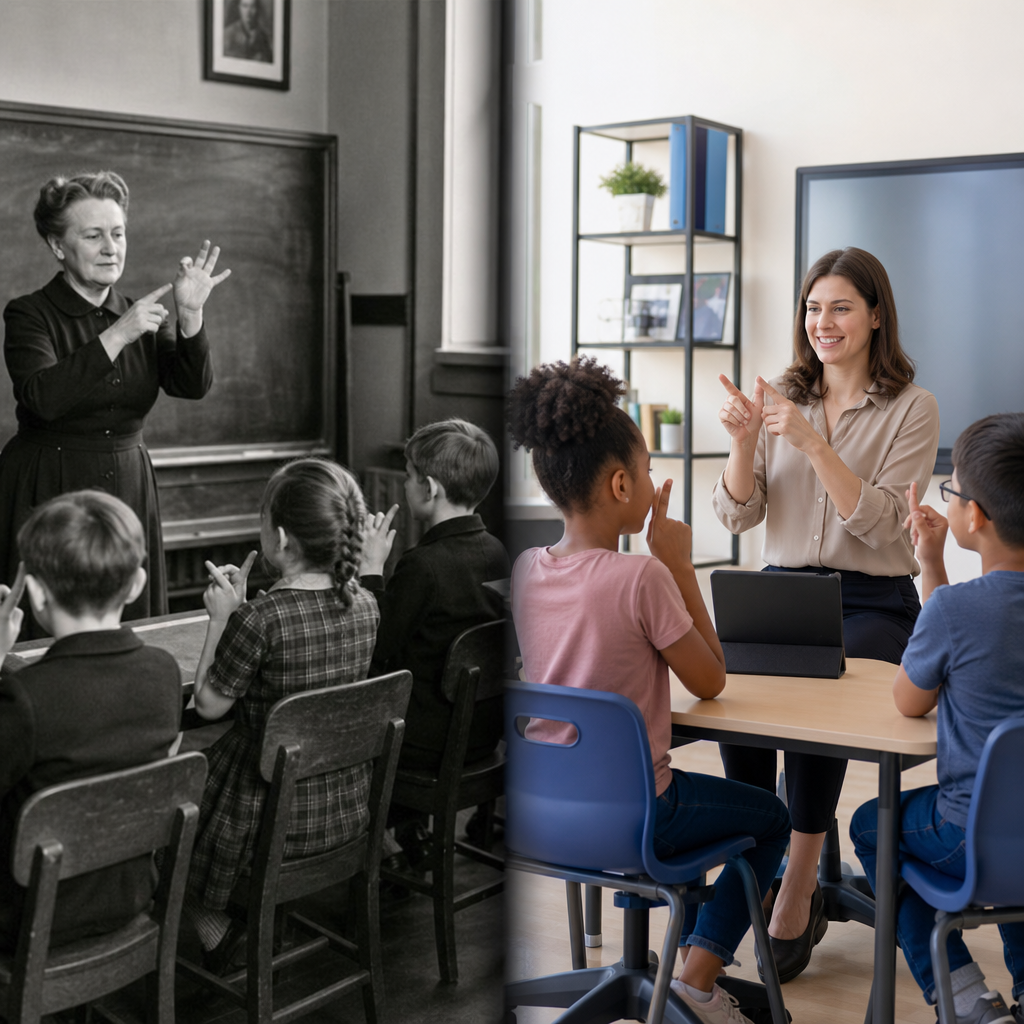
Deaf education has evolved from rigid systems built around control and correction into a broader field focused on language access, literacy, identity, and academic achievement. In practical terms, deaf education systems are the policies, teaching methods, school models, support services, and communication approaches used to educate deaf and hard of hearing students from early childhood through higher education. The topic matters because educational access shapes language development, employment, mental health, family relationships, and civic participation. When deaf children receive early, consistent access to a fully accessible language and qualified instruction, outcomes improve across reading, social development, and long-term independence. When access is delayed, the effects can last for years.
I have worked with deaf education programs where the same student could thrive or struggle depending on whether the classroom was language-rich, whether interpreters were qualified, and whether staff understood deaf learners beyond hearing thresholds on an audiogram. That experience makes one point clear: deaf education is not one method. It is a system requiring decisions about placement, communication, curriculum, technology, and cultural inclusion. Key terms help define the field. Deaf usually refers to individuals with significant hearing loss, while hard of hearing describes those with partial access to sound. Some people use Deaf with a capital D to reflect cultural and linguistic identity tied to sign language communities. Mainstreaming places students in general education settings, while residential or specialized schools serve larger populations of deaf learners directly.
Historically, deaf education has been shaped by debates over oralism, manual education, bilingual models, inclusion, and assistive technology. Those debates were never only academic. They affected whether children were allowed to sign, whether families were told to prioritize speech, whether schools hired deaf teachers, and whether success was measured by conformity or learning. Today, families and educators still ask practical questions: What is the best communication approach? Are mainstream schools enough? When do hearing aids or cochlear implants help? What support should colleges provide? This hub article answers those questions by tracing how deaf education systems changed over time and by outlining the major models, policies, and challenges that define the field now.
Early Deaf Education: From Manual Instruction to Organized School Systems
Formal deaf education began to take shape in Europe in the eighteenth century. One of the best-known figures was Abbé Charles-Michel de l’Épée in France, who supported instruction using signed communication and helped establish a public school for deaf students in Paris. His work mattered because it demonstrated that deaf children could learn academic subjects when teaching was accessible. In Germany, Samuel Heinicke promoted oral methods focused on speech and lipreading. Those two traditions, manual and oral, influenced deaf education systems for centuries.
In the United States, Thomas Hopkins Gallaudet and Laurent Clerc helped found the American School for the Deaf in Hartford, Connecticut, in 1817. That school became a landmark because it used sign-supported instruction and created a model for state-supported deaf schools. Throughout the nineteenth century, schools for the deaf expanded, and many employed deaf teachers and administrators. Students often lived on campus, learned from peers as well as teachers, and developed strong language and community ties. Academic expectations varied, but these schools proved that deaf children could study history, mathematics, writing, trades, and later college-preparatory subjects.
The Milan Conference of 1880 marked a turning point. Educators, mostly hearing, endorsed oralism and marginalized sign languages in many countries. In practice, this meant that countless deaf students were discouraged or forbidden from signing in class. Schools shifted toward speech drills, lipreading, and behavior management designed to produce spoken-language conformity. From an educational standpoint, the problem was not teaching speech itself; the problem was making speech the gatekeeper to learning. When time spent mastering speech replaced direct access to science, reading, and discussion, many students fell behind academically. That legacy still affects policy debates today.
Competing Communication Philosophies and What They Meant in Classrooms
To understand how deaf education evolved, it helps to compare the major communication approaches used in schools. Oralism emphasizes speech, listening, and lipreading. Manual approaches prioritize sign language. Total communication, widely adopted in the later twentieth century, encourages using multiple methods such as signing, speech, fingerspelling, visual aids, and amplification. Bilingual-bicultural models teach a natural sign language as a first language and the surrounding written or spoken language as a second language, while also recognizing deaf culture as part of education.
In classrooms, these philosophies created very different learning conditions. Under strict oral programs, I have seen students spend large portions of the day in articulation practice and auditory training while missing fast-moving content discussion. Some children benefit from structured spoken-language instruction, especially when residual hearing, early amplification, and family goals align. But oral-only systems often fail when they assume all students can access speech well enough for full learning. Lipreading alone typically provides incomplete information because many speech sounds look identical on the lips.
| Approach | Primary Goal | Typical Classroom Features | Main Limitation |
|---|---|---|---|
| Oral | Speech and listening development | Auditory training, articulation, spoken instruction | Limited access for students who cannot fully perceive speech |
| Manual | Direct visual language access | Sign-based teaching, visual explanations, peer interaction | Quality depends on staff fluency and curriculum design |
| Total Communication | Use any effective mode | Mixed signing, speech, visual supports, devices | Can become inconsistent or linguistically unclear |
| Bilingual-Bicultural | Strong first-language foundation plus literacy | Sign language instruction, written language teaching, cultural inclusion | Requires skilled signing staff and long-term planning |
Bilingual models gained support because language deprivation became impossible to ignore. Research and school experience showed that deaf children need full access to language early, whether through sign, spoken language, or both. A strong first language supports literacy, cognition, and emotional development. That is why many current experts argue that educational planning should begin with guaranteed language access, not with loyalty to one ideology.
Mainstreaming, Inclusion, and the Expansion of Student Rights
The second half of the twentieth century brought major legal and policy changes. In the United States, the Education for All Handicapped Children Act of 1975, later reauthorized as the Individuals with Disabilities Education Act, established the right to a free appropriate public education and individualized educational planning. Similar inclusion frameworks emerged in many countries. Deaf students increasingly entered neighborhood schools rather than specialized institutions. Mainstreaming expanded access to local education and allowed children to remain with families, but outcomes depended heavily on support quality.
In theory, inclusion means a deaf student can learn alongside hearing peers with interpreting, captioning, assistive listening systems, note-taking support, speech services, and accessible teaching methods. In reality, placement alone does not equal access. I have reviewed classrooms where a student technically sat in a general education room but missed jokes, side comments, class discussion, and peer collaboration because no one managed turn-taking or visual access. A deaf student can be socially isolated in a room full of people if systems are built only for hearing communication.
Specialized schools and mainstream programs therefore serve different needs. Schools for the deaf often provide direct communication access, deaf role models, extracurricular participation, and identity development that are difficult to replicate in isolated mainstream placements. Mainstream schools may offer broader local course options, easier family logistics, and continuous interaction with hearing peers. The most effective deaf education systems do not treat this as a moral contest. They evaluate language access, academic growth, social belonging, and family goals student by student.
Technology, Early Intervention, and the Changing Role of Families
Technology changed deaf education, but not in a simple or uniform way. Hearing aids improved significantly with digital signal processing, directional microphones, and better fitting protocols. Cochlear implants expanded auditory access for many children with profound hearing loss, especially when implanted early and supported by consistent therapy and family engagement. FM and DM systems helped reduce background noise in classrooms by transmitting a teacher’s voice directly to a student’s device. Real-time captioning, classroom microphones, visual alert systems, and video relay services also improved access.
These advances shifted educational planning toward earlier intervention. Universal newborn hearing screening, now standard in many health systems, made earlier identification possible. Earlier diagnosis often leads to earlier family counseling, device fitting, language planning, and entry into early childhood services. This matters because the first years of life are critical for language development. Children who experience delayed language exposure face higher risks in literacy and executive functioning later on.
Still, technology does not eliminate the need for accessible teaching. Cochlear implants do not restore typical hearing; outcomes vary by age at implantation, additional disabilities, consistency of use, mapping quality, family support, and classroom acoustics. I have seen implanted students perform strongly in spoken-language settings and others continue to depend heavily on sign, captioning, or both. Families need balanced guidance that explains benefits and limits. The best deaf education systems treat families as decision-makers, provide information in plain language, and avoid framing one pathway as the only responsible choice.
Language Access, Literacy, and Why Qualified Staff Matter Most
Across every historical period, one factor predicts educational quality better than slogans: whether students have consistent access to language and instruction from qualified professionals. Deaf education requires more than goodwill. Teachers need preparation in deaf child development, language acquisition, literacy strategies, differentiated instruction, and assessment practices that do not confuse language access with intelligence. Interpreters need certification-level skills, subject-matter vocabulary, and an understanding of classroom discourse. Administrators need to know how scheduling, acoustics, and staffing affect outcomes.
Literacy instruction is especially important in deaf education systems because many deaf students learn to read in a language they do not fully hear. Effective programs explicitly teach vocabulary, morphology, syntax, background knowledge, and comprehension strategies. They also use visual scaffolds, signed explanations, repeated exposure to print, and deliberate links between sign language structure and written language. Strong programs monitor reading progress with appropriate tools rather than assuming delays are inevitable.
Deaf teachers remain essential. They provide direct instruction, fluent language models, and proof that deaf adulthood includes professional authority. When students see deaf educators leading classrooms, coaching teams, and teaching complex subjects, expectations rise. Unfortunately, many systems still face shortages of teachers of the deaf, educational interpreters, and early intervention specialists. That workforce gap is one of the field’s most urgent problems because access cannot exist on paper alone.
Current Deaf Education Systems and the Future of the Field
Today, deaf education systems are more diverse than ever. A single region may offer mainstream placement with itinerant support, self-contained programs, bilingual schools, residential schools, auditory-verbal therapy, online interpretation, dual enrollment, and university disability services. Postsecondary education has also improved through captioning, interpreting, accessible course platforms, and legal protections under laws such as the Americans with Disabilities Act and Section 504 in the United States. Yet major inequities remain, especially for students in rural districts, low-resource countries, and multilingual families who receive conflicting advice.
The future of deaf education will be shaped by several clear priorities. First, language deprivation prevention must remain central. No child should wait for access while adults debate ideology. Second, data systems should measure real outcomes: literacy growth, graduation rates, mental health, attendance, and postsecondary success. Third, teacher preparation programs need stronger pipelines, especially for deaf professionals and bilingual educators. Fourth, schools must improve accessibility beyond academics by making sports, counseling, family communication, and peer interaction fully inclusive.
The central lesson from history is straightforward: deaf students succeed when education systems are designed around access rather than assimilation. Sign language, spoken language, technology, specialized schools, and mainstream settings can all play valuable roles, but none works automatically. What matters is whether the student can fully understand instruction, participate socially, develop a strong language base, and progress academically. If you are building, reviewing, or choosing a deaf education program, start with that question and follow the evidence. Better systems begin when access is treated as a right, not an accommodation.
Frequently Asked Questions
1. How has deaf education changed over time?
Deaf education has changed dramatically from its earliest models to the present day. In earlier periods, many systems were built around control, correction, and the belief that deaf students needed to be made as “hearing-like” as possible. This often meant strict oralist methods that emphasized speech training and lip-reading while discouraging or even banning sign language in the classroom. The goal in many schools was not simply academic learning, but conformity to hearing norms. As a result, language access was often limited, and many deaf students were denied a fully accessible path to literacy, content knowledge, and social development.
Over time, research in language development, education, and child psychology helped shift the field. Educators and families increasingly recognized that deaf and hard of hearing students need full access to language from the earliest possible age. That change moved deaf education toward broader priorities: language acquisition, academic achievement, literacy, communication access, self-advocacy, and social-emotional development. Rather than treating deafness only as a deficit to be corrected, many modern approaches see deaf students as learners who may benefit from multiple supports, including sign language, spoken language, assistive technology, interpreters, captioning, specialized teachers, and inclusive or bilingual learning environments.
Today, deaf education is more varied and student-centered than in the past. It includes a range of school models and communication approaches, from schools for the deaf to mainstream settings with support services, as well as bilingual-bicultural programs, auditory-based programs, and mixed approaches tailored to individual needs. The field now places far more emphasis on educational access, identity, family involvement, and long-term outcomes such as college readiness, career development, and full participation in society.
2. What were the biggest early debates in deaf education?
One of the biggest historical debates in deaf education centered on how deaf students should communicate and learn language. For generations, the most visible conflict was between manual approaches, which used sign language, and oralist approaches, which focused on speech and lip-reading. Supporters of oralism argued that spoken language would help deaf students integrate into the hearing world. In practice, however, oral-only systems often demanded enormous time and effort from students while limiting direct access to classroom instruction, especially for children who could not fully access spoken language through hearing or lip-reading alone.
The tension became especially significant because it affected every part of schooling: teaching methods, curriculum access, teacher training, school culture, and family expectations. In many places, sign language was marginalized despite its effectiveness as a natural and accessible language for many deaf children. This had major consequences, because when students lack full language access, their literacy, academic growth, and confidence can suffer. The debate was not merely about preference; it was about whether students could fully understand their education as it was happening.
Another major debate involved the purpose of deaf education itself. Was the goal to normalize deaf students according to hearing standards, or to provide them with the tools, language access, and support needed to succeed academically and socially as deaf individuals? That question shaped policy, school design, and service delivery for decades. Modern deaf education still includes discussion about communication methods and placement options, but the conversation is increasingly grounded in access, outcomes, evidence, and student well-being rather than ideology alone.
3. Why is language access considered so important in deaf education?
Language access is central because it is the foundation for learning. Children build thinking, memory, literacy, emotional expression, and social understanding through language. If a deaf or hard of hearing child does not have consistent, fully accessible language early in life, the effects can extend into reading development, classroom learning, self-expression, and long-term academic progress. In deaf education, this is why early and reliable access to language is not considered optional; it is essential.
For many students, language access may come through sign language, spoken language with amplification or cochlear implants, cued communication systems, or a combination of approaches. The key issue is not ideology but whether the child can fully and consistently access communication in real time. A child who is expected to “pick up” language through incomplete auditory access or partial visual cues may miss critical information. By contrast, a child with strong access to language is better positioned to develop vocabulary, comprehension, literacy skills, and the background knowledge needed across subjects such as math, science, and history.
Language access also affects identity and relationships. When students can communicate clearly with teachers, peers, and family members, they are more likely to develop confidence, belonging, and self-advocacy. In practical terms, strong deaf education systems pay close attention to how language is delivered and supported across settings, not just during formal lessons. That includes classroom instruction, social interaction, assessment, family communication, and access to extracurricular activities. The more complete the access, the stronger the educational foundation tends to be.
4. What role do schools for the deaf and mainstream schools play today?
Both schools for the deaf and mainstream schools play important roles in modern deaf education, and each can offer real benefits depending on the student. Schools for the deaf have historically been central to deaf education because they were designed specifically around deaf learners. Many provide direct communication access, deaf-focused teaching expertise, exposure to sign language, and a strong sense of community and cultural belonging. For some students, these schools offer an environment where communication is more immediate, social participation is easier, and deaf identity is affirmed rather than treated as an exception.
Mainstream schools, where deaf and hard of hearing students learn alongside hearing peers, have become more common due to changes in law, technology, and inclusive education policy. These settings can provide access to general education classrooms, broader course offerings, and opportunities to participate in local community life. However, mainstream placement is only effective when support services are strong. Students may need interpreters, captioning, assistive listening systems, itinerant teachers of the deaf, note-taking support, speech-language services, and educators who understand how deafness affects access to instruction. Without those supports, inclusion on paper may still result in isolation or limited learning access in practice.
The best placement is usually the one that matches the student’s language needs, academic profile, social development, and family goals. There is no single setting that works for every child. Some students thrive in schools for the deaf, others in mainstream environments, and some move between models over time. The most effective perspective is not “one model fits all,” but rather that deaf education should provide meaningful access, high expectations, and the right supports wherever the student is enrolled.
5. What does effective deaf education look like now?
Effective deaf education today is built around access, evidence, and individualized support. It begins with the understanding that deaf and hard of hearing students are a diverse group with different communication preferences, hearing levels, language backgrounds, and learning needs. Strong programs focus on giving students full access to instruction from the start, whether through sign language, spoken language supports, bilingual approaches, or a combination of methods. The emphasis is on ensuring students can understand, participate, and progress academically rather than forcing them into a single philosophy.
In practice, effective deaf education includes qualified teachers, accessible communication, early intervention, literacy-focused instruction, family engagement, and appropriate support services. It also includes regular monitoring of whether the student is truly accessing the curriculum. Technology may play an important role, including hearing aids, cochlear implants, FM or DM systems, real-time captioning, and visual learning tools, but technology alone does not guarantee access. The instructional environment, teacher expertise, and communication clarity matter just as much.
Another hallmark of effective deaf education is that it supports the whole student. Academic success is critical, but so are identity development, mental health, peer relationships, and self-advocacy skills. Students need opportunities to build confidence in who they are, communicate effectively across environments, and prepare for adulthood, higher education, and employment. The field has evolved most successfully where it has moved beyond narrow ideas of correction and toward a broader commitment to language, literacy, belonging, and high achievement.